Write your answer on paper. Then open the answer to check it.
Section A
A function g is defined by g(x) = ax − b, where a and b are constants. Given that the image of −3 is −21 and the object of 4 is 2. (a) Determine the values of a and b. (b) Find the object that is mapped onto itself under g.
Easy4 marks- (a)
Determine the values of a and b.
[2] - (b)
Find the object that is mapped onto itself under g.
[2]
Diagram 2 shows the graph of g(x) = √(4x − 3) for 3/4 ≤ x ≤ 3. The graph of h(x) is the image of g(x) under reflection in the line g(x) = x. Find (a) the function h(x), (b) the domain of function h, (c) gh(p/2).
Medium3 marks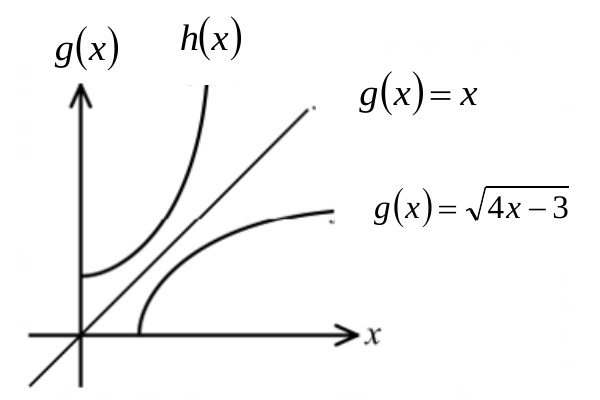
- (a)
Find the function h(x).
[1] - (b)
Find the domain of function h.
[1] - (c)
Find gh(p/2).
[1]
10 scouts, consisting of 6 boys and 4 girls, sit around a camp fire in a circle. Find the number of ways to arrange them if (a) there are no restrictions, (b) all the boys must be separated.
Easy5 marks- (a)
Number of ways if there are no restrictions.
[2] - (b)
Number of ways if all the boys must be separated.
[3]
(a) 98% of students in a particular class attended co-curriculum activities. A group of students was chosen at random. The probability that all of the students chosen attended co-curriculum activities is more than 0.6099. Find the value of n, given that n is the total number of students in the class. (b) Z is a continuous random variable of a normal distribution. Given that P(|Z| < m) = 8P(Z ≤ −m), find (i) P(Z < m), (ii) the value of m.
Medium6 marks- (a)
Find the value of n.
[3] - (b)(i)
Find P(Z < m).
[1] - (b)(ii)
Find the value of m.
[2]
Diagram 5 shows a semicircle OABCD with centre O and a right-angled triangle ADE. It is given that ED = 10 cm and the radius of the semicircle OABCD is 6 cm. Calculate (a) ∠EAD in radians, (b) the length, in cm, of arc CD, (c) the area, in cm², of the shaded region.
Medium6 marks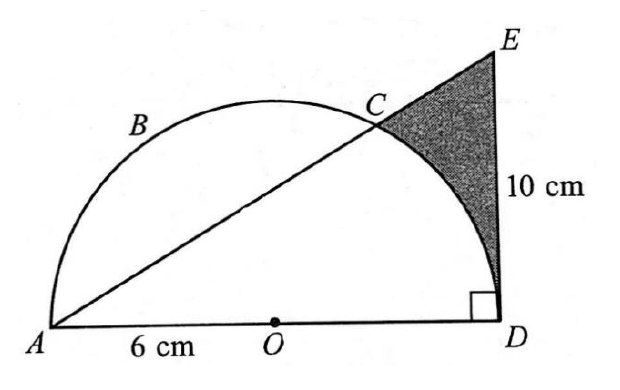
- (a)
Calculate ∠EAD in radians.
[1] - (b)
Calculate the length of arc CD.
[2] - (c)
Calculate the area of the shaded region.
[3]
(a) Diagram 6(a) shows the front view of a door. BAC is part of the graph y = 9 − x²/6; A is the highest point from DE. Find the surface area of the door. (b) Diagram 6(b) shows a curve y = g(x) and a straight line y = f(x). Given ∫₀ʰ g(x) dx = 6: (i) on the diagram, shade the region represented by ∫₀ʰ g(x) dx; (ii) find the area, in terms of m, of the region bounded by the y-axis, y = g(x) and y = f(x).
Medium6 marks- (a)
Find the surface area of the door (Diagram 6(a)).
[3]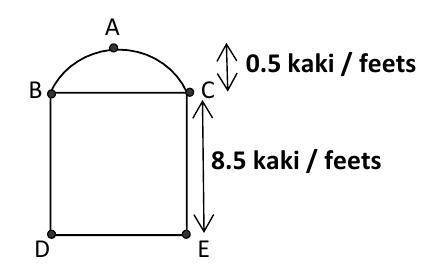
- (b)(i)
Shade the region represented by ∫₀ʰ g(x) dx on Diagram 6(b).
[1]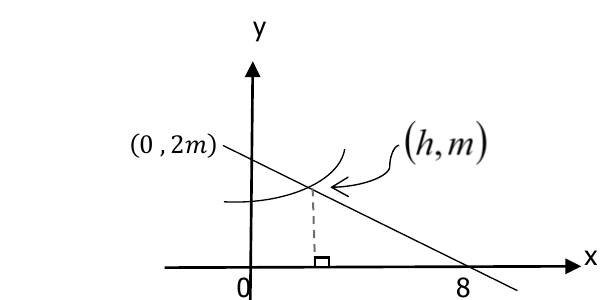
- (b)(ii)
Find the area, in terms of m, bounded by the y-axis, y = g(x) and y = f(x).
[2]
(a) Express the function f(x) = −2(x + 1/4) − 49/8 in the form of intercept. (b) Given the quadratic function f(x) = −x² + 4x + 12 where a = −1, b = 4 and c = 12: (i) make a generalisation on the shape of the graph when the value of a changes to −8; (ii) if the graph moves 5 units upwards, determine the maximum point.
Easy5 marks- (a)
Express f(x) in the form of intercept.
[2] - (b)(i)
Generalise the shape of the graph when a changes to −8.
[1] - (b)(ii)
Maximum point after the graph moves 5 units upwards.
[2]
(a) Two points have coordinates E(2, 4) and F(8, 6). Given that C(2, t) lies on the perpendicular bisector of EF, find the value of t. (b) A point R moves such that its distance from P(1, 0) is half of its distance from Q(2, −3). Find the equation of the locus of R.
Medium6 marks- (a)
Find the value of t.
[3] - (b)
Find the equation of the locus of R.
[3]
(a) The length of vector k is 5 units and its direction is opposite to the vector (1, −2) [column vector]. Find vector k. (b) Ship X left port O with velocity vₓ = 6i + 8j km h⁻¹. At the same time ship Y left port P with velocity v_y = −4i + 4j km h⁻¹. The position vector of port P is OP→ = 25i + 10j. (i) After t hours the position vector of ship X is t(6i + 8j). Find the position vector of ship Y at that time. (ii) Hence find the time when ship X collides with ship Y.
Easy6 marks- (a)
Find vector k.
[2] - (b)(i)
Position vector of ship Y after t hours.
[2] - (b)(ii)
Find the time when X collides with Y.
[2]
(a) Solve the equation log_√2 (x² − 4) + 1 = log₂ (2 − x). (b) The area of a rectangle is (3 + √3) cm². Given that its length is (2 + √3) cm, find its width in surd form.
Medium6 marks- (a)
Solve log_√2 (x² − 4) + 1 = log₂ (2 − x).
[4] - (b)
Find the width in surd form.
[2]
Given tan(A/2) = (1 − sin A)/cos A. Without using a calculator, find the value of tan 30°. State the answer in the form p − q√3, where p and q are constants [as printed: p − q]. Hence, solve the equation tan(A/2) = cos A for 0° ≤ A ≤ 360°.
Medium5 marksFind tan 30° in the form p − q√3, then solve tan(A/2) = cos A for 0° ≤ A ≤ 360°.
[5]
(a) Determine the number of terms, n, for 2p², 5p², 8p², ..., 92p². (b) The 9th term of an arithmetic progression is 36 and the sum of the first 19 terms of the progression is 760. Determine the sum of the 5 terms after the 19th term.
Medium6 marks- (a)
Determine the number of terms n.
[2] - (b)
Determine the sum of the 5 terms after the 19th term.
[4]
Section B
There are 40 spherical marbles of radius x cm and 60 spherical marbles of radius y cm. If x + y = 15 and x > y, find the values of x and y such that the total volume of the marbles is minimum.
Medium8 marksFind x and y so that the total volume is minimum.
[8]
(a) Sketch the graph y = ax² + b against x² on the given axes where a < 0 and b > 0. Based on the graph, what are represented by a and b? (b) Diagram 14 shows the graph y = x² + mx, crossing the x-axis at x = −4. Based on the graph, a table of y/x against x is obtained: y/x = −5 when x = p; y/x = k when x = −2. Calculate the values of m, p and k.
Medium8 marks- (a)
Sketch y against x² for a < 0, b > 0; state what a and b represent.
[3]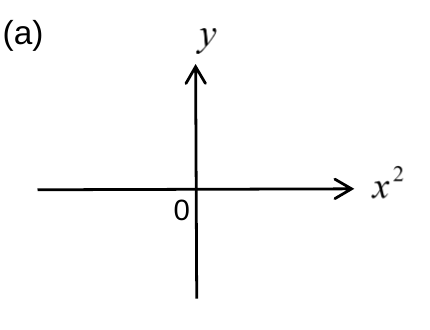
- (b)
Calculate m, p and k.
[5]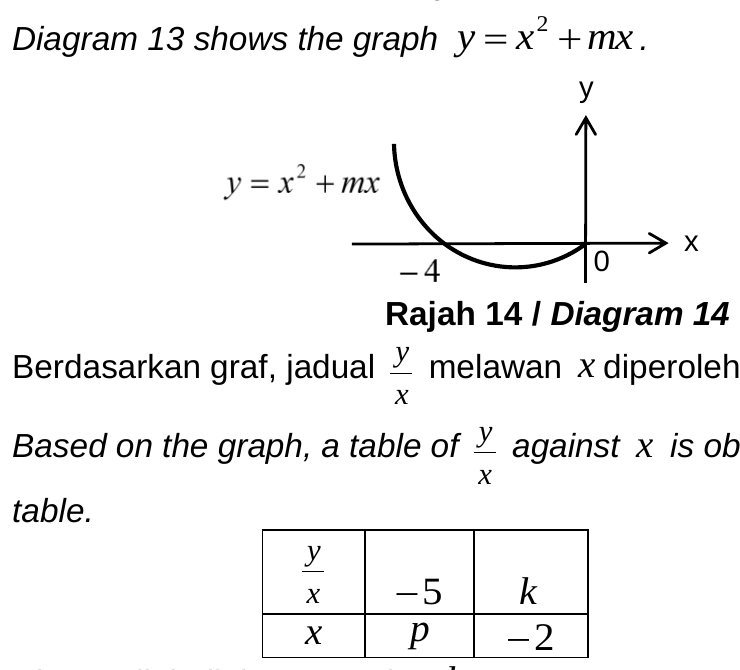
Fifi, a chemist, has three types of solution containing 10%, 40% and 60% acid. She wants 500 litres of a mixed solution with 45% acid concentration. The available amount of the 10% acid solution is twice the amount of the 40% acid solution. How much of each solution would you suggest Fifi use?
Medium8 marksFind the volume of each solution (x litres of 10%, y litres of 40%, z litres of 60%).
[8]