Write your answer on paper. Then open the answer to check it.
Section A
(a) Given f(x) = m/(3x − n), x ≠ 1/3, where m and n are constants. (b) Two functions k and g are defined by k(x) = x + 2 and g(x) = px + 2q.
Medium7 marks- (a)(i)
Find the value of n.
[1] - (a)(ii)
If 3f(−1) + f(1) = −1, find the value of m.
[2] - (b)
Given that g⁻¹(2) = k(−1) and gk⁻¹(4) = 5, find the value of p and of q.
[4]
The curve of a quadratic function f(x) = −(x − k)² − 2h + 1 intercepts the x-axis at points (−2, 0) and (4, 0). The straight line y = 9 touches the maximum point of the curve.
Easy4 marks- (a)
Find the value of h and of k.
[2] - (b)
Hence, sketch the graph of f(x) for −2 ≤ x ≤ 5.
[2]
(a) Solve ln(3x − 1) = 2, giving the answer in terms of e. (b) Given 27^(log₃ p) = (q + 1)³ where p > 0, express q in terms of p.
Easy5 marks- (a)
Solve the equation ln(3x − 1) = 2 and give your answer in terms of e.
[2] - (b)
Given 27^(log₃ p) = (q + 1)³ where p > 0, express q in terms of p.
[3]
(a) Diagram 4 shows a standard normal distribution curve (blank, axis z). (b) Given X ~ N(h, k), if X = h + 2.
Easy6 marks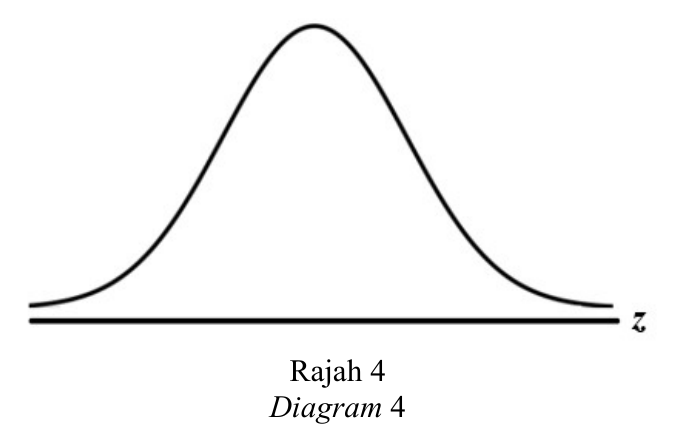
- (a)(i)
In Diagram 4, shade the probability of 1 − P(|Z| ≥ a).
[2]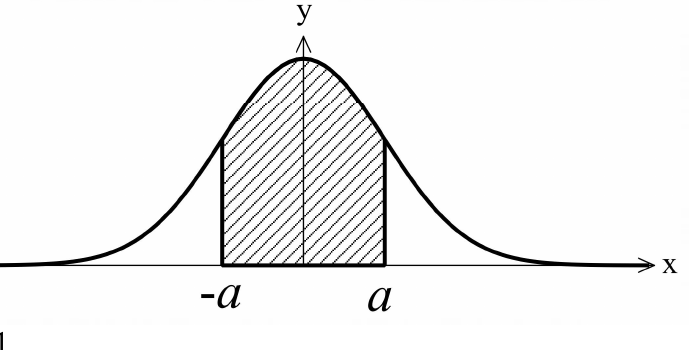
- (a)(ii)
Hence, if P(Z ≥ a) = 0.042, find the value of 1 − P(|Z| ≥ a).
[1] - (b)(i)
Express the z-score in terms of k.
[2] - (b)(ii)
If k = 16, find the value of the z-score.
[1]
Diagram 5 shows 8 circles formed from a piece of wire with a length of 255π cm. The diameter of each circle is twice that of the previous circle. The diameter of the smallest circle is d cm.
Medium5 marks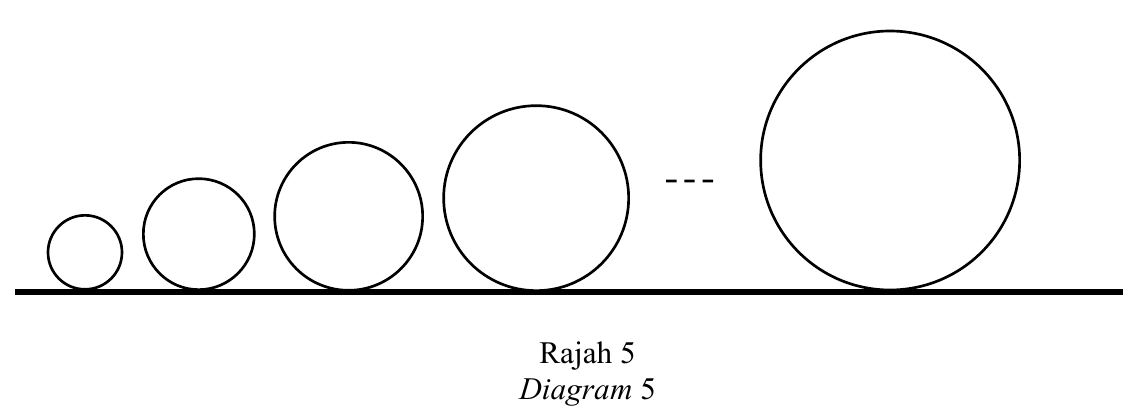
- (a)
Find the value of d.
[3] - (b)
Find the value of p, if the total area of the last three circles is pπ cm².
[2]
Diagram 6 shows the location of Azizi's house, (−3, 4), and his school on the Cartesian plane. The shortest distance of Azizi's house from the x-axis is 4 km and the vector from Azizi's house to his school is 8**i** + 15**j** (i and j are unit vectors in the x- and y-directions).
Easy4 marks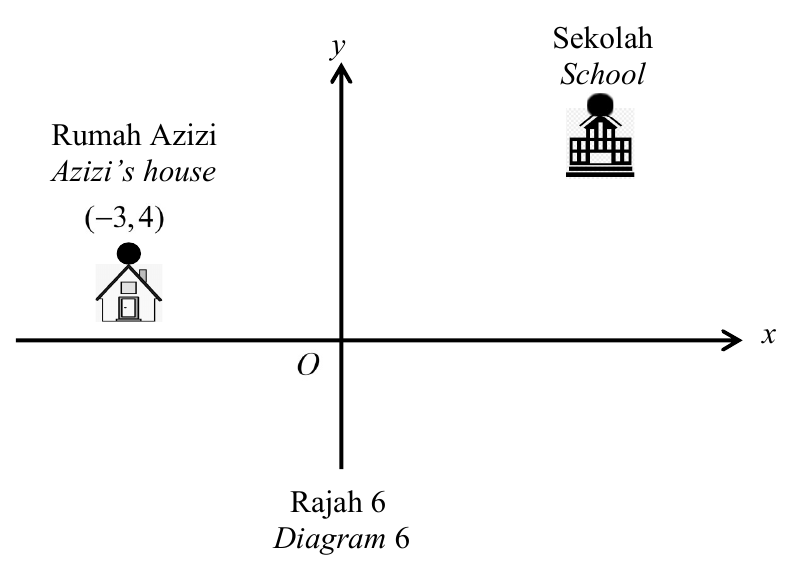
- (a)
Find the location of the school.
[2] - (b)
Find the distance of the school from Azizi's house.
[2]
Diagram 7(a) shows the curve y = ax² + bx, where a and b are constants, from (1, 1) to (3, −15). Diagram 7(b) shows the straight line graph Y against X obtained when y = ax² + bx is expressed in linear form; the line has Y-intercept 4, passes through (1, k) and meets the X-axis at h.
Easy4 marks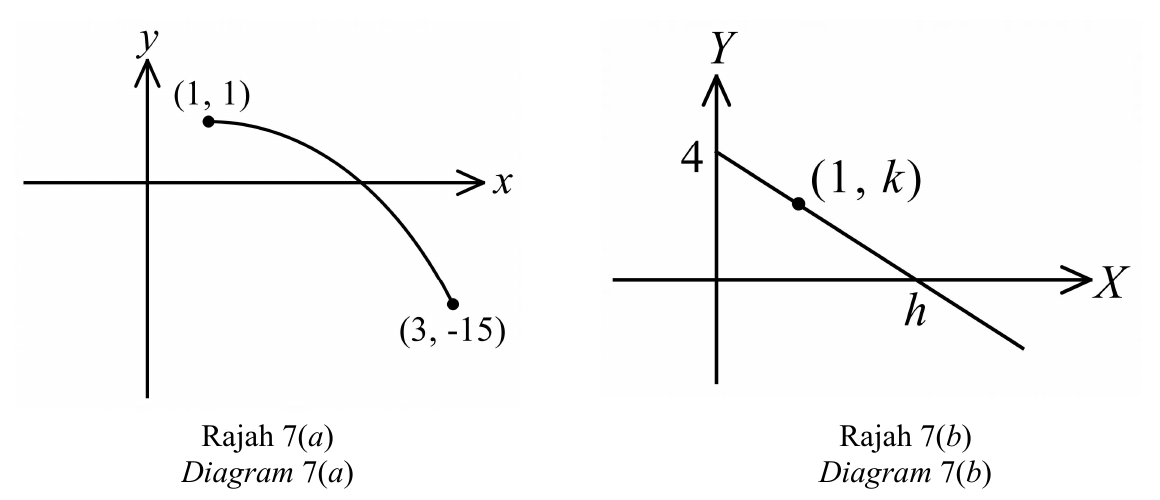
- (a)
Find the value of a and of b.
[2] - (b)
Find the value of h and of k.
[2]
The points A(1, 1), B(5, 1) and P(x, y) lie on a circumference such that AB is a diameter.
Easy7 marks- (a)
Show that x² + y² − 6x − 2y + 6 = 0.
[3] - (b)
If x = y and y ≠ 1, find the equation of the straight line PB.
[4]
Diagram 9 shows two sectors OPQ and ORS with centre O. Given ∠POQ = θ rad, the length of the arc PQ is twice the radius OQ, and the radius OS = 6 cm.
Easy4 marks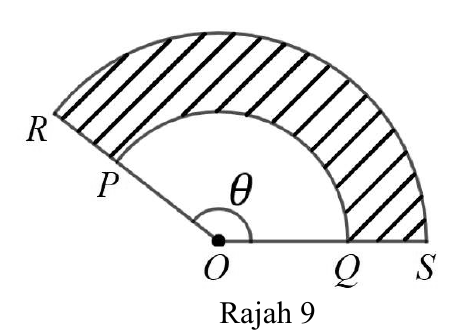
- (a)
Find θ.
[1] - (b)
Find the perimeter of the shaded region.
[3]
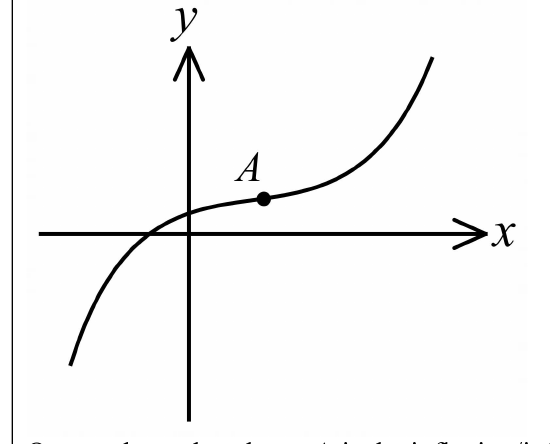
(a) Given y = f(x). A point A(h, k) lies on the curve such that dy/dx = 0 and d²y/dx² = 0. On the axes, sketch a possible graph for y = f(x) and label point A. (b) Determine the value of the limit as x → 3 of (9 − x²)/(4 − √(x² + 7)).
Easy4 marks- (a)
Sketch a possible graph for y = f(x) on the axes and label the position of point A.
[1]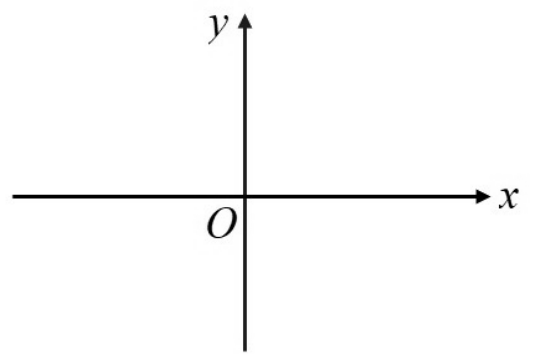
- (b)
Determine the value of lim (x → 3) (9 − x²)/(4 − √(x² + 7)).
[3]
(a) Diagram 11 shows a curve y = g(x) crossing the x-axis at x = a, 0 and b. Given ∫ from a to 0 of g(x) dx = 8 and ∫ from a to 0 of g(x) dx + |∫ from 0 to b of g(x) dx| = 10. (b) Given dV/dt = −2t, where V is the volume, in m³, of a water tank and t is the time in hours. The initial volume of water in the tank before it flows out is 4 m³.
Medium6 marks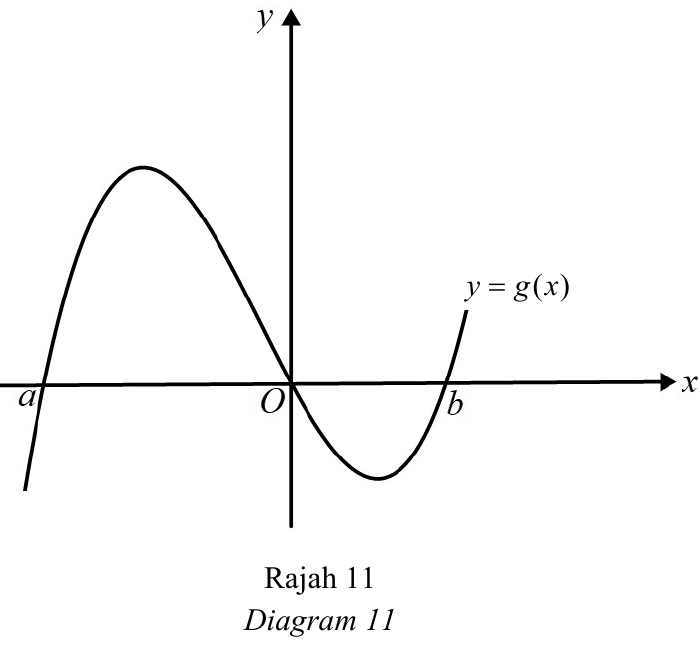
- (a)
Find the value of ∫ from 0 to b of g(x) dx.
[2] - (b)(i)
Express V in terms of t.
[2] - (b)(ii)
Find the time t if the water in the tank flows out and the tank is completely empty.
[2]
(a) A committee of 5 people to deal with floods is to be formed in a village. There are 7 male candidates and 4 female candidates. (b) Diagram 12(b) shows 4 tiles (A, B, C, D) proposed by the salesman to Mrs Fitriah. She wants to choose only three tiles to be installed in the living room and bathroom of her house. (c) Diagram 12(c) shows a colour palette container used by a painter (colours: brown, blue, white, black, yellow, red).
Medium8 marks- (a)(i)
Find the number of ways the committee can be formed if there is no restriction.
[1] - (a)(ii)
Find the number of ways the committee can be formed if Dr. Yusri bin Abdul Rahman and Ir. Siti Ramlah binti Ishak must be chosen and the committee must consist of at least 3 men.
[3] - (b)
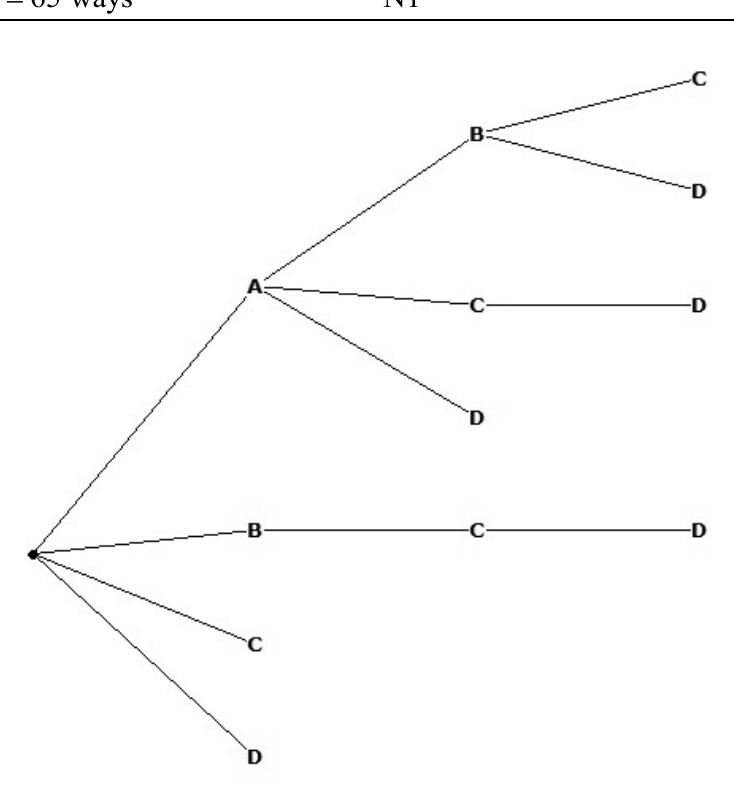
Draw a suitable tree diagram to solve this problem.
[2]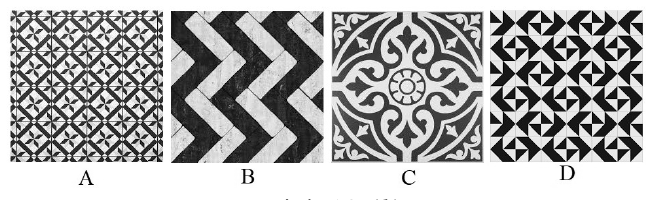
- (c)
Find the number of different ways a painter can fill the colour palette if red and yellow must be side by side. [Assume clockwise and anti-clockwise arrangements are different.]
[2]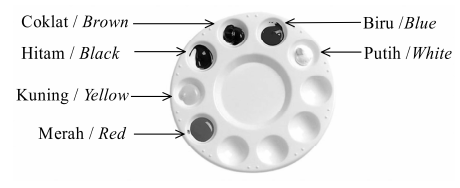
Section B
Diagram 13 shows a three-panel window to be installed in a house. The smaller panels have the same width of 0.5 m. The total width of the window is twice its height. The area of the middle panel is 3 m². [Ignore the frame width]
Medium8 marks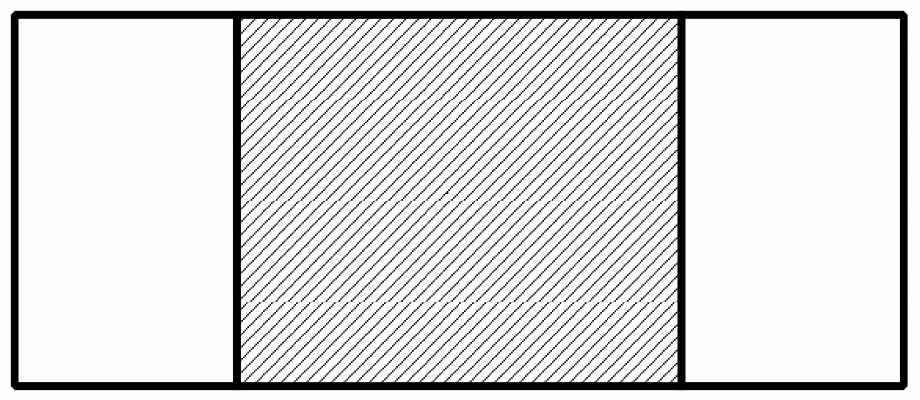
- (a)
Find the height of the window.
[5] - (b)
Find the perimeter of the whole window.
[3]
(a) Diagram 14(a) shows a rectangular piece of land ABCD with AB = x m and BD = (x + 3) m (the vegetable area is the triangle ABD). Mr Azizan plants vegetables on part of the land with AB at least 0.5 m. (b) Diagram 14(b) shows a golf ball hit so that it moves in a parabolic path. Its height from the ground, h m, after t seconds is given by h(t) = 15t − (15/8)t².
Medium8 marks- (a)
Determine the range of BD so that the area of land for vegetables is not more than 27 m².
[4]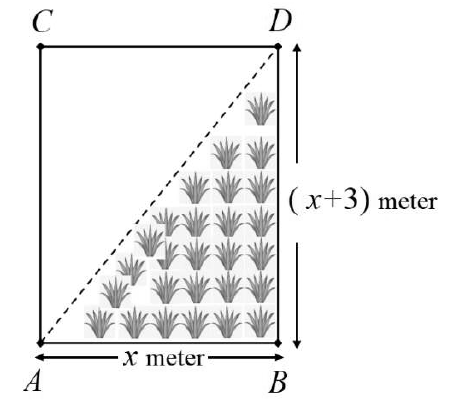
- (b)(i)
Find the maximum height of the ball.
[2]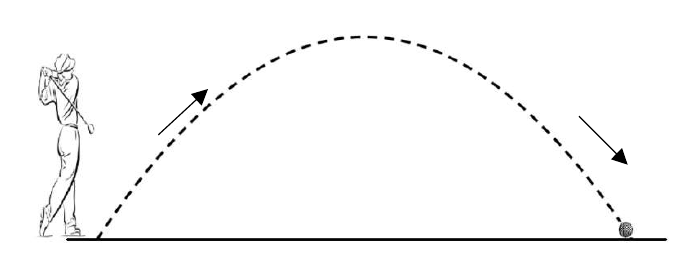
- (b)(ii)
Determine the range of time, in the nearest integer, if the position of the ball is more than 20 metres above the ground.
[2]
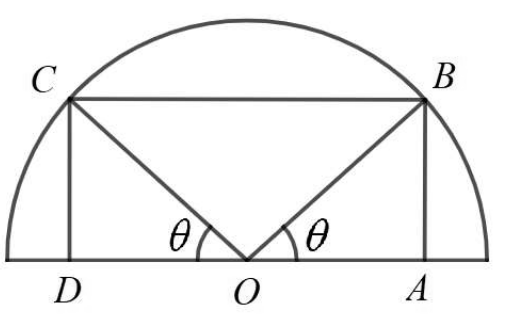
(a) Prove an identity. (b) Given sin α = −4/5 and cos β = −12/13; α and β are in the same quadrant. (c) Diagram 15 shows a rectangle ABCD inscribed in a semicircle with centre O, with ∠AOB = ∠COD = θ. The diameter of the semicircle is 36 m.
Medium8 marks- (a)
Prove that (cot θ + tan θ) cos θ = cosec θ.
[2] - (b)
Without using a calculator, find the value of cos(α/2).
[3] - (c)
If the perimeter of rectangle ABCD is P, show that P = 36 sin θ + 72 cos θ.
[3]