Write your answer on paper. Then open the answer to check it.
Section A
Diagram 1 shows six pieces of letter cards (K, E, A, R, T, S). A code of four cards is to be formed using those cards. Find the numbers of (a) different codes that can be formed, (b) different codes that can be formed if the code must end with a vowel.
Easy4 marks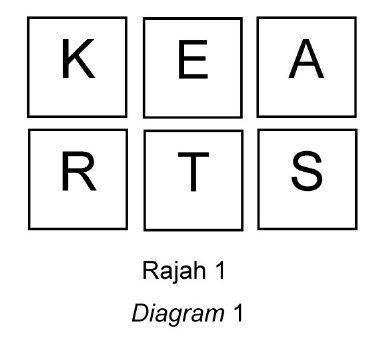
- (a)
Different codes that can be formed.
[2] - (b)
Different codes that can be formed if the code must end with a vowel.
[2]
Given function g⁻¹f(x) = (2x − 1)/x, x ≠ 0 and function f(x) = (3x − 6)/(x + 2), x ≠ −2. Find (a) function g(x), (b) value of p if g(p) = 2.
Easy5 marks- (a)
Function g(x).
[3] - (b)
Value of p if g(p) = 2.
[2]
Diagram 2 shows triangle PQR. Given that QT→ = (3/4) QR→, PQ→ = 8**p** and PR→ = 12**q**. (a) Express in terms of **p** and/or **q** (i) QR→, (ii) PT→. (b) Given PS→ = h PT→ and RS→ = k(2**p** − 7**q**) where h and k are constants, find the ratio between value h and value k.
Medium6 marks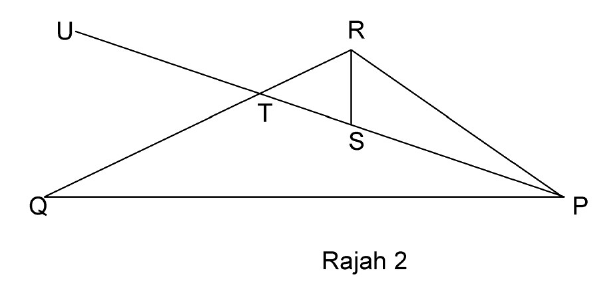
- (a)(i)
QR→ in terms of **p** and/or **q**.
[1] - (a)(ii)
PT→ in terms of **p** and/or **q**.
[1] - (b)
Given PS→ = h PT→ and RS→ = k(2**p** − 7**q**) where h and k are constants. Find the ratio between value h and value k.
[4]
(a) Diagram 3(a) shows a particle projected with an initial velocity V m/s from a fixed point O on horizontal ground. The angle of projection from O to the x-axis of the particle is θ. At time t seconds later, the particle is at a point Q(x, y). Given the motion of the particle satisfies the equation y = x tanθ − (gx²/(2V²)) sec²θ, where g m/s² is the acceleration caused by the gravity. If V = 20 and g = 10 and the particle falls to the ground at a fixed point located 24 meters from O, find the values of tanθ. (b) Diagram 3(b) shows a unit circle represented by an angle of 135°. Find the value of cosec(−45°), give your answer in the form of √a.
Medium5 marks- (a)
Find the values of tanθ (V = 20, g = 10, particle lands at P(24, 0)).
[3]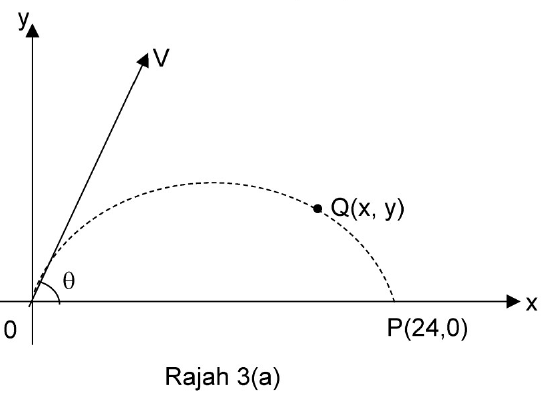
- (b)
Find the value of cosec(−45°), give your answer in the form of √a.
[2]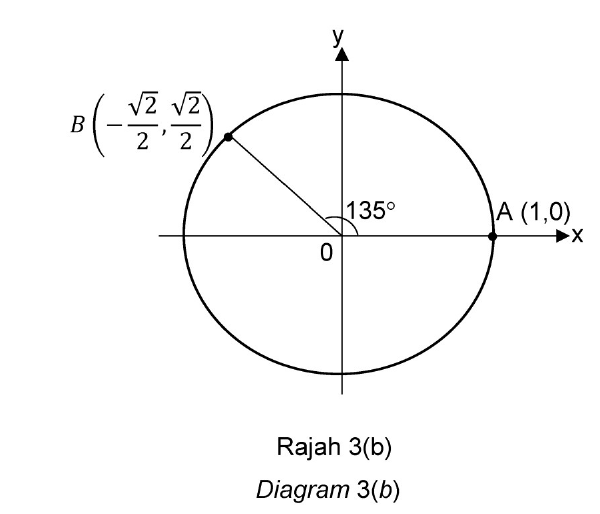
Diagram 4 shows the curve y = x² + p and the tangent to the curve at the point A(2, q). Find (a) the y-intercept for the curve in terms of q, (b) the equation of the tangent at point A if the y-intercept for the curve is 1.
Medium5 marks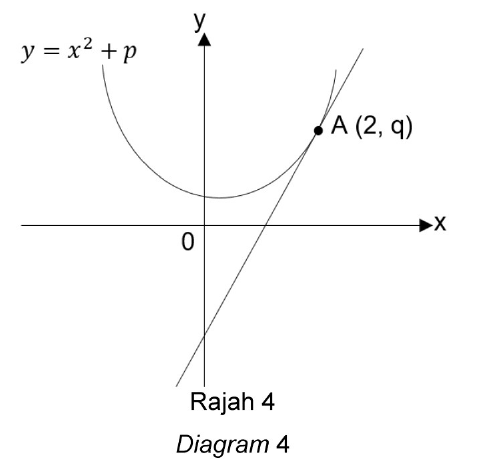
- (a)
y-intercept for the curve in terms of q.
[2] - (b)
Equation of the tangent at point A if the y-intercept for the curve is 1.
[3]
Given (h + 2), (2h − 11) and (h + 2)/9 are the first three odd terms of an arithmetic progression. Find (a) the value of h, (b) the common difference, give your answer in the form a/b.
Medium5 marks- (a)
The value of h.
[3] - (b)
The common difference, in the form a/b.
[2]
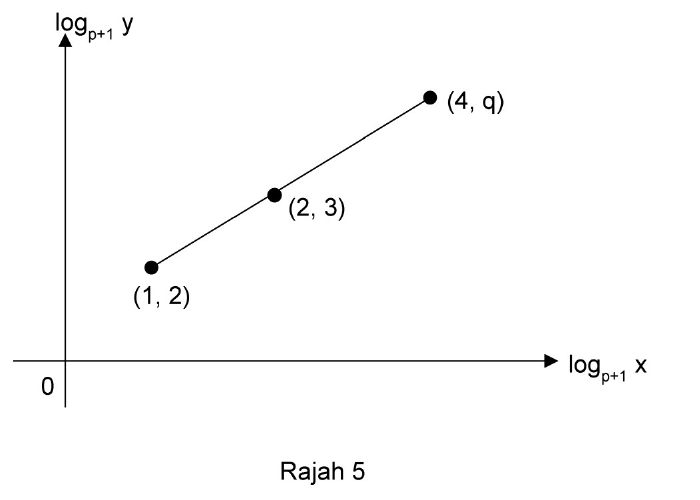
Table 1 shows the values for the two variables x and y: x = 2, 4, 16; y = 4, 8, 32. A graph of a straight line is drawn based on the table with the y-axis represented by log_(p+1) y and the x-axis represented by log_(p+1) x as shown in Diagram 5. The line passes through (1, 2), (2, 3) and (4, q). (a) Find the values of p and q. (b) Express y in terms of x in the form of an index.
Easy5 marks- (a)
Find the values of p and q.
[3]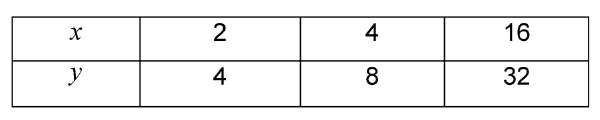
- (b)
Express y in terms of x in the form of an index.
[2]
Diagram 6 shows a circle of radius 6 cm with centre O. A straight line BC of length 9 cm is tangent to the circle. Given that AB = DC and the length of the major arc AD is 27.528 cm. Find (a) ∠AOD, in radian, (b) the area, in cm², of the shaded region.
Easy5 marks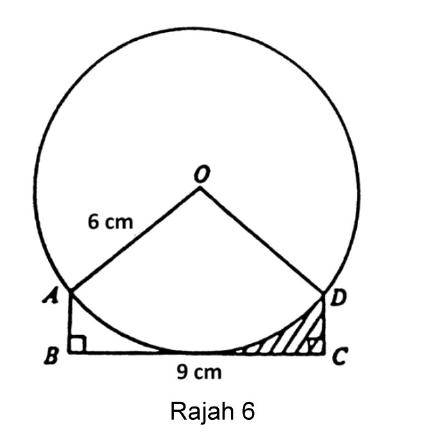
- (a)
∠AOD, in radian.
[1] - (b)
The area, in cm², of the shaded region.
[4]
Given that √(m + n√5) = 11/(4 − √5), where m and n are constants. Without using a calculator, find the value of m − n.
Medium5 marksFind the value of m − n.
[5]
(a) In a survey conducted on students in a school, it was found that 1 out of 5 students do not have a smartphone. (i) If 6 students are randomly selected from the school, find the probability that at least 3 people do not have a smartphone. (ii) If the number of students in the school is 705, calculate the standard deviation of the number of students who do not own a smartphone. (b) X is a continuous random variable with X ~ N(μ, 25). If P(X < 9) = 0.7257, find the value of μ.
Medium7 marks- (a)(i)
6 students are randomly selected. Find the probability that at least 3 do not have a smartphone.
[3] - (a)(ii)
The number of students is 705. Calculate the standard deviation of the number who do not own a smartphone.
[1] - (b)
X ~ N(μ, 25). If P(X < 9) = 0.7257, find μ.
[3]
(a) Determine the range of x for x(8 − x) ≤ 15. (b) The roots of the quadratic equation 2x² − 7x + 1 = 0 are α and β, while the roots of the quadratic equation 8x² + px + q = 0 are α + β and α² + β². Calculate the value and the values of p and q.
Medium6 marks- (a)
Determine the range of x for x(8 − x) ≤ 15.
[2] - (b)
Roots of 2x² − 7x + 1 = 0 are α and β; roots of 8x² + px + q = 0 are α + β and α² + β². Calculate p and q.
[4]
Solve the following system of linear equations: x − y + z = 8; 3x + 3y − 9z = −6; 7x − 2y + 5z = 39.
Easy6 marksSolve x − y + z = 8, 3x + 3y − 9z = −6, 7x − 2y + 5z = 39.
[6]
Section B
ABCD is a parallelogram labelled counter-clockwise, where A(−1, −1) and C(3, 5). (a) The straight line BD is parallel to the straight line 5y − x = 25. Find the equation of the straight line BD. (b) Given straight line BC is perpendicular to the straight line AC. (i) Find the coordinates of point B and D. (ii) Calculate the area, in unit², of parallelogram ABCD.
Medium8 marks- (a)
Find the equation of the straight line BD (parallel to 5y − x = 25).
[2] - (b)(i)
BC is perpendicular to AC. Find the coordinates of B and D.
[4] - (b)(ii)
Calculate the area, in unit², of parallelogram ABCD.
[2]
(a) Solve the equation 2/(log_y 2) = 4 + log₂(y + 5). (b) Given log_a N = ½[1/(log₂₄ a) − log_a (3/8) − 6 log_a 3]. (i) Without using a calculator, determine the value of N in simplest form p/q. (ii) Hence, if a = 2/3, find the value of log_a N.
Medium8 marks- (a)
Solve 2/(log_y 2) = 4 + log₂(y + 5).
[3] - (b)(i)
Without a calculator, find N in simplest form p/q.
[3] - (b)(ii)
Hence, if a = 2/3, find log_a N.
[2]
(a) Diagram 7 shows a straight line y = k and a curve y = x². Calculate the value of k if the area of the shaded area is 5⅓ unit². (b) The gradient function of a curve is px + 2, where p is a constant. Given that the normal gradient to the curve is −1/6 at point (1, −8), calculate (i) the value of p, (ii) the equation of the curve in intercept form.
Medium8 marks- (a)
Calculate k if the shaded area is 5⅓ unit².
[3]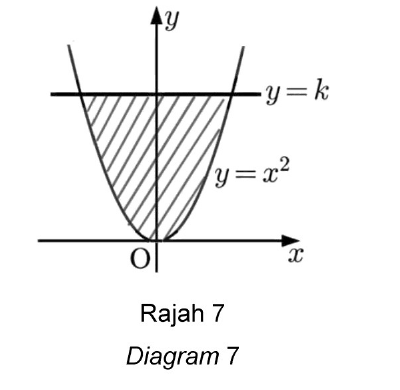
- (b)(i)
Find p (gradient function px + 2, normal gradient −1/6 at (1, −8)).
[2] - (b)(ii)
The equation of the curve in intercept form.
[3]