Write your answer on paper. Then open the answer to check it.
Section A
(a) It is given that one of the roots of the quadratic equation x² + (p + 3)x − p² = 0, where p is a constant, is negative of the other. Find the value of the product of the roots. (b) Find the range of values of x such that the quadratic function f(x) = 6 + 5x − x² is negative.
Easy5 marks- (a)
One root is the negative of the other. Find the product of the roots.
[2] - (b)
Find the range of values of x such that f(x) = 6 + 5x − x² is negative.
[3]
(a) Rationalise the denominator and simplify (6 − √3)/(9 − √12). (b) The total number of people infected by a highly infectious virus follows the equation M(t) = 1500 + e^(0.9t) after time t (in days). Determine the minimum number of days needed for the virus to infect more than 9500 people.
Medium5 marks- (a)
Rationalise the denominator and simplify (6 − √3)/(9 − √12).
[2] - (b)
Find the minimum number of days for M(t) > 9500.
[3]
(a) Given that f : x → ax + b and f³ : x → 64x − 42, find (i) the value of a, (ii) the value of b. (b) Mr. Kamil, 40, has been doing exercise activities every morning. Given that Mr. Kamil's heart rate is f(x) = 0.85(220 − x), where x is his age, (i) determine the inverse of this function, (ii) determine the estimated heart rate of Mr. Kamil.
Medium6 marks- (a)
Given f : x → ax + b and f³ : x → 64x − 42, find (i) a, (ii) b.
[4] - (b)(i)
Determine the inverse of f(x) = 0.85(220 − x).
[1] - (b)(ii)
Determine the estimated heart rate of Mr. Kamil (age 40).
[1]
Diagram 1 shows a trapezium shaped recreation park (right-angled at the left side; top side 4 m, left side y m, sloping side 5x m, base (x + 10) m). Given that the perimeter of the recreation park is 44 m, find the area of the recreation park.
Easy5 marks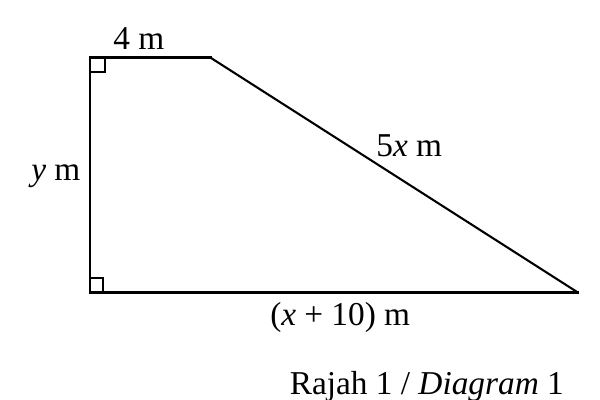
Find the area of the recreation park.
[5]
Diagram 2 shows a metal plate PQRSTU made by removing two shaded areas of a circle centred at O with radius 10 cm. Given PU = RS = 12 cm. (a) Show that ∠ROS = 1.287 radian. (b) Find (i) the perimeter, in cm, (ii) the area, in cm², of the metal plate.
Easy5 marks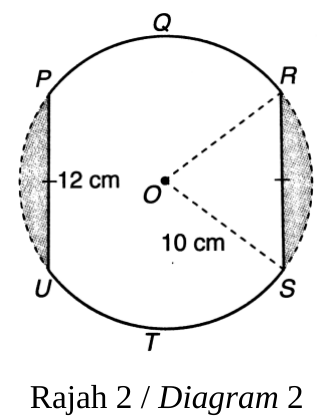
- (a)
Show that ∠ROS = 1.287 radian.
[1] - (b)(i)
Find the perimeter of the metal plate, in cm.
[2] - (b)(ii)
Find the area of the metal plate, in cm².
[2]
It is given that y = 3/(2x − 1)³. (a) Find the value of dy/dx when x = 2. (b) Express in terms of k, the approximate change in y, when x changes from 2 to 2 + k, where k is a small positive value. State whether this change is an increase or decrease.
Easy4 marks- (a)
Find dy/dx when x = 2.
[2] - (b)
Find the approximate change in y in terms of k and state increase or decrease.
[2]
(a) Given ∫₁³ g(x) dx = 5, find (i) ∫₃¹ g(x) dx, (ii) ∫₁³ [g(x) + 4] dx. (b) Given dy/dx = 5x − 2 and y = 10 when x = 2, express y in terms of x.
Medium6 marks- (a)(i)
Given ∫₁³ g(x) dx = 5, find ∫₃¹ g(x) dx.
[1] - (a)(ii)
Find ∫₁³ [g(x) + 4] dx.
[2] - (b)
Given dy/dx = 5x − 2 and y = 10 when x = 2, express y in terms of x.
[3]
The variables x and y are related by the equation y = h/3ˣ, where h is a constant. Diagram 3 shows a straight line graph obtained by plotting log₁₀ y against x (line with negative gradient passing through (0, −1) on the vertical axis). (a) Express the equation y = h/3ˣ in its linear form, Y = mX + c to obtain the straight line. State Y, X, m and c. (b) Find the value of h.
Easy6 marks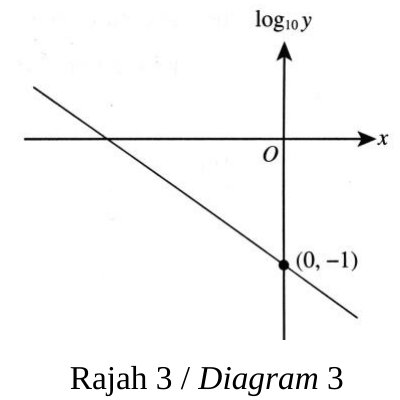
- (a)
Express y = h/3ˣ in the form Y = mX + c. State Y, X, m and c.
[4] - (b)
Find the value of h.
[2]
Diagram 4 shows a pentagonal swimming pool ABCDE with poles at A, B, C, D and E. Point F is the midpoint of DC. Given DE→ = (2/3)AB→, BC→ = ½AD→, AB→ = 6**q** and AD→ = 6**p** (vectors in bold). (a) If Ali swims from pole A to pole C, calculate the magnitude covered by Ali. (b) Another swimmer, Badrul, swims from pole A to pole E passing through point F. Determine whether the points A, F and E are collinear.
Medium5 marks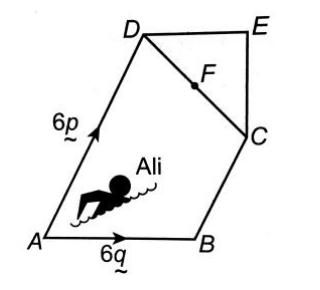
- (a)
Calculate the magnitude covered by Ali swimming from A to C.
[1] - (b)
Determine whether A, F and E are collinear.
[4]
(a) Given the first three terms of an arithmetic progression are 12 − x, 18 and 4x, find the value of x. (b) Three consecutive positive terms of a geometric progression are 36, h and k. It is given that the sum of the terms is 52. Find the value of h and k.
Easy5 marks- (a)
Find x for the arithmetic progression 12 − x, 18, 4x.
[2] - (b)
Find h and k for the geometric progression 36, h, k with sum 52.
[3]
(a) Given sin θ = p, where p is a constant and 90° ≤ θ ≤ 180°. Find in terms of p: (i) cosec θ, (ii) sin 2θ. (b) Solve the equation 3 sin²x + cos x = 1 for 0° ≤ x ≤ 360°.
Medium6 marks- (a)(i)
Find cosec θ in terms of p.
[1] - (a)(ii)
Find sin 2θ in terms of p.
[2] - (b)
Solve 3 sin²x + cos x = 1 for 0° ≤ x ≤ 360°.
[3]
(a) Given that the number of ways of selecting 2 objects from m different objects is 15, find the value of m. (b) Solve the equation ⁶Cᵣ = 5 × ⁴Cᵣ.
Medium6 marks- (a)
Given mC₂ = 15, find m.
[3] - (b)
Solve ⁶Cᵣ = 5 × ⁴Cᵣ.
[3]
Section B
Solution by scale drawing will not be accepted. Diagram 5 shows a triangle KMN with K(−1, 4), M(5, 7) and N on the x-axis side; L is on KM with LN perpendicular to KM. L is a point which divides the line KM in the ratio 1 : 2. Find (a) the coordinates of L, (b) the coordinates of N, if the equation of MN is y = 3x − 8, (c) the area of triangle KMN.
Medium8 marks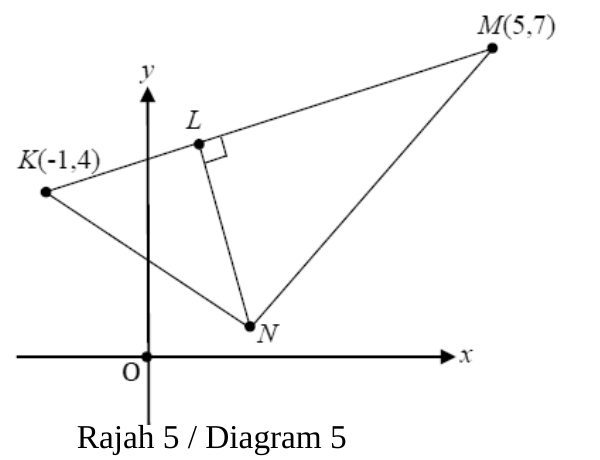
- (a)
Find the coordinates of L.
[2] - (b)
Find the coordinates of N, given MN: y = 3x − 8.
[3] - (c)
Find the area of triangle KMN.
[3]
Aleena has just completed her diploma in banking. She was offered a job from two banks. Bank A offered an initial salary of RM 45 000 per annum with 5% yearly increment from the basic salary. Bank B offered an initial salary of RM 47 000 per annum with RM 2 000 increment yearly. Aleena decided to choose the bank which offered higher income and save 15% of her salary for further study after working for 8 years. (a) Determine which bank Aleena should choose. Show calculation to support your answer. [Round off your answer to the nearest RM] (b) Does Aleena's total saving enough to pay her studies fee of RM 60 000? Justify your answer.
Medium8 marks- (a)
Determine which bank Aleena should choose (total salary for 8 years), to the nearest RM.
[5] - (b)
Is her saving enough for RM 60 000? Justify.
[3]
(a) Diagram 6 shows a standard normal distribution graph (shaded region between z = m and z = 1.4). Given P(m < Z < 1.4) = 0.1628, find P(0 < Z < m). (b) A computer course is supplied with 20 microcomputer discs. To determine if the discs supplied are in good condition, 10 discs are selected at random and inspected. If none or only one of the discs is defective, then the supply of 20 discs will be accepted. Given that one out of four discs is defective, calculate (i) the probability that the supply will be accepted entirely, (ii) the probability that at least 8 discs are not defective.
Medium8 marks- (a)
Given P(m < Z < 1.4) = 0.1628, find P(0 < Z < m).
[3]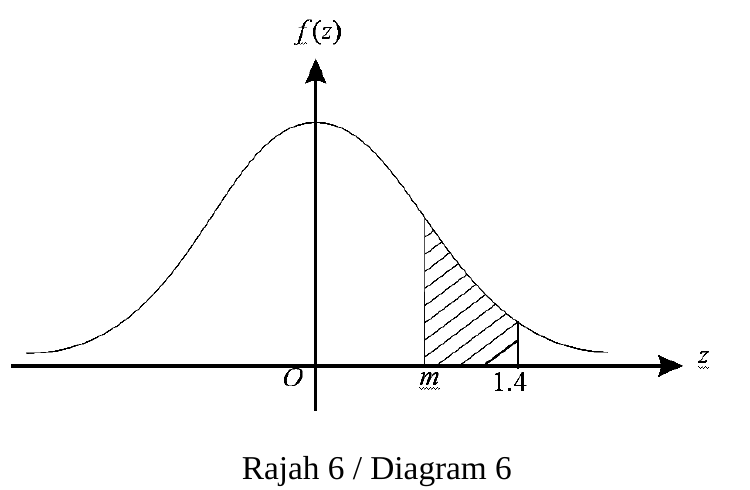
- (b)(i)
Find the probability that the supply will be accepted entirely.
[3] - (b)(ii)
Find the probability that at least 8 discs are not defective.
[2]