Write your answer on paper. Then open the answer to check it.
Section A
Diagram 1 shows the graph of an absolute function p(x) = |ax + b| for the domain −3 ≤ x ≤ k (the graph starts at (−3, 2), touches the x-axis at x = q, cuts the p(x)-axis at 4 and ends at (k, 12)). (a) Find the value of a and b if a > 1 and b > 0. (b) Find the value of k and q. (c) State the range of p(x) corresponding to the given domain.
Medium7 marks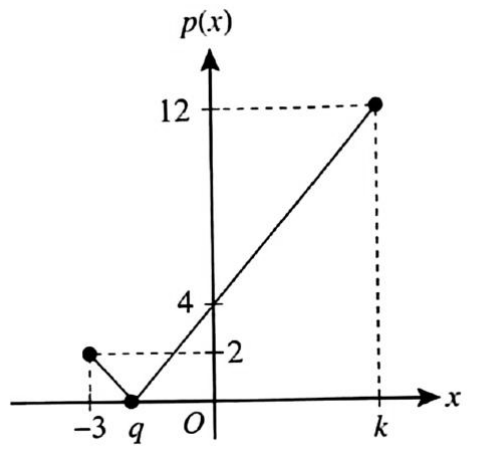
- (a)
Find the value of a and b if a > 1 and b > 0.
[2] - (b)
Find the value of k and q.
[4] - (c)
State the range of p(x) corresponding to the given domain.
[1]
Given that the sum of the perimeters of two squares is 20 cm and the sum of their areas is 17 cm², calculate the possible values of the sides of the two squares.
Medium6 marksCalculate the possible values of the sides of the two squares.
[6]
Diagram 3 shows an isosceles triangle ABC (angle x at A, equal base angles θ° at B and C). (a) Show that tan x = 2 tan θ/(tan² θ − 1). (b) Solve 3 cos 2y + sin y − 2 = 0 for all angles y between 0° and 360°. (c) Given sin θ = t where θ is an acute angle, express sin(π/2 − θ) in terms of t.
Medium8 marks- (a)
Show that tan x = 2 tan θ/(tan² θ − 1).
[3]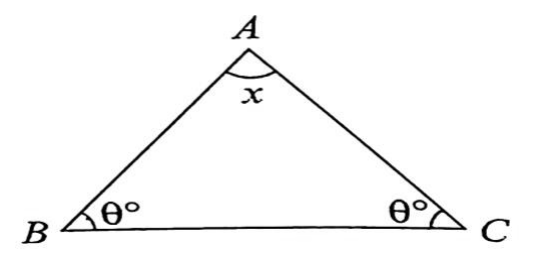
- (b)
Solve 3 cos 2y + sin y − 2 = 0 for 0° ≤ y ≤ 360°.
[4] - (c)
Express sin(π/2 − θ) in terms of t.
[1]
In Diagram 4, the straight line KL is normal to the curve y = x² + 1 at point A(1, 3). The straight line AM is parallel to the y-axis (M on the x-axis; L is (p, 0) on the x-axis; K is on the y-axis). Find (a) the value of p, (b) the area of the shaded region.
Medium7 marks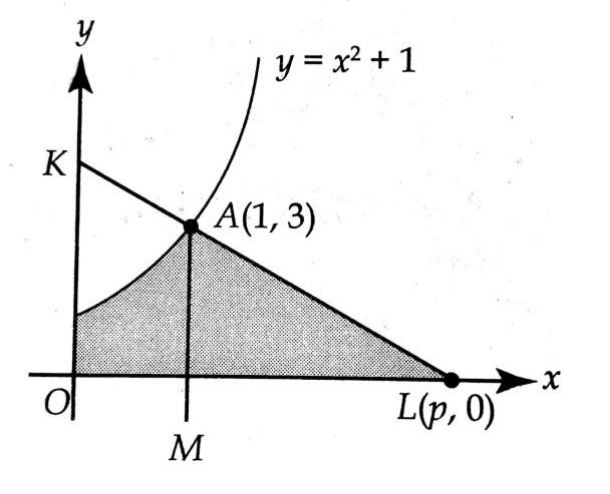
- (a)
Find the value of p.
[4] - (b)
Find the area of the shaded region.
[3]
Diagram 5 shows a circle with centre O and a radius of 9 cm. AOC is an arc of a circle with centre E. Given BD is parallel to AC, BD = 9 cm and ∠AOC = 2π/3 rad. [Use π = 3.142] (a) Calculate the area, in cm², of segment BED. (b) Show that the perimeter of the shaded region is (9√3 + 9 + 3π) cm.
Medium8 marks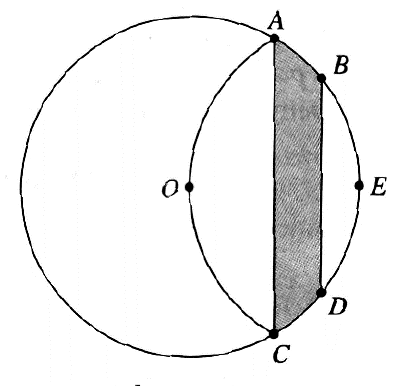
- (a)
Calculate the area, in cm², of segment BED.
[4] - (b)
Show that the perimeter of the shaded region is (9√3 + 9 + 3π) cm.
[4]
(a) Diagram 6 shows eight letter cards: B, I, S, E, C, T, O, R. A five-letter code is to be formed using five of these cards. Find (i) the number of different five-letter codes that can be formed, (ii) the number of different five-letter codes which begin with a consonant and end with a vowel. (b) The four-digit passcode '8772' is set by Johan on his door access device. He wants to reset the passcode such that the new passcode cannot contain digit 7 followed by digit 2. How many different passcodes can be formed?
Medium7 marks- (a)(i)
Find the number of different five-letter codes.
[1]
- (a)(ii)
Find the number of different five-letter codes which begin with a consonant and end with a vowel.
[2] - (b)
How many different passcodes can be formed without digit 7 followed by digit 2?
[4]
Diagram 7 shows part of a rectangular wall painted in blue, B, red, M, and green, H, in turn (B, M, H, B, M, H, …). The height of the wall is 1.5 m. The side length of the first coloured rectangle is 18 cm and the side length of each subsequent coloured rectangle increases by 5 cm. Given the total number of coloured rectangles is 60. (a) Find (i) the side length, in cm, of the last coloured rectangle, (ii) the total length, in cm, of the painted wall. (b) Which coloured rectangle has an area of 40200 cm²? Hence, state the colour of that rectangle.
Medium7 marks- (a)(i)
Find the side length, in cm, of the last coloured rectangle.
[2]
- (a)(ii)
Find the total length, in cm, of the painted wall.
[2] - (b)
Which coloured rectangle has an area of 40200 cm²? State its colour.
[3]
Section B
Section B: answer any three questions. Diagram 8 shows the locations of the bookshop (B), computer shop (C), park (P), shopping mall (S) and public library (L) in a town. The vector from the bookshop to the public library is 12x and the vector from the bookshop to the shopping mall is 16x + 10y. T is the intersection junction between the straight roads BC and LS. Given the distance of the public library from the bookshop is 3 times that from the park (BL : LP = 3 : 1). The computer shop is in the middle between the shopping mall and the park on the straight road PS. (a) Find the vector, in terms of x and y, from (i) the public library to the shopping mall, (ii) the bookshop to the computer shop. (b) Find BT : TC. Given BT→ = λ BC→ and LT→ = k LS→.
Medium10 marks- (a)(i)
Find the vector from the public library to the shopping mall.
[2]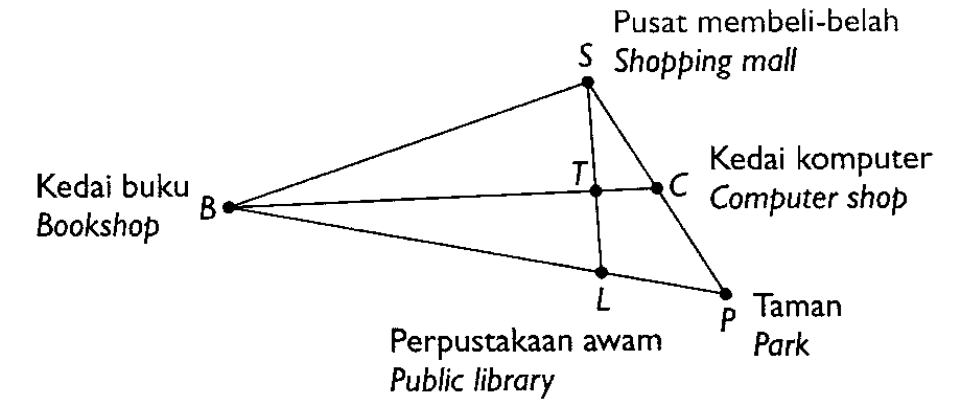
- (a)(ii)
Find the vector from the bookshop to the computer shop.
[3] - (b)
Find BT : TC.
[5]
Section B: answer any three questions. A particle moves along a straight line and passes through a fixed point O with a velocity of 10 m s⁻¹. The acceleration, a m s⁻², is given by a = 4t − 12, where t is the time, in seconds, after passing through O. Find (a) the initial acceleration, in m s⁻², (b) the minimum velocity, in m s⁻¹, (c) the value of t, in seconds, when the particle is instantaneously at rest, (d) the total distance, in m, travelled by the particle in the first 4 seconds.
Medium10 marks- (a)
Find the initial acceleration, in m s⁻².
[1] - (b)
Find the minimum velocity, in m s⁻¹.
[3] - (c)
Find the value of t, in seconds, when the particle is instantaneously at rest.
[2] - (d)
Find the total distance, in m, travelled in the first 4 seconds.
[4]
Section B: answer any three questions. Use graph paper to answer this question. Table 10 shows the values of two variables, x and y, obtained from an experiment. The variables x and y are related by the equation y = (2q − 3)x² + (p/q)x, where p and q are constants. Table 10: x = 2, 3, 4, 5, 6, 7; y = 9.6, 16.2, 23.8, 33, 42.6, 53.9. (a) Plot the graph of y/x against x, using a scale of 2 cm to 1 unit on both axes. Hence, draw the line of best fit. (b) Using the graph in (a), find the value of (i) q, (ii) p.
Medium10 marks- (a)
Plot the graph of y/x against x (scale 2 cm to 1 unit on both axes) and draw the line of best fit.
[5]
- (b)(i)
Find the value of q.
[3] - (b)(ii)
Find the value of p.
[2]
Section B: answer any three questions. (a) A survey in a school shows that two out of five students are scouts. If 6 students are selected at random, calculate the probability that (i) 3 students are scouts, (ii) at least one student is a scout. (b) The heights of players in a volleyball team are normally distributed with a mean of 170 cm and a standard deviation of 8 cm. (i) Find the probability that the height of a player is less than 174 cm. (ii) It is found that 15% of the players have a height more than p cm. Find the value of p.
Medium10 marks- (a)(i)
Find the probability that 3 students are scouts.
[2] - (a)(ii)
Find the probability that at least one student is a scout.
[3] - (b)(i)
Find the probability that the height is less than 174 cm.
[2] - (b)(ii)
Find the value of p.
[3]
Section C
Section C: answer any two questions. Table 12 shows the index numbers for the cost of five expenses of Encik Farid's family in the years 2018 and 2020 based on the year 2016: Food 108 and x; Clothes 110 and 114; Electricity 115 and 119; Transportation y and 112; Others 105 and 113. Diagram 12 is a pie chart showing the proportion of the family monthly expenses (angles: Food 80°, Clothes 60°, Electricity 100°, Transportation 70°, Others 50°). (a) Find the price index of clothes in the year 2020 based on the year 2018. (b) The cost of food in 2016 is RM750 and in 2020 is RM1050. Find (i) the percentage increase of the cost of food from 2016 to 2020, (ii) the cost of food in 2018. (c) The composite index for the cost of Encik Farid's family in 2020 based on 2018 is 109.6. Find the value of y, correct to three significant figures. (d) Given the cost of expenses of Encik Farid's family in 2020 is RM2500, find the cost of expenses to the nearest RM in 2018.
Medium10 marks- (a)
Find the price index of clothes in 2020 based on 2018.
[2]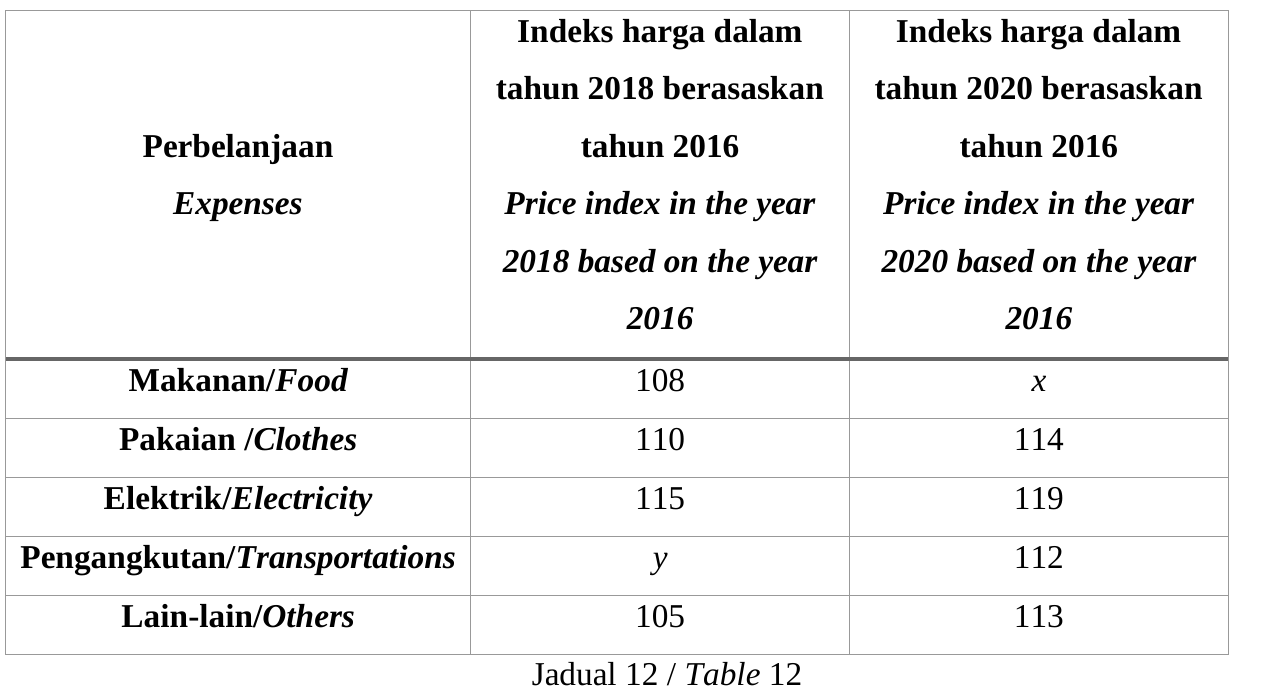
- (b)(i)
Find the percentage increase of the cost of food from 2016 to 2020.
[2] - (b)(ii)
Find the cost of food in 2018.
[2] - (c)
Find the value of y, correct to three significant figures.
[3]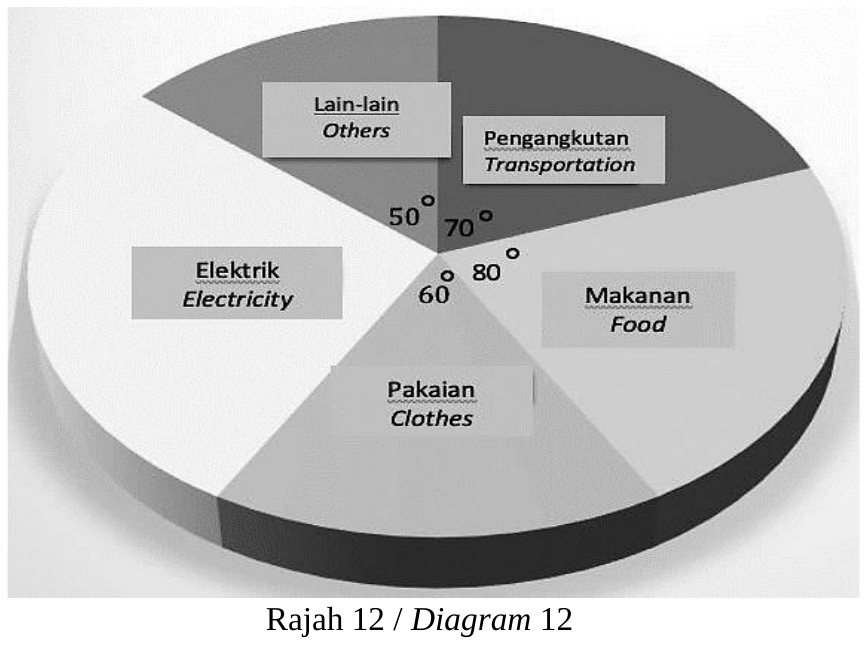
- (d)
Find the cost of expenses in 2018, to the nearest RM.
[1]
Section C: answer any two questions. Use graph paper to answer this question. A shop produces two types of sport shoes, M and N. A pair of sport shoes M requires 25 minutes on machine P and 35 minutes on machine Q. A pair of sport shoes N requires 15 minutes on machine P and 45 minutes on machine Q. Machines P and Q can only operate for 1200 minutes and 2520 minutes a day respectively. The factory produces x pairs of sport shoes M and y pairs of sport shoes N in a day. The number of pairs of M produced is not more than twice the number of pairs of N. (a) Write down three inequalities, other than x ≥ 0 and y ≥ 0, that satisfy all the above constraints. (b) Using a scale of 2 cm to 10 pairs on both axes, construct and shade the region R which satisfies all the above constraints. (c) Using the graph constructed in (b), find (i) the range of the number of pairs of sport shoes N produced if exactly 30 pairs of M are produced in a day, (ii) the maximum total profit per day if the profit from a pair of M and a pair of N are RM30 and RM35 respectively.
Medium10 marks- (a)
Write down three inequalities, other than x ≥ 0 and y ≥ 0.
[3] - (b)
Construct and shade the region R (scale 2 cm to 10 pairs on both axes).
[3]
- (c)(i)
Find the range of the number of pairs of N if exactly 30 pairs of M are produced.
[1] - (c)(ii)
Find the maximum total profit per day.
[3]
Section C: answer any two questions. Diagram 14 shows a triangle PQR (PQ = 2 km, QR = 1.5 km, ∠PQR = 65°). It is given that P is due north of R. (a) Calculate the distance, in km, of PR. (b) Given that the bearing of point S from point R is 040° and the distance PS is 1.6 km, calculate the possible values of ∠PSR. (c) If a piece of land PRS is used as a paddy field, calculate the maximum area of the paddy field.
Medium10 marks- (a)
Calculate the distance PR in km.
[2]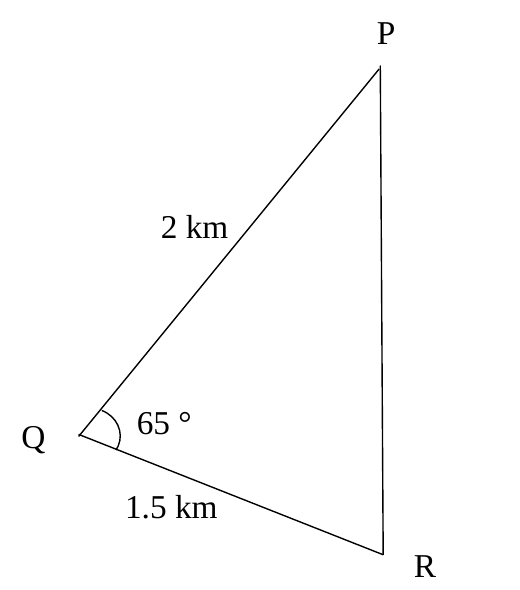
- (b)
Calculate the possible values of ∠PSR.
[5] - (c)
Calculate the maximum area of the paddy field PRS.
[3]
Section C: answer any two questions. (a) Given that the gradient of the normal to a curve is 5/(2x − 5). The curve passes through point P(1/2, 4) and has a minimum point (k, 2). Calculate (i) the equation of the tangent to the curve at point P, (ii) the value of k. (b) The curve y = −2x² + 8x + 5 has a stationary point at x = m, where m is a constant. Find the value of m and state the coordinates of the stationary point.
Medium10 marks- (a)(i)
Calculate the equation of the tangent to the curve at P(1/2, 4).
[4] - (a)(ii)
Calculate the value of k.
[2] - (b)
Find the value of m and state the coordinates of the stationary point.
[4]