Write your answer on paper. Then open the answer to check it.
Section A
Given f(x) = 3x − 2 and g(x) = x − 3. (a) Find f⁻¹(x) and g⁻¹(x). (b) What is the relation between (fg)⁻¹(x) and g⁻¹f⁻¹(x)? Justify your answer. (c) Using the same axes, sketch the graphs of y = f(x) and y = f⁻¹(x). Hence, state the relationship between the two graphs.
Medium8 marks- (a)
Find f⁻¹(x) and g⁻¹(x).
[2] - (b)
What is the relation between (fg)⁻¹(x) and g⁻¹f⁻¹(x)? Justify your answer.
[3] - (c)
Using the same axes, sketch y = f(x) and y = f⁻¹(x). Hence state the relationship between the two graphs.
[3]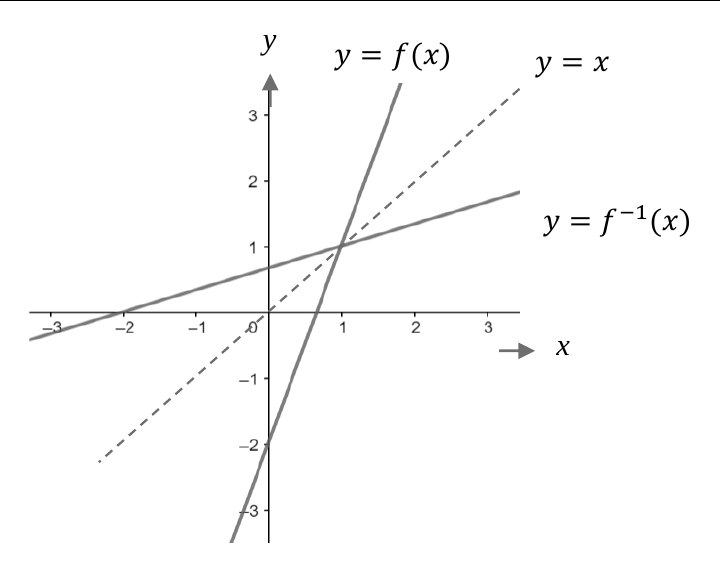
(a) The sum of the squares of two consecutive integers is 841. Find the two integers. (b) Given that α and β are the roots of the quadratic equation px² − 4px + 5 − p = 0. If α ≠ β, find the range of values of p.
Medium7 marks- (a)
Find the two consecutive integers whose squares sum to 841.
[4] - (b)
Given α ≠ β are the roots of px² − 4px + 5 − p = 0, find the range of values of p.
[3]
When 3 plastic glasses are stacked together as in Diagram 1, the height of the arrangement is 13.5 cm, whereas when 6 plastic glasses are stacked together, the height is 15.75 cm. (a) How high would a stack of 20 glasses stand? (b) Find how many glasses would it take to make a stack of at least 0.5 m high.
Medium7 marks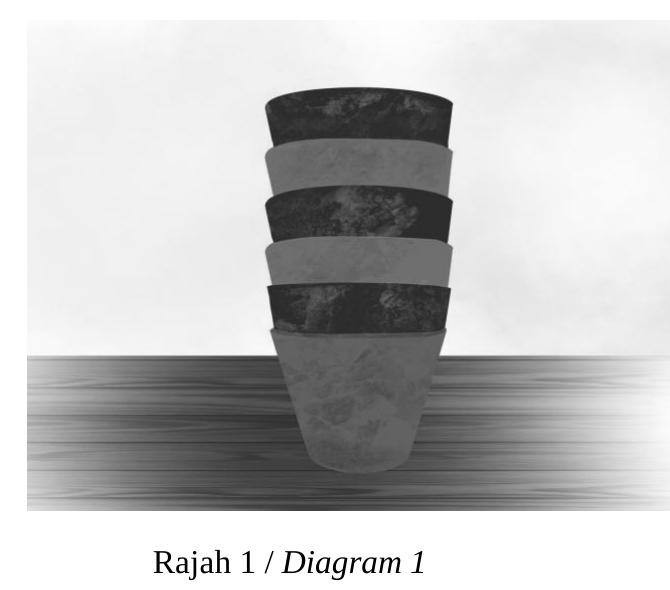
- (a)
How high would a stack of 20 glasses stand?
[5] - (b)
Find how many glasses make a stack of at least 0.5 m high.
[2]
Aisyah and Anaqi went to the school cooperative to buy exercise books, pens and drinking water. Table 1 shows the number of each item purchased and the total spent: Aisyah bought 3 exercise books, 2 pens and 3 bottles of drinking water for RM11.40; Anaqi bought 2 exercise books, 4 pens and 1 bottle of drinking water for RM9.80. Given that the price of an exercise book is twice the price of a bottle of drinking water, find the price of one exercise book, a pen and a bottle of drinking water.
Medium7 marks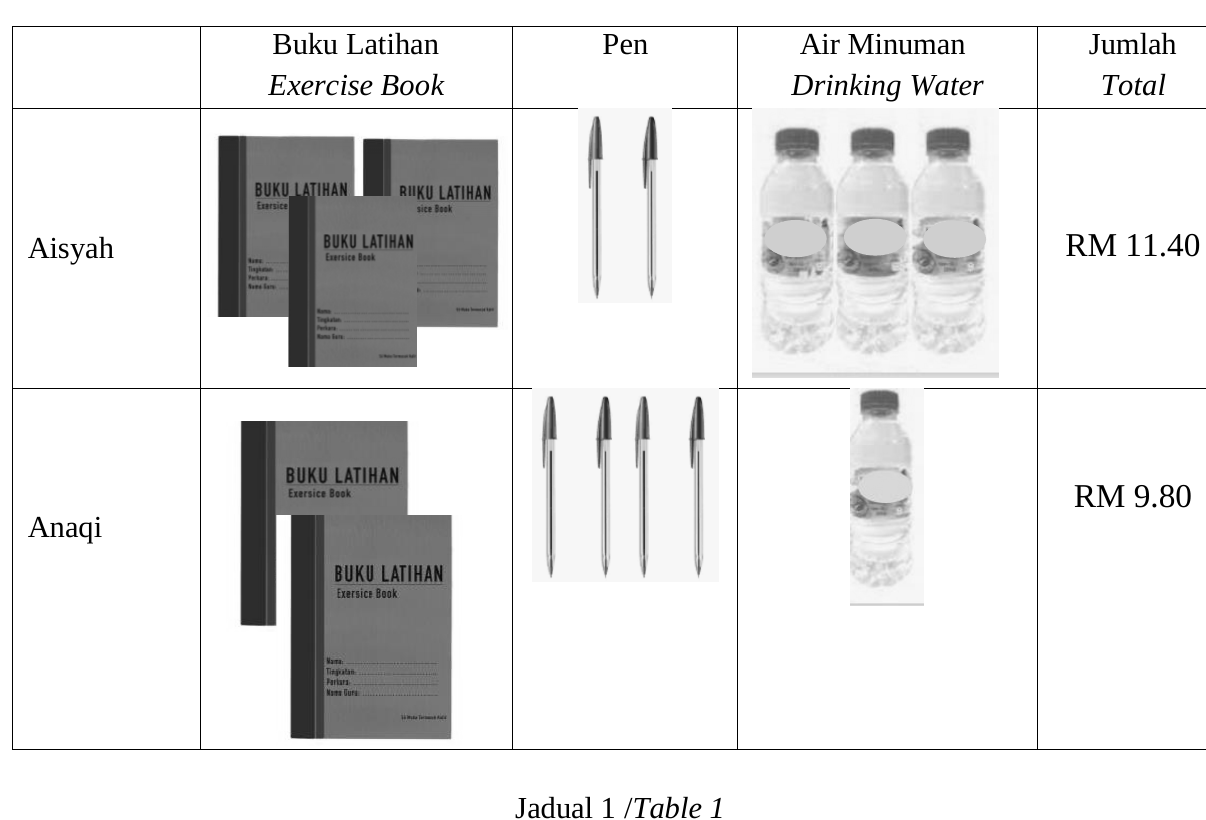
Find the price of one exercise book, a pen and a bottle of drinking water.
[7]
(a) Use the following information to find the value of N without using a calculator: log₃ p = 0.1, log₃ q = 0.5, N = −3(pq)⁵. (b) Diagram 2 shows a rectangle ABCD and a right-angled triangle BQP such that point Q is on the side AD and point P is on the side CD. Given AB = √5 cm, AQ = 2 cm and ∠PBQ = 30°. Find the length, in cm, of PQ. Give your answer in surd form.
Medium7 marks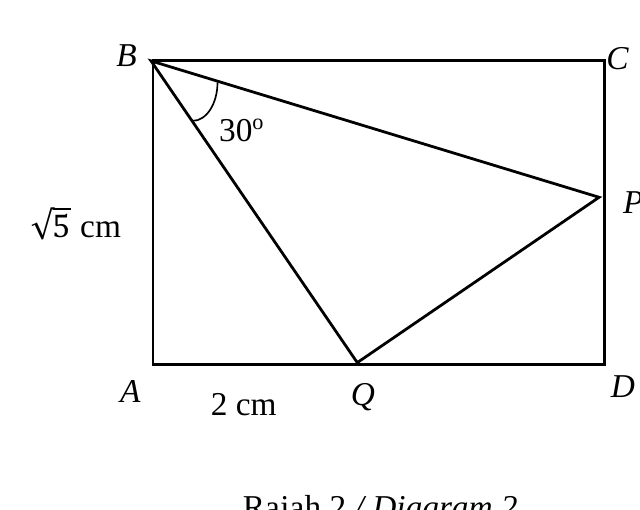
- (a)
Find the value of N without a calculator (log₃ p = 0.1, log₃ q = 0.5, N = −3(pq)⁵).
[3] - (b)
Find the length, in cm, of PQ in surd form.
[4]
Diagram 3 shows a rectangle ABCD. The straight lines AE and BF intersect at point T (E is on DC, F is on AD). It is given that AB→ = 25x, AD→ = 18y, AD = 3FD and DE : EC = 3 : 2. (a) Express AE→ in terms of x and y. (b) Given AT→ = hAE→ and BT→ = kBF→, where h and k are constants, (i) express AT→ in terms of h, x and y, (ii) express BT→ in terms of k, x and y, (iii) hence, find the values of h and of k.
Medium8 marks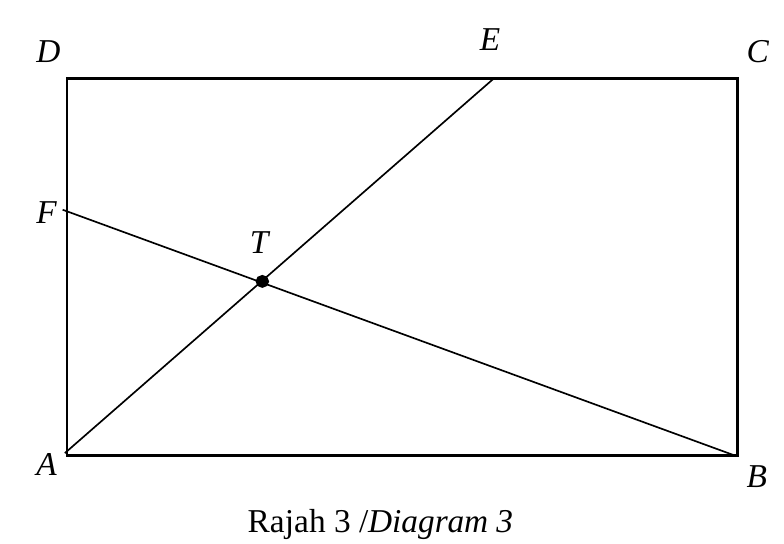
- (a)
Express AE→ in terms of x and y.
[2] - (b)(i)
Express AT→ in terms of h, x and y.
[1] - (b)(ii)
Express BT→ in terms of k, x and y.
[2] - (b)(iii)
Hence, find the values of h and of k.
[3]
Solution to this question by scale drawing will not be accepted. Diagram 4 shows a parallelogram ABCD. The coordinates of points A, B and C are (−4, 4), (2, 9) and (4, 1) respectively. Find (a) the coordinates of the point of intersection of the diagonals AC and BD, (b) the coordinates of the point D, (c) the area of the parallelogram ABCD.
Easy6 marks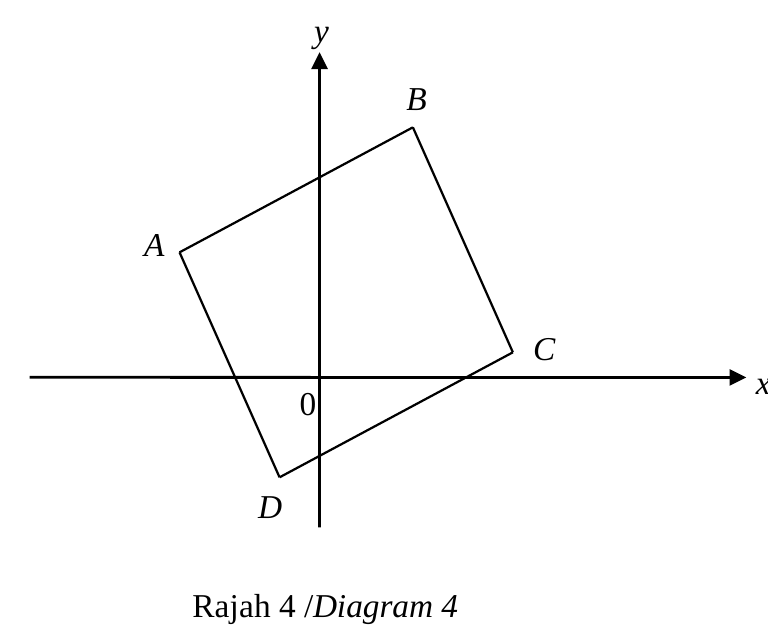
- (a)
Find the coordinates of the point of intersection of the diagonals AC and BD.
[2] - (b)
Find the coordinates of the point D.
[2] - (c)
Find the area of the parallelogram ABCD.
[2]
Section B
(a) Diagram 5a shows part of the curve y = 27 − (x − 2)³ intersecting the x-axis at point P. Find (i) the coordinates of P, (ii) the area of the shaded region (bounded by the curve, the axes and the line x = 0). (b) Diagram 5b shows the shaded region bounded by the curve y = √(3x + 4), the lines x = k and x = 4 and the x-axis. When the shaded region is rotated through 360° about the x-axis, the volume generated is 26π unit³. Find the value of k.
Medium10 marks- (a)(i)
Find the coordinates of P.
[2]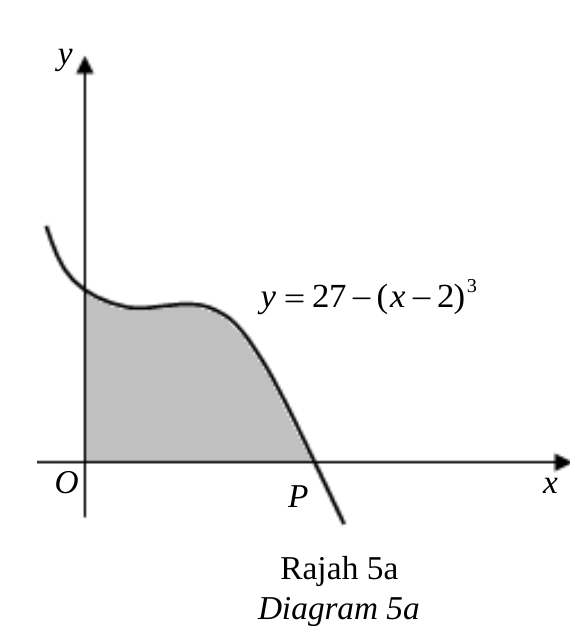
- (a)(ii)
Find the area of the shaded region.
[4] - (b)
Find the value of k (volume generated = 26π unit³).
[4]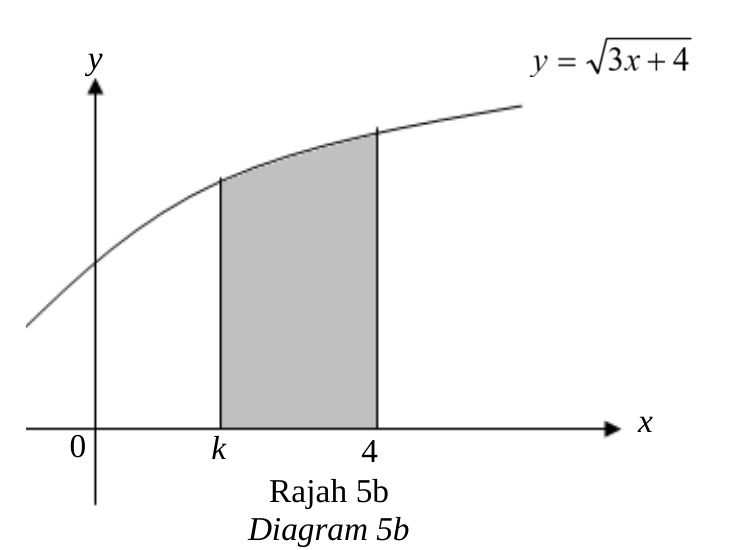
(a) Prove the identity sin(x + π/6) − sin(x − π/6) = cos x. (b) Sketch the graph y = 3 cos 2x + 2 for 0 < x < π. Then, determine the number of solutions for the trigonometric equation 3π cos 2x = 8x − π. (c) Find the values of x from 0° to 360° that satisfy the equation sin 2x + cos x = 0.
Hard10 marks- (a)
Prove sin(x + π/6) − sin(x − π/6) = cos x.
[2] - (b)
Sketch y = 3 cos 2x + 2 for 0 < x < π. Hence determine the number of solutions of 3π cos 2x = 8x − π.
[5]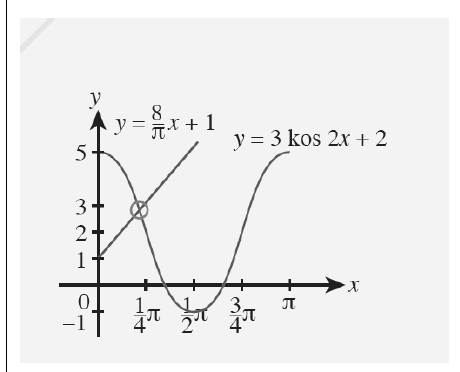
- (c)
Find the values of x from 0° to 360° satisfying sin 2x + cos x = 0.
[3]
(a) It is found that in a school, 150 of its 250 Form 5 students take the subject of Additional Mathematics. (i) If 8 students are chosen at random among the Form 5 students, find the probability that at least 2 students take Additional Mathematics. (ii) If the variance of students who sat for Additional Mathematics in the SPM examination is 33.36, find the number of students who probably sat for the subject in the examination. (b) The diameter of apples from a farm has a normal distribution with a mean of 2.9 cm and a standard deviation of 1.3 cm. Calculate (i) the probability that an apple chosen at random from this farm has a diameter of more than 3.2 cm, (ii) the value of d if 35% of the apples have diameters less than d cm.
Medium10 marks- (a)(i)
Probability that at least 2 of 8 chosen students take Additional Mathematics.
[3] - (a)(ii)
Variance = 33.36: find the number of students who probably sat the subject.
[2] - (b)(i)
Probability that the diameter is more than 3.2 cm.
[2] - (b)(ii)
Find d if 35% of apples have diameters less than d cm.
[3]
Use graph paper to answer this question. Table 2 shows the values of variables x and y, obtained from an experiment. The variables x and y are related by the equation y = p + q/x, where p and q are constants. x: 1, 2, 3, 4, 5, 6; y: 7.00, 4.50, 3.67, 3.30, 3.00, 2.77. (a) Construct a table for the values of x and xy. (b) Using a scale of 2 cm to 1 unit on the x-axis and 2 cm to 2 units on the xy-axis, plot a graph of xy against x. Hence draw the line of best fit. (c) Use the graph from (b) to find the value of (i) y when x = 3.5, (ii) p, (iii) q.
Medium10 marks
- (a)
Construct a table for the values of x and xy.
[1] - (b)
Plot a graph of xy against x (2 cm to 1 unit on the x-axis, 2 cm to 2 units on the xy-axis) and draw the line of best fit.
[3]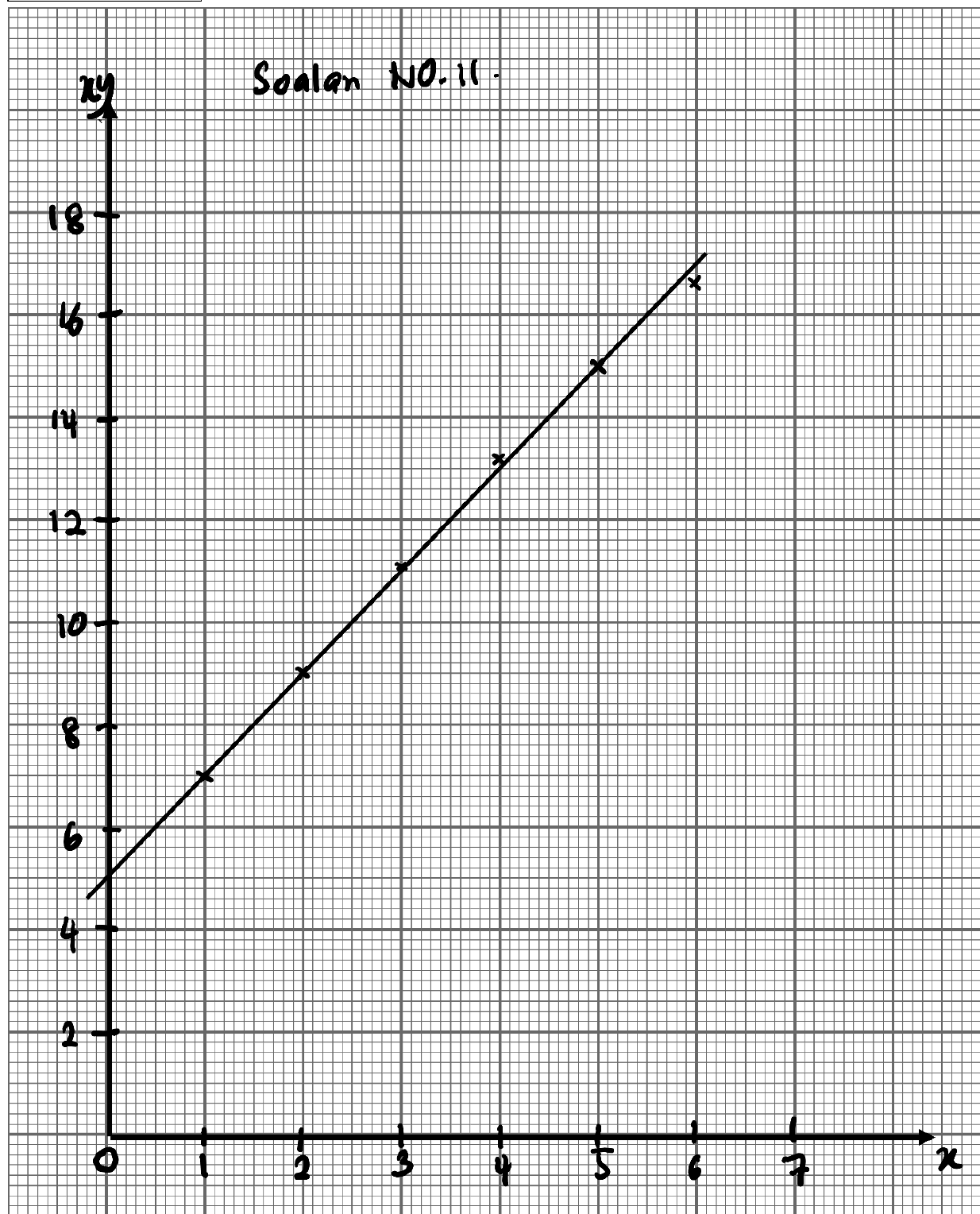
- (c)(i)
Find y when x = 3.5.
[2] - (c)(ii)
Find p.
[2] - (c)(iii)
Find q.
[2]
Section C
A particle moves along a straight line from a fixed point O. The velocity, v cm s⁻¹, of the particle is given by v = 6t − 3t², where t is the time in seconds after leaving O. Find (a) the acceleration, in cm s⁻², of the particle when t = 4, (b) the maximum velocity, in cm s⁻¹, of the particle, (c) the distance, in cm, from O when the particle is momentarily at rest, (d) the value of t when the particle returns to O.
Medium10 marks- (a)
Find the acceleration when t = 4.
[2] - (b)
Find the maximum velocity.
[2] - (c)
Find the distance from O when the particle is momentarily at rest.
[4] - (d)
Find the value of t when the particle returns to O.
[2]
Table 13 shows the prices of four ingredients, E, F, G and H, used in the making of a type of dessert. Price (RM) per kilogram in 2015 and 2017, and weightage: E: 4.00, w, 7; F: 2.50, 3.50, 3; G: x, y, 4; H: 4.00, 4.80, 2. (a) The price index of ingredient E in the year 2017 based on the year 2015 is 120. Find the value of w. (b) The price index of ingredient G in the year 2017 based on the year 2015 is 140. The price per kilogram of ingredient G in the year 2017 is RM2.00 more than its corresponding price in the year 2015. Find the values of x and y. (c) Calculate the composite index for the cost of making the dessert in the year 2017 based on the year 2015. (d) The composite index for the cost of making the dessert increased by 30% from the year 2017 to the year 2019. Calculate the price of a bowl of the dessert in the year 2019 if its corresponding price in the year 2015 is RM15.
Medium10 marks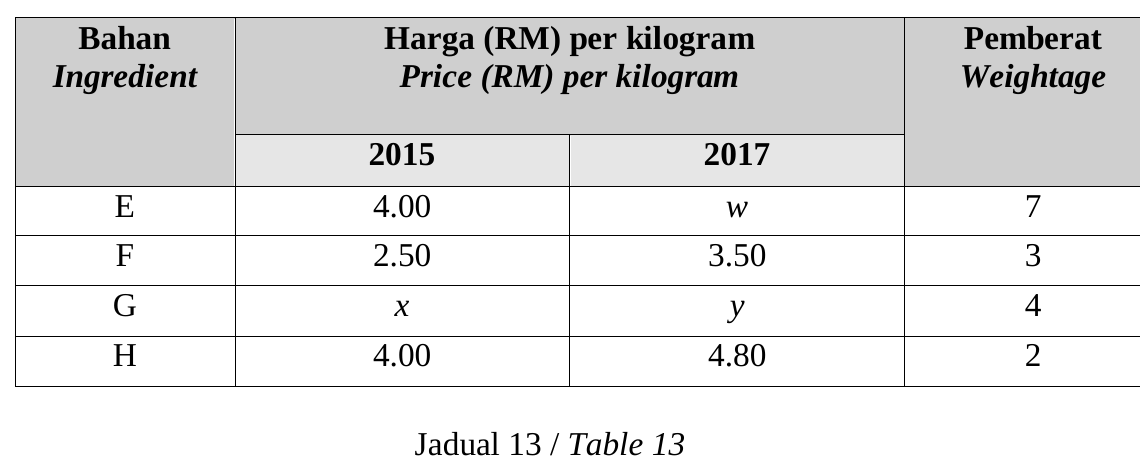
- (a)
Find the value of w.
[2] - (b)
Find the values of x and y.
[3] - (c)
Calculate the composite index for 2017 based on 2015.
[2] - (d)
Calculate the price of a bowl of the dessert in 2019 (2015 price RM15).
[3]
Diagram 14 shows two triangles RSP and QRP. RP is a straight line and ∠PQR is an acute angle (QR = 9 cm, RP = 15 cm, ∠QPR = 30°, RS = 8 cm, SP = 10 cm). (a) Calculate (i) ∠PQR, (ii) ∠RSP, (iii) the area, in cm², of the quadrilateral PQRS. (b) Sketch and label a new triangle P′Q′R′ of different shape from triangle PQR such that P′R′ = 15 cm, R′Q′ = 9 cm and ∠Q′P′R′ = 30°. Find the value of ∠P′Q′R′.
Medium10 marks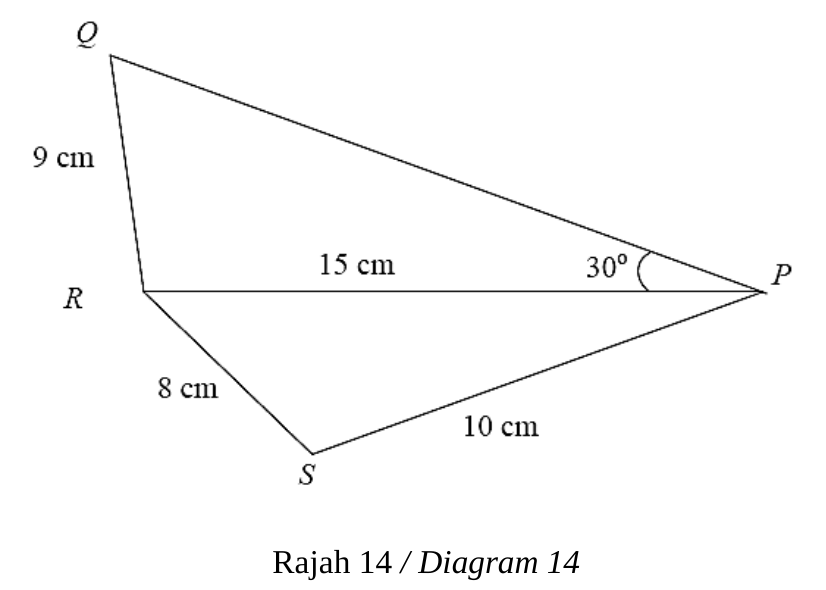
- (a)(i)
Calculate ∠PQR.
[2] - (a)(ii)
Calculate ∠RSP.
[2] - (a)(iii)
Calculate the area, in cm², of the quadrilateral PQRS.
[4] - (b)
Sketch and label triangle P′Q′R′ and find ∠P′Q′R′.
[2]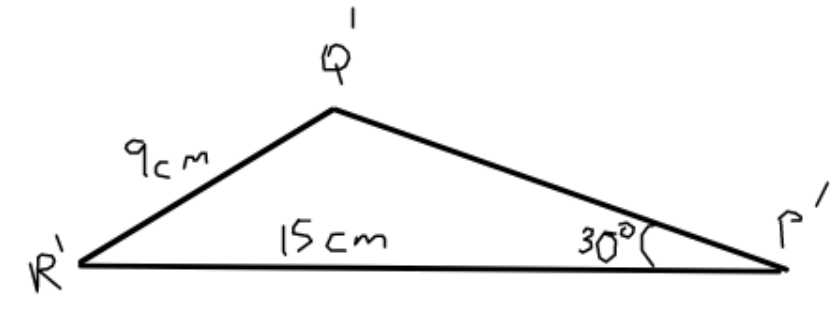
A book shop in a school plans to sell two types of calculator for the use of SPM students. The shop sells x units of calculator A and y units of calculator B, based on the following constraints: I The total number of calculators to sell is not more than 130. II The number of calculator A is at most twice the number of calculator B. III The number of calculator B exceeds the number of calculator A by not more than 80. (a) Write the three inequalities, other than x ≥ 0 and y ≥ 0, which satisfy all the above constraints. (b) Using a scale of 2 cm to 20 calculators on both axes, construct and shade the region R which satisfies all the above constraints. (c) Use the graph in (b) to find (i) the maximum number of calculator type A sold if 60 calculators type B are sold, (ii) the maximum profit obtained if the profit from the sale of one calculator A is RM3 and the profit from the sale of one calculator B is RM5.
Medium10 marks- (a)
Write the three inequalities, other than x ≥ 0 and y ≥ 0.
[3] - (b)
Construct and shade the region R (2 cm to 20 calculators on both axes).
[3]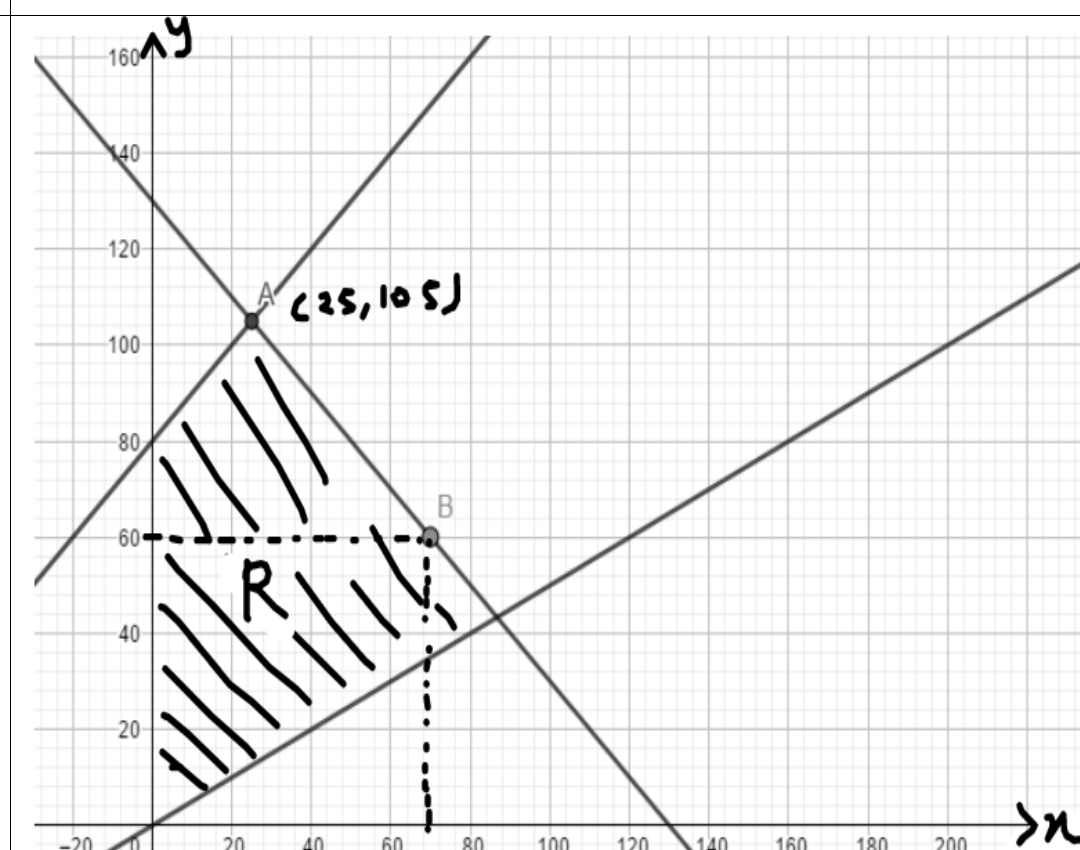
- (c)(i)
Maximum number of calculator A sold if 60 calculators B are sold.
[1] - (c)(ii)
Maximum profit (RM3 per calculator A, RM5 per calculator B).
[3]