Write your answer on paper. Then open the answer to check it.
Section A
Diagram 1 shows the relation between set P and set Q (arrow diagram: -1→1, 0→0, 1→1, 2→16; the arrows are labelled 'To the power of four'). (a) State (i) the range of the relation, (ii) the type of relation. (b) Given the function f : x → 9x − 2, find (i) the image of 4, (ii) the object of 16, (iii) f².
Medium6 marks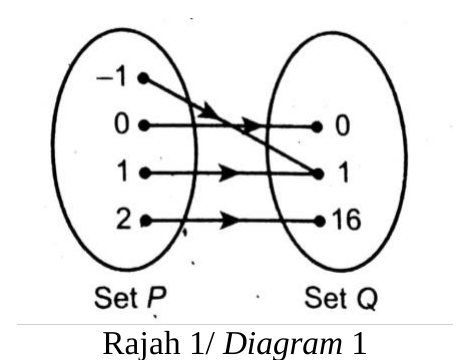
- (a)(i)
State the range of the relation.
[1] - (a)(ii)
State the type of relation.
[1] - (b)(i)
Find the image of 4.
[1] - (b)(ii)
Find the object of 16.
[1] - (b)(iii)
Find f².
[2]
Diagram 2 shows a graph of a quadratic function f(x) = −x² + mx − 11. The graph has a maximum point P(3, k) and intersects the y-axis at point Q. (a) State the coordinates of the point Q. (b) By using the method of completing the square, find the value of k and the value of m. (c) Determine the range of values of x if f(x) ≥ −18.
Easy5 marks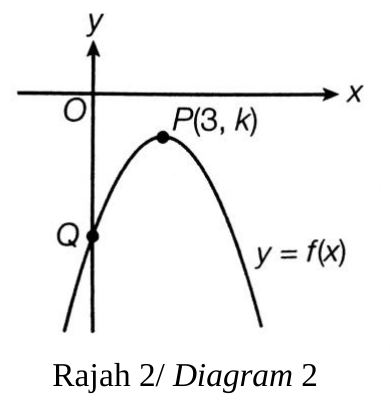
- (a)
State the coordinates of Q.
[1] - (b)
By completing the square, find k and m.
[4] - (c)
Determine the range of x for f(x) ≥ −18.
[0]
(a) Simplify 3/(√7 − 4). (b) Solve the equation log₂ x² + log₂ x = 3/4. Give your answer correct to four decimal places. (c) Given 2^(n−1) × 8ⁿ = 2048, find the value of n.
Medium7 marks- (a)
Simplify 3/(√7 − 4).
[2] - (b)
Solve log₂ x² + log₂ x = 3/4 (4 decimal places).
[3] - (c)
Given 2^(n−1) × 8ⁿ = 2048, find n.
[2]
The following sequence of numbers shows the number of people who received an injection of Covid-19 vaccine in a vaccination centre every day for a specified period: 1024, 1536, 2304, ..., 26244. Find the number of vaccine recipients during that period.
Medium5 marksFind the total number of recipients during the period.
[5]
Diagram 5 shows two pieces of square-shaped decorative tiles. Given that the sum of the perimeters of both tiles is 32 cm while the sum of the areas of both tiles is 34 cm², find the length of the sides of each tile.
Medium5 marks
Find the side length of each tile.
[5]
(a) Diagram 6 shows the graphs of two waves, Wave α f(x) = sin x and Wave β g(x) = cos 2x, for a continuous angle x. Find the values of x for 0° ≤ x ≤ 360° when both waves meet. (b) Given that tan(A − B) = 12/5 and tan A = 2/3, find tan B.
Easy5 marks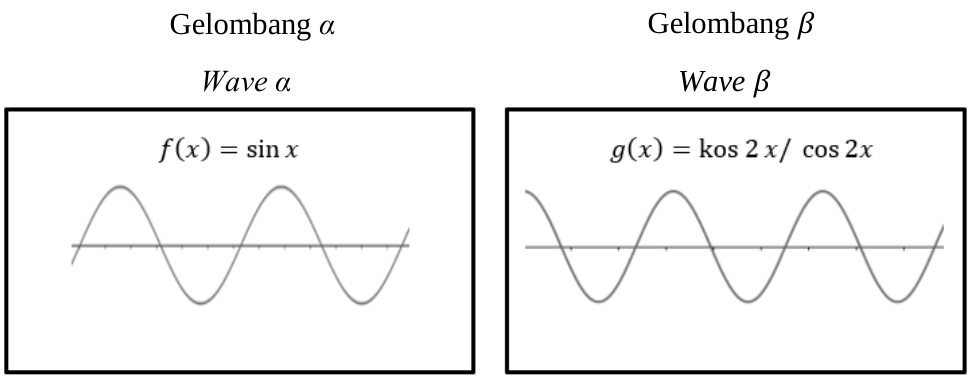
- (a)
Find x for 0° ≤ x ≤ 360° where sin x = cos 2x.
[3] - (b)
Find tan B.
[2]
Diagram 7 shows a straight line graph of log₃ y against log₃ x (the line passes through (1, 0) and (0, −2)). The variables x and y are related by the equation y = x^(2n)/k, where n and k are constants. Find the values of n and k.
Easy6 marks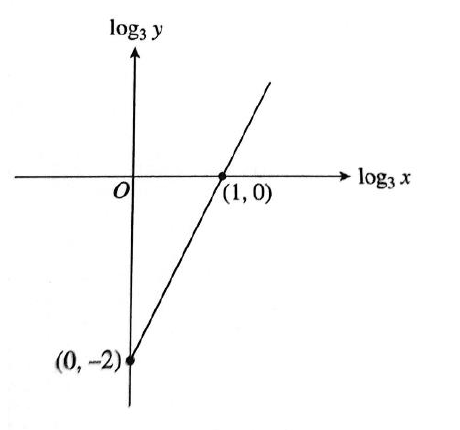
Find n and k.
[6]
It is given that m = (−12, 9) and n = (10, p + 2) (column vectors). (a) Find |m|. (b) Find the value of p such that m + n is parallel to the x-axis. (c) x and y are non-zero vectors and not parallel. Given (p + q − 3)x = (4 + q)y, where p and q are constants, find the values of p and q.
Easy6 marks- (a)
Find |m|.
[2] - (b)
Find p so that m + n is parallel to the x-axis.
[2] - (c)
Find p and q.
[2]
(a) Given lim(x→a) (√x − 3)/(x − 9) = 1/6, find the value(s) of a. (b) Find the value of dy/dx for y = 2/x − 1/x² when x = 4.
Medium6 marks- (a)
Find a.
[3] - (b)
Find dy/dx when x = 4.
[3]
Given ∫₃⁶ g(x) dx = 7/2, find (a) the value of ∫₆³ (1/4) g(x) dx, (b) the value of q such that ∫₃⁶ 2q dx = 16.
Easy4 marks- (a)
Find ∫₆³ (1/4) g(x) dx.
[2] - (b)
Find q such that ∫₃⁶ 2q dx = 16.
[2]
There are six boxes of different flavours of ice cream: avocado, chocolate, strawberry, mango, lemon and vanilla. A seller wants to arrange the ice creams in a freezer. (a) Find the number of different arrangements in one row, if he wants to arrange only three flavours of the ice creams. (b) If the strawberry, chocolate and lemon flavoured ice creams are displayed, find the number of different mixed flavours of ice creams that can be chosen by a buyer.
Easy4 marks- (a)
Number of arrangements of 3 flavours in a row.
[2] - (b)
Number of different mixed flavours from the 3 displayed.
[2]
In Diagram 12, the point N(0, −3) divides the line segment PQ in the ratio 2:1. The coordinates of point P are (−4, −6). The coordinates of point C are (−1, 2). CD is parallel to PQ. (a) Find the coordinates of point Q. (b) Find the equation of the straight line CD. (c) Point K(x, y) moves such that the distance of K from point Q is always the same as the distance NQ. (i) Describe the locus of the moving point K. (ii) Hence, find the equation of the locus of K.
Medium7 marks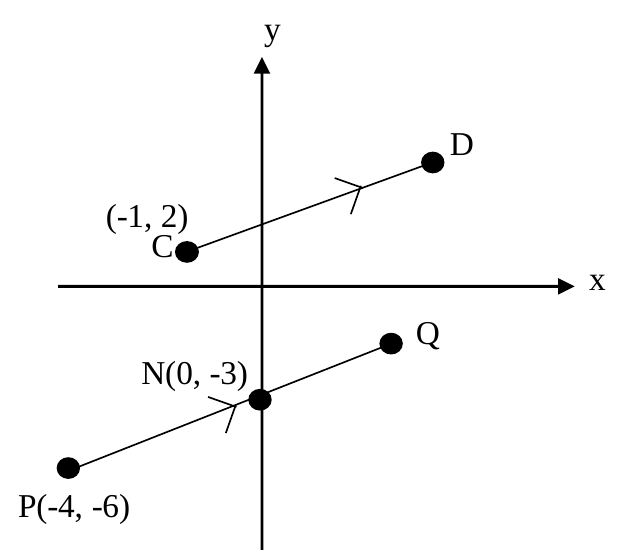
- (a)
Find the coordinates of Q.
[2] - (b)
Find the equation of the straight line CD.
[2] - (c)(i)
Describe the locus of K.
[1] - (c)(ii)
Find the equation of the locus of K.
[2]
(a) A piece of wire is bent to form a sector of a circle with centre O and of radius 6 cm. If the area of the sector is 18 cm², find the length, in cm, of the wire. (b) Diagram 13 shows AB and CD are two arcs of two circles that have the same centre, O. Given that the length of the arcs AB and CD are 13.1 cm and 23.6 cm respectively, and the radius of the small circle is 6 cm, find the perimeter, in cm, of the shaded region ABCD.
Medium8 marks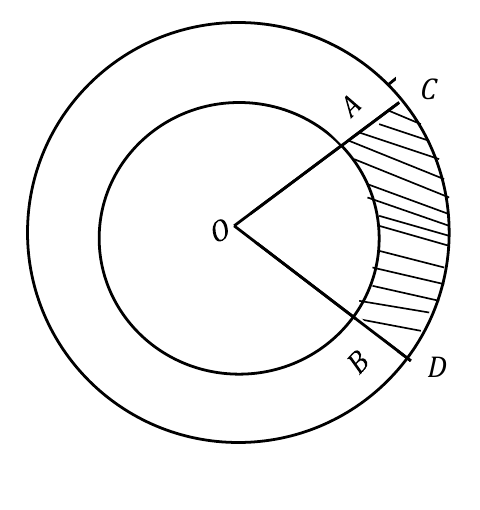
- (a)
Find the length of the wire.
[4] - (b)
Find the perimeter of the shaded region ABCD.
[4]
(a) In a survey carried out in a particular district, it is found that three out of five families own a national car. If 10 families are chosen at random from the district, calculate the probability that at least 8 families own a national car. (b) The masses of students in a school have a normal distribution with a mean of 54 kg and a standard deviation of 12 kg. Find (i) the mass of the student which gives a standard score of 0.5, (ii) the percentage of students with a mass of greater than 48 kg.
Medium8 marks- (a)
Probability that at least 8 of 10 families own a national car.
[4] - (b)(i)
Mass of a student with standard score 0.5.
[2] - (b)(ii)
Percentage of students heavier than 48 kg.
[2]
(a) A curve y = f(x) is such that dy/dx = 3kx + 5, where k is a constant. The gradient of the curve at x = 2 is 9. Find the value of k. (b) The gradient of the tangent to the curve y = x²(2 + px) at x = −2 is 7. Find the value of p. (c) Find ∫₄^a (x + 4) dx, in terms of a.
Easy8 marks- (a)
Find k.
[2] - (b)
Find p.
[3] - (c)
Find ∫₄^a (x + 4) dx in terms of a.
[3]