Write your answer on paper. Then open the answer to check it.
Section A
The function g is defined as g: x → (x² − 1)/2 for 0 ≤ x ≤ 3. (a) On the same plane, sketch the graph of function g and g⁻¹. (b) Using the horizontal line test, explain why g⁻¹ exists. (c) Find (i) g⁻¹, (ii) the domain and range of g⁻¹.
Medium7 marks- (a)
Sketch the graphs of g and g⁻¹ on the same plane.
[2]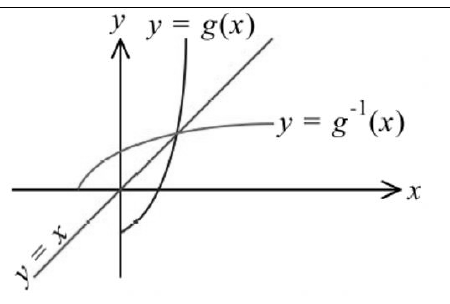
- (b)
Using the horizontal line test, explain why g⁻¹ exists.
[2] - (c)(i)
Find g⁻¹(x).
[1] - (c)(ii)
State the domain and range of g⁻¹.
[2]
Express x² − 3x + 5 in the form a(x − b)² + c, where a, b and c are constants. Hence, state (a) the minimum value of x² − 3x + 5, (b) the value of x at which the minimum value occurs, (c) sketch the curve of x² − 3x + 5.
Easy8 marks- Express
Express x² − 3x + 5 in the form a(x − b)² + c.
[2] - (a)
State the minimum value.
[1] - (b)
State the value of x at the minimum.
[1] - (c)
Sketch the curve of x² − 3x + 5.
[4]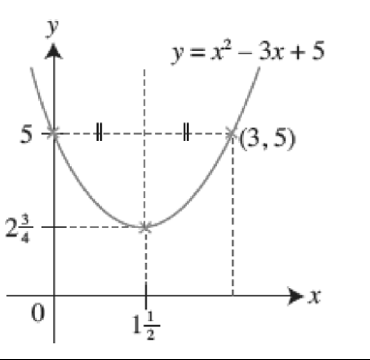
A chicken farmer has 3000 chickens. Starting the next day, he sells 25 chickens a day. Calculate (a) on what day there are 2000 chickens (the wording: 'On what day are 2000 chickens sold' / 'Pada hari keberapakah terdapat 2000 ekor ayam yang dijual'), (b) the total income of the breeder up to the day there are 2000 unsold chickens if he spends 15 sen on food for each chicken per day.
Medium7 marks- (a)
On what day are there 2000 chickens?
[3] - (b)
Find the total up to that day, with 15 sen food cost per chicken per day.
[4]
An automobile company has an assembly factory in town A, B and C to assemble three types of car, P, Q and R. Table 1 shows the number of cars of each model assembled in each factory every day: Town A: P 10, Q 20, R 5; Town B: P 20, Q 15, R 35; Town C: P 40, Q 45, R 30. The company has received orders for 640 cars of model P, 750 of model Q and 650 of model R. How many days will each assembly factory need to fulfil the orders? Assume all factories operate every day.
Medium6 marks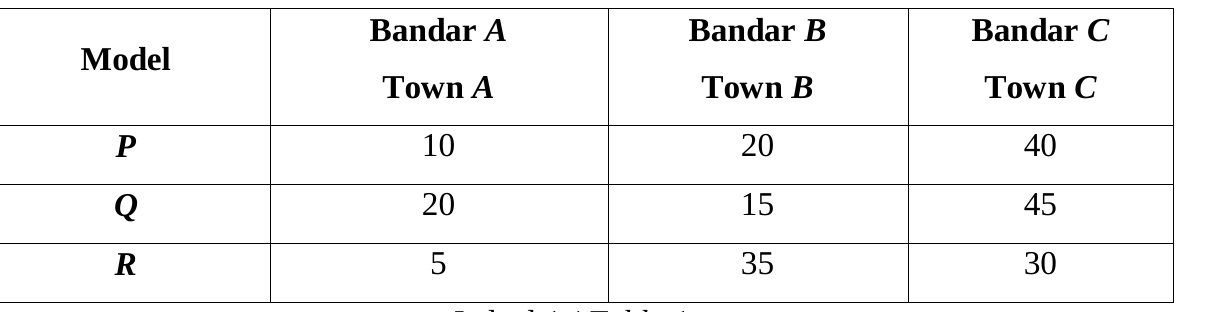
Find the number of days each factory needs.
[6]
(a) Solve the equation 8^(log₂ u) = 125. (b) A right-angled triangle has a base of (2√3 + 1) m and height h m. If the area of the triangle is ½(9√3 − 1) m², find the value of h. Give your answer in the form a + b√3, where a and b are constants.
Medium7 marks- (a)
Solve 8^(log₂ u) = 125.
[3] - (b)
Find h in the form a + b√3.
[4]
The information refers to Diagram 1: OA = 4a, OB = 8b (vectors), AP = α AN, OA = 2MA, ON : OB = 5 : 8 (M is on OA, N is on OB, P is the intersection of AN and MB). (a) Express (i) MB in terms of a and b, (ii) AP in terms of α, a and b, (iii) MP in terms of α, a and b. (b) Given M, P and B are collinear, find the value of α.
Medium8 marks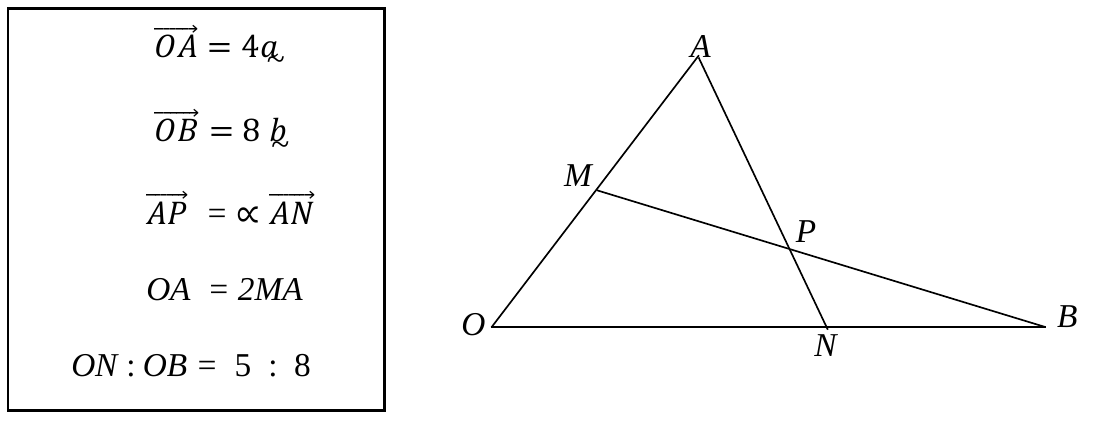
- (a)(i)
Express MB in terms of a and b.
[2] - (a)(ii)
Express AP in terms of α, a and b.
[2] - (a)(iii)
Express MP in terms of α, a and b.
[1] - (b)
Find α given M, P, B are collinear.
[3]
(a) Find the equation of the straight line that passes through the point (−1, 5) and is perpendicular to the straight line that joins point (2, −6) and point (3, 8). (b) Solution to this question by scale drawing will not be accepted. Diagram 2 shows the triangle AOB where O is the origin and C lies on the straight line AB; A(−3, 4), B(6, −2). Calculate the area, in unit², of triangle AOB. (c) Given that AC : CB = 3 : 2, find the coordinates of C.
Medium7 marks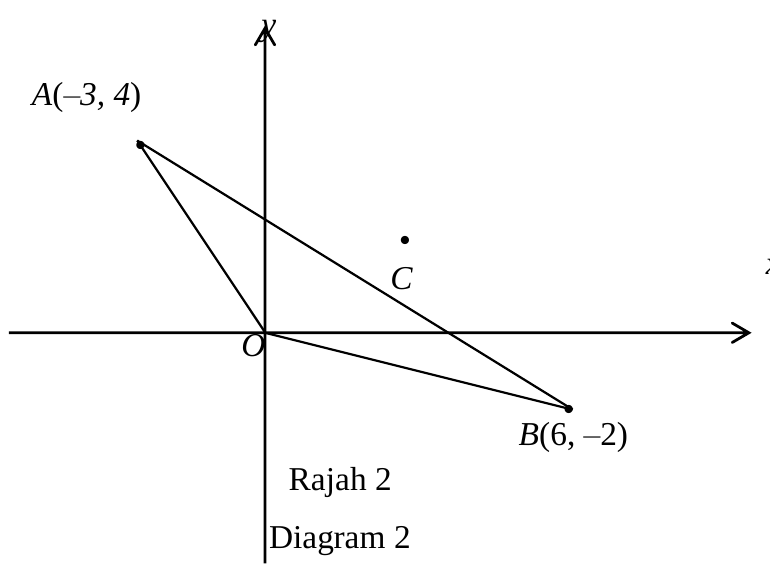
- (a)
Find the equation of the line through (−1, 5) perpendicular to the line joining (2, −6) and (3, 8).
[3] - (b)
Calculate the area of triangle AOB.
[2] - (c)
Find the coordinates of C given AC : CB = 3 : 2.
[2]
Section B
Diagram 3 shows the straight line y = x + 4 intersecting the curve y = (x − 2)² at the points A and B. Find (i) the value of k, (ii) the area of the shaded region P, (iii) the volume generated, in terms of π, when the shaded region Q is revolved 360° about the x-axis.
Medium10 marks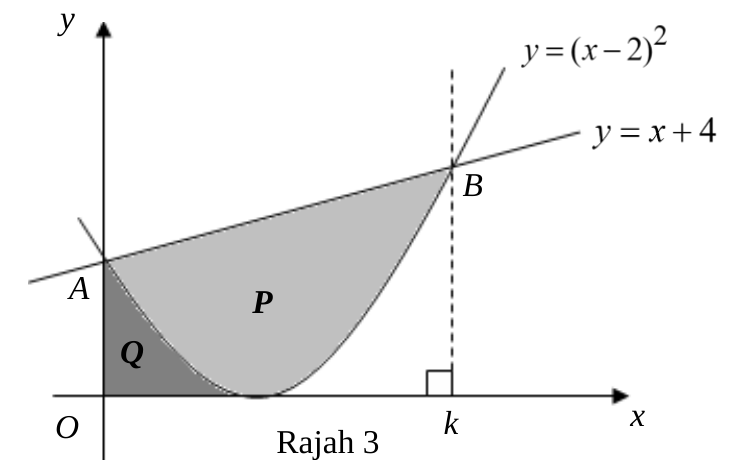
- (i)
Find the value of k.
[3] - (ii)
Find the area of the shaded region P.
[4] - (iii)
Find the volume generated when Q is revolved about the x-axis.
[3]
(a) Prove the identity sin (90° + A) = cos A. (b) Sketch the graph y = 3 cos 2x + 2 for 0 < x < π. Then, determine the number of solutions for the trigonometric equation 3x cos 2x = π − 2x. (c) Find the values of x that range from 0° to 360° that satisfy the equation sin 2x + cos x = 0.
Medium10 marks- (a)
Prove sin (90° + A) = cos A.
[2] - (b)
Sketch y = 3 cos 2x + 2 for 0 < x < π and find the number of solutions of 3x cos 2x = π − 2x.
[5]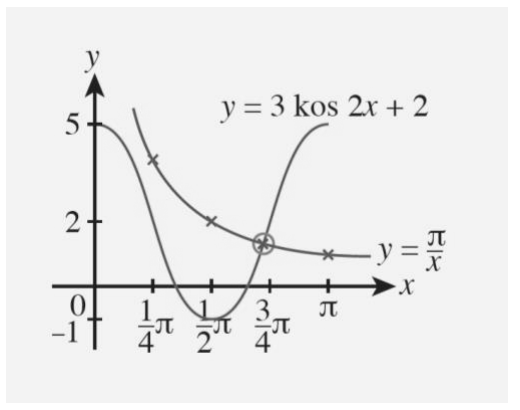
- (c)
Solve sin 2x + cos x = 0 for 0° ≤ x ≤ 360°.
[3]
(a) Senior citizens make up 20% of the population of a settlement. 10 people are randomly selected from the settlement. It is given that the variance of the senior citizens is 130. Find (i) the probability that at least two of them are senior citizens, (ii) the population of the settlement. (b) The masses of durians from a farm have a normal distribution with a mean of 2.2 kg and a standard deviation of 0.9 kg. Calculate (i) the probability that a durian chosen at random from this farm has a mass of more than 1.2 kg, (ii) the value of m if 87% of the durians have masses less than m kg.
Medium10 marks- (a)(i)
Probability that at least two of the 10 are senior citizens.
[3] - (a)(ii)
Find the population of the settlement.
[2] - (b)(i)
P(mass more than 1.2 kg).
[2] - (b)(ii)
Find m if 87% of durians have mass less than m kg.
[3]
Use graph paper to answer this question. Table 2 shows the values of variables x and y, obtained from an experiment: x = 2, 3, 4, 5, 6, 7 and y = 12.7, 21.3, 30.9, 42.5, 55.6, 69.9. The variables x and y are related by the equation y = 4px² + (p/q)x, where p and q are constants. (a) Construct a table for the values of x and y/x. (b) Using a scale of 2 cm to 1 unit on the x-axis and 2 cm to 1 unit on the (y/x)-axis, plot a graph of y/x against x. Hence draw the line of best fit. (c) Use the graph from (b) to find the value of (i) y when x = 3.3, (ii) p, (iii) q.
Medium10 marks- (a)
Construct a table of x and y/x.
[1]
- (b)
Plot y/x against x and draw the line of best fit.
[3]
- (c)(i)
Find y when x = 3.3.
[2] - (c)(ii)
Find p.
[2] - (c)(iii)
Find q.
[2]
Section C
A particle moves in a straight line and passes through a fixed point O. The velocity of the particle, v m s⁻¹, is given by v = 8 + 2t − t², where t is the time in s, after leaving O. Find (a) the initial velocity, in m s⁻¹, of the particle, (b) the maximum velocity, in cm s⁻¹, of the particle, (c) the acceleration when the particle reverses its direction, (d) the total distance travelled during the first 5 seconds after leaving O.
Medium10 marks- (a)
Find the initial velocity.
[1] - (b)
Find the maximum velocity in cm s⁻¹.
[3] - (c)
Find the acceleration when the particle reverses its direction.
[3] - (d)
Find the total distance in the first 5 seconds.
[3]
Four major ingredients, P, Q, R and S are required to make a particular kind of fast food. Table 3 shows the prices (RM) of the ingredients in 2020 and 2021: P 1.60, x; Q 0.90, 1.26; R y, z; S 0.40, 0.60. (a) The price index of ingredient P in the year 2021 based on the year 2020 is 125. Calculate the value of x. (b) The price index of ingredient R in 2021 based on 2020 is 120. Its price in 2021 is RM0.22 higher than its price in 2020. Calculate the values of y and z. (c) The composite index for the cost of producing the food in 2021 based on 2020 is 140. Calculate (i) the price of one set of fast food in 2020 if its price in 2021 is RM7.70, (ii) the value of k if the quantities required for P, Q, R and S are in the ratio 2 : 2 : 1 : k.
Medium10 marks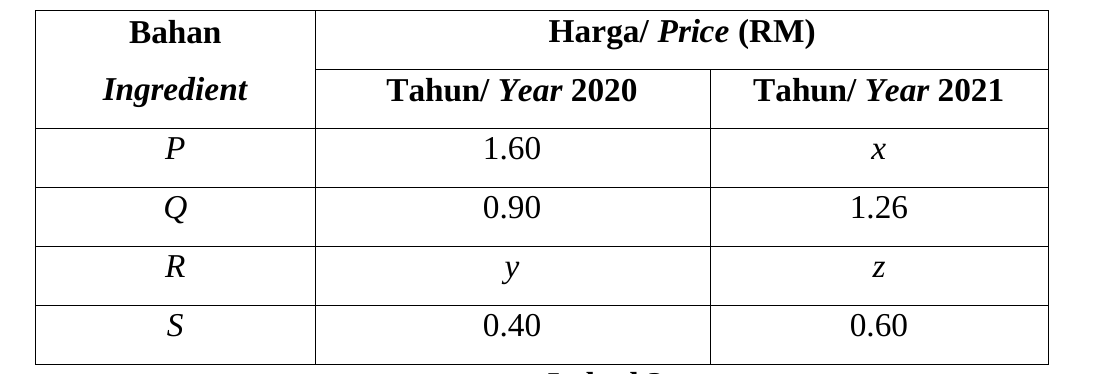
- (a)
Find x.
[2] - (b)
Find y and z.
[3] - (c)(i)
Price of one set in 2020.
[2] - (c)(ii)
Find k.
[3]
Diagram 5 shows a piece of land in the shape of triangle ABC, divided into three parts. ADB, BFC and AEGH are straight lines. In the diagram AD = 0.13 km, DB = 0.07 km, AE = 0.06 km and the distance from E to C is 0.24 km. Given sin ∠BAC = 12/13. [Use π = 3.142] (a) Calculate ∠DAE in radian. (b) If a fence is to be built along BC, calculate the length of the fence needed. (c) Given the area of ΔFGC is equal to the area of ΔADE, calculate the length of EG if the length of FC is 0.09 km.
Medium10 marks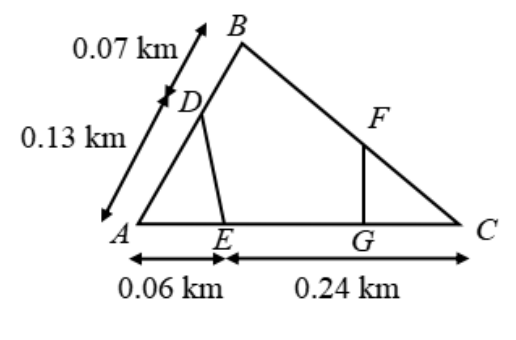
- (a)
Calculate ∠DAE in radians.
[3] - (b)
Length of the fence along BC.
[2] - (c)
Find EG given area FGC = area ADE and FC = 0.09 km.
[5]
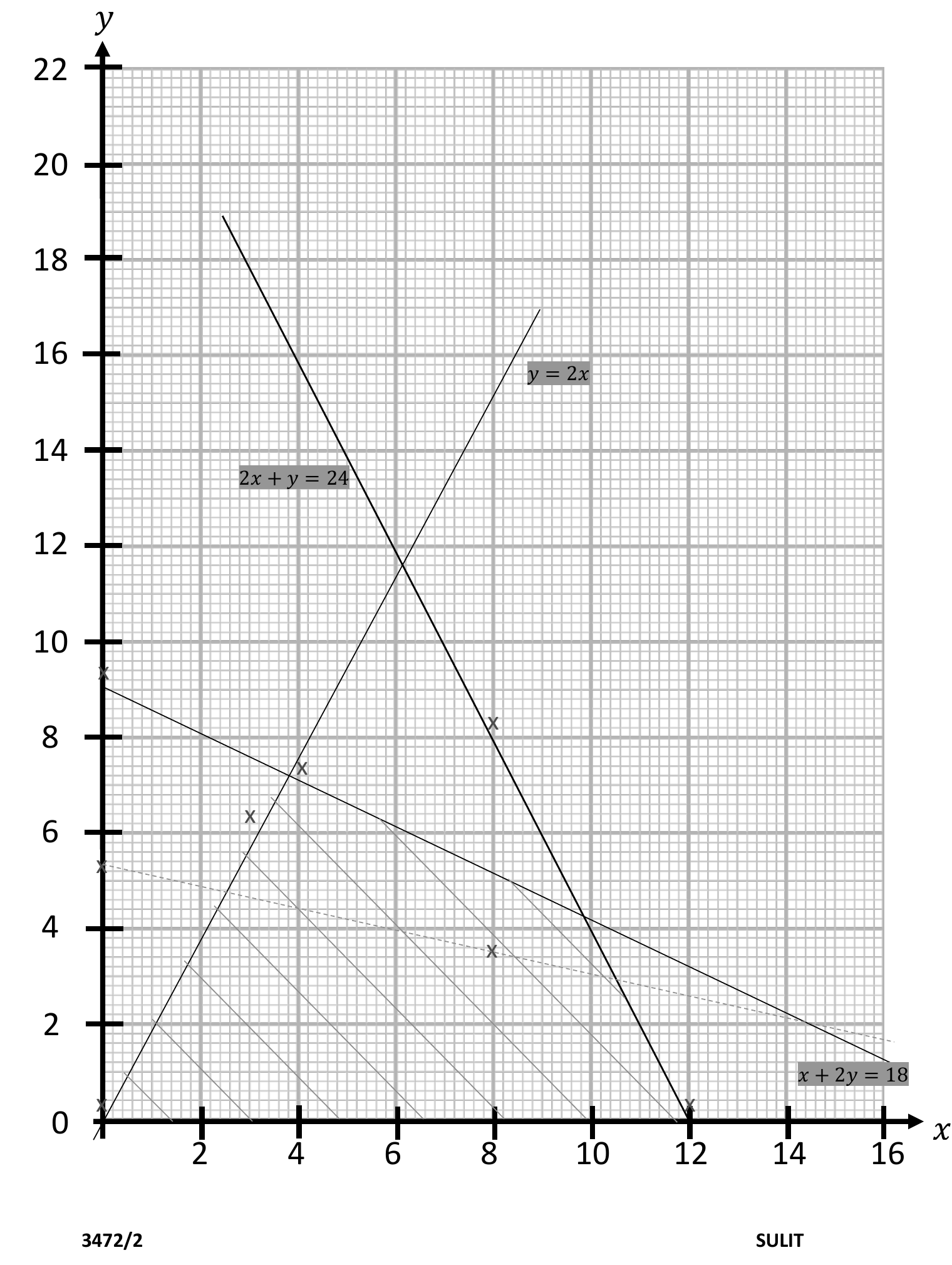
Use graph paper to answer this question. A painter produces two types of drawings, H and K. A drawing H takes 1 hour to draw and 20 minutes to colour. A drawing K takes 30 minutes to draw and 40 minutes to colour. In a day, the painter can produce x drawings H and y drawings K with the following conditions: I: the maximum total time to draw is 12 hours; II: the total time for colouring is at most 6 hours; III: the ratio of the number of drawings K to drawings H produced is not more than 2 : 1. (a) Write down three inequalities, other than x ≥ 0 and y ≥ 0, which satisfy all the above constraints. (b) Using a scale of 2 cm to 2 units on both axes, construct and shade the region R that satisfies all the above constraints. (c) Use your graph in (b) to answer: (i) Find the number of drawings K produced if 2 drawings H are produced on a given day, (ii) by selling the drawings, the painter earns a profit of RM20 for each drawing H and RM16 for each drawing K. What is the maximum profit the painter gets?
Medium10 marks- (a)
Write three inequalities.
[3] - (b)
Construct and shade the region R.
[3]
- (c)(i)
Number of drawings K when 2 drawings H are produced.
[1] - (c)(ii)
Maximum profit.
[3]