Write your answer on paper. Then open the answer to check it.
Section A
Given that (2k, 3p) is a solution of the simultaneous equations x − 2y = 8 and 2/x + 3/(2y) = 1/2. Find the value of k and the value of p.
Easy5 marksFind the value of k and the value of p.
[5]
Diagram 2 shows a cross section of a cylindrical fuel barrel with diameter of 60 cm, floating on the water. The straight line AB is the water surface level and the highest point P is 6 cm above the water surface. [Use π = 3.142] (a) Find the minor angle of AOB, in radians. (b) Hence, find (i) the arc length, in cm, above the water surface, (ii) the cross section area, in cm², under the water surface.
Medium8 marks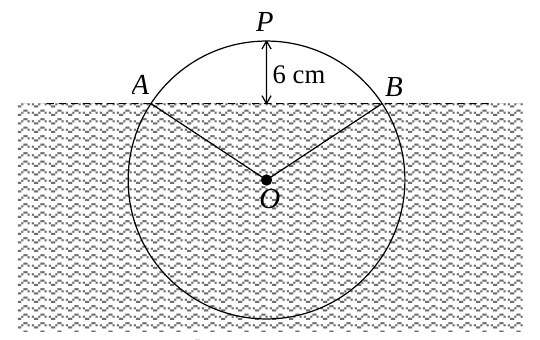
- (a)
Find the minor angle AOB, in radians.
[2] - (b)(i)
Find the arc length, in cm, above the water surface.
[2] - (b)(ii)
Find the cross section area, in cm², under the water surface.
[4]
(a) Diagram 3(a) shows a part of the graph y = (5/3) cos 3x. State the value of h and k. (b)(i) Given that A, B and C are the interior angles of an acute-angled triangle. Show that tan C = (tan A + tan B)/(tan A tan B − 1). (ii) If tan B = 3 and tan C = 2 tan A, find the value of A.
Medium7 marks- (a)
State the value of h and k (h = minimum value on the y-axis; k = the second x-intercept).
[2]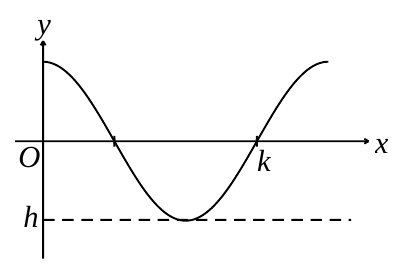
- (b)(i)
Show that tan C = (tan A + tan B)/(tan A tan B − 1).
[3] - (b)(ii)
If tan B = 3 and tan C = 2 tan A, find A.
[2]
Diagram 4 shows a sketch of a mini garden plan, a triangle PQR with P(8, 6), Q on the x-axis and R on the lines 5y − x = 22 and y − 2x = 8. A rocky path runs along PQ. (a) The rocky path is extended to point S such that PQ : PS = 2 : 3. Find the end point of the rocky path. (b) A lamp pole is installed at R. Find (i) the coordinates of R, (ii) the area of mini garden PQR.
Medium7 marks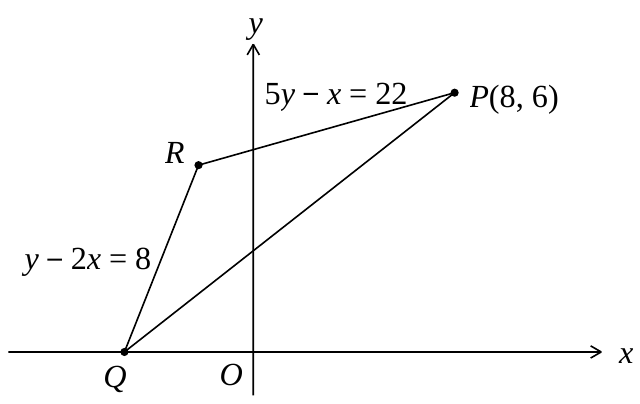
- (a)
Extend PQ to S such that PQ : PS = 2 : 3. Find S.
[3] - (b)(i)
Find the coordinates of R.
[2] - (b)(ii)
Find the area of PQR.
[2]
A ribbon with length of 176 cm has been cut into 20 parts with the length of each part forming an ascending arithmetic progression. Given the total length of the shortest five parts is 14 cm. Find (a) the common difference, (b) the shortest part of the ribbon, (c) the longest part of the ribbon.
Medium7 marks- (a)
Find the common difference.
[3] - (b)
Find the shortest part of the ribbon.
[2] - (c)
Find the longest part of the ribbon.
[2]
Given that p(x) = 2x − 1 and q(x) = 5 − 2x. (a) Find (i) the value of k if p(k − 2) = (1/3)[q(2)], (ii) qp(x). (b) Hence, sketch the graph f(x) = |qp(x)| for −2 ≤ x ≤ 3. Given the range of f(x) is m ≤ f(x) ≤ n with the corresponding domain. Find the value of m and n.
Medium7 marks- (a)(i)
Find k if p(k − 2) = (1/3)[q(2)].
[2] - (a)(ii)
Find qp(x).
[1] - (b)
Sketch f(x) = |qp(x)| for −2 ≤ x ≤ 3; find m and n.
[4]
(a) Given that y = mx + 5/8 is the tangent to the curve y = (4 + 3x)/(6 + 6x) at point P(1, k), such that m and k are constants. (i) Find the value of m. (ii) Hence find the equation of the normal at point P. (b) There is a small change in the radius of a spherical balloon, which increases by p% from its previous radius of 10 cm. By using the method of differentiation, find the corresponding percentage change in its surface area, in terms of p.
Medium8 marks- (a)(i)
Find the value of m.
[2] - (a)(ii)
Hence find the equation of the normal at P.
[2] - (b)
Radius 10 cm increases by p%. Find the percentage change in surface area, in terms of p.
[4]
Section B
Use graph paper to answer this question. Table 8 shows the values of displacement, s metre and time, t seconds of a moving particle, obtained from an experiment. Given s and t are related by the equation s = ut + ½at² where u and a are the initial velocity and acceleration of the particle respectively. A pair of data is misrecorded because of a mistake. Table 8: t (s): 20, 50, 80, 110, 140, 150; s (m): 6, 22.5, 48, x, 126, 142.5. (a) Plot s/t against t, using a scale of 2 cm to 20 units on the t-axis and 2 cm to 0.1 unit on the s/t-axis. Hence, draw the line of best fit. (b) Mark ⊗ on the graph to represent the exact point of the misrecorded data. (c) Use the graph from (a) to find the value of (i) initial velocity, (ii) acceleration, (iii) x.
Medium10 marks

- (a)
Plot s/t against t and draw the line of best fit.
[4] - (b)
Mark ⊗ for the misrecorded point.
[1]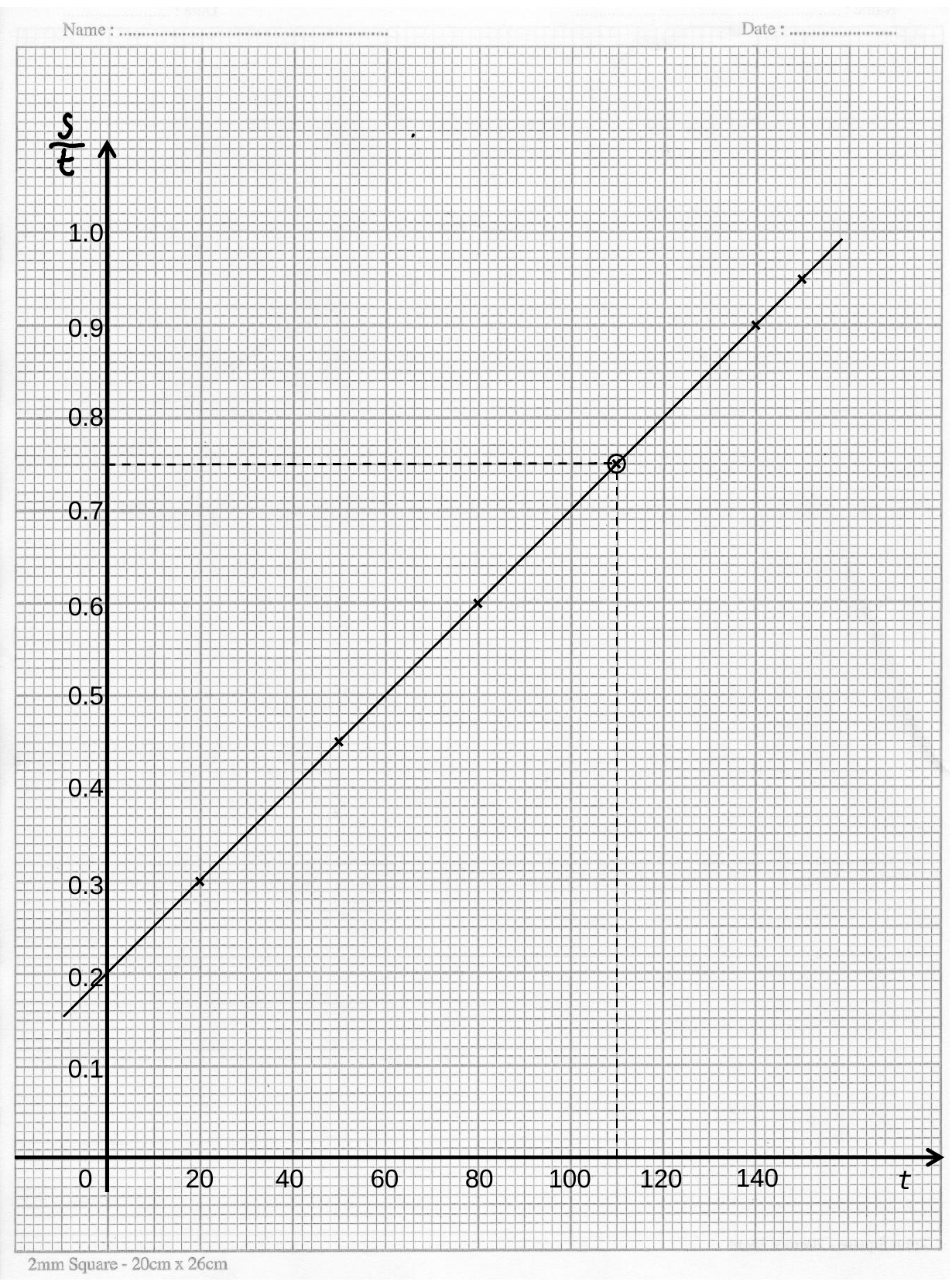
- (c)(i)
Find the initial velocity.
[2] - (c)(ii)
Find the acceleration.
[2] - (c)(iii)
Find x.
[1]
(a) Diagram 9(a) shows the curve y = x² − 6x + 16 and the curve y = 6x − x² intersect at points A and B. Find (i) the coordinates of the points A and B, (ii) the area bounded by the curve y = x² − 6x + 16 and the curve y = 6x − x². (b) Diagram 9(b) shows part of a curve y = √(x + 6), the straight line x = k, and the straight line AC (A on the x-axis at x = 3, C on the curve above A). When the shaded region is revolved 360° about the x-axis, the volume generated is 42½π unit³. Find the value of k.
Medium10 marks- (a)(i)
Find the coordinates of A and B.
[2]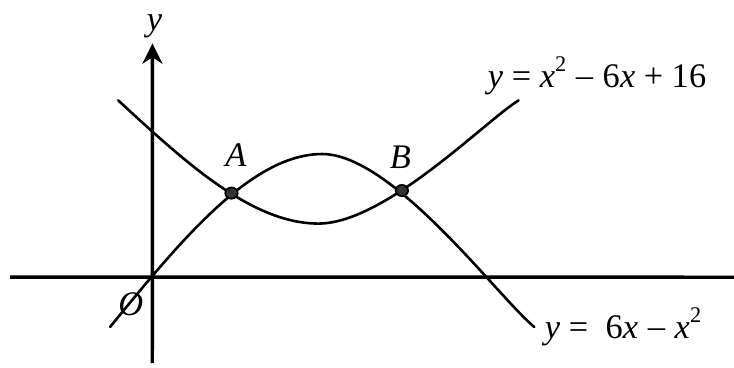
- (a)(ii)
Find the area bounded by the two curves.
[3] - (b)
Revolved 360° about the x-axis, the volume is 42½π. Find k.
[5]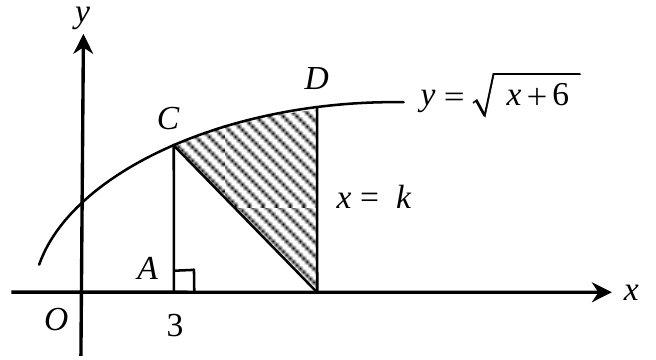
Solution by scale drawing is not accepted. Diagram 10 shows the position vectors of two boats, A and B, relative to the fixed point O, which are −2i + 8j and −qi − 2j respectively. Boat A moves with a velocity of (4i + pj) m min⁻¹ and boat B moves with a velocity of (3i − j) m min⁻¹ at the same time. (a) Given boat A moves with a speed of 5 m min⁻¹, find the value of p where p < 0. (b) Find the direction of boat A that moves with a velocity of (4i + pj) m min⁻¹, correct to the nearest degree. (c) Find the time taken in minutes, when boat A meets boat B. Hence, find the position vector where the two boats meet.
Hard10 marks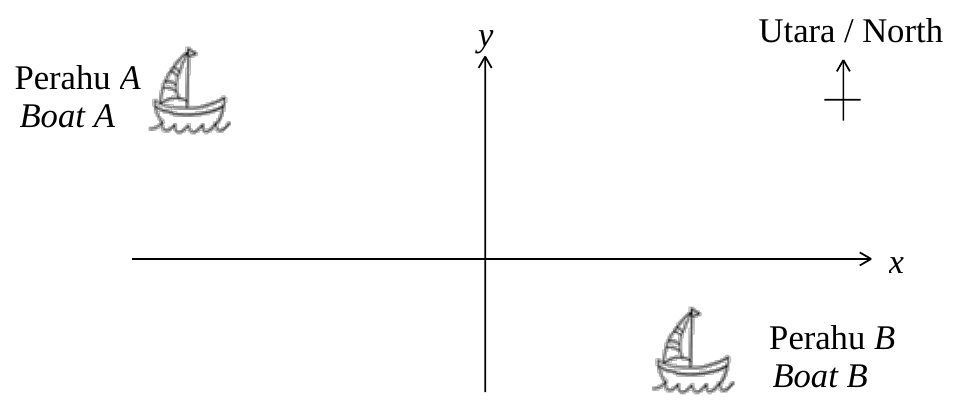
- (a)
Boat A has speed 5 m min⁻¹; find p (p < 0).
[2] - (b)
Find the direction of boat A, to the nearest degree.
[3] - (c)
Find the time when A meets B and the position vector of the meeting point.
[5]
(a) The probability of Aziz winning an archery competition is 0.25. The games are played n times. The probability he wins exactly 4 games is three times the probability he wins exactly 3 games. (i) Find the value of n. (ii) Calculate the variance for the number of games Aziz loses. (b) In a town, the height of women is normally distributed with mean 165 cm and standard deviation 11.7 cm. Find (i) the probability that the height of a woman selected at random is less than 150 cm, (ii) the height of the tallest woman among the tallest 10% of the women (the height k such that 10% of the women are taller).
Medium10 marks- (a)(i)
Find n if P(X = 4) = 3 P(X = 3).
[3] - (a)(ii)
Calculate the variance for the number of games Aziz loses.
[2] - (b)(i)
Find P(height < 150 cm).
[2] - (b)(ii)
Find the height of the tallest woman among the 10 (top 10%).
[3]
Section C
Diagram 12 shows three points, A, B and C lie on a plane to form a triangle. Given that the point A is due west of the point B, AB = 14 m, AC = 18 m, and the bearing of the point C from the point A is 126°. Find (a)(i) the length, in m, of BC, (ii) the angle ACB. (b) The bearing of point D from point A is the same as the bearing of point C from point A, and BD = BC. (i) Sketch the triangle ABD, and state the angle ADB. (ii) Hence, find the area of triangle ABD.
Medium10 marks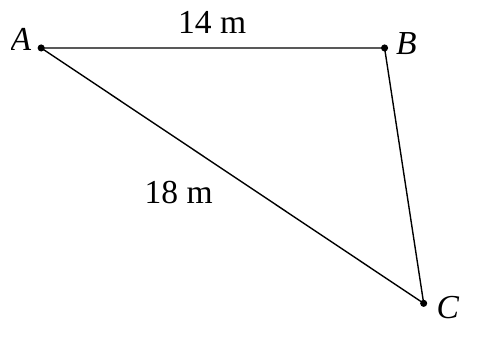
- (a)(i)
Find the length of BC, in m.
[3] - (a)(ii)
Find angle ACB.
[2] - (b)(i)
Sketch triangle ABD and state angle ADB.
[2] - (b)(ii)
Find the area of triangle ABD.
[3]
Use the graph provided to answer this question. An entrepreneur wants to produce two types of shoes, L and S by using a machine. In a day, the machine produces x units of type L shoes and y units of type S shoes. The time required to produce a type L shoe is 6 minutes and the time required to produce a type S shoe is 5 minutes. The production of shoes is based on the following constraints: I: The total number of shoes produced must be more than 40 units in a day. II: The machine can operate for only 15 hours a day. III: The ratio of the number of type L shoes to the number of type S shoes is at most 3 : 5. (a) Write three inequalities, other than x ≥ 0 and y ≥ 0, which satisfy all the above constraints. (b) Using a scale of 2 cm to 20 shoes on both axes, construct and shade the region R which satisfies all the above constraints on the graph paper provided. (c) Using the graph constructed in (b), find the range of total sales that can be obtained if the selling price of a type L shoe is RM5 and the selling price of a type S shoe is RM3.
Medium10 marks
- (a)
Write three inequalities for the constraints.
[3] - (b)
Construct and shade region R on the graph paper.
[3]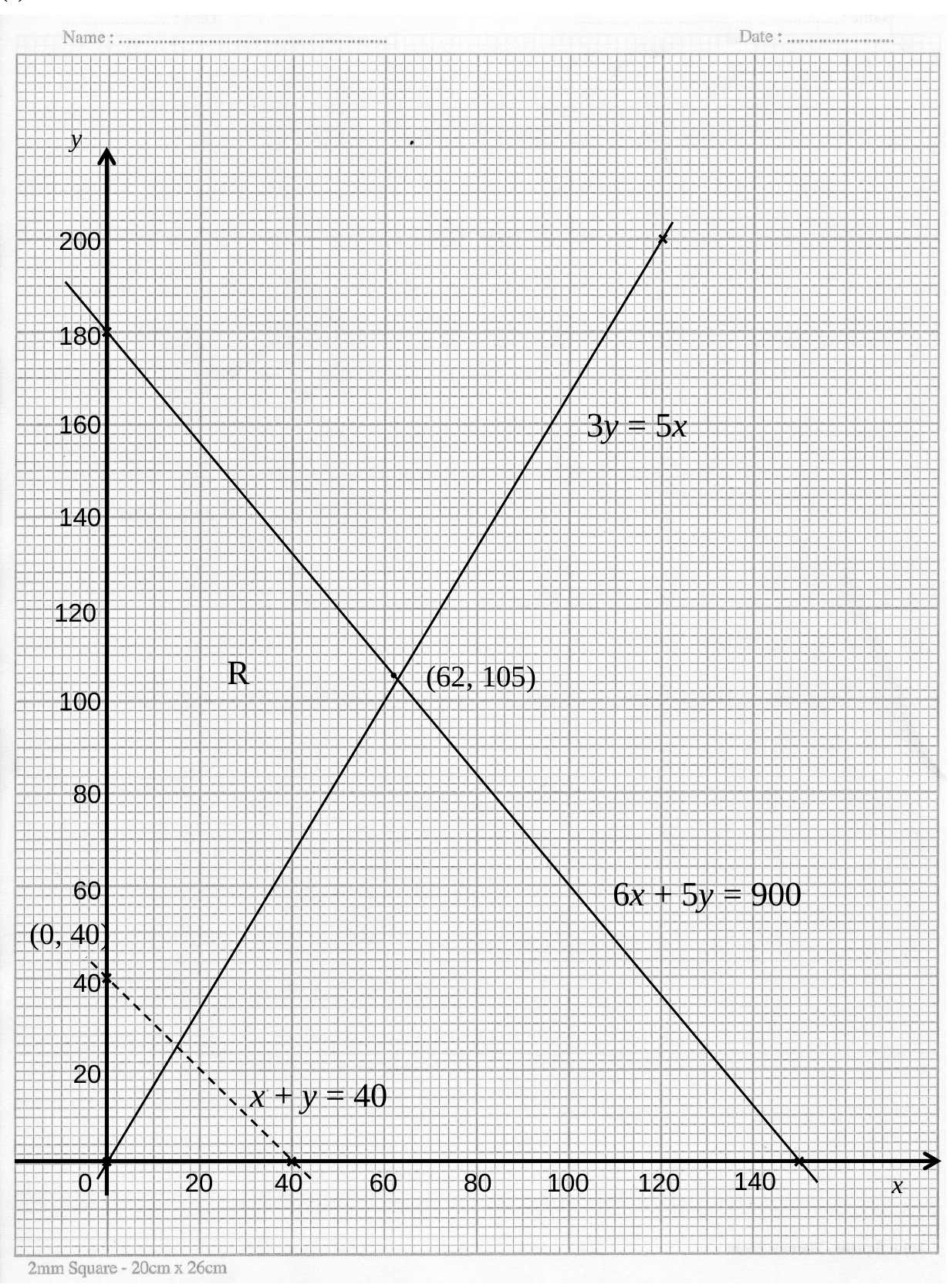
- (c)
Find the range of total sales (L at RM5, S at RM3).
[4]
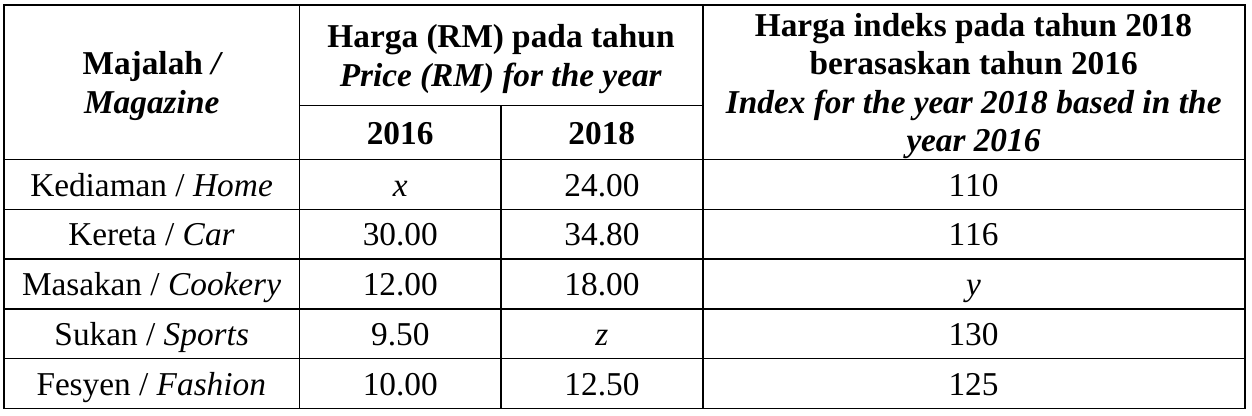
Diagram 14 shows a bar chart representing the quantities of five types of magazines sold in a bookstore: Home 230, Car 520, Cookery 380, Sports 670, Fashion 200. Table 14 (Price RM in 2016, 2018; Index for 2018 based on 2016): Home x, 24.00, 110; Car 30.00, 34.80, 116; Cookery 12.00, 18.00, y; Sports 9.50, z, 130; Fashion 10.00, 12.50, 125. (a) Find the values of x, y and z. (b)(i) Calculate the composite index for the prices of the magazines in the year 2018 based on the year 2016. (ii) The total sales of the magazines in the year 2016 is RM50 000. Calculate the corresponding sales in the year 2018. (c) The prices of the magazines increase by 10% from the year 2018 to the year 2020. Calculate the composite index in the year 2020 based on the year 2016.
Medium10 marks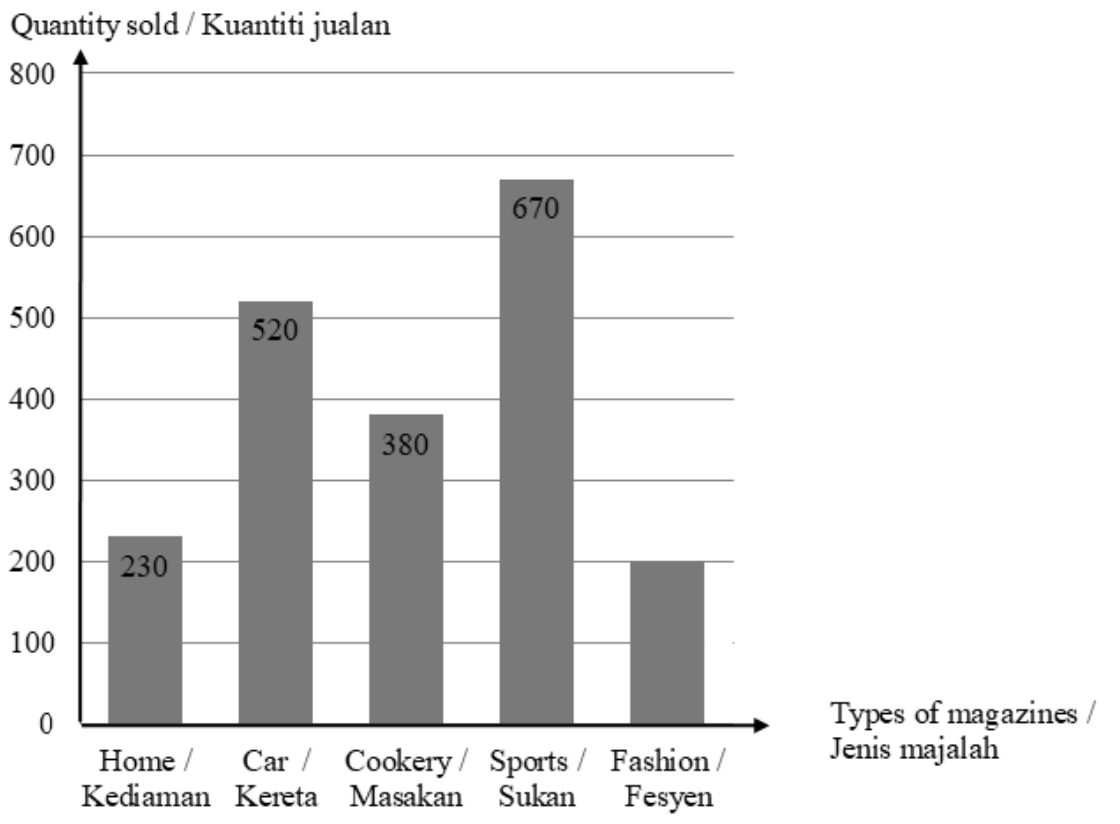
- (a)
Find x, y and z.
[3] - (b)(i)
Calculate the composite index for 2018 based on 2016.
[3] - (b)(ii)
Total sales 2016 is RM50 000; find the 2018 sales.
[2] - (c)
Prices up 10% from 2018 to 2020; find composite index 2020 based on 2016.
[2]
A particle moves along a straight line and passes through a fixed point O. The velocity, v m s⁻¹, of the particle at t seconds after passing through O is given by v = t² − 9t + 18. [Assume the movement to the right is positive] (a) Calculate (i) the initial velocity, in m s⁻¹, of the particle, (ii) the maximum displacement, in m, in the first 5 seconds of the particle. (b) If the particle stops instantaneously at point A and point B, find the distance, in m, between point A and point B. (c) (i) Sketch a velocity-time graph for the motion of the particle for a time period 0 ≤ t ≤ 6. (ii) Hence, find the total distance, in m, travelled by the particle in the first 6 seconds.
Medium10 marks- (a)(i)
Find the initial velocity.
[1] - (a)(ii)
Find the maximum displacement in the first 5 seconds.
[4] - (b)
Find the distance between A and B (where the particle stops).
[2] - (c)(i)
Sketch the velocity-time graph for 0 ≤ t ≤ 6.
[2]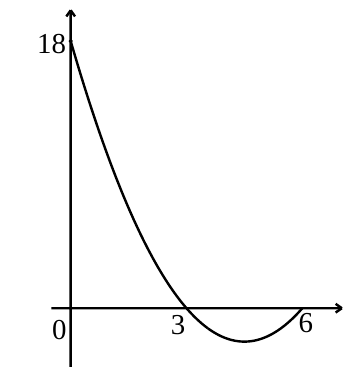
- (c)(ii)
Find the total distance travelled in the first 6 seconds.
[1]