Write your answer on paper. Then open the answer to check it.
Section A
Given g(x) = (ax + b)/(cx + d), x ≠ k.
Medium6 marks- (a)
Express k in terms of c and d. Hence, find g⁻¹(x).
[3] - (b)(i)
Using g⁻¹(x) obtained, determine g⁻¹(x) for g(x) = (7x − 4)/(2x − 3), x ≠ 3/2.
[1] - (b)(ii)
Using g⁻¹(x) obtained, determine g⁻¹(x) for g(x) = (2x − 3)/(x − 5), x ≠ 5.
[1] - (c)
If c ≠ 0, what is the condition on a and d so that g = g⁻¹?
[1]
Find the range of values of x for 5 < 2x² + x + 4 and 2x² + x + 4 < 10. Hence, solve the inequality 5 < 2x² + x + 4 < 10.
Easy4 marksFind the range of values of x for 5 < 2x² + x + 4 and 2x² + x + 4 < 10. Hence, solve 5 < 2x² + x + 4 < 10.
[4]
(a) If √7 x = √2 x + √3, find the value of x in the form (√p + √6)/q. (b) Find the value of p which satisfies 4/log_p(pq) + 4/log_q(pq) + 2 = 6p.
Hard6 marks- (a)
If √7 x = √2 x + √3, find the value of x in the form (√p + √6)/q.
[3] - (b)
Find the value of p which satisfies 4/log_p(pq) + 4/log_q(pq) + 2 = 6p.
[3]
(a) Determine whether the following equations are a system of linear equations in three variables or not. Explain. x − y + 3z + 6 = 0; 4xy + 2z − y = 10; 7y + 3x − z = 8. (b) Solve the following system of linear equations and explain the result of the findings. x − 2y = 4; 2x − 3y + 2z = −2; 4x − 7y + 2z = 6.
Medium5 marks- (a)
Determine whether the equations x − y + 3z + 6 = 0, 4xy + 2z − y = 10, 7y + 3x − z = 8 are a system of linear equations in three variables or not. Explain.
[1] - (b)
Solve x − 2y = 4, 2x − 3y + 2z = −2, 4x − 7y + 2z = 6 and explain the result of the findings.
[4]
(a) Given a geometric progression with terms a, ar, ar², ar³, ..., arⁿ⁻², arⁿ⁻¹ and the sum of first n terms is Sₙ. Derive the formula for the sum of the first n terms, Sₙ for the geometric progression when |r| > 1. (b) Hence, find the value of n for which the sum of the first 2n terms is 28 times the sum of first n terms of a geometric progression which has a common ratio of 3.
Medium7 marks- (a)
Derive the formula for the sum of the first n terms, Sₙ, for the geometric progression when |r| > 1.
[3] - (b)
Hence, find n for which S₂ₙ = 28Sₙ for a geometric progression with common ratio 3.
[4]
Diagram 1 shows part of the graph of y against x for the equation y = pˣq, such that p and q are constants. Points A(3, 27) and B(1, 9). (a) Sketch the straight line graph of log₃ y against x. Hence, mark and state the coordinates of the corresponding point A and B. (b) Calculate the value of p and q.
Medium5 marks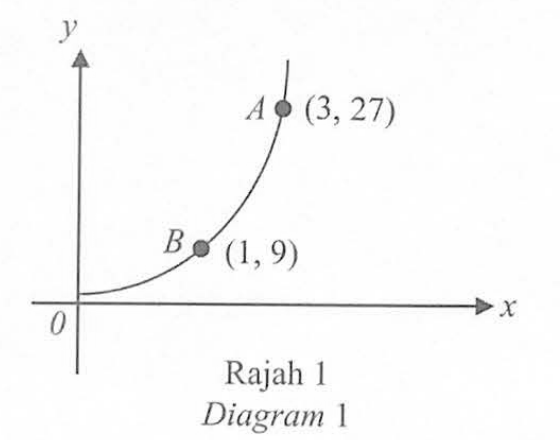
- (a)
Sketch the straight line graph of log₃ y against x. Hence, mark and state the coordinates of the corresponding points A and B.
[2] - (b)
Calculate the value of p and q.
[3]
Solutions by scale drawing is not accepted. Diagram 2 shows a trapezium ABCD. The equation of the straight line AB is 2y − x = 1, where AD is the height of the trapezium ABCD. B(7, 4), C(p, 0), D(4, −1). Find (a) the value of p, (b) the coordinates of point A.
Easy5 marks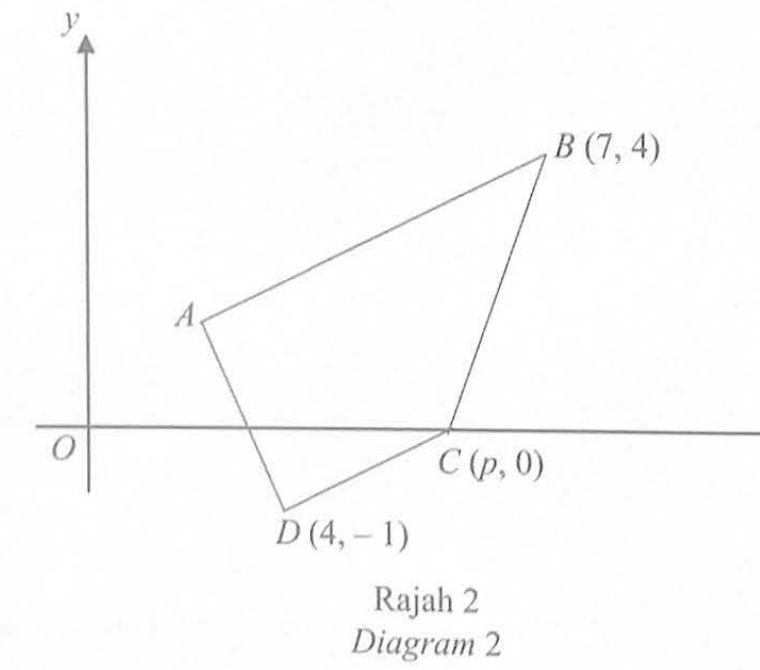
- (a)
Find the value of p.
[2] - (b)
Find the coordinates of point A.
[3]
In Diagram 3, OPQ is a triangle with OP→ = 5x and OQ→ = y. R and S are two points that lie on the line OP and PQ respectively with condition OR→ = (3/5) OP→ and PS→ = (2/3) PQ→. Express (a) OS→ in terms of x and y, (b) the unit vector in the direction of RS→ in terms of x and y.
Easy5 marks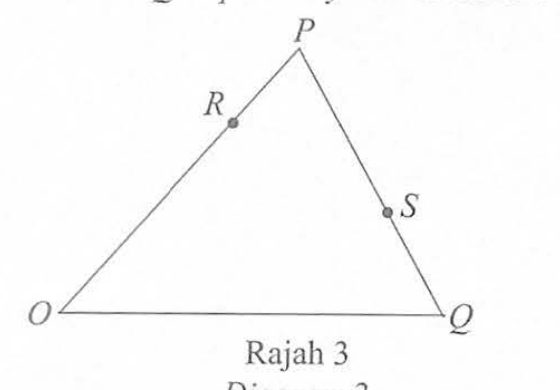
- (a)
Express OS→ in terms of x and y.
[2] - (b)
Express the unit vector in the direction of RS→ in terms of x and y.
[3]
Diagram 4 shows a circle with centre at point O, the origin of a Cartesian plane. Straight line BOC is the diameter of the circle. B(5, 10). By using π = 3.142, find (a) ∠BOD in radians, (b) the perimeter of the shaded region, (c) the area of the major sector BOD.
Medium6 marks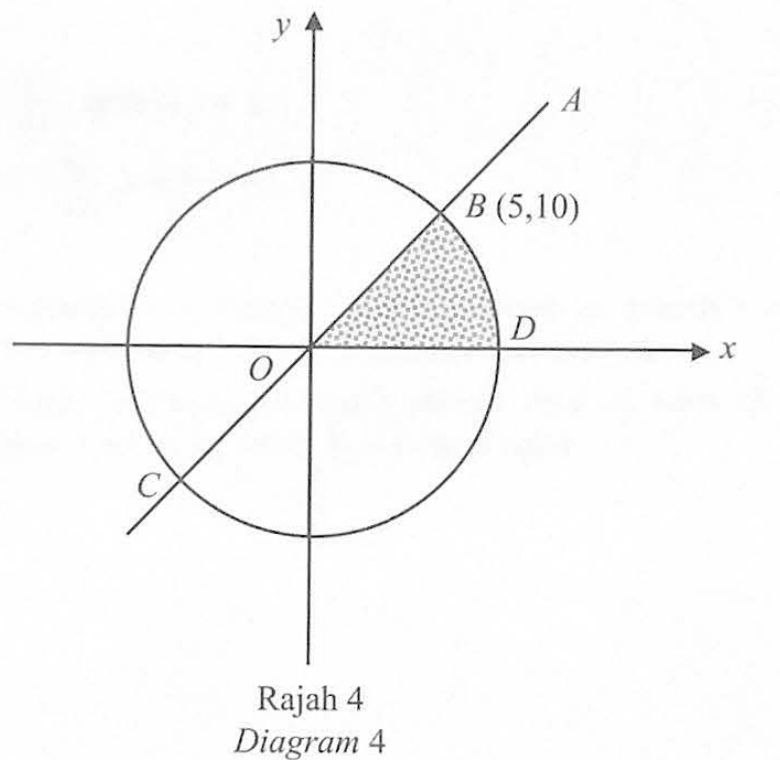
- (a)
Find ∠BOD in radians.
[1] - (b)
Find the perimeter of the shaded region.
[3] - (c)
Find the area of the major sector BOD.
[2]
Given that y = 3x² − 2x + 3, find (a) the value of dy/dx when x = 2, (b) the percentage of the approximate change in y, in term of m, when x changes from 2 to 2 + m, where m is a small value.
Medium5 marks- (a)
Find the value of dy/dx when x = 2.
[2] - (b)
Find the percentage of the approximate change in y, in term of m, when x changes from 2 to 2 + m, where m is a small value.
[3]
Diagram 5 shows the curve y = x² + 3 intersects the straight line AC at point B. It is given that the equation of the straight line AC is y + x = 9 and the gradient of the curve at point B is 4. Find (a) the area of region P, (b) the generated volume, in term of π, when the region Q is revolved through 360° about the x-axis.
Medium5 marks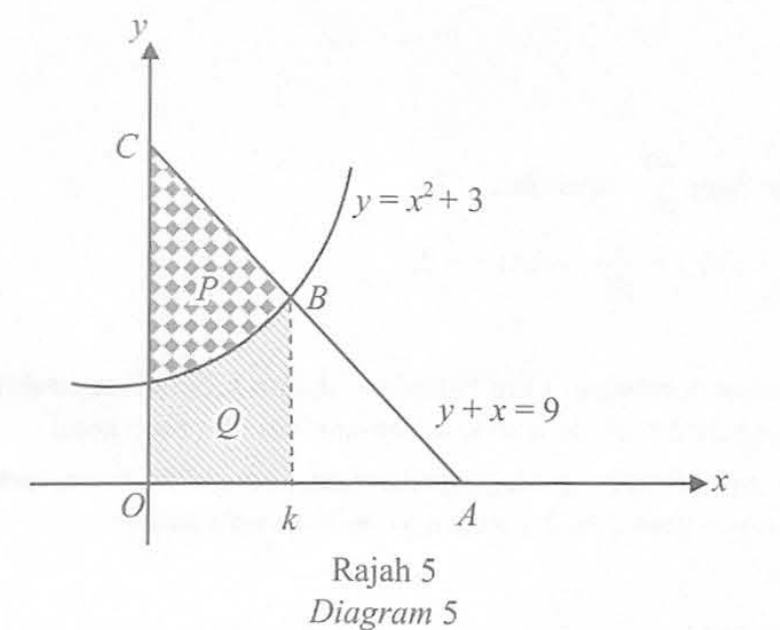
- (a)
Find the area of region P.
[3] - (b)
Find the generated volume, in term of π, when region Q is revolved through 360° about the x-axis.
[2]
(a) How many ways are there to seat 3 boys and 4 girls in a row of 7 chairs if the three boys are sitting next to each other. (b) In a box, there are 10 balls, each with a different colour. These balls are divided among 2 boys where each of them gets at least 4 balls. Find the number of ways the balls can be divided between the 2 boys.
Medium5 marks- (a)
How many ways are there to seat 3 boys and 4 girls in a row of 7 chairs if the three boys sit next to each other?
[2] - (b)
Find the number of ways the 10 differently coloured balls can be divided between 2 boys where each gets at least 4 balls.
[3]
Section B
(a) The probability that Jessy will win in a badminton competition is 1/5. If she participates in n competitions, the probability for Jessy to win once in the badminton competition is 16 times the probability of losing in all of the competitions. (i) Find the value of n. (ii) Calculate the mean for the number of wins. (b) Given that Z is a continuous random variable in a standard normal distribution. Find (i) P(|Z| > 2.159), (ii) P(|Z| ≤ 1.684).
Medium8 marks- (a)(i)
Find the value of n.
[3] - (a)(ii)
Calculate the mean for the number of wins.
[1] - (b)(i)
Find P(|Z| > 2.159).
[2] - (b)(ii)
Find P(|Z| ≤ 1.684).
[2]
(a) Solve the equation 3 cos²x + sin 2x = 0 for 0° ≤ x ≤ 360°. (b) Solve the simultaneous equations 2 sin (x + y) = √3 and 2 sin (x − y) = 1, where x and y are both acute angles.
Medium8 marks- (a)
Solve 3 cos²x + sin 2x = 0 for 0° ≤ x ≤ 360°.
[4] - (b)
Solve 2 sin (x + y) = √3 and 2 sin (x − y) = 1, where x and y are both acute angles.
[4]
In Diagram 6, ABC is a triangle with AB = 18 cm, AD = 16 cm, DC = 8 cm, BC = 15 cm and ∠ADE = 120°. Calculate (a) ∠ACB, (b) the length of DE, (c) the length of the perpendicular line from B to straight line AC.
Medium8 marks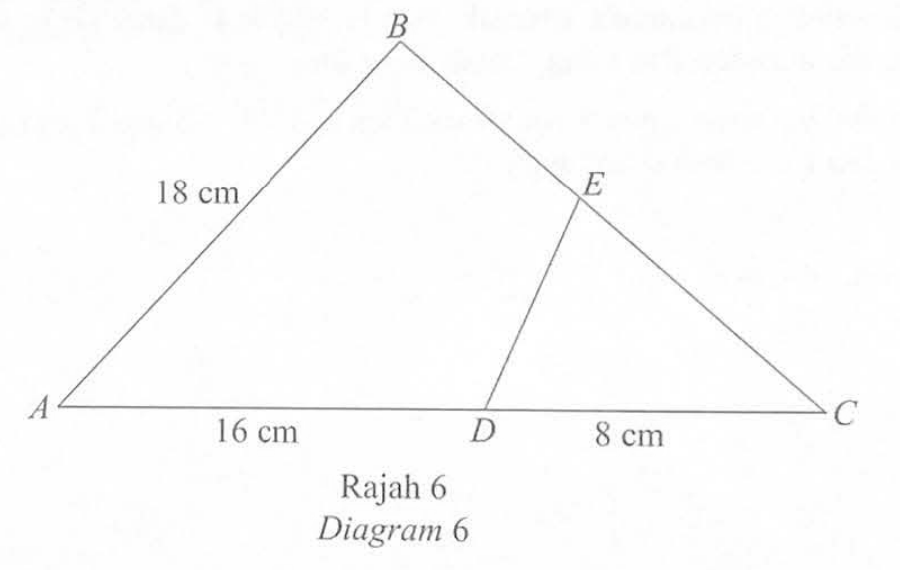
- (a)
Calculate ∠ACB.
[3] - (b)
Calculate the length of DE.
[3] - (c)
Calculate the length of the perpendicular line from B to straight line AC.
[2]