Write your answer on paper. Then open the answer to check it.
Section A
Given g(x) = (2x − 5)/(3x − p), x ≠ q.
Medium6 marks- (a)(i)
Express p in terms of q and find g⁻¹(x) in terms of p.
[3] - (a)(ii)
Given g^(n−1)(x) = (px − 5)/(3x − 2), x ≠ k, determine the value of n by comparing g⁻¹(x) above with the given g^(n−1)(x). Next, find the value of k.
[2] - (b)
What is the condition on p so that g = g⁻¹?
[1]
Find the range of values of x for 5 < 2x² + x + 4 and 2x² + x + 4 ≤ 10. Hence, solve the inequality 5 < 2x² + x + 4 ≤ 10.
Easy4 marksFind the range of values of x for 5 < 2x² + x + 4 and 2x² + x + 4 ≤ 10. Hence, solve the inequality 5 < 2x² + x + 4 ≤ 10.
[4]
(a) Find the value of p and q for the equation (√2 − 1)(p + q√2) = 5 − √8. (b) Find the value of p which satisfies 3/log_p(pq) + 3/log_q(pq) + 2 = 5p.
Medium6 marks- (a)
Find the value of p and q for the equation (√2 − 1)(p + q√2) = 5 − √8.
[3] - (b)
Find the value of p which satisfies the following equation: 3/log_p(pq) + 3/log_q(pq) + 2 = 5p
[3]
(a) Determine whether the following equations are a system of linear equations in three variables or not. Explain. 2x + y = z²; 4x − 2y + 3z = 6; 11y + 5x − z = 3. (b) Solve the following system of linear equations and explain the result of the findings: y − 7z = −2; x − y + 5z = 2; −2x + 2y − 10z = 6.
Easy5 marks- (a)
Determine whether the following equations are system of linear equations in three variables or not. Explain. 2x + y = z²; 4x − 2y + 3z = 6; 11y + 5x − z = 3
[1] - (b)
Solve the following system of linear equations and explain the result of the findings: y − 7z = −2 ... (1); x − y + 5z = 2 ... (2); −2x + 2y − 10z = 6 ... (3)
[4]
(a) A geometric progression has terms a, ar, ar², ar³, ..., ar^(n−2), ar^(n−1) and the sum of the first n terms is Sₙ. Derive the formula for the sum of the first n terms, Sₙ, for the geometric progression when |r| < 1. (b) Hence, find the value of n for which the sum of the first 2n terms is 127/128 times of the sum of first n terms of a geometric progression which has a common ratio of −1/2.
Medium7 marks- (a)
Derive the formula for the sum of the first n terms, Sₙ, for the geometric progression when |r| < 1.
[3] - (b)
Hence, find the value of n for which the sum of the first 2n terms is 127/128 times of the sum of first n terms of a geometric progression which has a common ratio of −1/2.
[4]
Diagram 1 shows part of the graph of y against x for the equation y = pqˣ, such that p and q are constants. The graph passes through A(3, 27) and B(1, 9). (a) Sketch the straight line graph of log₃ y against x. Hence, mark and state the coordinates of the corresponding point A and B. (b) Calculate the value of p and q.
Easy5 marks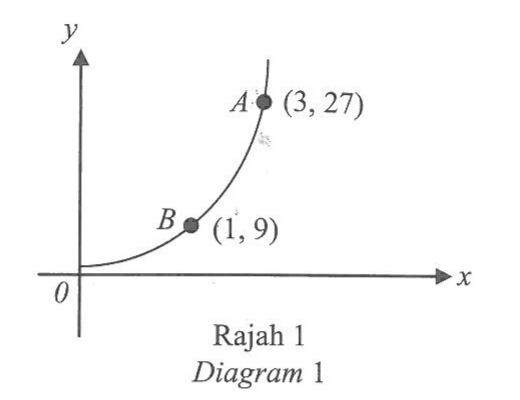
- (a)
Sketch the straight line graph of log₃ y against x. Hence, mark and state the coordinates of the corresponding point A and B.
[2] - (b)
Calculate the value of p and q.
[3]
Solutions by scale drawing is not accepted. Diagram 2 shows a trapezium ABCDE where BC is the height of the trapezium ABCDE. A(4, 3), B(7, 4), D(k, 0), E(2, −1). Find (a) the value of k, (b) the coordinates of point C.
Easy6 marks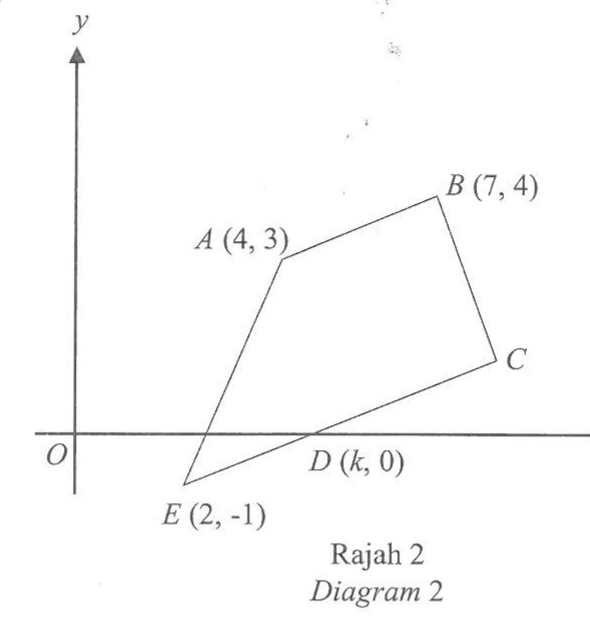
- (a)
the value of k,
[2] - (b)
the coordinates of point C.
[4]
Diagram 3 shows a parallelogram OABC. Point P is the midpoint of AB and the ratio of QP : OP = 2 : 5 (as printed). Given that OA→ = 3i + 4j and OC→ = 6i + j. Express in terms of i and j, (a) OP→, (b) AQ→.
Easy4 marks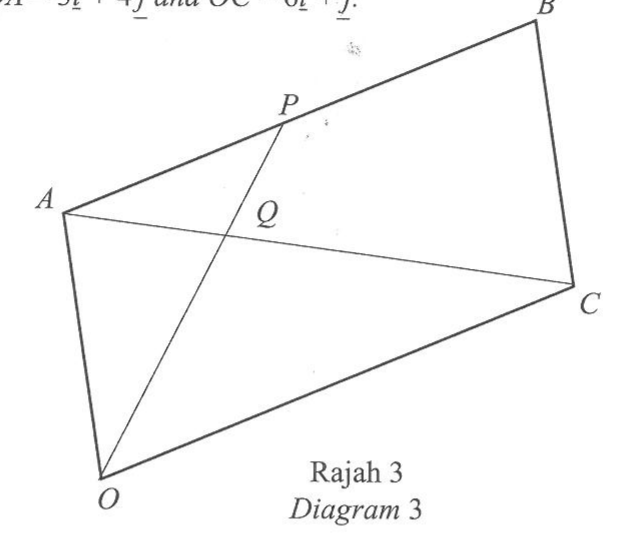
- (a)
OP→
[1] - (b)
AQ→
[3]
Diagram 4 shows a circle ADBC, with centre O and diameter 12 cm while sector ADC with the centre A and radius AD = 10 cm. By using π = 3.142, find (a) ∠BAC in radians, (b) the area, in cm², of the shaded region.
Easy5 marks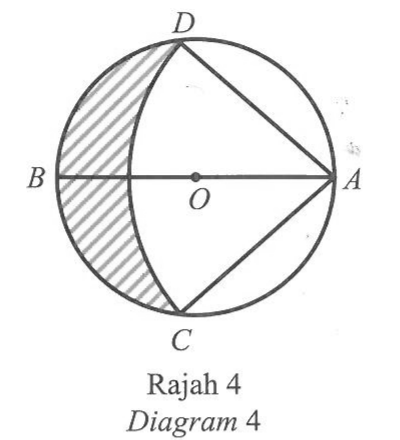
- (a)
∠BAC in radians,
[2] - (b)
area, in cm², of the shaded region.
[3]
(a) Given the gradient of the tangent to the curve y = x²(3 + px) is −3 when x = −1. Find the value of p. (b) Volume, V cm³, of a solid is given by V = 8πr² + (2/3)πr³, r is the radius. Find the approximate change in V, in terms of π, if r increases from 3 cm to 3.005 cm.
Medium5 marks- (a)
Given the gradient of the tangent to the curve y = x²(3 + px) is −3 when x = −1. Find the value of p.
[2] - (b)
Volume, V cm³, of a solid is given by V = 8πr² + (2/3)πr³, r is the radius. Find the approximate change in V, in terms of π, if r increases from 3 cm to 3.005 cm.
[3]
Diagram 5 shows the curve y = 2x² + 1 and a straight line x + y = 4 intersect at point P. Find (a) the area of the shaded region J, (b) the volume generated, in terms of π, when the region K which is bounded by the curve y = 2x² + 1, the straight line PQ, the x-axis and the y-axis is revolved through 360° about the x-axis.
Medium6 marks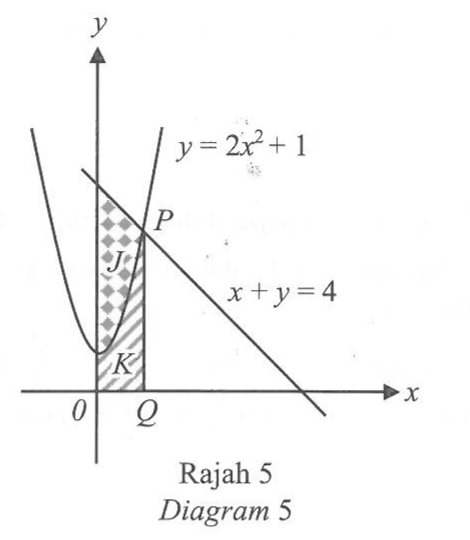
- (a)
the area of the shaded region J,
[3] - (b)
the volume generated, in term of π, when the region K which bounded by the curve y = 2x² + 1, the straight line PQ, x-axis and y-axis is revolved through 360° about the x-axis.
[3]
(a) Find the number of ways to arrange each word SAKU and SAKA if no repetition is allowed. Are the number of arrangements that formed the same? Explain. (b) Two boats are used to cross a river with each boat only able to carry 7 passengers. There are 9 adults and 4 children passengers. If the number of children are the same on both boats, find the number of ways that these 13 passengers can be carried by the two boats.
Medium5 marks- (a)
Find the number of ways to arrange each word SAKU and SAKA if no repetition is allowed. Are the number of arrangement that formed are the same? Explain.
[3] - (b)
Two boats are used to cross a river with each boat only able to carry 7 passengers. There are 9 adults and 4 children passengers. If the number of children are the same on both boats, find the number of ways that these 13 passengers can be carried by the two boats.
[2]
Section B
(a) The probability that Jessy will win in a badminton competition is 1/3. If she participates in n competitions, the probability for Jessy to win once in the badminton competition is 18 times the probability of losing in all of the competitions. (i) Find the value of n. (ii) Calculate the mean for the number of wins. (b) Given Z is a continuous random variable in a standard normal distribution. Find (i) P(|Z| > 2.053), (ii) P(|Z| ≤ 1.351).
Medium8 marks- (a)
(i) Find the value of n. (ii) Calculate the mean for the number of wins. [p = 1/3 chance of winning one competition; P(win once) = 18 × P(lose all)]
[4] - (b)
Given Z is a continuous random variable in a standard normal distribution. Find (i) P(|Z| > 2.053), (ii) P(|Z| ≤ 1.351).
[4]
(a) Solve the equation 3 sin 2x = 4 cos x for 0° ≤ x ≤ 360°. (b) Solve the simultaneous equations 2 cos(x − y) = √3 and 2 cos(x + y) = 1, where x and y are both acute angles.
Medium8 marks- (a)
Solve the equation 3 sin 2x = 4 cos x for 0° ≤ x ≤ 360°.
[4] - (b)
Solve the simultaneous equations 2 cos(x − y) = √3 and 2 cos(x + y) = 1, where x and y are both acute angles.
[4]
Diagram 6 shows a triangle ABC. Given that the area of triangle ABC is 21 cm² and ∠BAC is obtuse angle. AB = 14 cm and AC = 5 cm. Find (a) ∠BAC, (b) the length of BC, in cm, (c) the length of the perpendicular line from A to BC.
Medium8 marks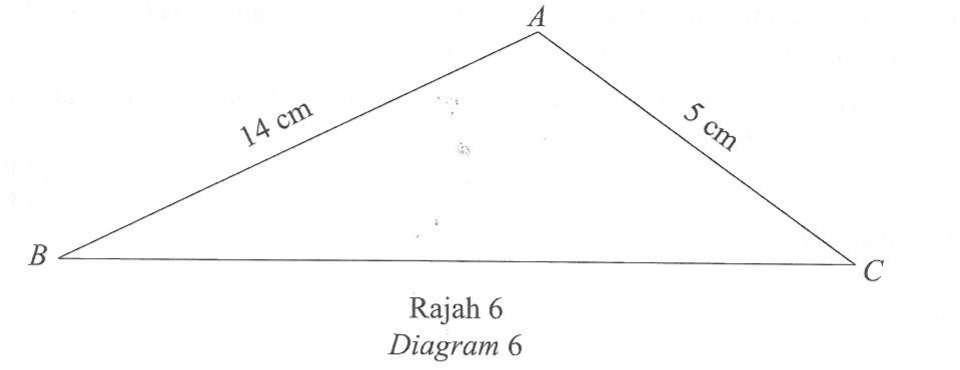
- (a)
∠BAC,
[3] - (b)
the length of BC, in cm,
[2] - (c)
the length of the perpendicular line from A to BC.
[3]