Write your answer on paper. Then open the answer to check it.
Section A
The curve y = 3x(5 − 2x)⁴ passes through point Q at x = 2. Find (a) the gradient of the curve at Q, (b) the equation of the normal to the curve at Q.
Medium6 marks- (a)
The gradient of the curve at Q.
[3] - (b)
The equation of the normal to the curve at Q.
[3]
The quadratic function f(x) = x² + 5k² − 4kx + 1 has a minimum value of h² + 2k, where h and k are constants.
Medium6 marks- (a)
By using the completing the square method, express h in terms of k.
[3] - (b)
Hence, find the value of k and of h if the axis of symmetry is at x = h − 1.
[3]
Given two geometric progressions, X and Y, with common ratio 1/2 and 1/3 respectively. The sums to infinity of both progressions are the same. If the fourth term of progression X exceeds the fourth term of progression Y by 49/36, find the difference of the first terms of the two progressions.
Medium7 marksFind the difference of the first terms of the two progressions.
[7]
Diagram 4 shows a crescent shape constructed using two major arcs ACB and ADB, centred at O and P respectively. The radius of arc ADB is 5.8 m and of arc ACB is 7 m. The length of chord AB is 8.6 m.
Medium8 marks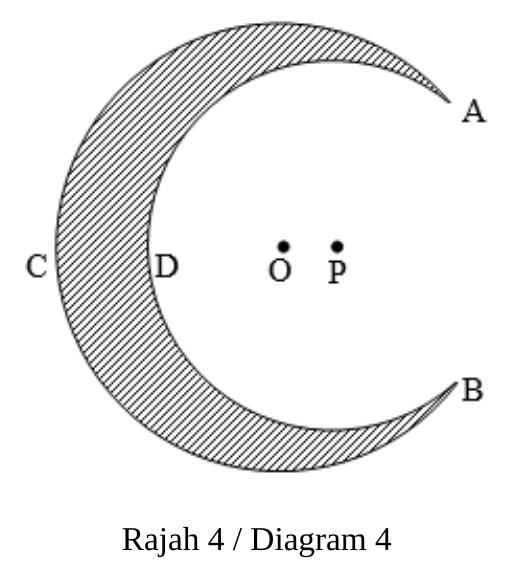
- (a)
Find ∠AOB and ∠APB in radians, correct to 3 decimal places.
[3] - (b)
Find the area, in m², of the crescent.
[5]
Diagram 5 shows a plan of footpaths in a school forming a quadrilateral PQRS. A lamp post is placed at T, such that PT : TR = 1 : 3. The footpaths QP and RS are parallel with RS→ = (3/4) QP→. In the diagram PS→ = 20**x** and QP→ = 24**y** (arrows as drawn).
Medium8 marks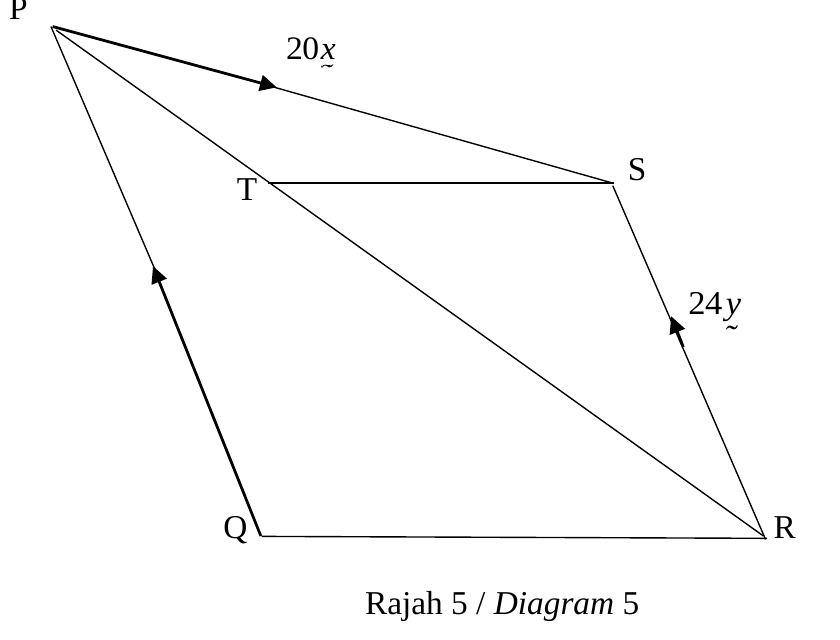
- (a)
Express PR→ and TS→ in terms of **x** and **y**.
[3] - (b)
Show that the footpath TS is parallel to the footpath QR.
[5]
(a) Prove an identity involving tan²x. (b) Sketch y = cos 2x for 0 ≤ x ≤ 3π/2. (c) Using the same axes, sketch a suitable straight line to find the number of solutions of 5(1 − tan²x) = x(1 + tan²x) for 0 ≤ x ≤ 3π/2.
Medium8 marks- (a)
Prove that (1 − tan²x)/(1 + tan²x) = cos 2x.
[2] - (b)
Sketch the graph of y = cos 2x for 0 ≤ x ≤ 3π/2.
[3] - (c)
Hence, using the same axes, sketch a suitable straight line to find the number of solutions of 5(1 − tan²x) = x(1 + tan²x) for 0 ≤ x ≤ 3π/2. State the number of solutions.
[3]
(a) A function g is defined by g(x) = (x − m)/(x − 8), x ≠ 8. If x = 3 maps onto itself, find the value of m. (b) Given k(x) = 4x/(x − 3), x ≠ 3 and h(x) = 3x/(x − 4), x ≠ 4. Find kh(x). Hence, verify that the function k(x) has the inverse function h(x).
Medium7 marks- (a)
If x = 3 maps onto itself, find the value of m.
[2] - (b)
Find kh(x). Hence, verify that k(x) = 4x/(x − 3), x ≠ 3 has the inverse function h(x) = 3x/(x − 4), x ≠ 4.
[5]
Section B
Diagram 8 shows a rectangle DEFG with D(1, 7), E(5, 6) and F(m, n).
Medium10 marks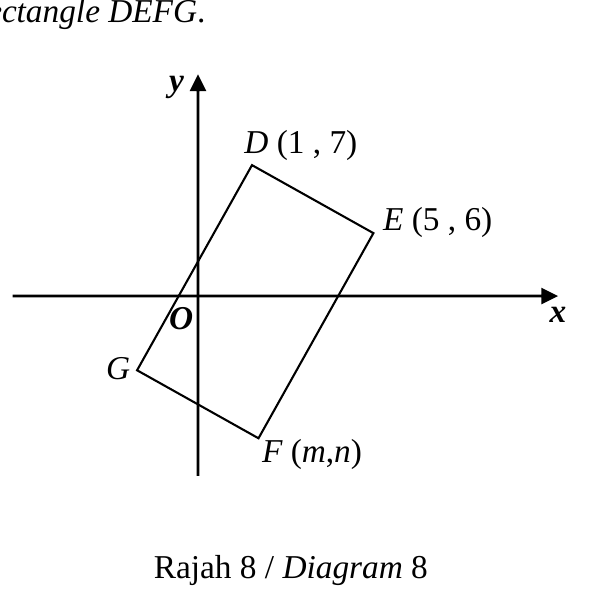
- (a)
Find the equation of straight line DG in general form.
[3] - (b)(i)
Find the equation of straight line EF in terms of m and n.
[2] - (b)(ii)
Express the area of triangle DEF in terms of m and n. Hence, find the value of m and of n if the area of triangle DEF is 34 unit².
[5]
Use graph paper to answer this question. Table 9 shows values of two variables, x and y, from an experiment: x = 1.50, 1.82, 2.50, 3.00, 3.50, 6.67; y = 1.07, 0.92, 0.72, 0.69, 0.65, 0.56. The variables are related by px = qy + xy, where p and q are constants.
Medium10 marks
- (a)
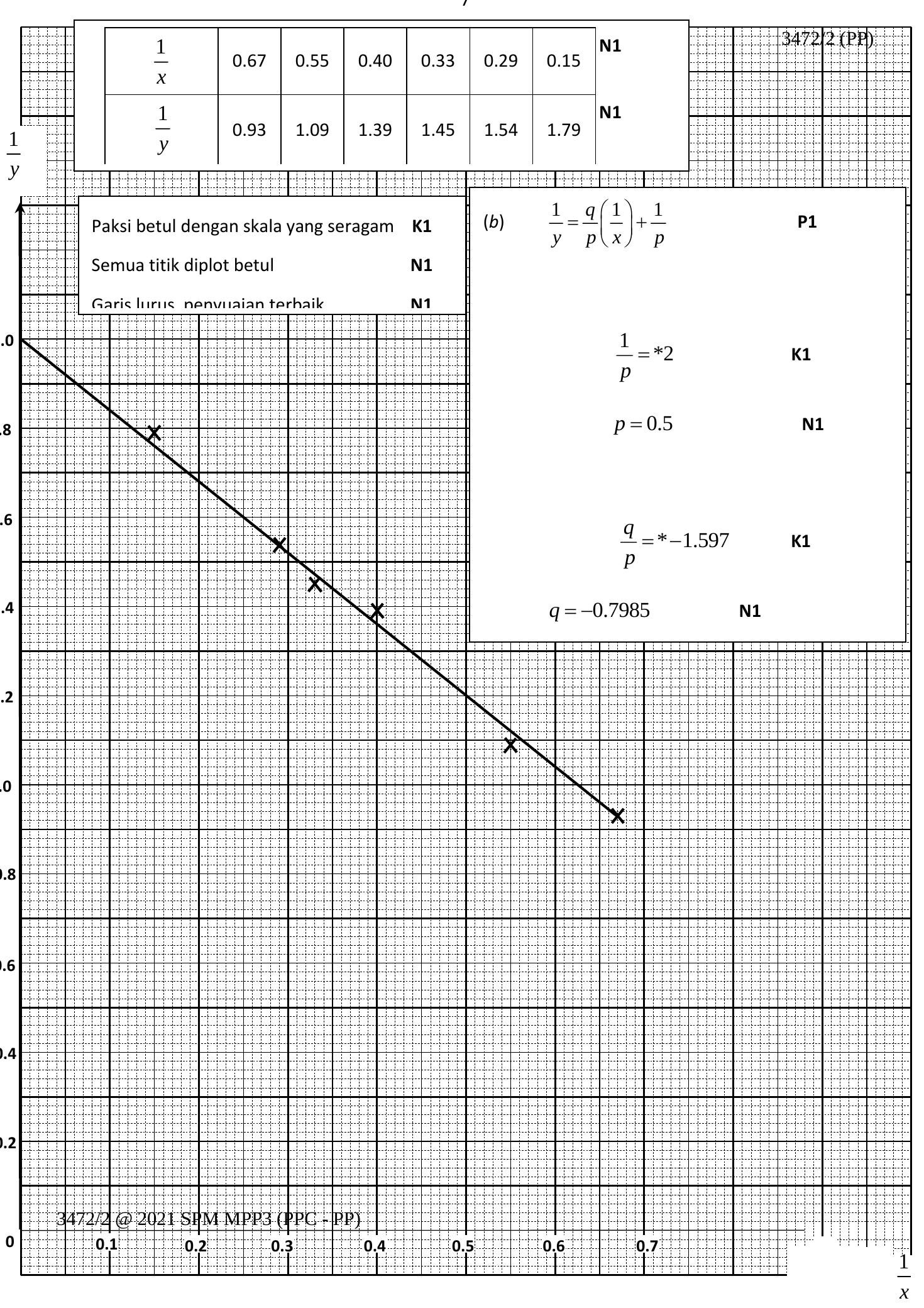
Based on Table 9, construct a table for the values of 1/x and 1/y.
[2] - (b)
Plot 1/y against 1/x, using a scale of 2 cm to 0.1 unit on the 1/x-axis and 2 cm to 0.2 unit on the 1/y-axis. Hence, draw the line of best fit.
[3]
- (c)(i)
Using the graph in 9(b), find the value of p.
[3] - (c)(ii)
Using the graph in 9(b), find the value of q.
[2]
Diagram 10 shows a curve with gradient function k − 6x, where k is a constant. PR is a tangent to the curve where R(1, 3) is the maximum point. The curve passes through the origin O and P lies on the y-axis (PR is horizontal).
Medium10 marks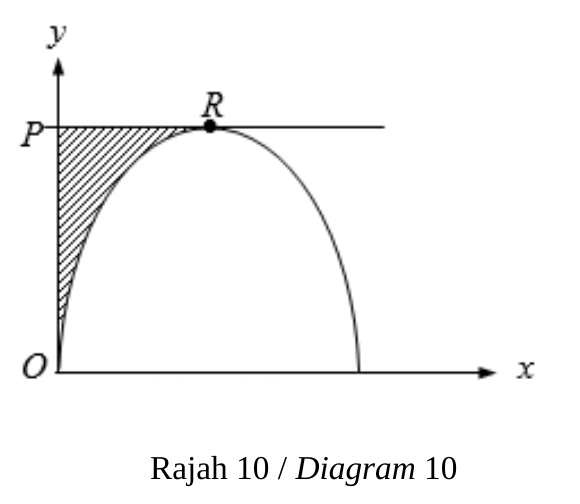
- (a)
Find the value of k.
[2] - (b)
Find the equation of the curve.
[2] - (c)
Find the area of the region bounded by the curve and the x-axis.
[2] - (d)
Find the volume generated when the shaded region is revolved through 360° about the x-axis.
[4]
(a) In a company, 80% of the workers are more than 25 years old. (b) The weight of the workers in a biscuit factory follows a normal distribution with a mean of 63 kg and a variance of 121 kg².
Medium10 marks- (a)(i)
Given the mean number of workers more than 25 years old is 300, find the total number of workers in the company.
[2] - (a)(ii)
If 8 workers are randomly chosen, find the probability that at most 2 of them are more than 25 years old.
[3] - (b)(i)
Calculate the probability of workers with weight between 58 kg and 67 kg.
[2] - (b)(ii)
If 98.7% of the workers weigh more than m kg, find the value of m.
[3]
Section C
Table 12 shows the price index of raw materials in 2020 based on 2016: P 140, Q 120, R 125, S 115, T 130. Diagram 12 is a bar chart of the mass (kg) of the raw materials used as the main ingredients of a cake: P 40, Q x, R 40, S 30, T x. The composite index for the cost of the items in 2020 based on 2016 is 127.
Medium10 marks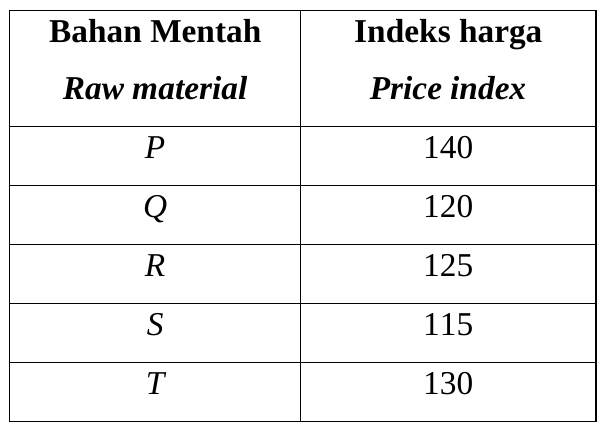
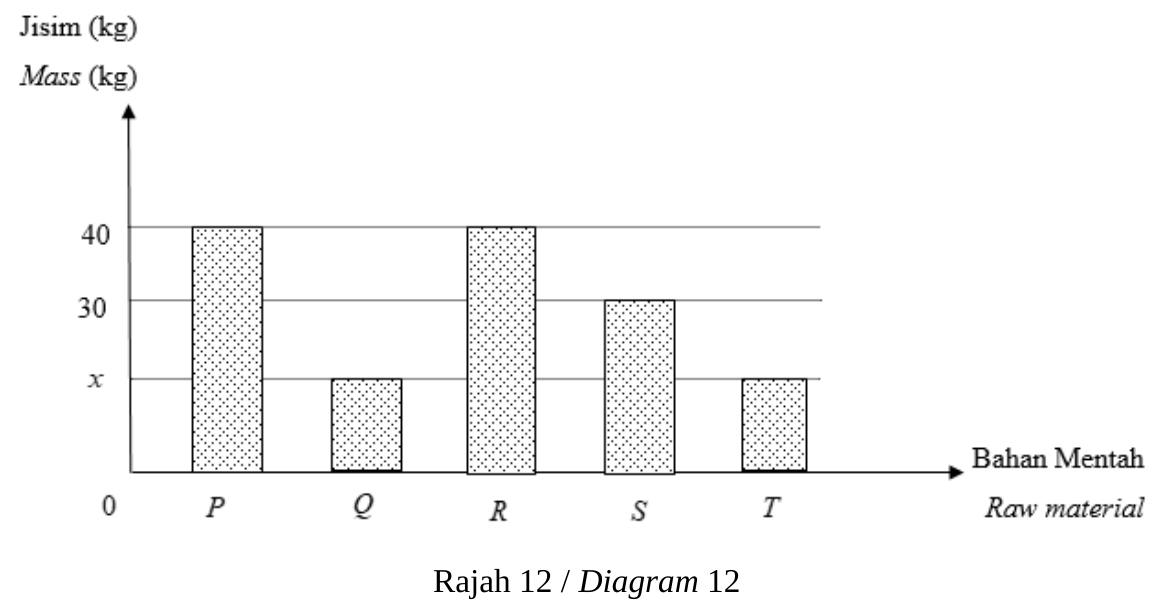
- (a)
Find the value of x.
[3] - (b)
The cost of making a cake in 2020 is RM40. Calculate the corresponding cost in 2016.
[2] - (c)
Calculate the price index of R in 2020 based on 2010 if its price index in 2016 based on 2010 is 125.
[2] - (d)
If the cost of making a cake in 2018 is 30% lower than in 2020, calculate the composite index in 2018 based on 2016.
[3]
In Diagram 13, ABC is an isosceles triangle and BCD is a straight line. AB = AC = 12 cm, AD = 18 cm and BD = 20 cm.
Medium10 marks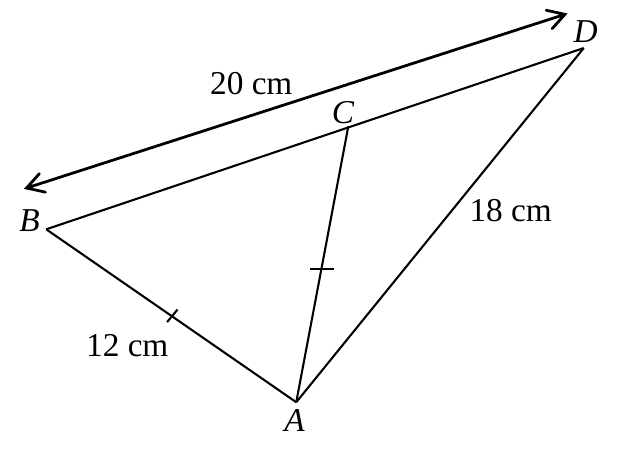
- (a)(i)
Calculate ∠ABD.
[2] - (a)(ii)
Calculate the length of BC, in cm.
[2] - (a)(iii)
Calculate the area, in cm², of triangle ABC.
[2] - (b)(i)
Sketch triangle A′C′D′ with a different shape from triangle ACD such that A′C′ = AC, C′D′ = CD and ∠C′A′D′ = ∠CAD.
[1]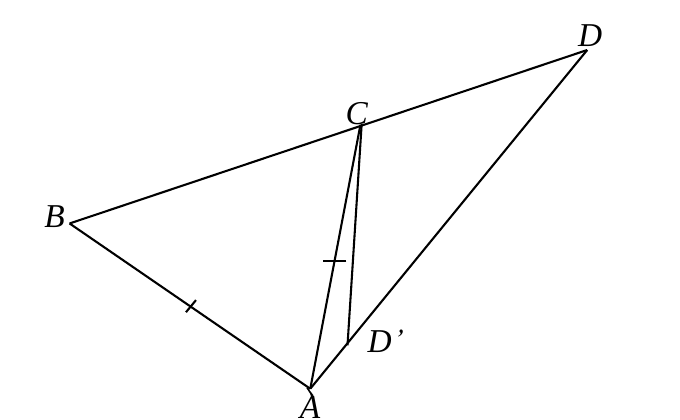
- (b)(ii)
Hence, calculate ∠A′D′C′.
[3]
Use graph paper to answer this question. A local charity organisation intends to organise a Charity Run. The run is open to x adults and y children based on these constraints: I The number of children is at least 10. II The number of children is at most 3/2 times the number of adults. III The maximum total number of participants is 80.
Medium10 marks
- (a)
Write three inequalities, other than x ≥ 0 and y ≥ 0, which satisfy all the above constraints.
[3] - (b)
Using a scale of 2 cm to 10 participants on both axes, construct and shade the region R which satisfies all the above constraints.
[3]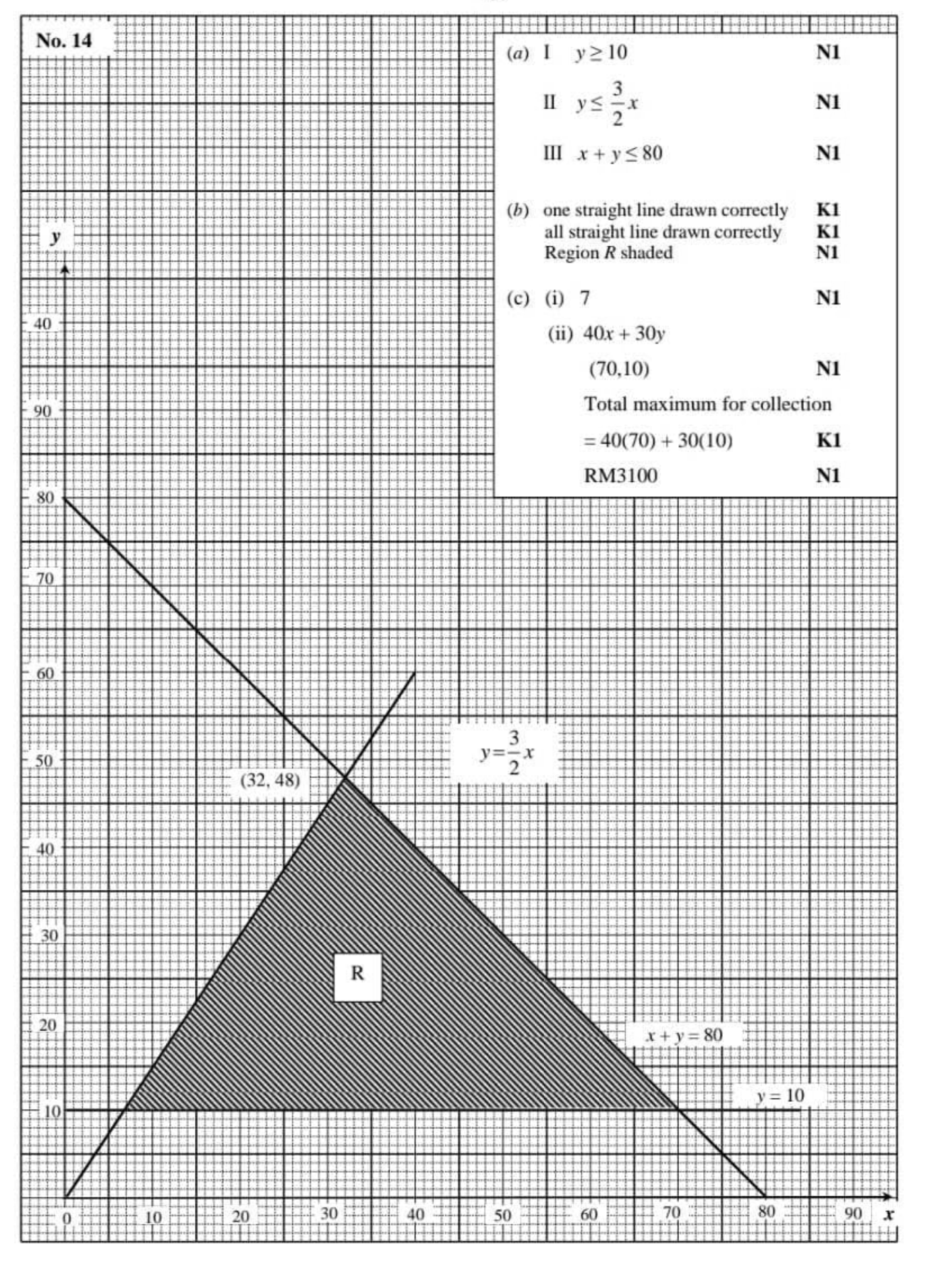
- (c)(i)
Find the minimum number of adults participating in the run.
[1] - (c)(ii)
Determine the maximum total fees collected if the fee for an adult is RM40 and for a child is RM30.
[3]
A particle moves along a straight line such that its displacement, s m, is given by s = t³ − 6t² + 9t, where t is the time, in seconds, after passing through a fixed point O. [Assume motion to the right is positive.]
Medium10 marks- (a)
Find the initial velocity, in m s⁻¹, of the particle.
[2] - (b)
Find the values of t, in seconds, when the particle stops instantaneously.
[2] - (c)
Find the instantaneous velocity, in m s⁻¹, of the particle when its acceleration is zero.
[3] - (d)
Find the total distance, in m, travelled by the particle when its acceleration is negative.
[3]