Write your answer on paper. Then open the answer to check it.
Section A
In Diagram 1, O is the centre of arcs AB and CD. Given the perimeter of the whole diagram is 40 cm, ∠DOC and ∠BOA are λ radian and μ radian respectively, OD = 10 cm and OA = 6 cm. Express μ in terms of λ.
Easy2 marks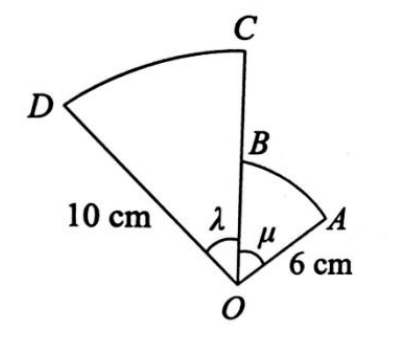
Express μ in terms of λ.
[2]
Diagram 2 shows part of the curve of y against x, passing through (2, 10) and (4, 48). It is known that x and y are related by the linear equation y/x = k²x + 5/h, where h and k are constants.
Easy4 marks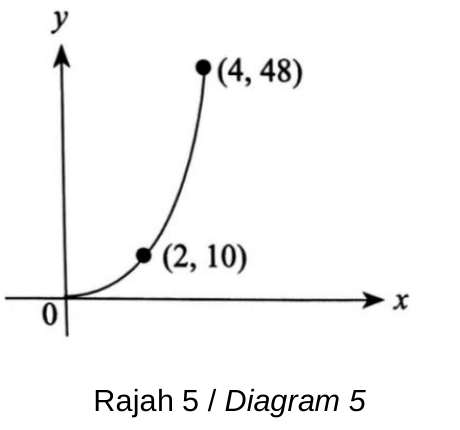
- (a)
Sketch the straight line graph for the equation y/x = k²x + 5/h.
[2] - (b)
Find the values of h and of k.
[2]
(a) Solve the equation 3ˣ = 162 − 3ˣ. (b) Show that 3ⁿ⁺⁴ + 3ⁿ⁺⁵ + 3ⁿ = 325(3ⁿ).
Medium5 marks- (a)
Solve the equation 3ˣ = 162 − 3ˣ.
[3] - (b)
Show that 3ⁿ⁺⁴ + 3ⁿ⁺⁵ + 3ⁿ = 325(3ⁿ).
[2]
(a) Find the value of lim(k→4) (k² − 16)/(k − 4). (b) Given that V = y²(3 − 2/y), find the small change in V when y changes from 2 to 1.99.
Easy4 marks- (a)
Find the value of lim(k→4) (k² − 16)/(k − 4).
[2] - (b)
Given V = y²(3 − 2/y), find the small change in V when y changes from 2 to 1.99.
[2]
Diagram 5 shows part of the graph of the quadratic function f(x) = ax² − 8x + c, where a and c are constants. The graph is a U-shaped curve cutting the x-axis at m (negative) and n (positive) and the y-axis below the origin.
Medium7 marks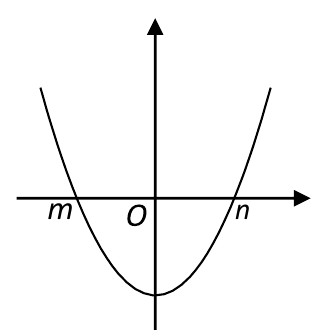
- (a)
State the range of values of x if f(x) > 0.
[2] - (b)
Express the range of values of a in terms of c.
[2] - (c)
Prove that (m + n)/(mn) = 8/c.
[3]
Diagram 6 shows a circle with centre O and radius 5 cm. Given OQTC is a rectangle with an area of 40 cm², find, using π = 3.142: (a) the value of θ, in radians, (b) the area of sector OAB, (c) the perimeter of the shaded region.
Medium6 marks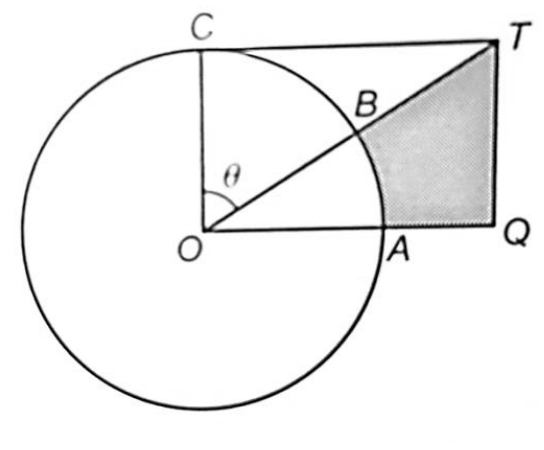
- (a)
Find the value of θ, in radians.
[2] - (b)
Find the area of sector OAB.
[2] - (c)
Find the perimeter of the shaded region.
[2]
In Diagram 9, ABCD is a quadrilateral and M is the midpoint of the diagonal BD. It is given AB→ = u + 6v, AD→ = 7u − 2v and DC→ = 3kv − u, where k is a constant. (a) Express in terms of u and v: (i) BM→, (ii) AM→. (b) Find AC→ in terms of k, u and v. Hence, find the value of k if A, M and C are collinear.
Medium6 marks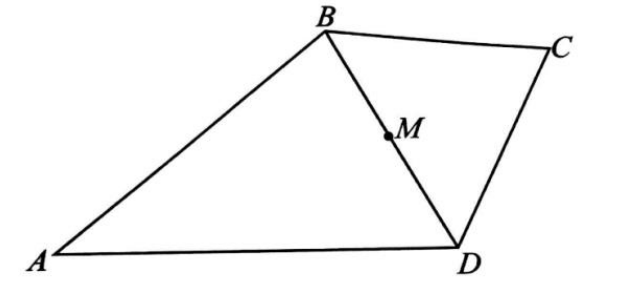
- (a)(i)
Express BM→ in terms of u and v.
[2] - (a)(ii)
Express AM→ in terms of u and v.
[1] - (b)
Find AC→ in terms of k, u and v. Hence, find the value of k if A, M and C are collinear.
[3]
The points A(2h, h), B(p, t) and C(2p, 3t) lie on a straight line. Given AB = (2/5)AC, (a) express p in terms of t, (b) given the gradient of AC is 3 and t = 1, find the equation of the straight line that is perpendicular to AC and passes through point B.
Medium6 marks- (a)
Express p in terms of t.
[3] - (b)
Given the gradient of AC is 3 and t = 1, find the equation of the straight line perpendicular to AC and passing through B.
[3]
(a) Given that y = (2x − 1)/x² and dy/dx = 2g(x), where g(x) is a function of x, find the value of ∫ from −1 to 1 of g(x) dx. (b) Given ∫ from 4 to 10 of f(x) dx = 7, find ∫ from 4 to 5 of f(x) dx + ∫ from 5 to 7 of f(x) dx − ∫ from 10 to 7 of f(x) dx.
Easy5 marks- (a)
Given y = (2x − 1)/x² and dy/dx = 2g(x), find ∫ from −1 to 1 of g(x) dx.
[3] - (b)
Find ∫(4→5) f(x) dx + ∫(5→7) f(x) dx − ∫(10→7) f(x) dx.
[2]
Diagram 10 shows part of the arrangement of bricks of equal size on a wall built by Zainal. The number of bricks in the bottom row is 80. For the next rows, the number of bricks is 2 less than the row below. The height of each brick is 7 cm. The number of bricks in the top row is 6. Calculate (a) the height, in cm, of the wall, (b) the total cost of the bricks used if the price of a brick is 50 sen.
Medium6 marks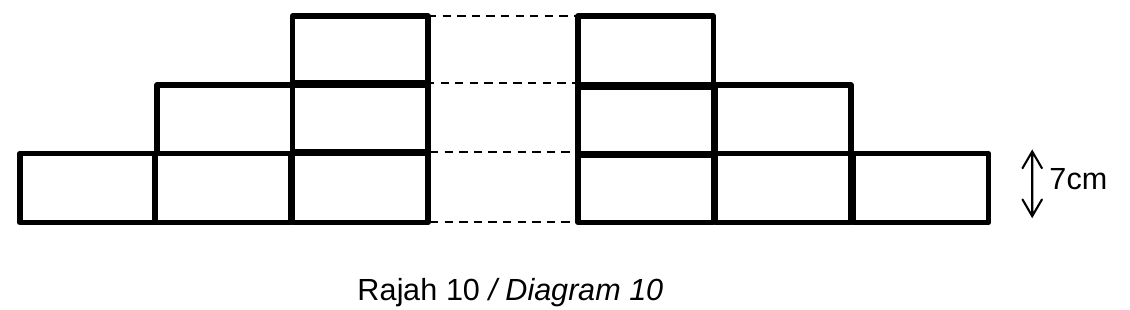
- (a)
Calculate the height, in cm, of the wall.
[3] - (b)
Calculate the total cost of the bricks used if the price of a brick is 50 sen.
[3]
(a) Solve ⁿC₂ = 36. (b) Find the number of ways to form four-digit numbers from the digits 2, 3, 4, 5 and 6 without repetition if the numbers must be (i) less than 4000, (ii) even numbers.
Medium7 marks- (a)
Solve ⁿC₂ = 36.
[4] - (b)(i)
Number of four-digit numbers less than 4000.
[2] - (b)(ii)
Number of four-digit even numbers.
[1]
Given X = {0, 1, 2, 3, 4} is a discrete random variable with the probability distribution in the table: X = r: 0, 1, 2, 3, 4; P(X = r): a, b, a + b, b + a, 0.1. (a) If b = 2a, find the values of a and b. (b) Find P(X > 1).
Easy4 marks- (a)
If b = 2a, find the values of a and b.
[3] - (b)
Find P(X > 1).
[1]
Section B
Given the function f: x → (x + m)/(x − 8), x ≠ k, where m is a constant. (a) State the value of k. (b) Given that 10 maps onto itself under the function f, find (i) the value of m, (ii) f⁻¹(x), (iii) the value of p, given ½f⁻¹(p) = 1.
Medium8 marks- (a)
State the value of k.
[1] - (b)(i)
Given 10 maps onto itself under f, find the value of m.
[3] - (b)(ii)
Find f⁻¹(x).
[2] - (b)(iii)
Find the value of p, given ½f⁻¹(p) = 1.
[2]
(a) Given cos θ = k, 0° < θ < 90°, express in terms of k: (i) sec 2θ, (ii) sin(90° − θ). (b) Solve 4 cos 4θ + 2 cos 2θ + 1 = 0 for 0° ≤ θ ≤ 360°.
Medium8 marks- (a)(i)
Express sec 2θ in terms of k.
[2] - (a)(ii)
Express sin(90° − θ) in terms of k.
[2] - (b)
Solve 4 cos 4θ + 2 cos 2θ + 1 = 0 for 0° ≤ θ ≤ 360°.
[4]
Given that (3k, −2p) and (m/9, n/9) are the solutions of the simultaneous equations x − y − 1 = 0 and 4y/(3x) − 10x/(3y) = 1, find the values of k, m, n and p.
Medium8 marksFind the values of k, m, n and p.
[8]