Write your answer on paper. Then open the answer to check it.
Section A
A bakery bakes three types of cakes, with the monthly cost being RM7 750 for 245 cakes. The costs for baking a banana cake, a carrot cake and a chocolate cake are RM20, RM30 and RM40 respectively. The selling prices of a banana cake, a carrot cake and a chocolate cake are RM25, RM35 and RM50 respectively. If the bakery intends to make a profit of RM1 725 monthly, how many cakes of each type should be baked?
Medium7 marksFind the number of banana, carrot and chocolate cakes (x, y, z).
[7]
(a) Simplify (5 + √7)/(5 − √7). (b) Solve 3^(x−4) = 50^(x−3). Give your answer correct to 3 decimal places.
Easy6 marks- (a)
Simplify (5 + √7)/(5 − √7).
[3] - (b)
Solve 3^(x−4) = 50^(x−3), correct to 3 decimal places.
[3]
Muiz started working for a company on 1 January 2022 with an initial annual salary of RM22 800. Every January, the company increased his salary by 3.5% of the previous year's salary. Give your answers correct to two decimal places. Calculate (a) his annual salary, in RM, for the year 2027, (b) the total salary, in RM, paid to him by the company for the years 2022 to 2027, (c) the minimum value of n such that his annual salary in the nth year will exceed RM40 000.
Medium7 marks- (a)
His annual salary for 2027 (RM).
[2] - (b)
Total salary paid for 2022 to 2027 (RM).
[2] - (c)
Minimum n such that the salary in the nth year exceeds RM40 000.
[3]
It is given that the quadratic equation 3x² − 5x − 2 = 0 has roots α and β where α > 0 and β < 0. (a) Find the sum of roots and the product of roots. (b) Form the quadratic equation with roots α − 1 and β + 3/4.
Medium6 marks- (a)
Find the sum and the product of the roots.
[2] - (b)
Form the quadratic equation with roots α − 1 and β + 3/4.
[4]
(a) Prove the identity 1 − 2sin²θ = 2cos²θ − 1. (b)(i) Sketch the graph of y = −3 sin 2x + 1 for the domain 0 ≤ x ≤ 2π. (ii) Hence, sketch a suitable straight line on the same axes to solve the equation x/(2π) − 1 = −3 sin 2x.
Medium8 marks- (a)
Prove 1 − 2sin²θ = 2cos²θ − 1.
[2] - (b)(i)
Sketch y = −3 sin 2x + 1 for 0 ≤ x ≤ 2π.
[3]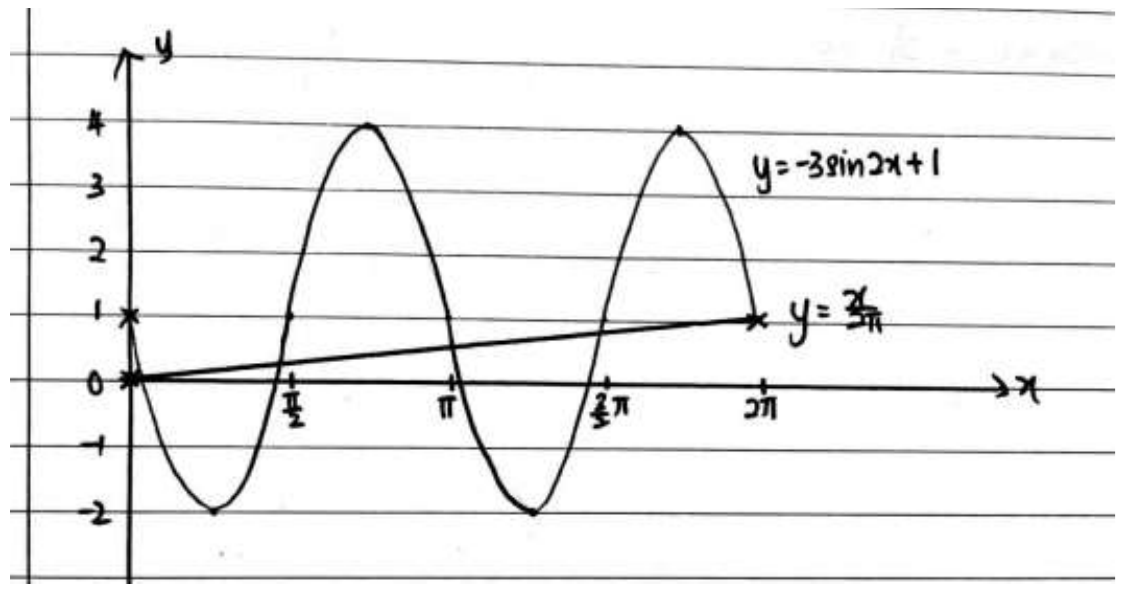
- (b)(ii)
Sketch a suitable straight line to solve x/(2π) − 1 = −3 sin 2x.
[3]
Solutions by scale drawing are not accepted. The diagram shows a quadrilateral ABCD with A(−9, 9), D(1, 9) and B(−8, k). Point M(−5, 3) is the midpoint of AC. Point B lies on the perpendicular bisector of AC. (a) Find the equation of the perpendicular bisector of AC. (b) Find the area of quadrilateral ABCD. (c) Circle Z represents the locus of a moving point P such that its distance from point A is always 10 units. Find the equation of circle Z. Hence, determine whether point B is on the locus of circle Z or not.
Medium8 marks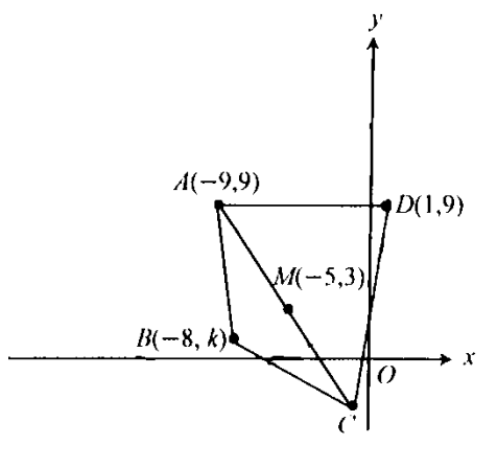
- (a)
Find the equation of the perpendicular bisector of AC.
[2] - (b)
Find the area of quadrilateral ABCD.
[3] - (c)
Find the equation of circle Z and determine whether B lies on it.
[3]
The diagram shows a part of the curve y = x(x − 2)³. (a) Find an expression for dy/dx. (b) Find the coordinates of the two stationary points, P and Q. (c) Hence, determine which stationary point is a point of inflection.
Medium8 marks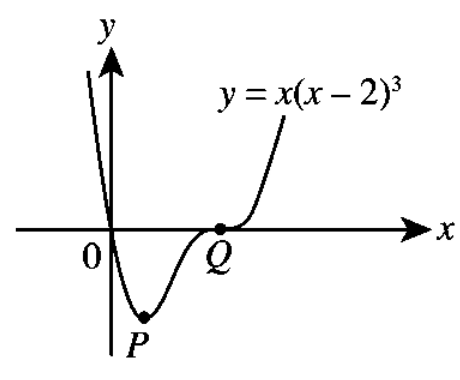
- (a)
Find dy/dx.
[2] - (b)
Find the coordinates of P and Q.
[4] - (c)
Determine which stationary point is a point of inflection.
[2]
Section B
(a) Diagram 8a shows the graph x = −(y + 1)(y − 3). Calculate the area of the shaded region. (b) Diagram 8b shows the straight line x + y = 5 intersecting the curve y = 4/x, x > 0 at point A and point B. (i) Find the coordinates of point A and point B. (ii) The region bounded by the curve y = 4/x and the straight line AB is revolved through 360° about the x-axis. Calculate the volume, in terms of π, of the solid generated.
Medium10 marks- (a)
Calculate the area of the shaded region.
[4]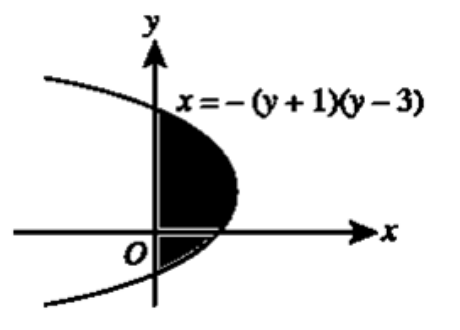
- (b)(i)
Find the coordinates of A and B.
[2]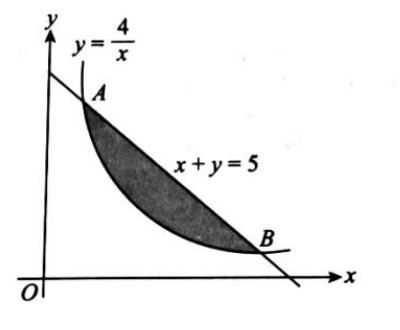
- (b)(ii)
Find the volume of the solid of revolution in terms of π.
[4]
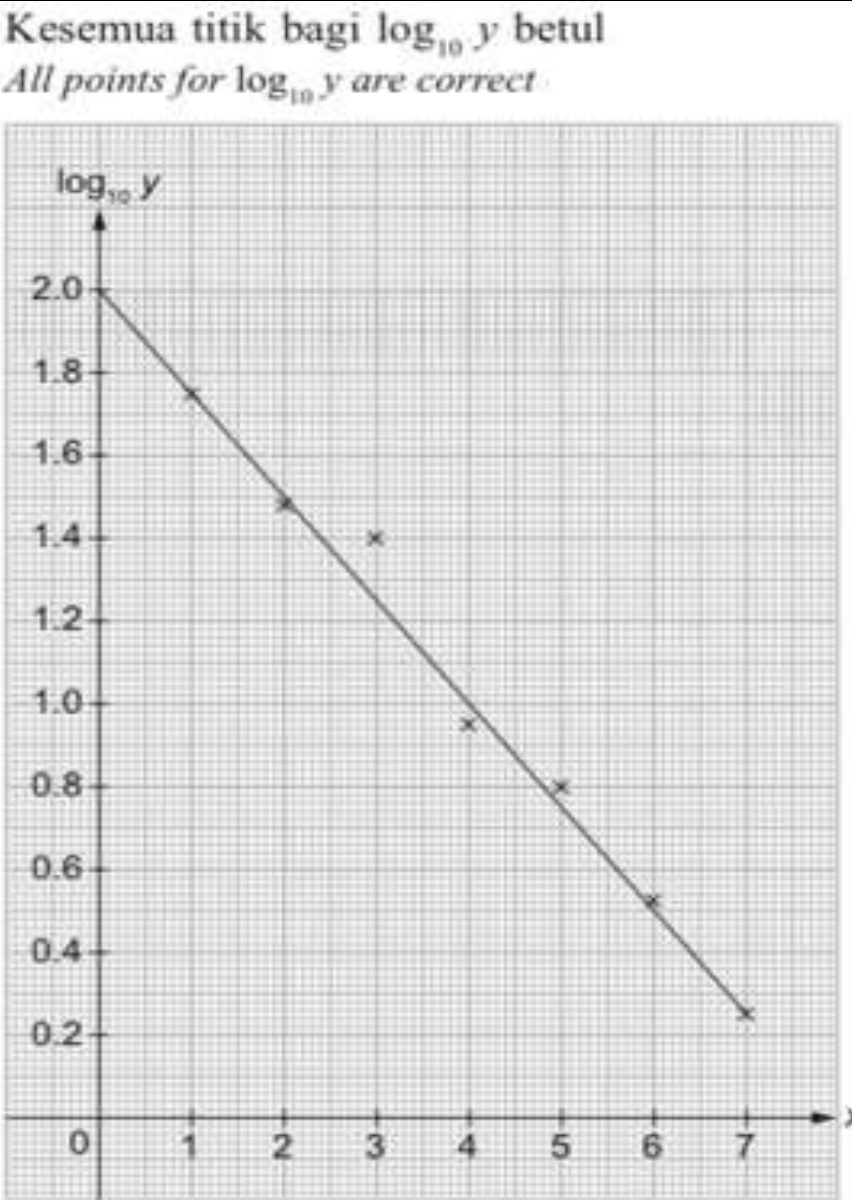
Use graph paper to answer this question. The variables x and y are related by the equation y = mn^(−x), where m and n are constants. The values of x and y obtained from an experiment are shown in Table 1. One of the values of y is wrongly recorded. Table 1: x = 1, 2, 3, 4, 5, 6, 7; y = 56.2, 29.9, 25.1, 8.91, 6.31, 3.35, 1.78.
Medium10 marks
- (a)
Plot log₁₀y against x, using a scale of 2 cm to 1 unit on the x-axis and 2 cm to 0.2 unit on the log₁₀y-axis. Hence, draw the line of best fit.
[4]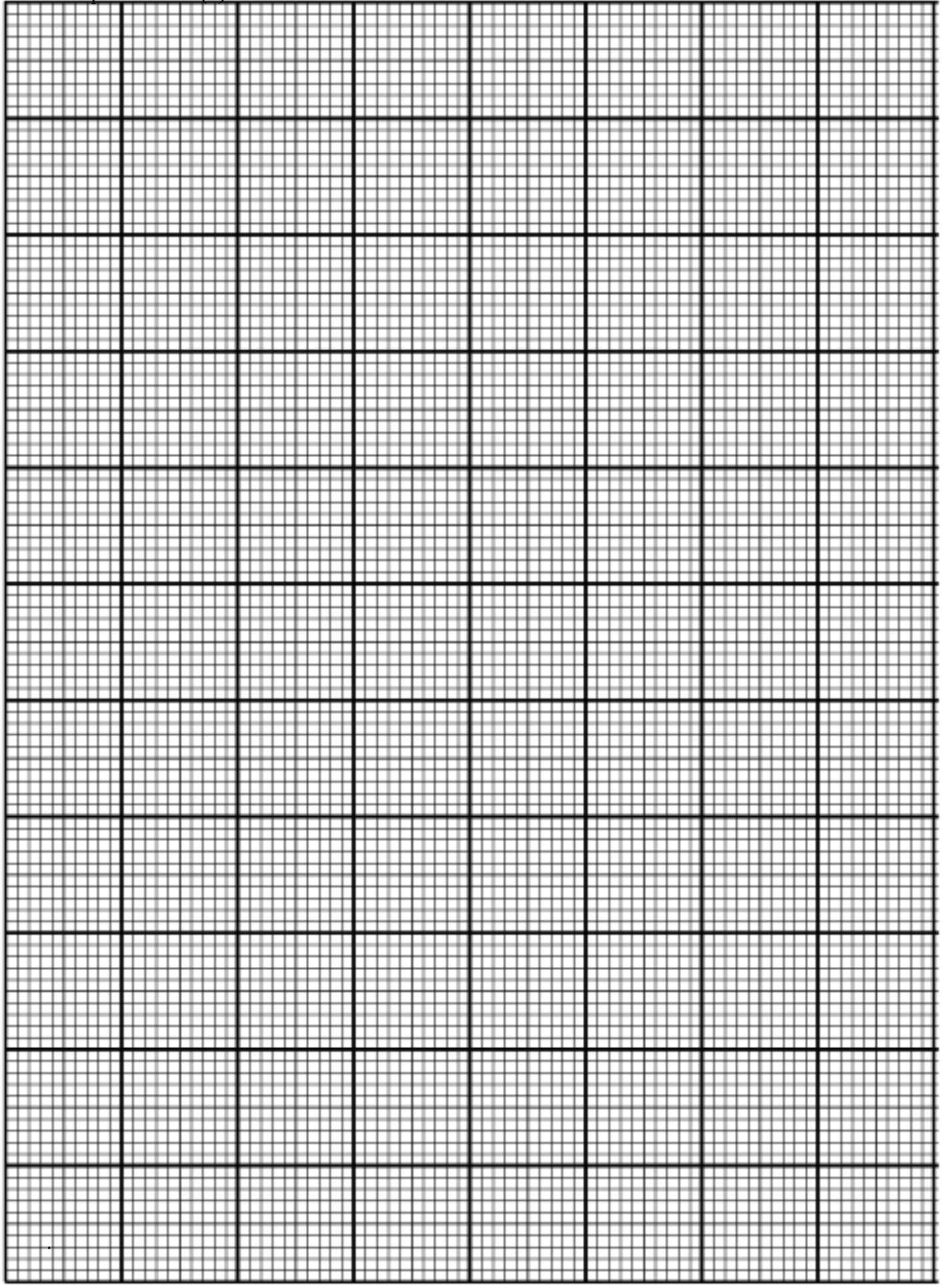
- (b)(i)
Use your graph to find the wrongly recorded value of y and state the correct value of y.
[1] - (b)(ii)
Use your graph to find the values of m and n.
[5]
(a) It is found that 20% of primary school students in Muar district suffer from malnutrition. (i) If the number of students suffering from malnutrition is 50, calculate the total number of primary school students in the district. (ii) If 10 students from the district are selected at random, find the probability that exactly 4 of them suffer from malnutrition. (b) The masses of babies born in a hospital are normally distributed with a mean of 3.1 kg and a variance of 0.09 kg². (i) Find the probability that a baby born in that hospital has a mass between 2.9 kg and 3.3 kg. (ii) If 25% of babies born in that hospital are categorised as underweight, find the maximum mass of this category.
Medium10 marks- (a)(i)
Total number of primary school students in the district.
[2] - (a)(ii)
Probability that exactly 4 of 10 students suffer from malnutrition.
[2] - (b)(i)
Probability that a baby has a mass between 2.9 kg and 3.3 kg.
[3] - (b)(ii)
Maximum mass of the underweight category (25% of babies).
[3]
Diagram 11 shows triangles OAQ and OPB where point P lies on OA and point Q lies on OB. The straight lines AQ and PB intersect at point R. It is given that OA→ = 18x, OB→ = 16y, OP : PA = 1 : 2, OQ : QB = 3 : 1, PR→ = m PB→ and QR→ = n QA→, where m and n are constants. (a) Express OR→ in terms of (i) m, x, y (ii) n, x, y. (b) Hence, find the value of m and the value of n. (c) Given |x| = 2 units and |y| = 1 unit and OA is perpendicular to OB, calculate |PR→|.
Medium10 marks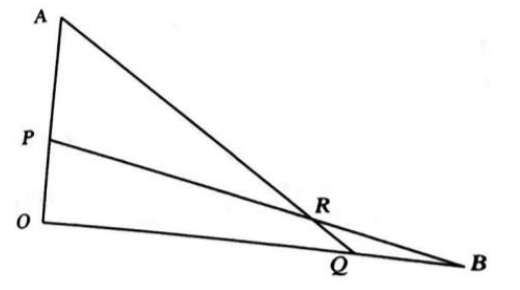
- (a)
Express OR→ in terms of (i) m, x, y and (ii) n, x, y.
[4] - (b)
Find the values of m and n.
[4] - (c)
Calculate |PR→|.
[2]
Section C
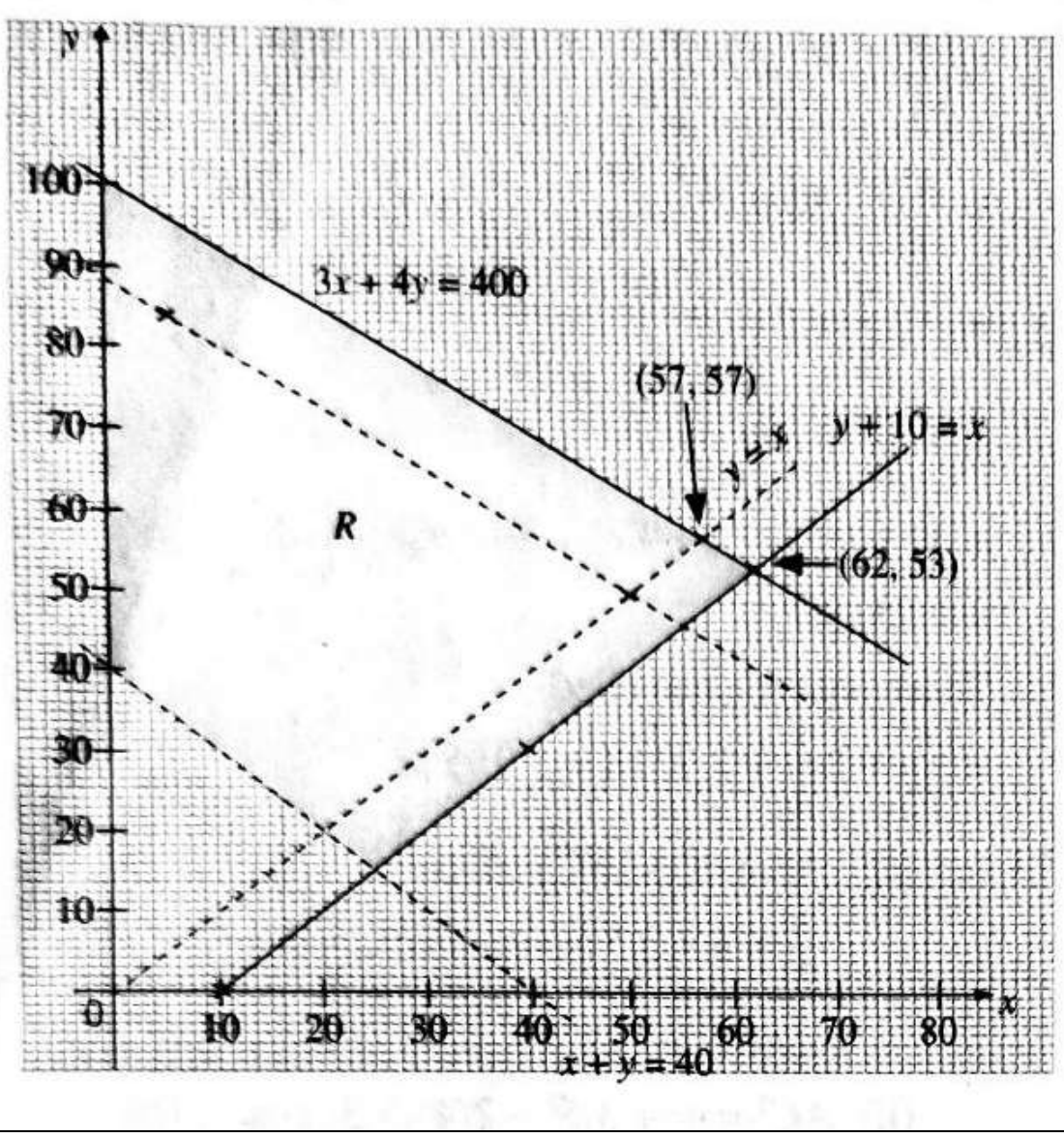
Use graph paper to answer this question. Siti is assigned to prepare prizes for STEM Week. She must buy x sets of pens and y sets of notebooks. The price of one set of pens is RM3 and the price of one set of notebooks is RM4. The purchase is based on these constraints: I The total number of sets of pens and sets of notebooks must be more than 40. II The total allocation is RM400. III The number of sets of pens exceeds the number of sets of notebooks by at most 10. (a) Write three inequalities, other than x ≥ 0 and y ≥ 0, which satisfy all the above constraints. (b) Using a scale of 2 cm to 10 sets on both axes, construct and shade the region R which satisfies all the above constraints. (c) Use your graph in (b) to find (i) the minimum balance of the allocation, if the number of sets of pens purchased equals the number of sets of notebooks, (ii) the maximum number of sets of pens that can be purchased if Siti spends RM50 on wrapping paper.
Medium10 marks- (a)
Write three inequalities (other than x ≥ 0, y ≥ 0) for the constraints.
[3] - (b)
Construct the three straight lines and shade region R (2 cm to 10 sets on both axes).
[3]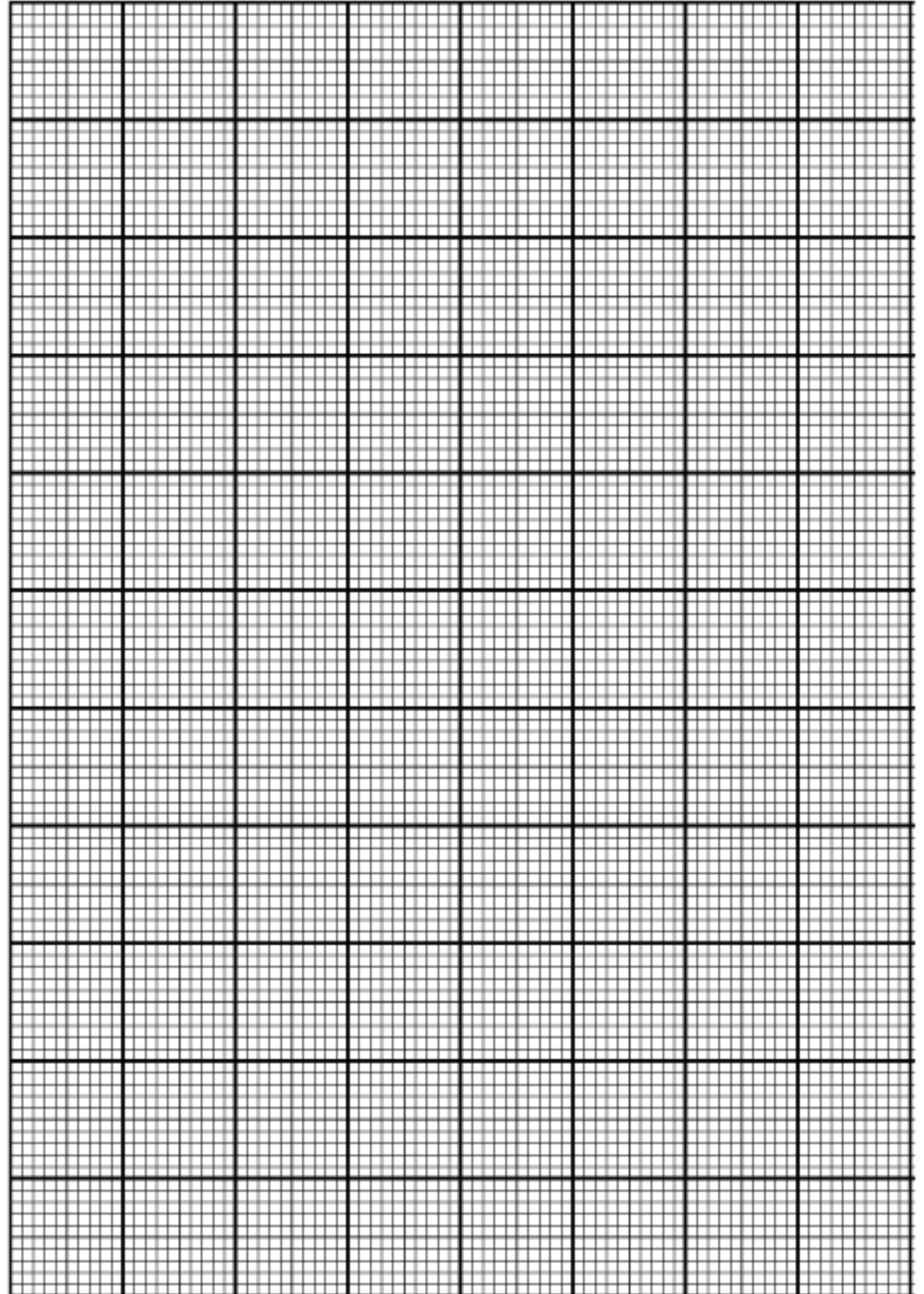
- (c)(i)
Minimum balance of the allocation if the number of sets of pens equals the number of sets of notebooks.
[2] - (c)(ii)
Maximum number of sets of pens if Siti spends RM50 on wrapping paper.
[2]
Solutions by scale drawing are not accepted. The diagram shows a cyclic quadrilateral ABCD with AB = 8 cm, BC = 7 cm, ∠ABC = 80°, CD = 3 cm. (a) Calculate (i) the length, in cm, of AC, (ii) ∠ACD. (b) Find (i) the area, in cm², of △ABC using Heron's formula, (ii) the shortest distance, in cm, from point B to AC.
Medium10 marks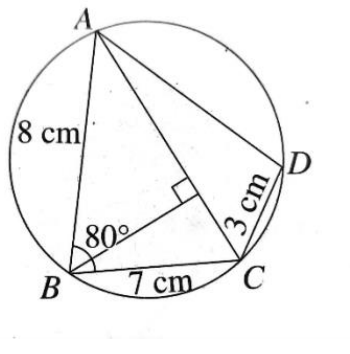
- (a)(i)
Calculate the length of AC.
[2] - (a)(ii)
Calculate ∠ACD.
[3] - (b)(i)
Area of △ABC using Heron's formula.
[3] - (b)(ii)
Shortest distance from B to AC.
[2]
The table shows information related to four materials P, Q, R and S used in making a toy. The percentage of usage of material Q is not shown. Material P: reduced by 10% (change in price index from 2016 to 2019), usage 50%. Q: increased by 60%, usage k%. R: increased by 40%, usage 10%. S: increased by 20%, usage 10%. The production cost of the toy was RM61 750 in the year 2019. (a) If the price of material R in the year 2016 was RM8.50, find its price in the year 2019. (b) Calculate the corresponding production cost in the year 2016. (c) The production cost is expected to increase by 65% from the year 2019 to the year 2021. Calculate the percentage change in the production cost from the year 2016 to the year 2021.
Medium10 marks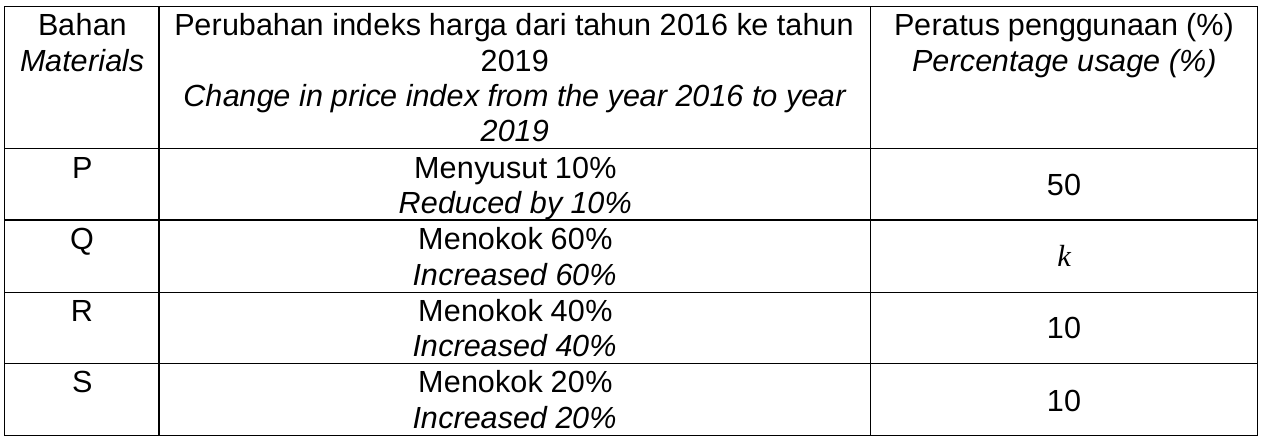
- (a)
Price of material R in 2019 (price in 2016: RM8.50).
[2] - (b)
Production cost in 2016.
[5] - (c)
Percentage change in production cost from 2016 to 2021.
[3]
The acceleration, a m s⁻², of a particle that moves along a straight line is given by a = 8 − 2t, where t is the time in seconds after passing through a fixed point O. It is given that its velocity is 16 m s⁻¹ when t = 2. Find (a) the initial velocity of the particle, (b) the maximum velocity of the particle, (c) the distance travelled in the 3rd second.
Medium10 marks- (a)
Initial velocity of the particle.
[4] - (b)
Maximum velocity of the particle.
[3] - (c)
Distance travelled in the 3rd second.
[3]