Write your answer on paper. Then open the answer to check it.
Section A
The diagram shows a circle with centre O and radius 9 cm. AOB is an arc of a circle with centre C which is on the circumference of the circle. Find ∠AOB in radians.
Easy2 marks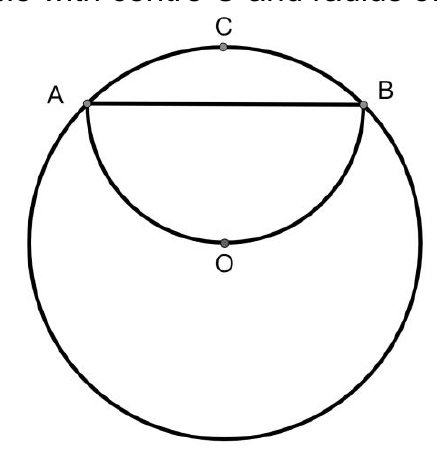
Find ∠AOB in radians.
[2]
Diagram 2 shows part of a graph of y against x. The curve has end points (0.5, 9) and (1.5, 81). The variables x and y are related by the equation y = 3^(px+q) where p and q are constants.
Medium4 marks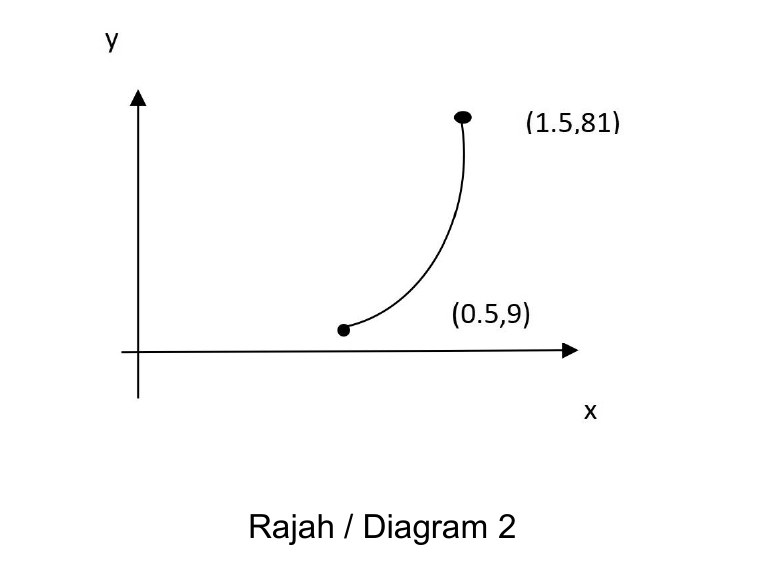
- (a)
Calculate the values of p and q.
[2] - (b)
Reduce the equation y = 3^(px+q) to the linear form Y = mX + c. Hence, sketch the linear graph for the equation.
[2]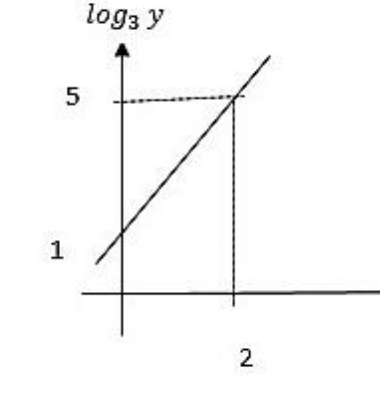
(a) Show that (3⁵ + 13)(5^(3n) + 2^(8(n+1))) is divisible by 8 for all positive integers n. (b) Given 3(4^p) = 5(2^q) and 9(8^p) = 10(4^q), show that 2^(p+1) = 5.
Medium5 marks- (a)
Show that (3⁵ + 13)(5^(3n) + 2^(8(n+1))) is divisible by 8 for all positive integers n.
[2] - (b)
Given 3(4^p) = 5(2^q) and 9(8^p) = 10(4^q), show that 2^(p+1) = 5.
[3]
Two variables, x and y, are related by the equation y = 24/x². Express in terms of p, the approximate change in y when x changes from 6 to 6 + p, where p is a small value.
Easy4 marksExpress the approximate change in y in terms of p.
[4]
(a) The quadratic equation 3x² − x + k = kx − 1, where k is a constant, has two distinct roots. Find the range of values of k. (b) Diagram 5 shows the graph of quadratic function y = f(x) with a minimum point (3, −7); the graph passes through (0, 5). Express f(x) in the form a(x + p)² + q where a, p and q are constants. (c) If the graph in Diagram 5 is reflected in the x-axis, write the new f(x) and state whether the axis of symmetry changes.
Medium7 marks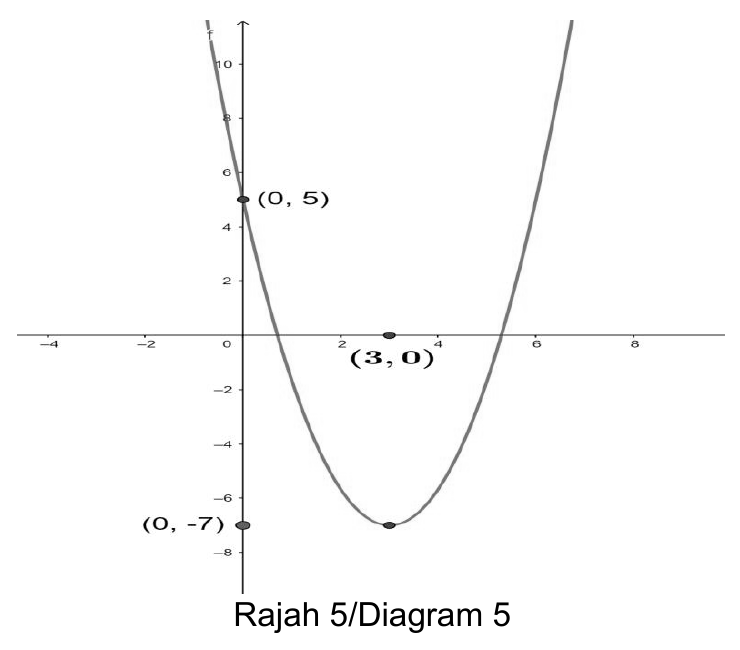
- (a)
Find the range of values of k.
[3] - (b)
Express f(x) in the form a(x + p)² + q.
[2] - (c)
Write the new f(x) after reflection in the x-axis; does the axis of symmetry change?
[2]
Diagram 13 shows the cross section of a log floating in water. The cross section is a circle with centre O and radius 30 cm. The chord AB is at the water surface level and the highest point P is 6 cm above the water surface. Use π = 3.142. Find (a) the minor ∠AOB in radians, (b) the cross-sectional area, in cm², under the water surface.
Medium6 marks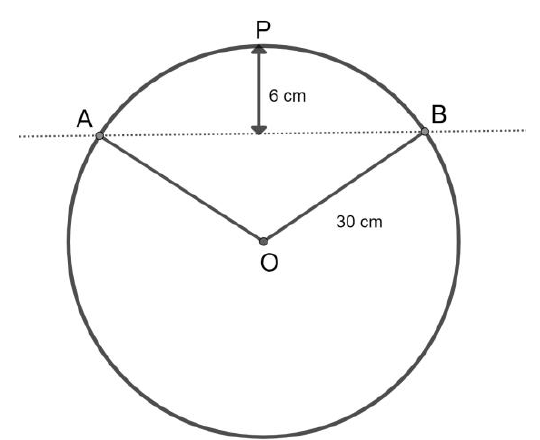
- (a)
Find the minor ∠AOB in radians.
[2] - (b)
Find the cross-sectional area, in cm², under the water surface.
[4]
(a) Given the functions f: x → 2x − 7, g: x → px + 3 and gf: x → 2px + 5q. Express q in terms of p. (b) Diagram 1 shows a graph of a function g(x): a straight line from (0, −3) to (2, 5). (i) If the range of g(x) for the domain 0 ≤ x ≤ 2 is −3 ≤ g(x) ≤ m/2, determine the value of m. (ii) Determine the function g⁻¹(x).
Medium6 marks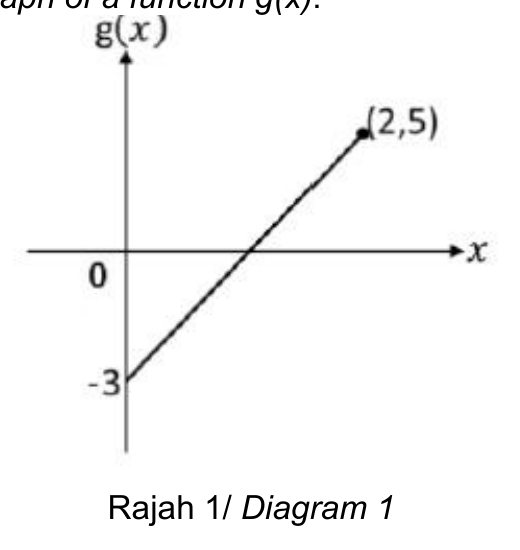
- (a)
Express q in terms of p.
[3] - (b)(i)
Determine the value of m.
[2] - (b)(ii)
Determine the function g⁻¹(x).
[1]
Given the points P(1, 2), Q(−2, −4), R(−3, h) and S(3, −4). If the straight line PQ is perpendicular to the straight line RS, find the value of h. Then, find the coordinates of the intersection point of lines PQ and RS.
Easy6 marks- (a)
Find the value of h.
[2] - (b)
Find the coordinates of the intersection point of PQ and RS.
[4]
(a) Given h(x) = (5x + 2)²/10, find ∫₁² h′(x) dx. (b) Given ∫₁⁷ k(x) dx = 10, find the value of ∫₁³ [k(x) − 3] dx + ∫₃⁷ k(x) dx.
Easy5 marks- (a)
Find ∫₁² h′(x) dx.
[2] - (b)
Find ∫₁³ [k(x) − 3] dx + ∫₃⁷ k(x) dx.
[3]
(a) The diagram shows a circle with centre O divided into 10 sectors. The angles of the sectors (18°, 22°, 26°, 30°, …) form an arithmetic progression with first term 18°. Show that the formula for the nth term of an arithmetic progression is Tₙ = a + (n − 1)d. (b) The sum of the first n terms of an arithmetic progression is given by Sₙ = 2n² − 4n. Find (i) the sum of the first 8 terms, (ii) the 8th term.
Medium8 marks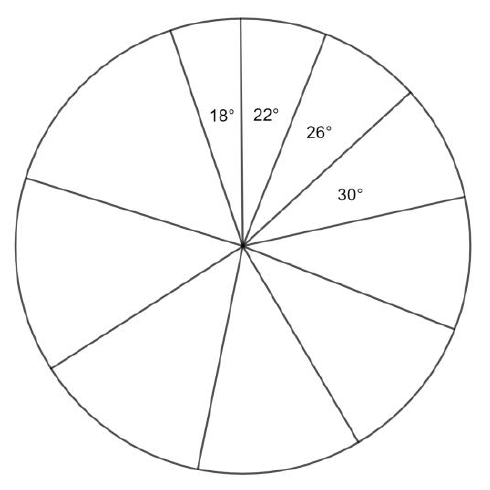
- (a)
Show that Tₙ = a + (n − 1)d.
[4] - (b)(i)
Find the sum of the first 8 terms.
[2] - (b)(ii)
Find the 8th term.
[2]
(a) Prove that ⁿ⁺¹C₂ − ⁿC₂ = n. (b) Find the number of ways for eight people, Ahmad, Ben, Chia, Dorty, Ezam, Fauzi, Gandhi and Haiza, to sit at a round table such that Dorty and Ben cannot sit side by side.
Medium7 marks- (a)
Prove that ⁿ⁺¹C₂ − ⁿC₂ = n.
[3] - (b)
Find the number of ways for the eight people to sit at a round table with Dorty and Ben not side by side.
[4]
The probability that Wecy will win a speech contest is 3/5. If she takes part in 6 speech contests, find the probability that (i) she wins exactly 4 times, (ii) she loses less than twice.
Easy4 marks- (i)
Find the probability that she wins exactly 4 times.
[2] - (ii)
Find the probability that she loses less than twice.
[2]
Section B
Ship A leaves harbour P with a velocity of v_A = (3**i** + **j**) km h⁻¹ at the same time as ship B leaves harbour Q with a velocity of v_B = (−2**i** + 3**j**) km h⁻¹. The position vector of harbour Q from O is OQ→ = (10**i** + 4**j**) km. (a) Determine the speed of ship A. (b) Find the velocity of ships A and B after t hours, in terms of t. (c) Did the two ships meet? State your reasons.
Medium8 marks- (a)
Determine the speed of ship A.
[1] - (b)
Find the velocity of ships A and B after t hours, in terms of t.
[2] - (c)
Did the two ships meet? State your reasons.
[5]
The graphs of 2x + 3y = 2 and 2/x + 3/y = 13 are shown in the diagram. State the coordinates of points A and B.
Medium8 marks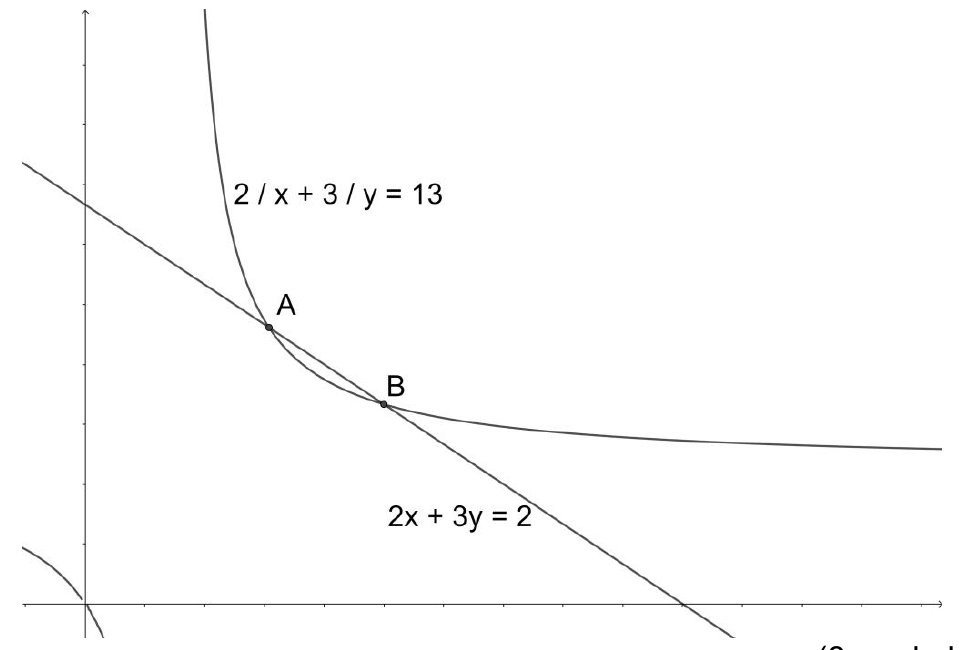
State the coordinates of points A and B.
[8]
(a) Solve the equation sin 2θ = sin θ for 0° ≤ θ ≤ 360°. (b) Given that tan x = c/d, where π ≤ x ≤ 3π/2. Express the following in terms of c and d. (i) sin (90° − x), (ii) tan 2x.
Medium8 marks- (a)
Solve sin 2θ = sin θ for 0° ≤ θ ≤ 360°.
[3] - (b)(i)
Express sin (90° − x) in terms of c and d.
[2] - (b)(ii)
Express tan 2x in terms of c and d.
[3]