Write your answer on paper. Then open the answer to check it.
Section A
A charity show was held to raise funds for flood victims. An adult ticket sold for RM15, a student ticket for RM10 and a child ticket for RM8. The organisers sold 250 tickets and obtained RM2 825 in one night. The number of student tickets sold is twice the number of adult tickets sold. How many of each type of ticket did the organisers sell?
Medium7 marksFind the number of adult, student and child tickets sold.
[7]
(a) The area of a rectangle is (3 + √2) unit². If the length is (2 − √2) units, find its width in the form (a + b√2) units. (b) Solve the logarithmic equation log₇(x − 1) − log₇(x − 7) = 1.
Medium6 marks- (a)
Find the width in the form (a + b√2) units.
[4] - (b)
Solve log₇(x − 1) − log₇(x − 7) = 1.
[2]
Radesh is offered a job in two companies, X and Y. Company X offers RM 45 500 per annum with a RM 500 yearly increment, while company Y offers RM 40 300 per annum with a 7% yearly increment. (a) Based on the salaries and increments offered, determine which company's salary scheme follows (i) a geometric progression. (b) Find his salary if he works for 5 years in company X or Y. (c) Radesh chooses the company that offers the higher salary amount. During his tenure at the company, he saves 13% of his annual salary in the bank. Calculate the amount deposited in the bank after 10 years, regardless of bank interest.
Medium7 marks- (a)(i)
Determine which company's salary scheme follows a geometric progression.
[3] - (b)
Find his salary after working for 5 years in company X or Y.
[2] - (c)
Calculate the amount deposited in the bank after 10 years.
[2]
The quadratic equation x² + 3(4x + k) = 0, where k is a constant, has roots p and 2p, p ≠ 0. (a) Find the value of p and of k. (b) Hence, form the quadratic equation that has the roots p + 1 and p − 5.
Medium6 marks- (a)
Find the value of p and of k.
[4] - (b)
Form the quadratic equation with roots p + 1 and p − 5.
[2]
(a) Prove that sin²A + cos²A = 1. (b) Sketch the graph y = −sin x for 0 ≤ x ≤ 2π. (c) Given f(x) = a sin bx + c for 0° ≤ x ≤ 360°. If the amplitude of the graph is 4, its period is 120° and the minimum value of f(x) is −3, state the values of a, b and c. Hence, sketch the graph of the function.
Medium8 marks- (a)
Prove that sin²A + cos²A = 1.
[2] - (b)
Sketch the graph y = −sin x for 0 ≤ x ≤ 2π.
[2]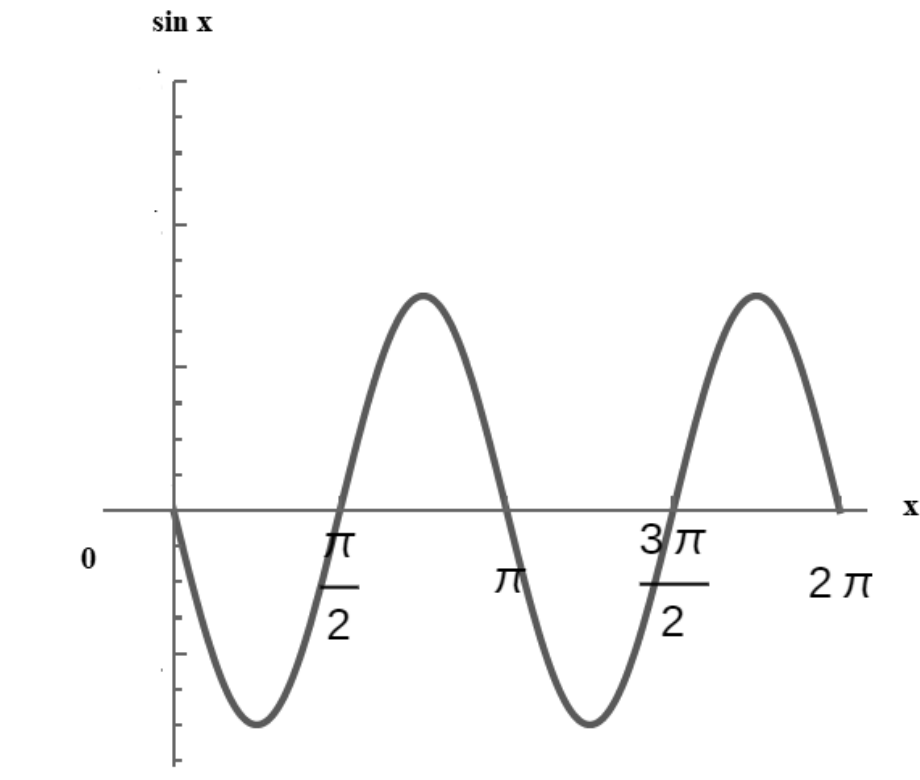
- (c)
State the values of a, b and c, and sketch the graph of the function.
[4]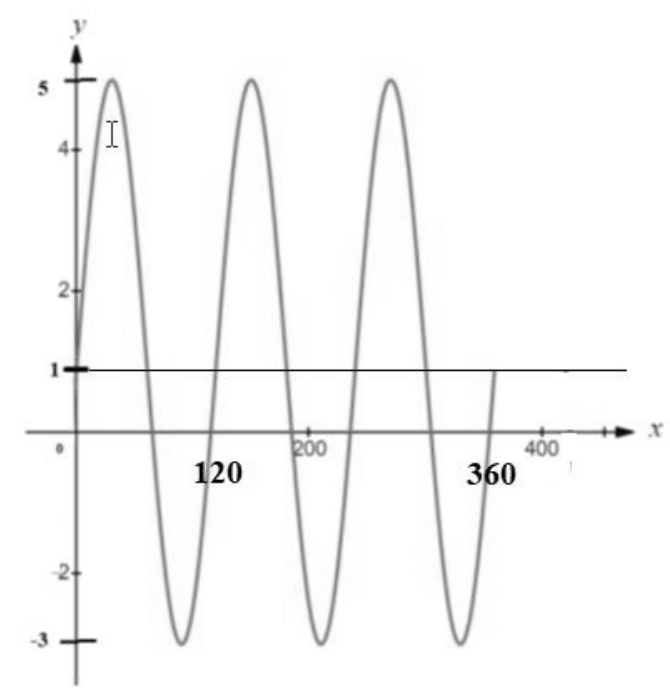
A and C are two points with coordinates (5, 2) and (9, 8) respectively. Point B lies on the x-axis. (a) Find the equation of the locus of a moving point P such that P is always equidistant from A and C. (b) D is a point such that ABCD is a rhombus. Find the area of the rhombus. (c) Determine whether the locus of P passes through the point R(10, 2).
Medium8 marks- (a)
Find the equation of the locus of P equidistant from A and C.
[3] - (b)
Find the area of the rhombus ABCD.
[3] - (c)
Determine whether the locus passes through R(10, 2).
[2]
Diagram 7 shows part of the curve y = x(x + 2)³, with stationary points P and Q. (a) Find an expression for dy/dx. (b) Find the coordinates of the two stationary points, P and Q. (c) Hence, determine the nature of stationary point P using the tangent sketching method.
Medium8 marks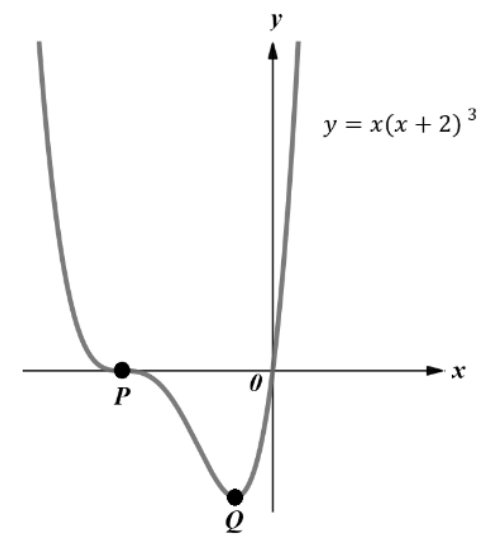
- (a)
Find an expression for dy/dx.
[2] - (b)
Find the coordinates of the stationary points P and Q.
[4] - (c)
Determine the nature of P using the tangent sketching method.
[2]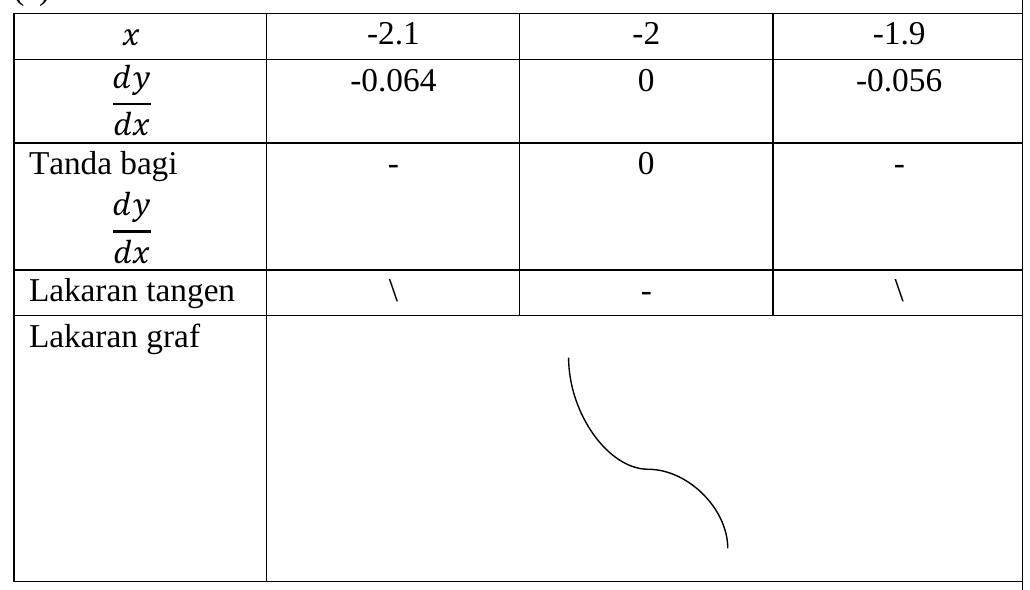
Section B
Diagram 8 shows the curve x = y² + 3 intersecting the straight line y = 5 − x at A and the x-axis at point B. The point A is given as A(1, 4) in the paper (the diagram marks 1 on the y-axis and 4 on the x-axis, so A is at x = 4, y = 1). Find (a) the coordinates of point B, (b) the area of the shaded region R, (c) the volume generated, in terms of π, when the region bounded by the curve x = y² + 3, the straight line y = 5 − x and the x-axis is revolved through 360° about the x-axis.
Medium10 marks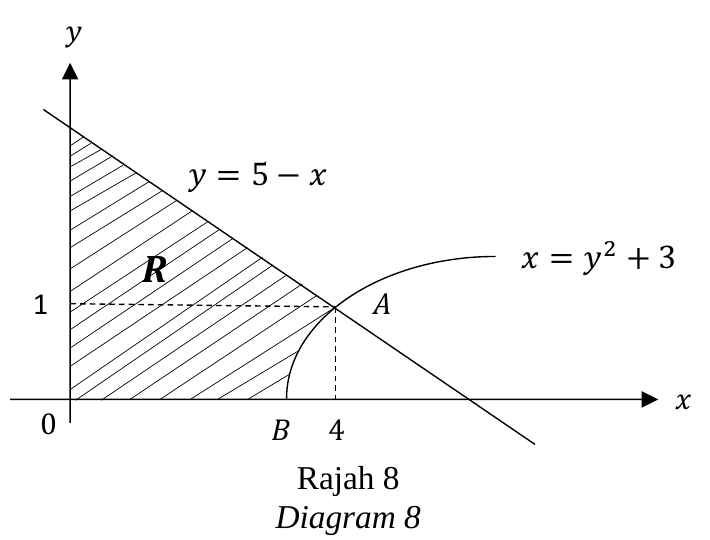
- (a)
Find the coordinates of point B.
[2] - (b)
Find the area of the shaded region R.
[4] - (c)
Find the volume generated, in terms of π.
[4]
Diagram 9 shows a quadrilateral ABCD. The diagonals BD and AC intersect at F. Point E lies on AD. It is given that AE→ = (1/5)AD→, BF→ = (1/5)BD→, AB→ = **x** and AE→ = **y**. (a) Express in terms of **x** and **y**: (i) DB→, (ii) AF→. (b) Given DC→ = m**x** − **y** and AF→ = nAC→, where m and n are constants, find the value of m and of n.
Medium10 marks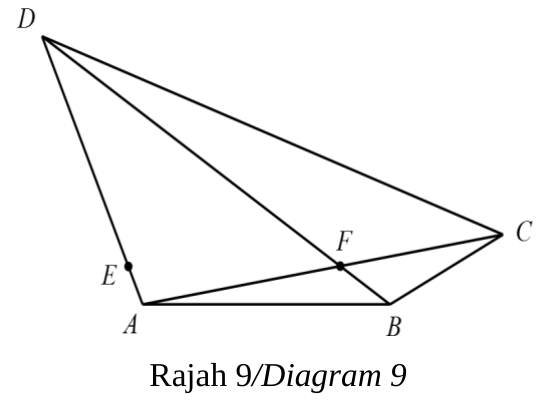
- (a)(i)
Express DB→ in terms of x and y.
[2] - (a)(ii)
Express AF→ in terms of x and y.
[3] - (b)
Find the value of m and of n.
[5]
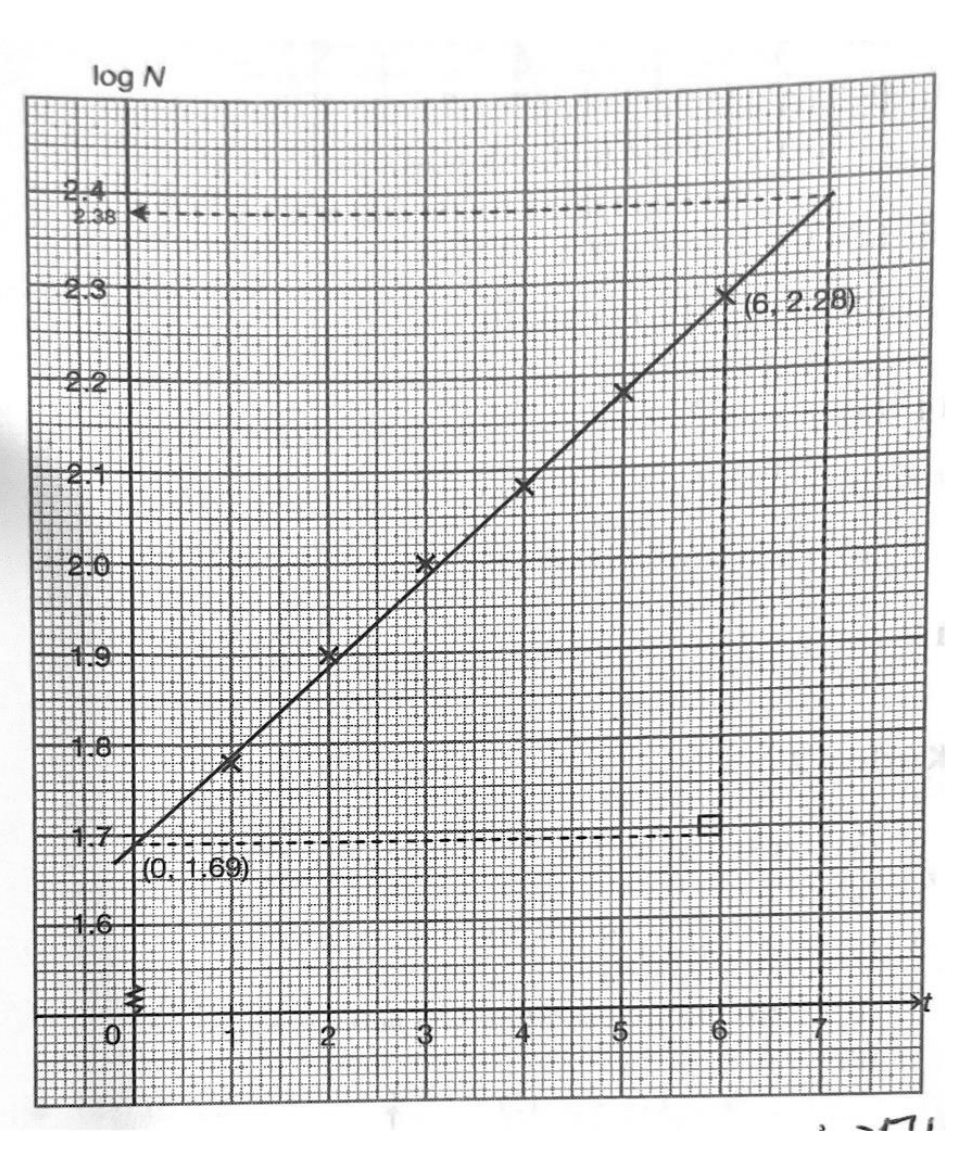
Use graph paper. A colony of bacteria is cultured in a petri dish. The number of colonies N after t days is: t = 1, 2, 3, 4, 5, 6 (days); N = 60, 80, 100, 120, 150, 190 (colonies) (Table 1). The culture is related by N = Ar^t, where A and r are constants and N and t are integers. (a) Plot log₁₀N against t using a scale of 2 cm to 1 day on the t-axis and 2 cm to 0.1 unit on the log₁₀N-axis. Hence draw the line of best fit. (b) Use the graph in (a) to estimate the value of (i) A, (ii) r. (c) Find the number of colonies of bacteria when t = 7.
Medium10 marks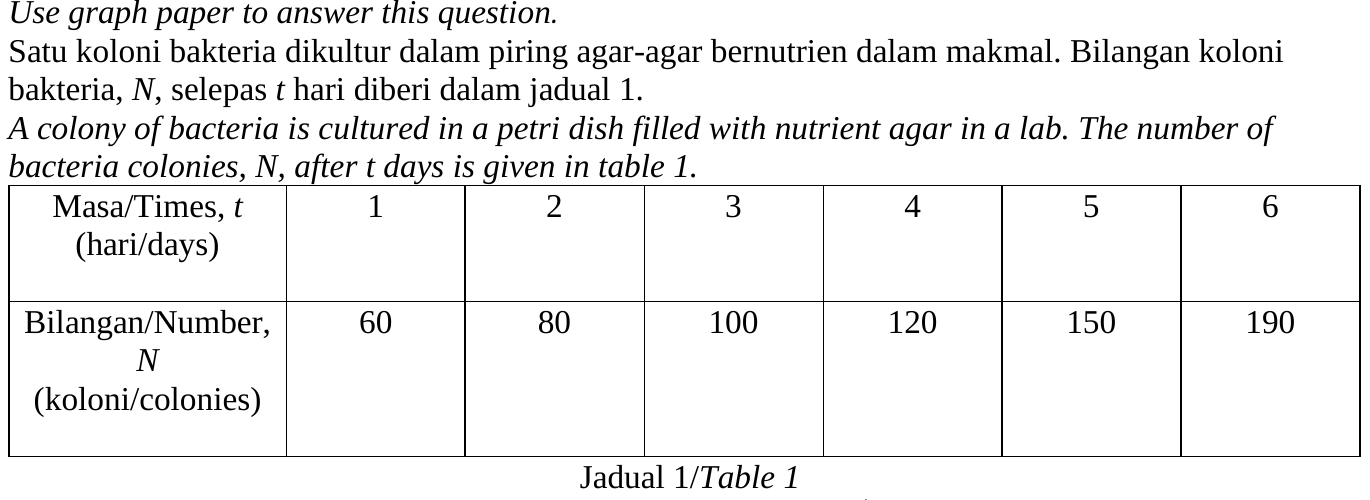
- (a)
Plot log₁₀N against t (2 cm to 1 day; 2 cm to 0.1 unit) and draw the line of best fit.
[5]
- (b)(i)
Estimate the value of A.
[2] - (b)(ii)
Estimate the value of r.
[2] - (c)
Find the number of colonies of bacteria when t = 7.
[1]
(a) 10% of the mobile phones produced in a factory are spoilt. Find the probability that out of 8 mobile phones chosen randomly, (i) exactly 3 phones are spoilt, (ii) more than 5 phones are in good condition. (b) In an Explorace competition with 600 students, the time taken to complete the race follows a normal distribution with a mean of 25 minutes and a standard deviation of 8 minutes. Participants take no points if they take more than 35 minutes. (i) If a participant is chosen at random, find the probability that the participant does not get any point. (ii) Trophies are awarded to the first 100 participants who take less than t minutes. Find the value of t.
Medium10 marks- (a)(i)
Find the probability that exactly 3 phones are spoilt.
[2] - (a)(ii)
Find the probability that more than 5 phones are in good condition.
[3] - (b)(i)
Find the probability that a participant does not get any point.
[2] - (b)(ii)
Find the value of t.
[3]
Section C
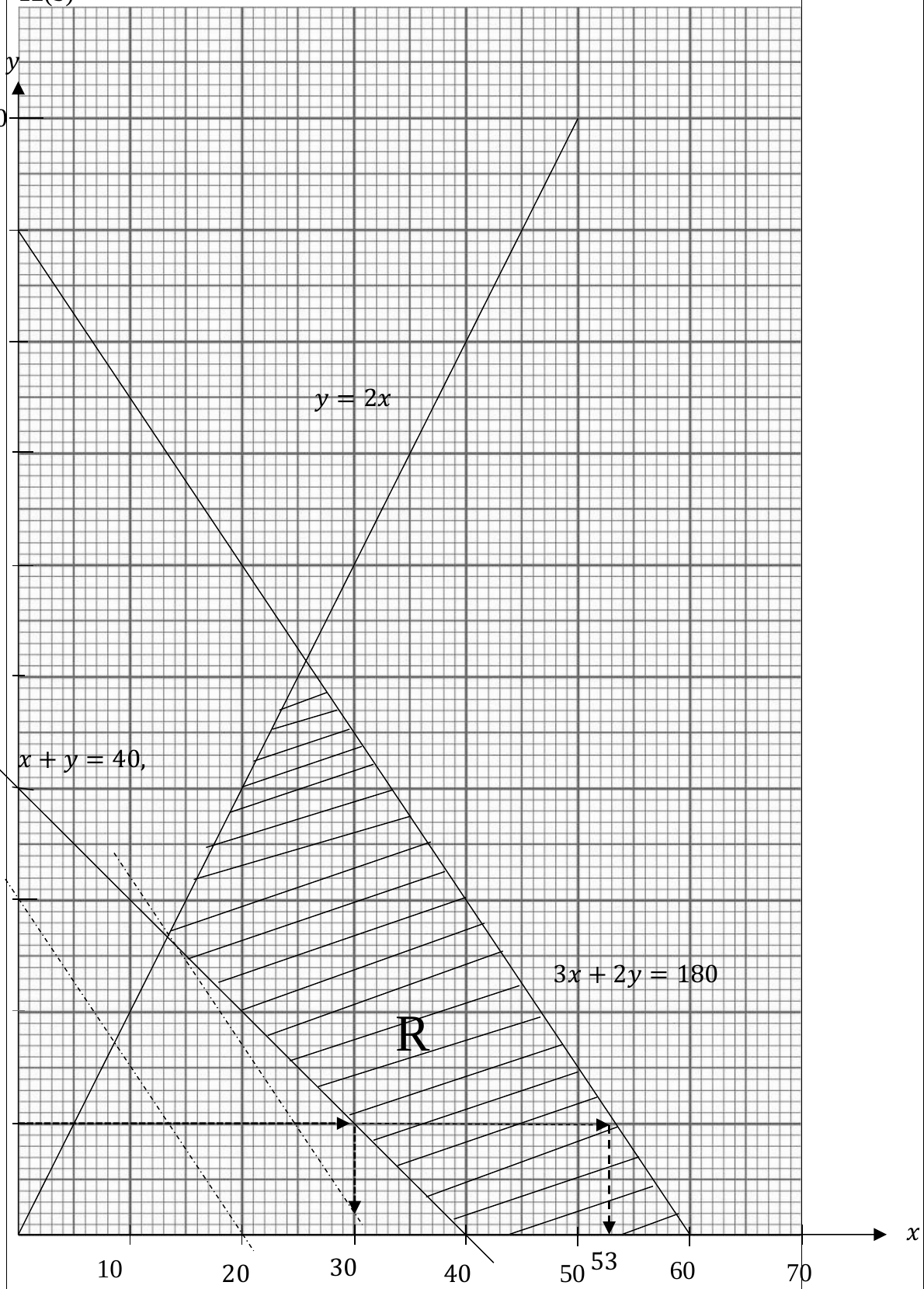
Use graph paper. A District Education Office plans a course on teaching Mathematics and Science in English, attended by x Mathematics participants and y Science participants. The constraints are: I. The total number of participants is at least 40. II. The number of Science participants is at most twice the number of Mathematics participants. III. The maximum allocation for the course is RM7200. The expenditure for a Mathematics participant is RM120 and for a Science participant is RM80. (a) Write down three inequalities, other than x ≥ 0 and y ≥ 0, which satisfy the above constraints. (b) Using a scale of 2 cm to 10 participants on both axes, construct and shade the region R which satisfies all the constraints. (c) Using the graph from (b), find (i) the maximum and minimum number of Mathematics participants when the number of Science participants is 10, (ii) the minimum cost to run the course.
Medium10 marks- (a)
Write down three inequalities, other than x ≥ 0 and y ≥ 0.
[3] - (b)
Construct and shade the region R (scale 2 cm to 10 participants on both axes).
[3]
- (c)(i)
Find the maximum and minimum number of Mathematics participants when there are 10 Science participants.
[2] - (c)(ii)
Find the minimum cost to run the course.
[2]
A particle moves along a straight line to the right with a velocity of 5 m s⁻¹. It experiences an acceleration a = 11 − 6t m s⁻², where t is the time in seconds after leaving point O. (a) Find the velocity function of the particle. (b) Sketch the velocity-time graph for 0 ≤ t ≤ 6. (c) Find for the first 6 seconds (i) the displacement, in m, (ii) the total distance, in m, travelled by the particle.
Medium10 marks- (a)
Find the velocity function of the particle.
[2] - (b)
Sketch the velocity-time graph for 0 ≤ t ≤ 6.
[2]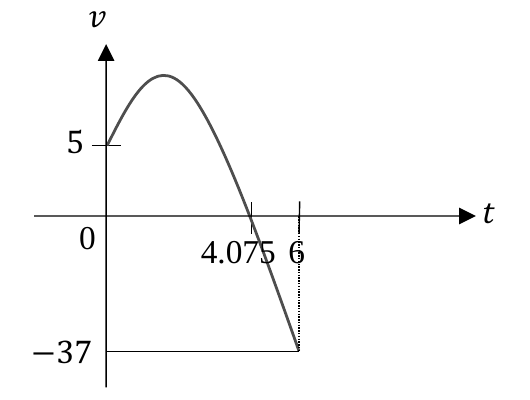
- (c)(i)
Find the displacement in the first 6 seconds.
[3] - (c)(ii)
Find the total distance travelled in the first 6 seconds.
[3]
Diagram 14 shows a cyclic quadrilateral PQRS. Given PQ = 5.3 cm, QR = 4.6 cm, PR = 7.4 cm and ∠PRS = 60°, find (a) the area of △PQR, (b) ∠PSR, (c) the area of the quadrilateral PQRS.
Medium10 marks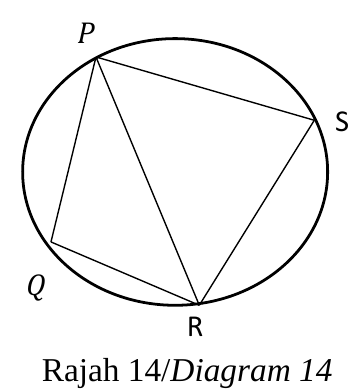
- (a)
Find the area of △PQR.
[3] - (b)
Find ∠PSR.
[3] - (c)
Find the area of the quadrilateral PQRS.
[4]
Table 2 shows the prices, price indices and daily production for commodities A, B, C and D. Commodity A: price 2014 RM24, 2017 RM30, price index in 2017 based on 2014 = p, production 12 (thousand units). B: RM40, q, index 120, production 14. C: r, RM18, index 90, production 10. D: RM20, RM23, index 115, production 4. (a) Find the values of p, q and r. (b) Calculate the composite index for the commodities in 2017 based on 2014. (c) From 2017 to 2021, the price of B increased by 30%, the price of D dropped by 10%, while the prices of A and C remained unchanged. By finding the price index of each commodity in 2021 based on 2014, calculate the composite index in 2021 based on 2014.
Medium10 marks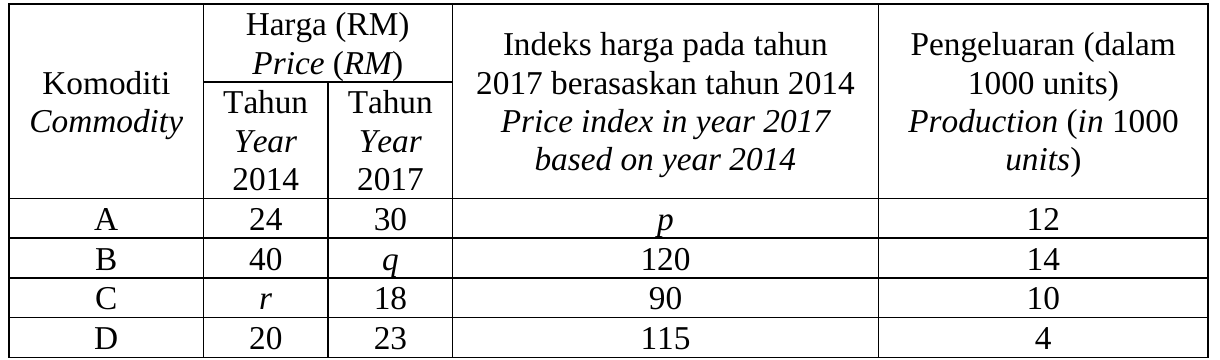
- (a)
Find the values of p, q and r.
[4] - (b)
Calculate the composite index in 2017 based on 2014.
[2] - (c)
Calculate the composite index in 2021 based on 2014.
[4]