Write your answer on paper. Then open the answer to check it.
Section A
Diagram 1 shows part of a curve passing through (−11, 4) and (−5, 2). The variables x and y are related by the equation y² = (p/2)x + q, where p and q are constants. (a) Find the value of p and of q. (b) Hence, sketch the linear graph of y² against x.
Easy4 marks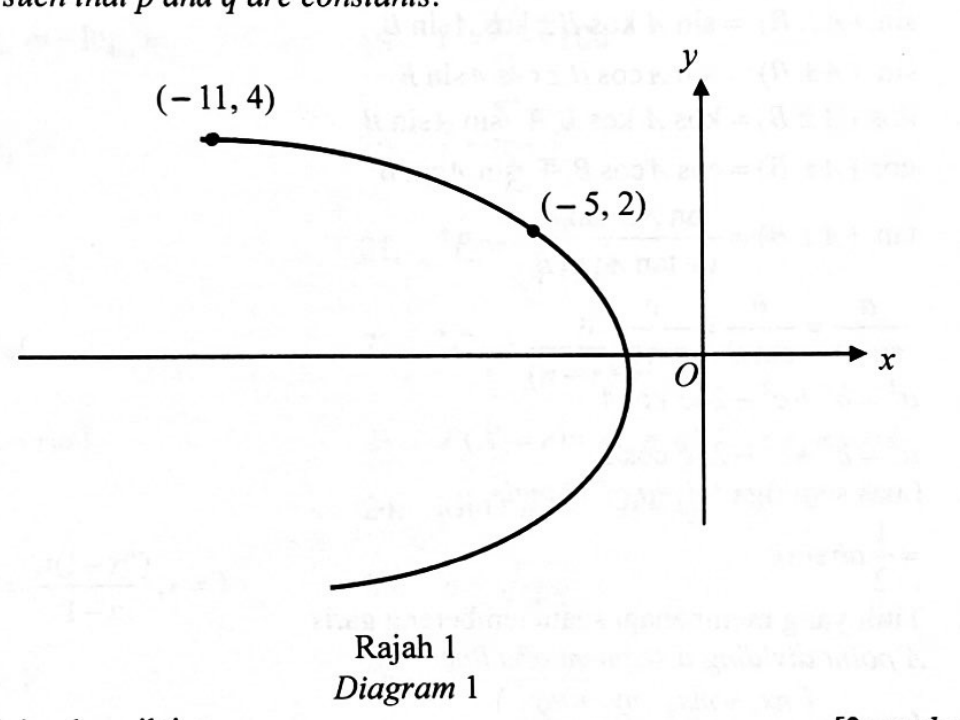
- (a)
Find the value of p and of q.
[3] - (b)
Hence, sketch the linear graph of y² against x.
[1]
It is given that 2α and 2β are the roots of the quadratic equation x² + mx − 3 = 0. (a) Find the value of m if α + β = −2. (b) Hence, form a quadratic equation with roots α and β.
Easy4 marks- (a)
Find the value of m if α + β = −2.
[2] - (b)
Hence, form a quadratic equation with roots α and β.
[2]
Diagram 2 shows the graph of y = f(x) and x = g(y). (a) Determine which graph represents a function and state your reason. (b) Hence, state (i) the domain, (ii) the range, (iii) the function notation of the function.
Easy4 marks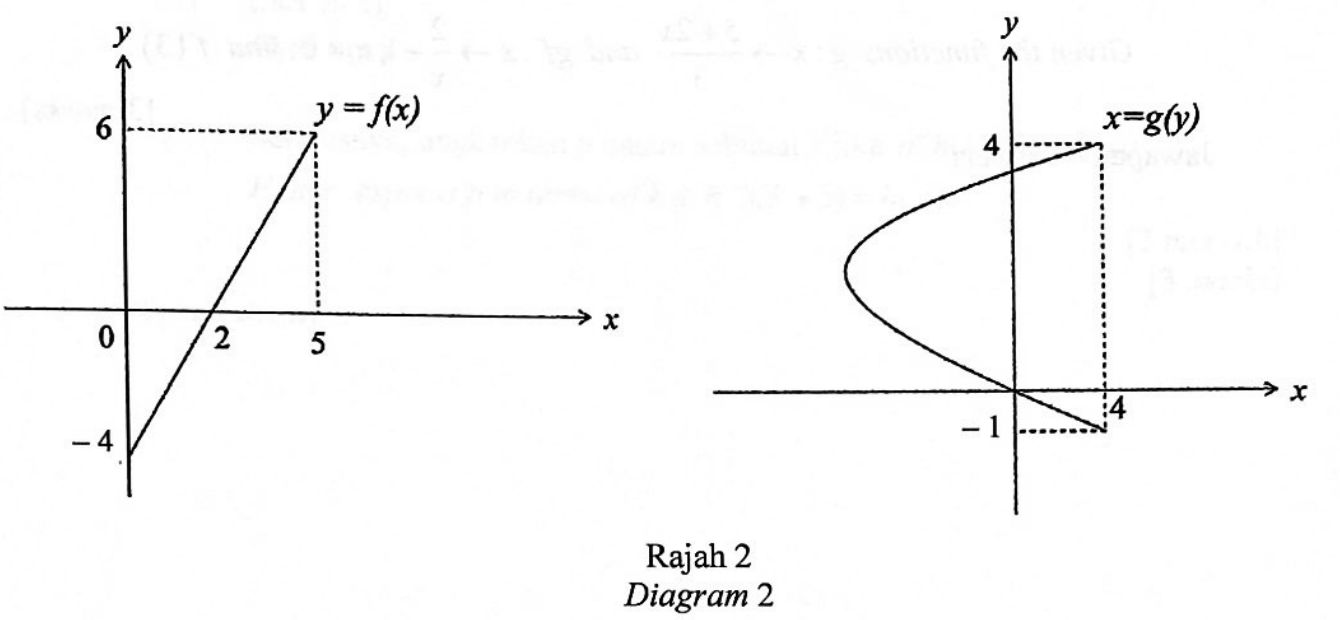
- (a)
Determine which graph represents a function and state your reason.
[1] - (b)(i)
State the domain.
[1] - (b)(ii)
State the range.
[1] - (b)(iii)
State the function notation.
[1]
(a) Given the functions g : x → (5 + 2x)/3 and gf : x → 2/x − 1, x ≠ 0, find f(3). (b) It is given that the inverse function h⁻¹(x) = 4x − 7. (i) Find h(x). (ii) Hence, express p in terms of k if h⁻¹h(k + 5) = h(p).
Medium6 marks- (a)
Given g : x → (5 + 2x)/3 and gf : x → 2/x − 1, x ≠ 0, find f(3).
[3] - (b)(i)
Given h⁻¹(x) = 4x − 7, find h(x).
[1] - (b)(ii)
Hence, express p in terms of k if h⁻¹h(k + 5) = h(p).
[2]
(a) Given log₁₀ a < 0, state the range of values of a. (b) Given that a = 7ˣ and b = 7ʸ, simplify 49^(x+y) + 7^(x−y) in terms of a and b.
Easy4 marks- (a)
Given log₁₀ a < 0, state the range of values of a.
[1] - (b)
Given that a = 7ˣ and b = 7ʸ, simplify 49^(x+y) + 7^(x−y) in terms of a and b.
[3]
The population of bacteria A grows according to the function Aₙ = 200eⁿ and the population of bacteria B grows according to the function Bₙ = 20e^(n+1), such that n is a number of days. (a) Find the total population of bacteria A on the 2nd day. (b) After how many days will the total population of both bacteria exceed 800 000?
Easy4 marks- (a)
Find the total population of bacteria A on the 2nd day.
[1] - (b)
After how many days will the total population of both bacteria exceed 800 000?
[3]
(a) According to a study of an express delivery system service, 2% of the packages mailed through a company do not arrive at their destination within the specified time. State the type of random variable involved and give your justification. (b) In a jewellery store, 2 out of 7 customers bought jewellery on a certain day. If 10 customers from the store are selected at random on that day, find the probability that (i) exactly 4 of them bought jewellery, (ii) at most 2 of them did not buy jewellery.
Medium6 marks- (a)
State the type of random variable involved and give your justification.
[1] - (b)(i)
Find the probability that exactly 4 of them bought jewellery.
[2] - (b)(ii)
Find the probability that at most 2 of them did not buy jewellery.
[3]
(a) A school Mathematics quiz competition team consists of 15 participants. These participants are to be chosen from 8 boys and 10 girls. Calculate the number of different ways the team can be formed if at least 8 girls are chosen. (b) There are 7 pearls and 6 beads of different colours to be arranged using different ways. All the pearls are arranged in a circle to make a bracelet as an example shown in Diagram 3(a), while only 4 beads are arranged on a hairclip as an example shown in Diagram 3(b). Are the number of different ways to arrange the pearls on the bracelet equal to the number of different ways to arrange the beads on the hairclip? Verify your answer with calculation.
Easy5 marks- (a)
Calculate the number of different ways the team can be formed if at least 8 girls are chosen.
[3] - (b)
Are the number of different ways to arrange the pearls on the bracelet equal to the number of different ways to arrange the beads on the hairclip? Verify your answer with calculation.
[2]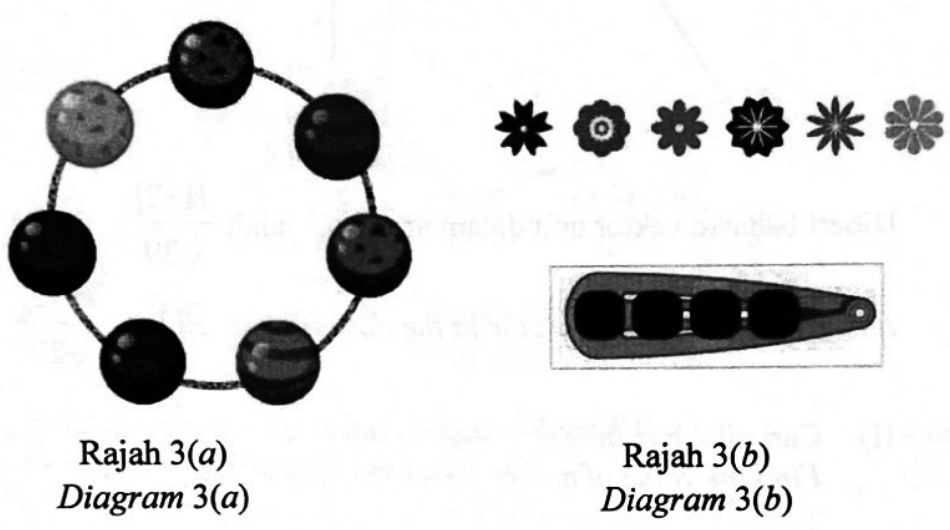
(a) Diagram 4 shows a straight line PQ with P(−3, 8) and Q(n, 10). It is given that the unit vector in the direction of PQ→ is (ki + 2j)/√29. (i) Find the value of n. (ii) Hence, express OQ→ in the form of column vector. (b) Diagram 5 shows a quadrilateral KLMN with KL→ = 3a, LM→ = a + b and NM→ = λ(5a + b). Prove the vector LM→ is parallel to vector KN→.
Medium8 marks- (a)(i)
Find the value of n.
[3]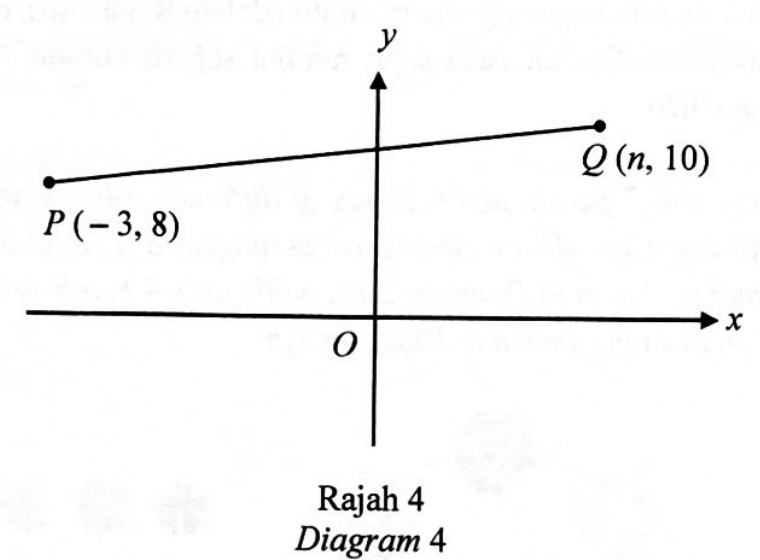
- (a)(ii)
Hence, express OQ→ in the form of column vector.
[1] - (b)
Prove the vector LM→ is parallel to vector KN→.
[4]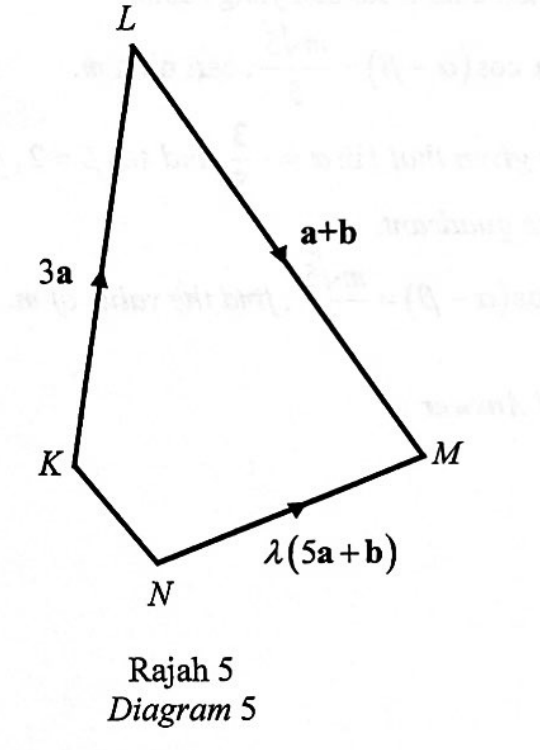
(a) It is given that sin α = −3/5 and tan β = 2, such that angle α and β are in the same quadrant. If cos(α − β) = m√5/5, find the value of m. (b) It is given that tan(θ − 60°) = −1 and tan θ = k. Find the value of k in surd form.
Medium7 marks- (a)
If cos(α − β) = m√5/5, find the value of m.
[3] - (b)
Find the value of k in surd form.
[4]
The normal line to the curve y = ax² + b/x at the point (1, 5) is parallel to the straight line x + y − 8 = 0. Find the value of a and of b.
Easy4 marksFind the value of a and of b.
[4]
(a) The variables f and g are related by the equation 1/f + 1/g = 1/15. Given g increases at a rate of 1.2 cm s⁻¹, find the rate of change of f, in cm s⁻¹, when g = 20 cm. (b) Diagram 6 shows part of the curve y = 1 − x². (i) Find the first derivative of y with respect to x. (ii) Hence, calculate the approximate value of q in terms of p and k.
Medium8 marks- (a)
Find the rate of change of f, in cm s⁻¹, when g = 20 cm.
[4] - (b)(i)
Find the first derivative of y with respect to x.
[1] - (b)(ii)
Hence, calculate the approximate value of q in terms of p and k.
[3]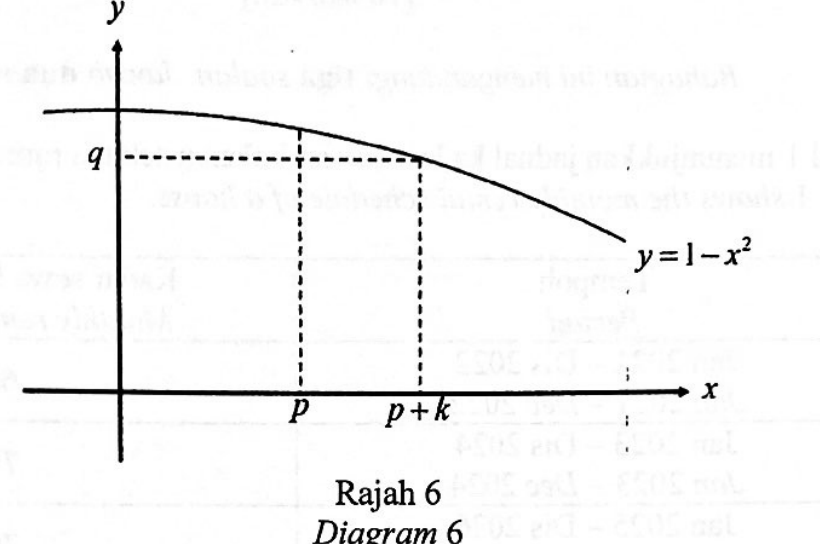
Section B
Table 1 shows the monthly rental schedule of a house: Jan 2021 – Dec 2022: RM660; Jan 2023 – Dec 2024: RM710; Jan 2025 – Dec 2026: RM760; Jan 2027 – Dec 2028: RM810. Rizqi rents the house with monthly rental of RM660 on 1 January 2021. The house owner will increase his monthly rental on a regular basis every 2 years. (a) Determine whether the monthly rental form an arithmetic progression or a geometric progression. Verify your answer with calculation. (b) When will the monthly rental exceed RM1 350 for the first time? (c) Calculate the total rental paid to the house owner for the years 2028 to 2056.
Medium8 marks- (a)
Determine whether the monthly rental form an arithmetic progression or a geometric progression. Verify your answer with calculation.
[2]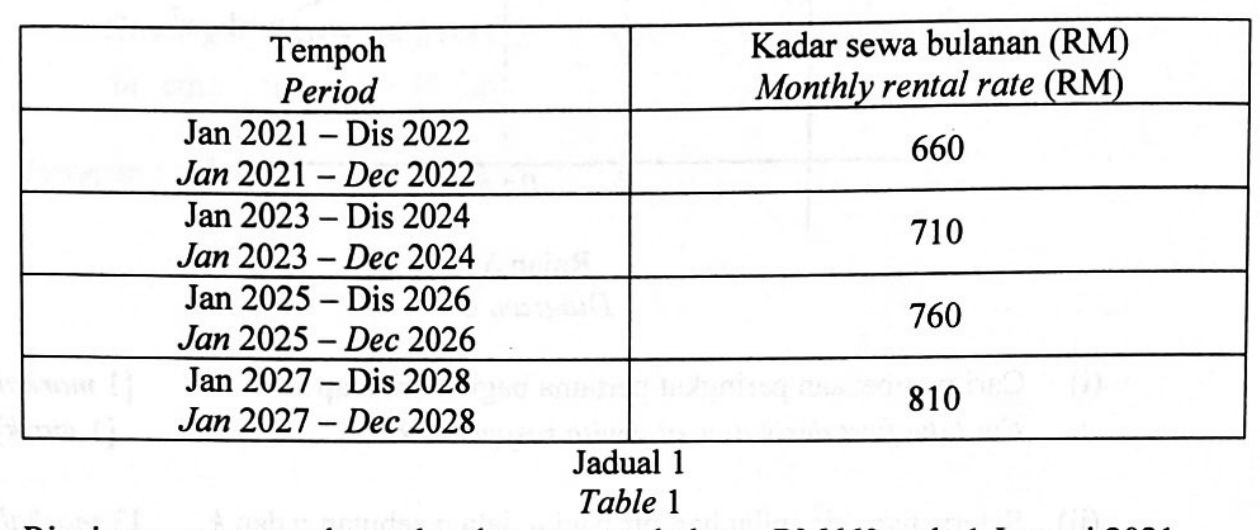
- (b)
When will the monthly rental exceed RM1 350 for the first time?
[3] - (c)
Calculate the total rental paid to the house owner for the years 2028 to 2056.
[3]
Diagram 7 shows the curve x = y³ intersecting the curve x = y² at the points O and B. (a) Find (i) the coordinates of point B, (ii) the area of the shaded region. (b) Calculate the volume generated, in terms of π, when the region bounded by the curve x = y², the straight line y = −x + 2 and the y-axis is revolved through 360° about the y-axis.
Medium8 marks- (a)(i)
Find the coordinates of point B.
[2] - (a)(ii)
Find the area of the shaded region.
[3]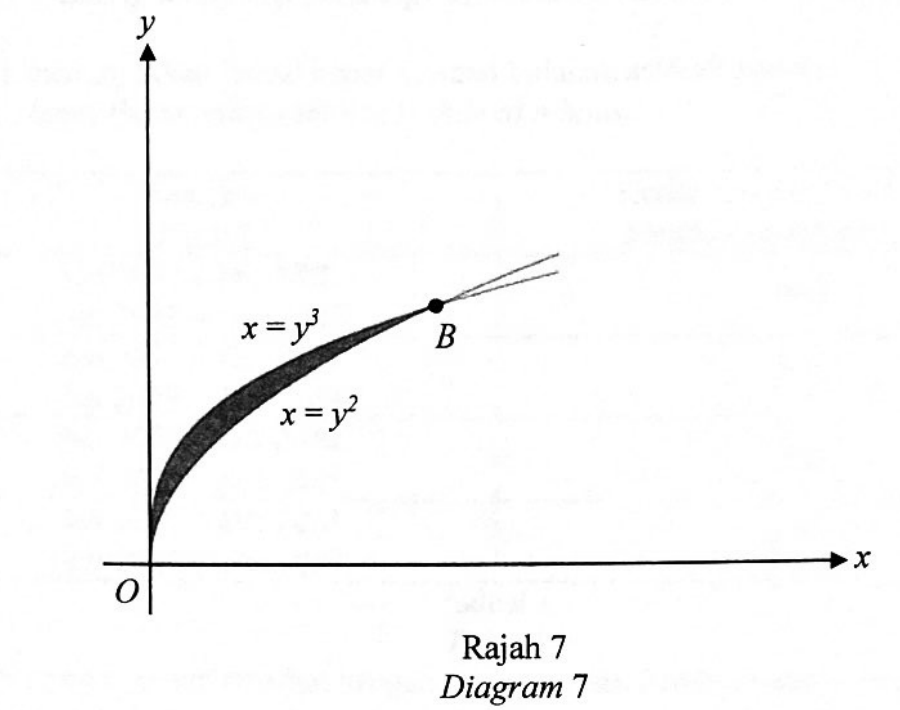
- (b)
Calculate the volume generated, in terms of π, when the region bounded by x = y², y = −x + 2 and the y-axis is revolved through 360° about the y-axis.
[3]
Solution by scale drawing is not accepted. Diagram 8 shows a rectangular wall surface PQSV, 3 m by 4 m. Anas wanted to mark a point A so that the wall fan could be installed at that position accurately. The switch of the fan is located at point R. He had made measurements using two straight strings PT and QU. [Use R as the origin] (a) State the coordinates of point A. (b) Find the distance, in m, of VU and of UT so that the two straight strings intersect at point A. Hence, state the ratio of VU : UT. (c) Anas wants to hang a picture frame at point B as in the diagram. He used a straight string PB to make the measurements. Show that the straight string is not perpendicular to the straight string QU.
Medium8 marks- (a)
State the coordinates of point A.
[1] - (b)
Find the distance, in m, of VU and of UT so that the two straight strings intersect at point A. Hence, state the ratio of VU : UT.
[5]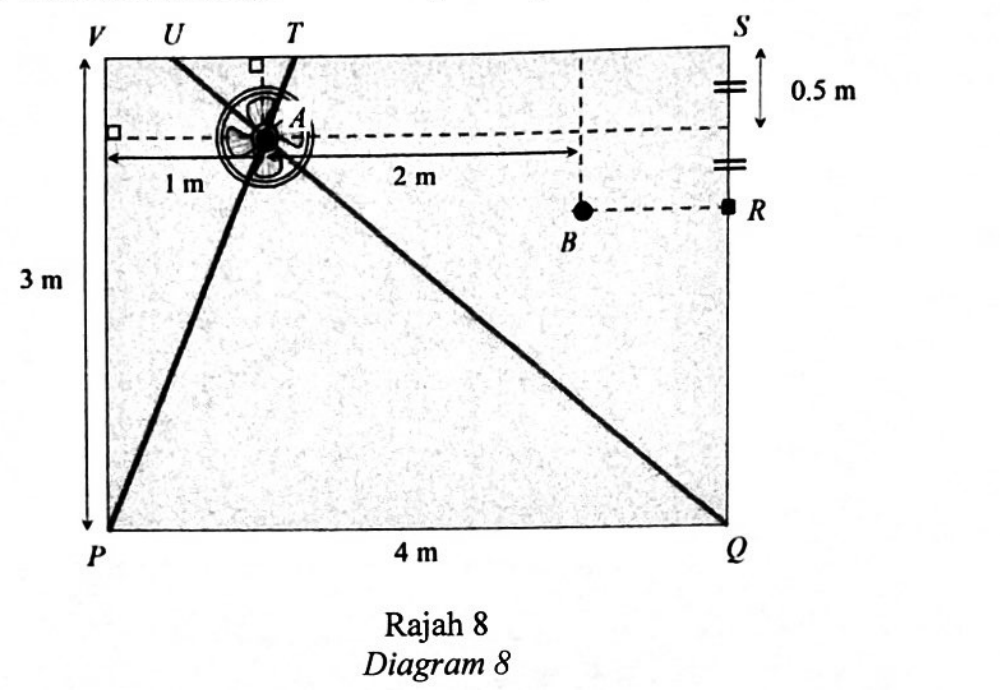
- (c)
Show that the straight string PB is not perpendicular to the straight string QU.
[2]