Write your answer on paper. Then open the answer to check it.
Section A
Solve the following simultaneous equations: 2y = −2x − 10 and 2y² + x = 5.
Easy5 marksSolve the following simultaneous equations: 2y = −2x − 10 and 2y² + x = 5.
[5]
(a) Prove that cot²x/(1 + cot²x) = cos²x. (b) (i) Sketch the graph of y = (2/cos x)(cot²x/(1 + cot²x)) + 1 for 0 ≤ x ≤ 2π. (ii) Hence, using the same axes, sketch a suitable straight line to find the number of solutions for the equation (2/cos x)(cot²x/(1 + cot²x)) = x/π − 1 for 0 ≤ x ≤ 2π. State the number of solutions.
Medium8 marks- (a)
Prove that cot²x/(1 + cot²x) = cos²x.
[2] - (b)(i)
Sketch the graph of y = (2/cos x)(cot²x/(1 + cot²x)) + 1 for 0 ≤ x ≤ 2π.
[3] - (b)(ii)
Hence, using the same axes, sketch a suitable straight line and state the number of solutions.
[3]
(a) Given d/dx(3x² − x) = f(x), find the value of ∫₀¹ f(x) dx. (b) The gradient function of a curve is 3x − h. Tangent to the curve at point (5, 7.5) cuts the x-axis at x = 3.75. Find the equation of the curve.
Medium6 marks- (a)
Given d/dx(3x² − x) = f(x), find the value of ∫₀¹ f(x) dx.
[3] - (b)
The gradient function of a curve is 3x − h. Tangent to the curve at (5, 7.5) cuts the x-axis at x = 3.75. Find the equation of the curve.
[3]
Diagram 1(a) shows a wave front formed after bait is dropped into a river. Diagram 1(b) shows the plan of the wave front formed on the surface of the river. Both types of wavelengths formed a geometric progression. (a) Given that the sum of the wavelength from the source towards the deep water is Sₙ = 5/2 + 3(2ⁿ⁻¹ − 1). Find (i) the first wavelength, (ii) the common ratio of this progression. (b) Given that 9T₄ = 10T₅ and the first wavelength from the source towards the riverbank is 1 cm, find the total distance of the wavelength when the wave front stops forming.
Medium7 marks- (a)
Given Sₙ = 5/2 + 3(2ⁿ⁻¹ − 1), find (i) the first wavelength, (ii) the common ratio.
[4]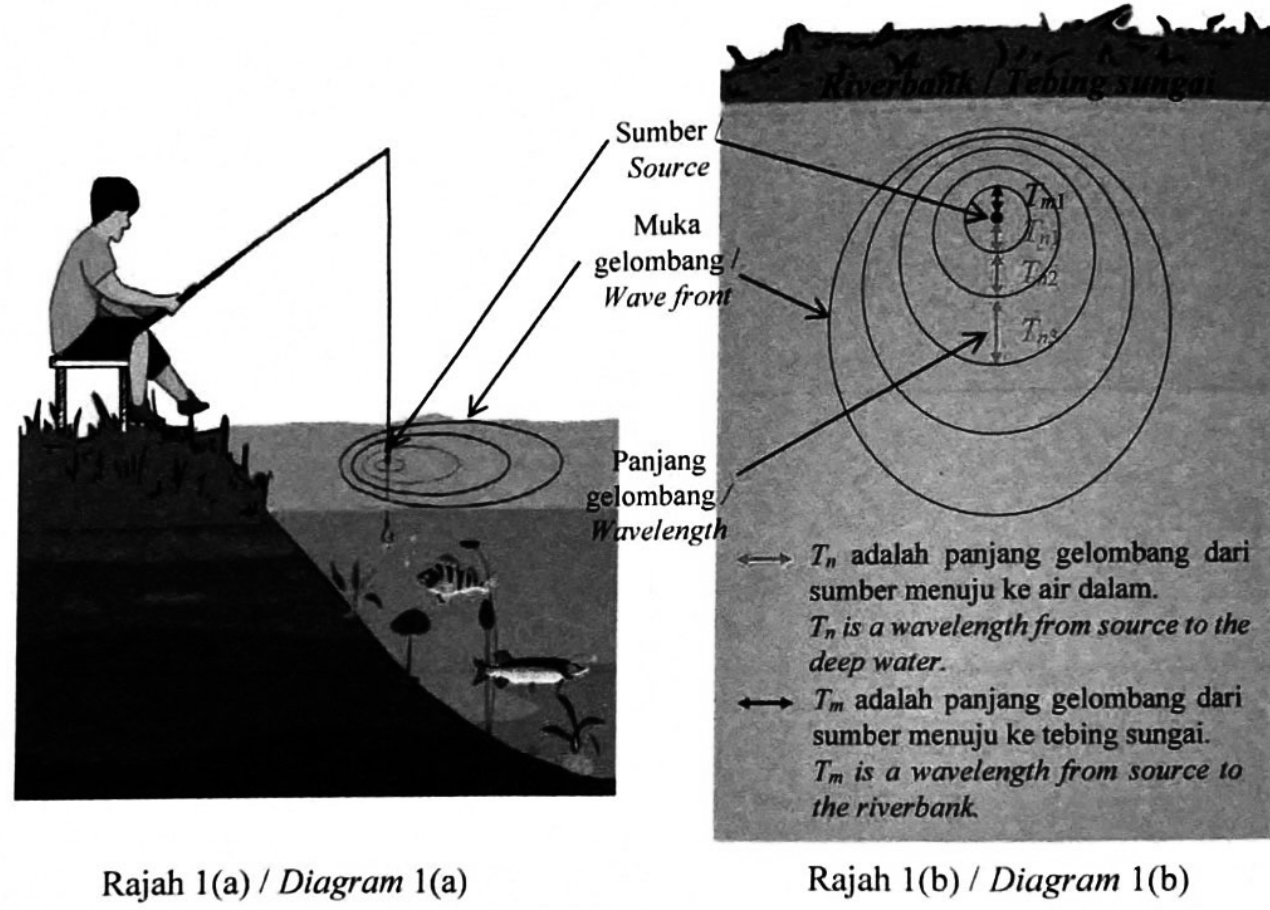
- (b)
Given 9T₄ = 10T₅ and the first wavelength from the source towards the riverbank is 1 cm, find the total distance of the wavelength when the wave front stops forming.
[3]
Diagram 2 shows a point Q that moves along the circumference of a circle with centre S. The straight line 2x = y − 3 is tangent to the circle at point B(2, 7) and intersects the y-axis at point A. P is the point (−2, 9). (a) Point S is the image of point P under a reflection at line 2x = y − 3. Points P, B and S are collinear. Find the equation of locus of point Q. (b) If the straight line BS is extended to point N, such that 3BN = 4SN, calculate the area of quadrilateral OABN.
Medium8 marks- (a)
Find the equation of locus of point Q.
[4]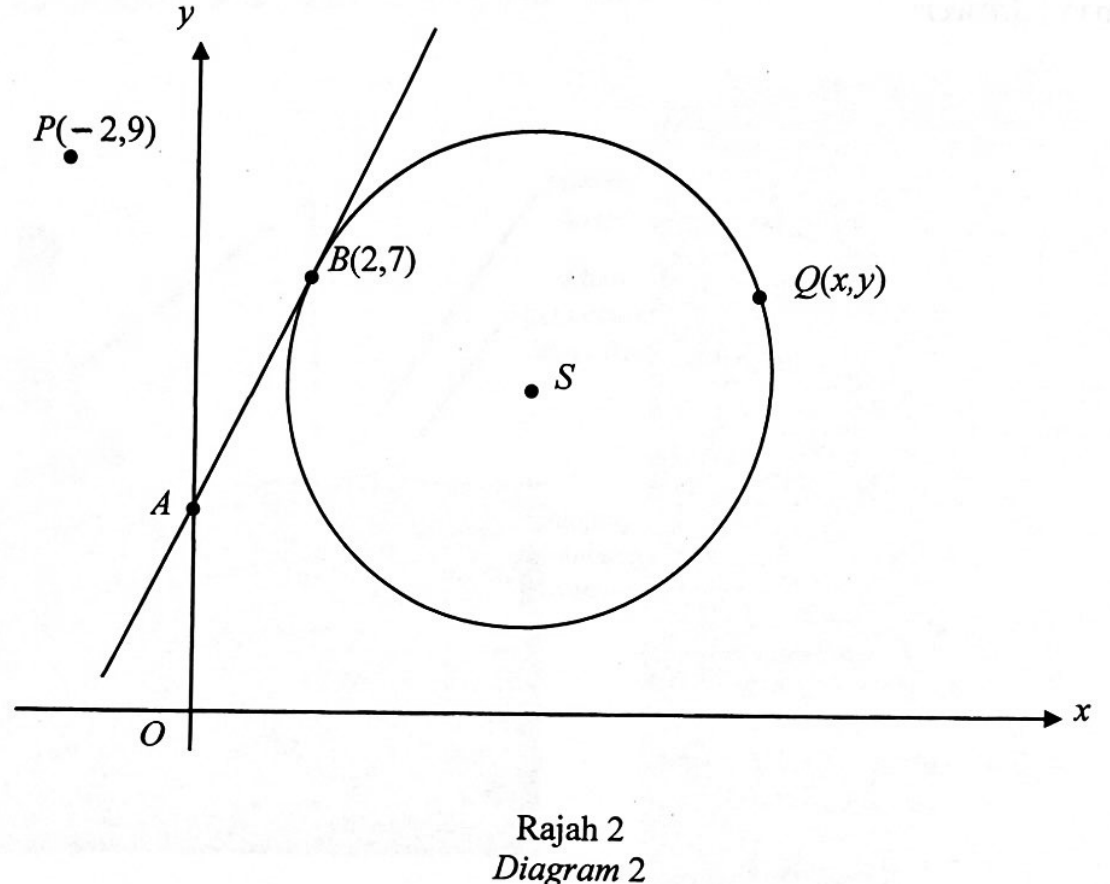
- (b)
If the straight line BS is extended to point N, such that 3BN = 4SN, calculate the area of quadrilateral OABN.
[4]
Diagram 3 shows a circle ACP with centre O and a semicircle EAD with centre P. The straight line BA is a tangent to the circle ACP at point A. Circle ACP and semicircle EAD intersect at point A and point P. [Use π = 3.142] (a) It is given that ∠AOP = 113.56° and BO − BA = k cm. The arc length AP is 4.754 cm. Find the value of k and state your answer in two decimal places. (b) Find the area, in cm², of the shaded region.
Medium8 marks- (a)
Find the value of k (BO − BA = k) to two decimal places.
[3]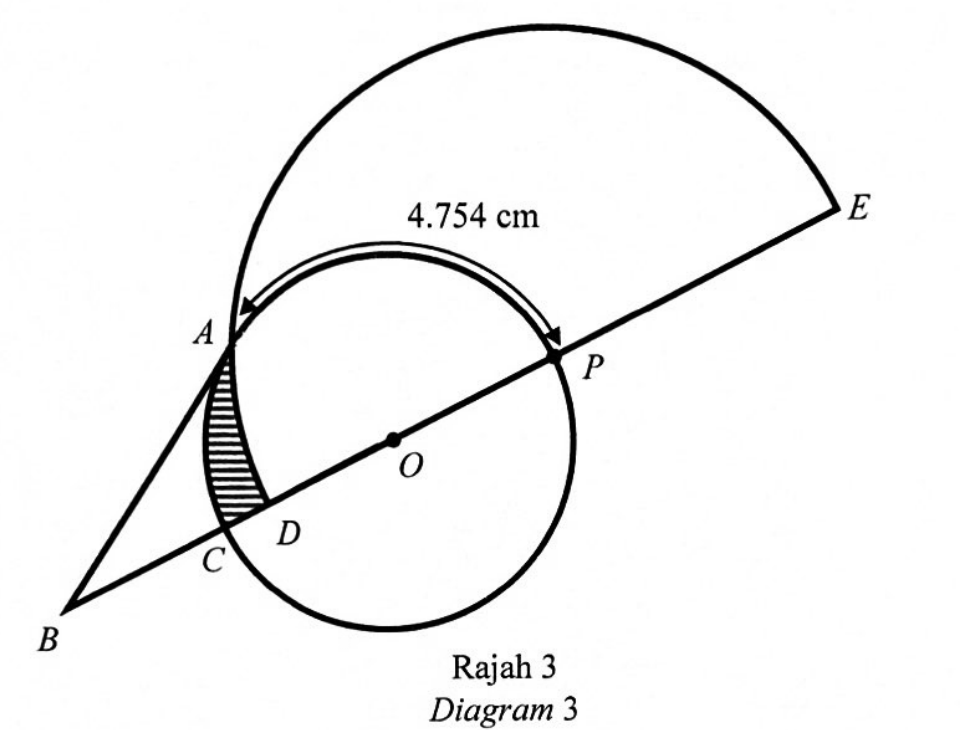
- (b)
Find the area, in cm², of the shaded region.
[5]
Diagram 4 shows the straight line AB intersects with the straight line CD at point E. A is (0, 2) and B is (2, 0). The equation of straight line CD is −3x + √2 y = 1. (a) Find the coordinates of point E in the form (p + q√2, r + s√2). (b) Given the distance between point E and point (−1 + m√2, −√2) is √17. Find the values of m.
Medium8 marks- (a)
Find the coordinates of point E in the form (p + q√2, r + s√2).
[5]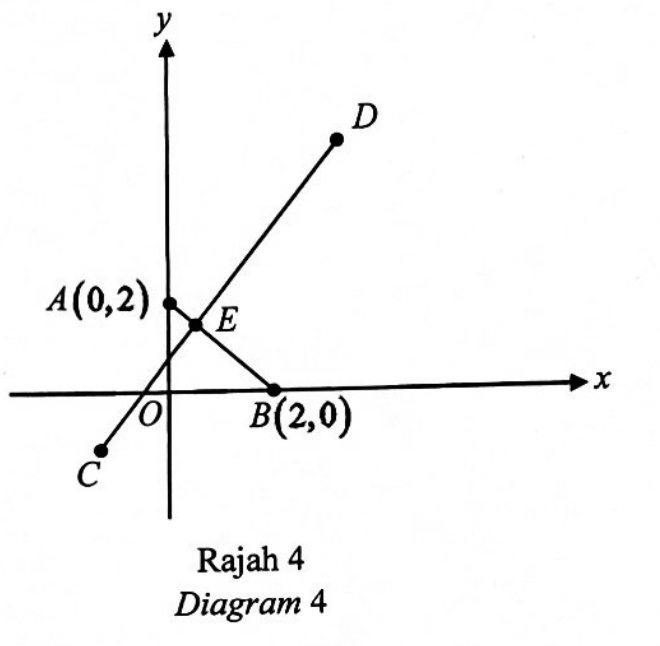
- (b)
Given the distance between point E and point (−1 + m√2, −√2) is √17. Find the values of m.
[3]
Section B
(a) It is found that the probability that a patient will experience side effect while taking new medications is p. (i) Given the number of patients who experience side effect while taking the new medication has a mean of 20 and a variance of 16, find the value of p. (ii) If 10 patients are selected at random, find the probability that 3 patients will experience the side effect. (b) The diastolic blood pressure for a woman in a certain district follows a normal distribution with a mean μ mmHg and a standard deviation of 50 mmHg. If a woman is randomly selected, it is found that the probability that diastolic blood pressure less than 72 mmHg is 0.4364. (i) Find the value of μ. (ii) A special treatment will be given to women who have diastolic blood pressure more than 144.1 mmHg. Find the probability of the women manage to get the special treatment. (iii) Hence, if there are 3500 women in the district, find the total cost of the treatment if the treatment is worth RM150 per person.
Medium10 marks- (a)(i)
Given the number of patients who experience side effect has a mean of 20 and a variance of 16, find the value of p.
[2] - (a)(ii)
If 10 patients are selected at random, find the probability that 3 patients will experience the side effect.
[2] - (b)(i)
Find the value of μ.
[3] - (b)(ii)
Find the probability of the women manage to get the special treatment (diastolic blood pressure more than 144.1 mmHg).
[1] - (b)(iii)
Hence, if there are 3500 women in the district, find the total cost of the treatment if the treatment is worth RM150 per person.
[2]
(a) Diagram 5 shows trapezium ADEF and triangle ABC. It is given that AD→ = 8x, BE→ = 3y, BE→ = (3/5)BC→ and ratio AD : FE = 2 : 1. (i) Express AC→ in terms of x and/or y. (ii) Line FE is extended to a point M such that FM→ = (8/5)FE→ and BM→ = kAC→. Find the value of k. (b) Airport Q is located at the north of airport P and on the west of airport R. The bearing of airport R from airport P is 036.87°. An airplane travelled from airport P to airport R with position vector of 900i + 1200j. After that, the airplane continues its journey to airport S which is located 3000 km on the north of airport P in 2 hours. Find the speed, in km/h, of the airplane after leaving airport R.
Medium10 marks- (a)(i)
Express AC→ in terms of x and/or y.
[3]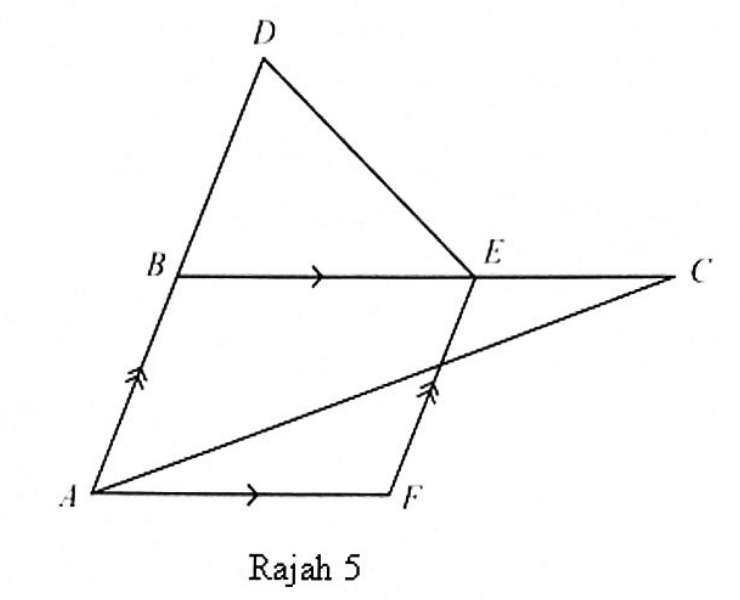
- (a)(ii)
Find the value of k (FM→ = (8/5)FE→, BM→ = kAC→).
[4] - (b)
Find the speed, in km/h, of the airplane after leaving airport R.
[3]
Table 1 shows the values of two variables, x and y, obtained from an experiment. Variables x and y are related by the equation y = d/(2x − f), where d and f are constants. x: 4.4, 6.4, 8.6, 12, 14.9, 16.4; y: 0.9, 0.5, 0.34, 0.23, 0.18, 0.16. (a) Based on Table 1, plot 1/y against x using a scale of 2 cm to 2 units on the x-axis and 2 cm to 1 unit on the 1/y-axis. Hence, draw the line of best fit. (b) By using the graph in 10(a), find the value of (i) y when x = 8, (ii) d and f.
Medium10 marks- (a)
Plot 1/y against x using a scale of 2 cm to 2 units on the x-axis and 2 cm to 1 unit on the 1/y-axis. Hence, draw the line of best fit.
[4]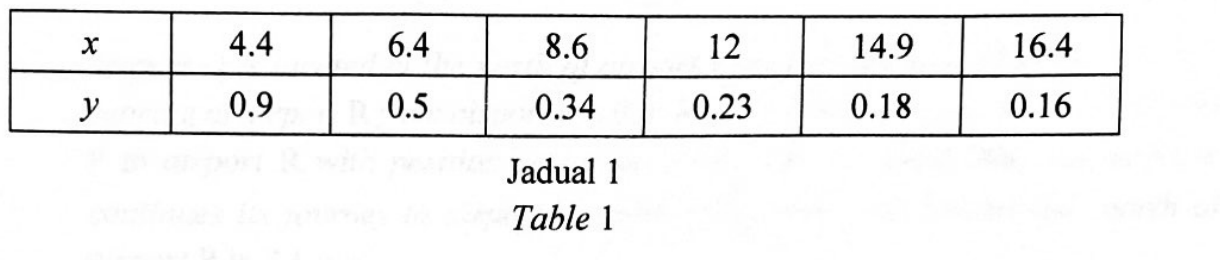
- (b)(i)
Using the graph, find y when x = 8.
[1] - (b)(ii)
Using the graph, find d and f.
[5]
Amrin participates in a workshop to build a geometric model. He has been given a piece of wire to make a cuboid-shaped box frame. The volume of the box is 375 cm³ and the base length of the box must be twice its base width. (a) By taking the base width of the box as x, show that the length of wire used is P = 12x + 750/x². (b) (i) Find the value of x, in cm, that makes the value of P the shortest. (ii) Hence, calculate the value of P. (c) Given that the price for a meter of a wire is RM 1.80, how much should the organizer of the workshop need to spend, in RM, for 30 participants?
Medium10 marks- (a)
By taking the base width as x, show that the length of wire used is P = 12x + 750/x².
[3] - (b)(i)
Find the value of x, in cm, that makes the value of P the shortest.
[3] - (b)(ii)
Hence, calculate the value of P.
[2] - (c)
Given that the price for a meter of wire is RM 1.80, how much should the organizer need to spend, in RM, for 30 participants?
[2]
Section C
A particle moves along a straight line and passes through a fixed point O. Its velocity, v m s⁻¹, is given by v = ht² + kt, where h and k are constants and t is the time, in second, after passing through O. The particle stops instantaneously when t = 3 s and its acceleration is −3 m s⁻² when t = 1 s. [Assume motion to the right is positive] (a) Find the value of h and of k. (b) Find the time interval, in second, when the particle moves to the left. (c) Calculate the total distance, in m, travelled by the particle from t = 2 to t = 5.
Medium10 marks- (a)
Find the value of h and of k.
[4] - (b)
Find the time interval, in second, when the particle moves to the left.
[3] - (c)
Calculate the total distance, in m, travelled by the particle from t = 2 to t = 5.
[3]
A nursery produces two types of organic fertilizer, type A and type B. It is given that the nursery produces x bottles of organic fertilizer type A and y bottles of organic fertilizer type B daily. I The ratio of the number of organic fertilizer type A to the number of organic fertilizer type B is at most 3 : 2. II The total number of organic fertilizer type A and type B that can be produced does not exceed 80 bottles. III The number of organic fertilizer type B exceed the number of organic fertilizer type A by at most 40. (a) Write three inequalities, other than x ≥ 0 and y ≥ 0, which satisfy all the above constraints. (b) Using a scale of 2 cm to 10 bottles on both axes, construct and shade the region R which satisfies all the above constraints. (c) Use the graph constructed in 13(b) to answer the following questions. (i) On a particular day, only 50 bottles of organic fertilizer type B are produced. Determine the minimum number of organic fertilizer type A produced on that day. (ii) Hence, find the maximum cost, in RM, of producing the organic fertilizer on that day if the cost of producing a bottle of fertilizer type A and type B are RM20.00 and RM30.00 respectively.
Medium10 marks- (a)
Write three inequalities, other than x ≥ 0 and y ≥ 0, which satisfy all the above constraints.
[3] - (b)
Using a scale of 2 cm to 10 bottles on both axes, construct and shade the region R.
[3] - (c)(i)
Only 50 bottles of type B are produced. Determine the minimum number of type A produced on that day.
[1] - (c)(ii)
Hence, find the maximum cost, in RM, of producing the fertiliser on that day (type A RM20.00, type B RM30.00 per bottle).
[3]
Solution by scale drawing is not accepted. Diagram 6 shows a triangle PQR such that ∠PQR is an obtuse angle. The straight line PAB intersects with the straight line AR at point A and B is the midpoint of QR. Given that 2PA = 3AB and the shortest distance from Q to the straight line PR is 5.36 cm. (QR = 6.99 cm, PR = 12.01 cm.) (a) Find the length, in cm, of PQ. (b) (i) Sketch a triangle P′Q′R′ which has a different shape from triangle PQR such that P′Q′ = PQ, Q′R′ = QR and ∠Q′P′R′ = ∠QPR. (ii) Hence, state the size ∠P′R′Q′. (iii) Find ∠QPR. (c) Find the area, in cm², of triangle ABR.
Medium10 marks- (a)
Find the length, in cm, of PQ.
[3]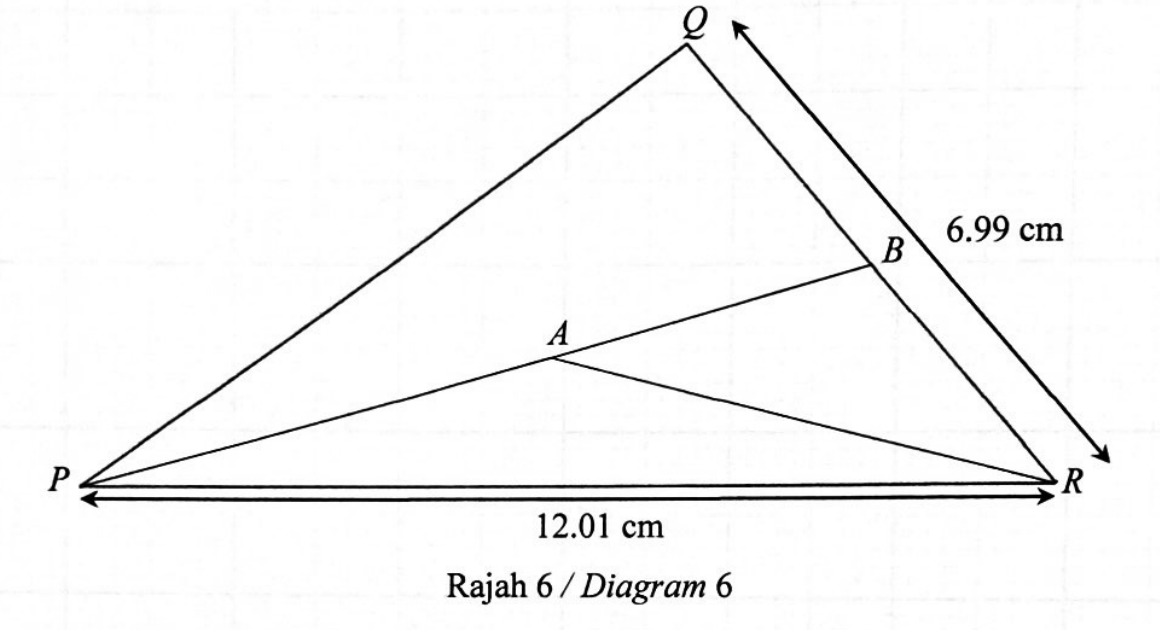
- (b)(i)
Sketch a triangle P′Q′R′ which has a different shape from triangle PQR such that P′Q′ = PQ, Q′R′ = QR and ∠Q′P′R′ = ∠QPR.
[1] - (b)(ii)
Hence, state the size ∠P′R′Q′.
[1] - (b)(iii)
Find ∠QPR.
[2] - (c)
Find the area, in cm², of triangle ABR.
[3]
Table 2 shows the price indices of four materials in making a type of jewellery. Diagram 7 shows the distribution of material usage to make the jewellery. Table 2 (price in RM per unit in 2019, 2020; price index in 2020 based on 2019): Pearl 2.50, 2.70, p; Crystal Bead 2.00, 2.40, 120; Nylon String 1.80, q, 145; Hook 1.00, 1.30, 130. Diagram 7 (pie chart of material usage): Pearl 162°, Crystal Bead 15%, Nylon String 108°, Hook (remainder). (a) Find the value of p and of q. (b) The price of the hook is expected to increase by 12.5% from the year 2020 to the year 2021. Calculate the price index of the hook in 2021 based on the year 2019. (c) (i) Calculate the composite index for the cost of making the jewellery in the year 2020 based on the year 2019. (ii) The cost of all materials increases 10% from the year 2020 to the year 2021. If the cost of making a jewellery in 2020 is RM2.50 cheaper than 2021, find the cost of making a jewellery in 2021.
Medium10 marks- (a)
Find the value of p and of q.
[3]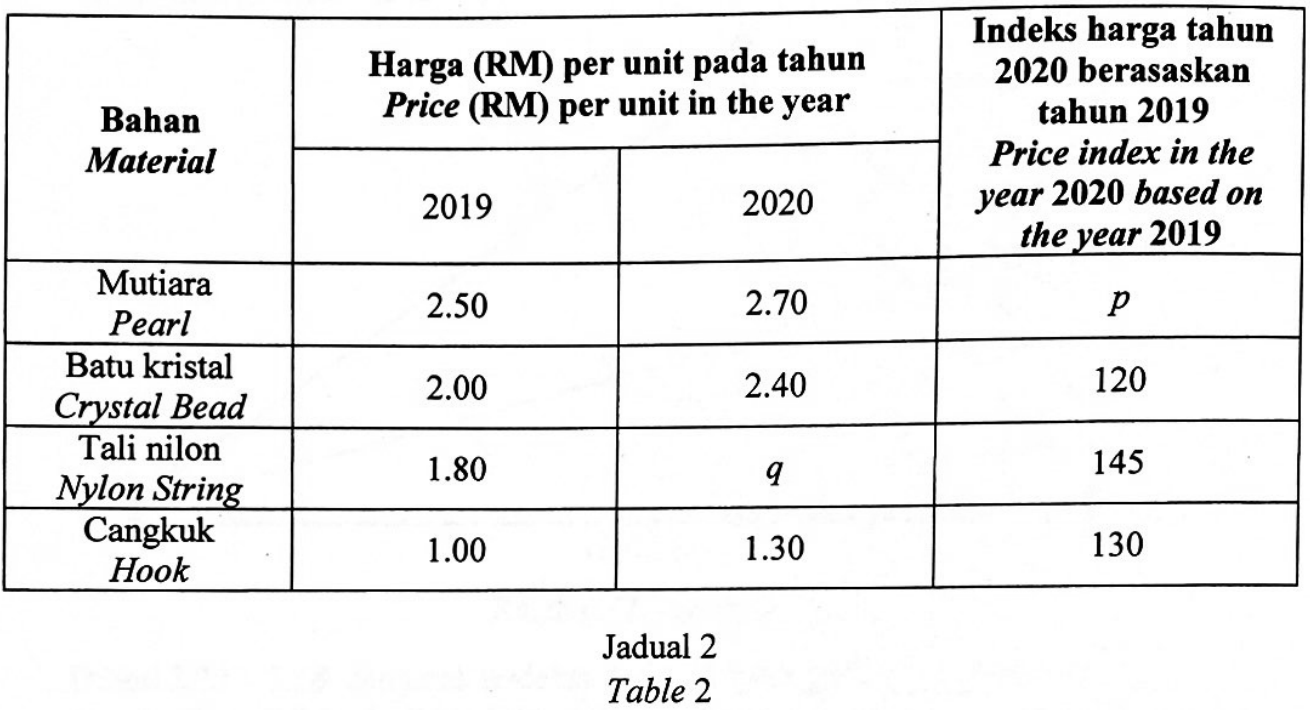
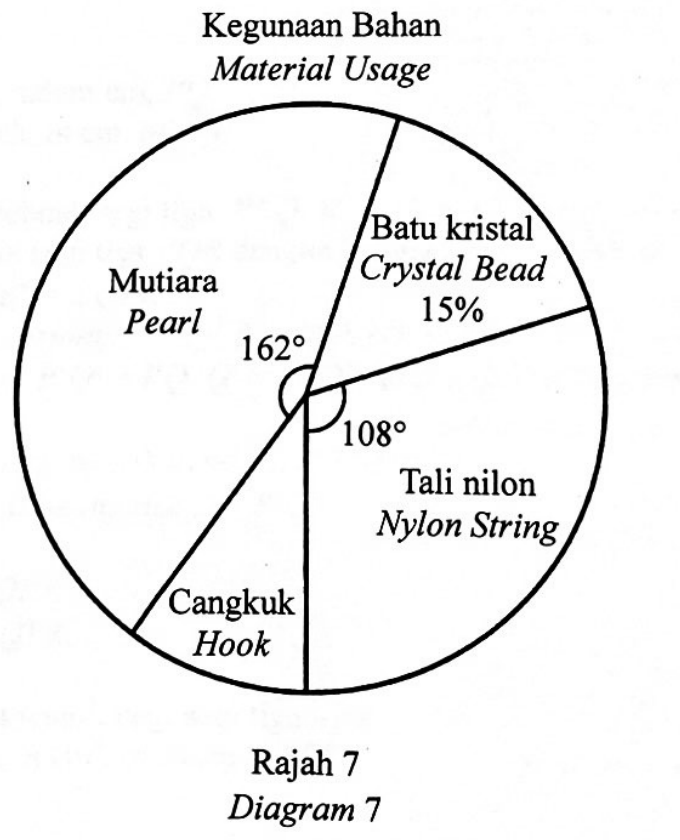
- (b)
The price of the hook is expected to increase by 12.5% from 2020 to 2021. Calculate the price index of the hook in 2021 based on 2019.
[2] - (c)(i)
Calculate the composite index for the cost of making the jewellery in 2020 based on 2019.
[3] - (c)(ii)
The cost of all materials increases 10% from 2020 to 2021. If the cost of making a jewellery in 2020 is RM2.50 cheaper than 2021, find the cost of making a jewellery in 2021.
[2]