Write your answer on paper. Then open the answer to check it.
Section A
Given y = 2x³ − 6x² − 18x + 4, find (a) dy/dx when x = 2, (b) hence, determine its maximum point.
Easy6 marks- (a)
Find dy/dx when x = 2.
[2] - (b)
Hence, determine its maximum point.
[4]
Diagram 1 shows a straight line graph of 1/y against 1/x. The line passes through (1, −3) and (4, 3). (a) Express y in terms of x. (b) Find the value of x when y = 3.
Easy4 marks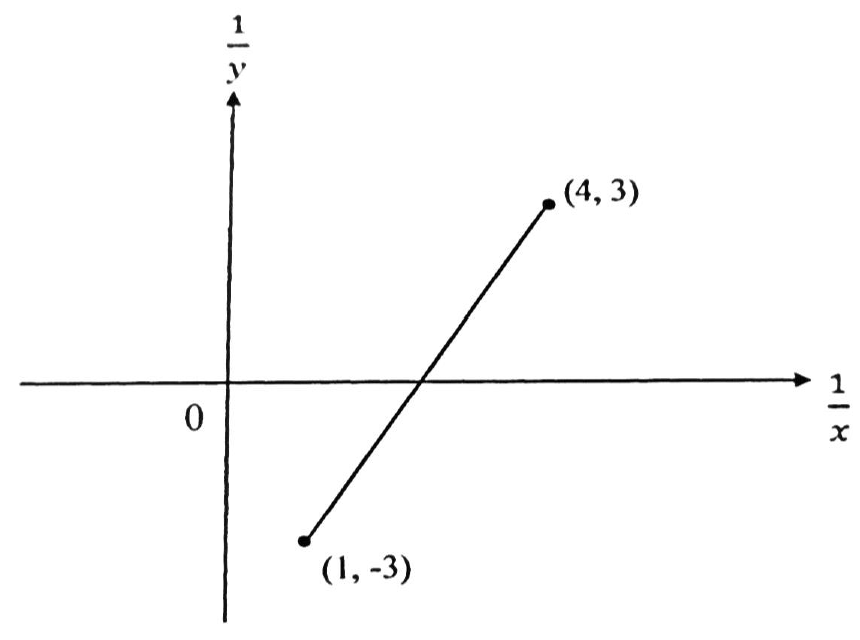
- (a)
Express y in terms of x.
[2] - (b)
Find the value of x when y = 3.
[2]
(a) Given a = (3, −2) and b = (1, 8) (column vectors), find the unit vector in the direction of 2a − b. (b) Vectors u and v are non-zero and not parallel. Given (h + k)u = (h − k + 2)v where h and k are constants, find the value of h and of k.
Medium6 marks- (a)
Find the unit vector in the direction of 2a − b, where a = (3, −2) and b = (1, 8).
[3] - (b)
Given (h + k)u = (h − k + 2)v with u and v non-zero and not parallel, find h and k.
[3]
Diagram 2 shows sector AOC of a circle with centre O. Given that OB = 4 cm and OA = 5 cm (AB is perpendicular to OC, B lies on OC). [Use π = 3.142] Find (a) the value of θ, in radian, (b) the perimeter of the shaded region, in cm.
Easy4 marks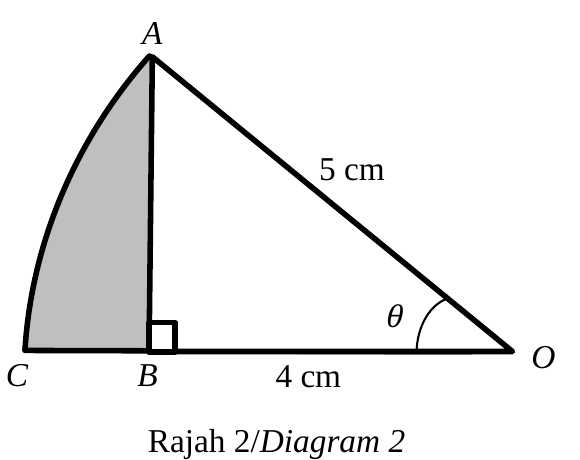
- (a)
Find the value of θ, in radian.
[2] - (b)
Find the perimeter of the shaded region, in cm.
[2]
Given that the ratio of the 18th term to the 6th term in an arithmetic progression is 3 : 1, calculate the ratio of the sum of the first 12 terms to the sum of the first 4 terms.
Easy4 marksFind the ratio of S₁₂ to S₄.
[4]
(a) Given A(−1, −3), B(−4, 0) and C(−6, 2). Show that A, B and C are collinear by finding the area of the polygon ABC. (b) Diagram 3 shows the straight line 2y − px = 0 and the straight line y = 6 − (q² + 5)x intersecting at point P (the lines are perpendicular). Express q in terms of p.
Easy5 marks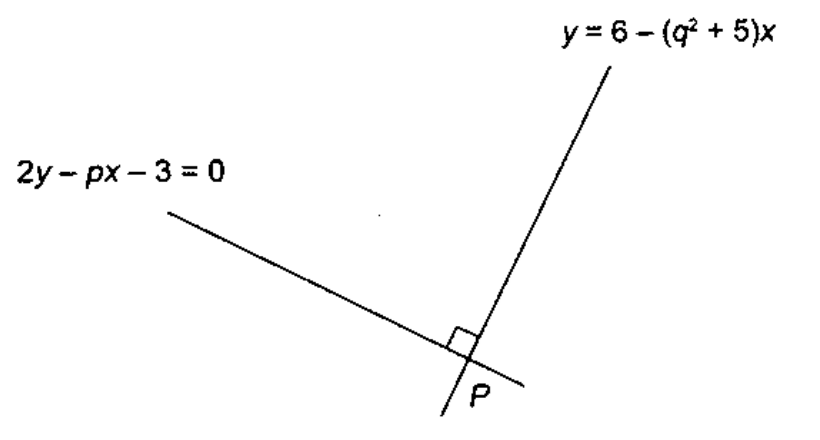
- (a)
Show that A, B and C are collinear by finding the area of the polygon ABC.
[2] - (b)
Express q in terms of p.
[3]
(a) Given ∫₂⁵ f(x) dx = 5, find the value of k if ∫₂⁵ [2f(x) + kx] dx = −1/2. (b) Diagram 4 shows the curve y = f(x) that intersects the x-axis at x = b. Given the area of the shaded region is 85 units², find the value of ∫₆ᵇ −11 f(x) dx. (The shaded region is bounded by the curve, the axes and y = 11 for 0 ≤ x ≤ 6.)
Medium6 marks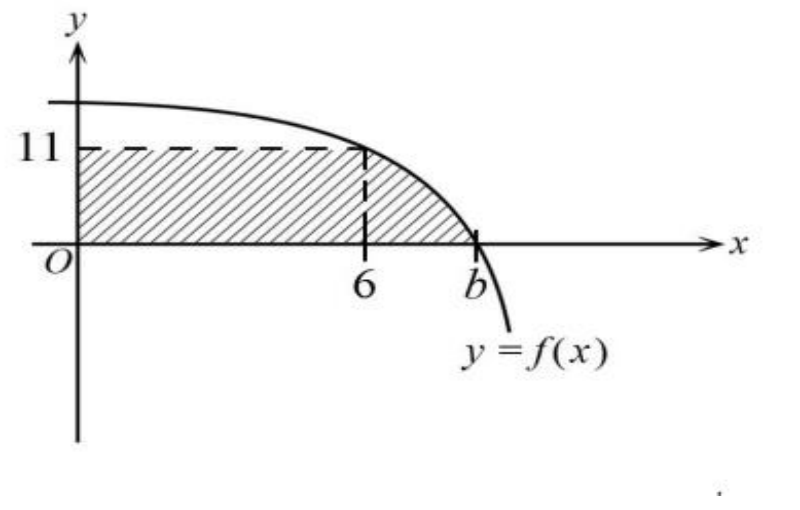
- (a)
Given ∫₂⁵ f(x) dx = 5, find k if ∫₂⁵ [2f(x) + kx] dx = −1/2.
[3] - (b)
Given the area of the shaded region is 85 units², find ∫₆ᵇ −11 f(x) dx.
[3]
(a) Diagram 5 shows function h (arrow diagram: −2 → 3, 2 → 3, 4 → 15, 6 → m). (i) State the value of m. (ii) By using the function notation, express h in terms of x. (b) Given f(x) = mx + n, where m and n are constants and m > 0, and f²(x) = 36x − 21, find the value of m and of n.
Easy6 marks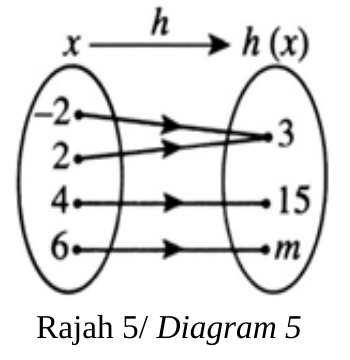
- (a)(i)
State the value of m.
[1] - (a)(ii)
Express h in terms of x using function notation.
[1] - (b)
Given f(x) = mx + n (m > 0) and f²(x) = 36x − 21, find m and n.
[4]
Diagram 6 shows a semicircle with centre O and radius 10 cm. ∠OKL is α in radian (J, O, L are on the diameter; θ = ∠JOK; the shaded region is the segment between chord KL and arc KL). [Use π = 3.142] (a) Find the length of arc KL in terms of α. (b) It is given that the length of arc JK is equal to the radius of the semicircle. State the value of θ in radian. Hence, find the area of the shaded region.
Medium7 marks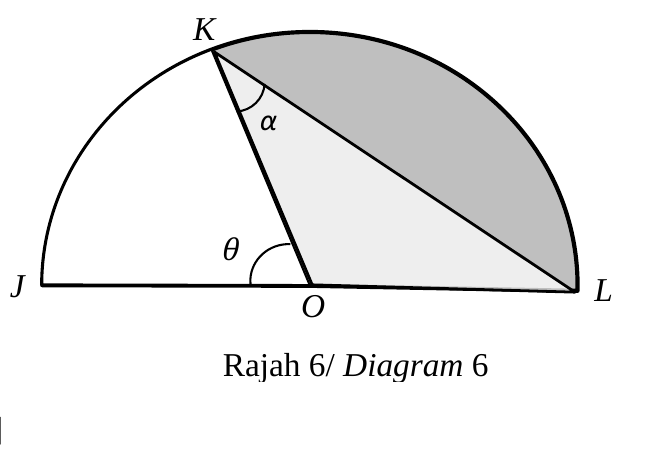
- (a)
Find the length of arc KL in terms of α.
[3] - (b)
Arc JK equals the radius. State θ in radian. Hence find the area of the shaded region.
[4]
Given the unit vector in the direction of vector u is û = ((1 − p)i + qj)/5, express q in terms of p.
Easy4 marksExpress q in terms of p.
[4]
(a) Determine the value of n for the equation (n+2)P3 = 30n. (b) A four-digit passcode '8772' is set by Akif on a door access device. He wants to reset the passcode such that the new passcode cannot contain digit 7 followed by digit 2. How many different passcodes can be formed using the digits 8, 7, 7, 2?
Medium6 marks- (a)
Determine the value of n for (n+2)P3 = 30n.
[3] - (b)
How many different passcodes cannot contain digit 7 followed by digit 2?
[3]
(a) Solve the equation 3sin²x + cos x = 1 for 0° ≤ x ≤ 360°. (b) Given sec θ = t, where 0 ≤ θ ≤ π/2, find the value, in terms of t, for (i) sin θ, (ii) tan(π − θ).
Medium6 marks- (a)
Solve 3sin²x + cos x = 1 for 0° ≤ x ≤ 360°.
[3] - (b)(i)
Given sec θ = t, find sin θ in terms of t.
[1] - (b)(ii)
Given sec θ = t, find tan(π − θ) in terms of t.
[2]
Section B
Given a quadratic function m(x) = 8x² − kx − (5 − k) where k < 5, has a minimum value of −25/8. (a) Express m(x) in terms of x and k in the vertex form. (b) Hence, find the value of k. (c) If the graph of the function m(x) intersects the graph of the function n(x) = 7x² + p − 1 at two different points, find the range of values of p.
Medium8 marks- (a)
Express m(x) in vertex form.
[3] - (b)
Hence, find the value of k.
[2] - (c)
Find the range of values of p so that m(x) and n(x) intersect at two different points.
[3]
(a) Given that 5ⁿ⁺² − 5ⁿ − 125(5ⁿ⁻²) = k(5ⁿ), find the value of k. (b) Express (4√5 − 2)²/(√5 − 1) in the form p√5 + q, where p and q are integers. (c) Given log₃ p = m, express log₃ √p in terms of m.
Medium8 marks- (a)
Given 5ⁿ⁺² − 5ⁿ − 125(5ⁿ⁻²) = k(5ⁿ), find k.
[3] - (b)
Express (4√5 − 2)²/(√5 − 1) in the form p√5 + q.
[4] - (c)
Given log₃ p = m, express log₃ √p in terms of m.
[1]
(a) X is a discrete random variable with X ~ B(n, p). The table shows the probability distribution of X: x = 0, 1, 2, 3 with P(X = x) = 6/125, 36/125, k, 64/125. Find the value of n, k and p. (b) X is a discrete random variable with X ~ B(n, p) with mean 3 and variance 0.75. Find (i) the value of n and p, (ii) P(X = 2).
Medium8 marks- (a)
Find the value of n, k and p.
[3] - (b)(i)
Mean 3 and variance 0.75: find n and p.
[3] - (b)(ii)
Find P(X = 2).
[2]