Write your answer on paper. Then open the answer to check it.
Section A
The straight line x + 2y − 10 = 0 cuts the curve 5x² − 2xy = 24 at two different points. Find the coordinates of the intersection points.
Easy5 marksFind the coordinates of the intersection points.
[5]
(a) Are all numbers with roots surds? Support your statement. (b) Solve the equation 8(4^(x−1)) = 8^(2x−1). (c) Given that x = 3^p and y = 3^q, express log₂₇ x − log₉ y in terms of p and q.
Medium7 marks- (a)
Are all numbers with roots surds? Support your statement.
[2] - (b)
Solve 8(4^(x−1)) = 8^(2x−1).
[2] - (c)
Given x = 3^p and y = 3^q, express log₂₇ x − log₉ y in terms of p and q.
[3]
(a) Given g: x → px + q, where p and q are constants, f: x → 3x − 4 and gf: x → 6x + 5, find the value of p and q. (b) Given f⁻¹(x) = 4/(m − x), x ≠ m, where m is a constant, and g(x) = 3 + x, find (i) the function f in terms of m, (ii) the value of m if f⁻¹f(m² + 7) = g[(2 + m)²].
Medium8 marks- (a)
Find p and q.
[4] - (b)(i)
Find the function f in terms of m.
[2] - (b)(ii)
Find the value of m.
[2]
Given that f(x) = 2x² + 6x − 8. (a) Write the function in vertex form f(x) = a(x + b)² + c. (b) Based on part (a), (i) state the equation of the axis of symmetry, (ii) determine the characteristic of the turning point of the function. Justify your answer. (c) Hence, sketch the graph of |f(x)| for −6 ≤ x ≤ 2.
Medium7 marks- (a)
Write f(x) in the form a(x + b)² + c.
[2] - (b)(i)
State the equation of the axis of symmetry.
[1] - (b)(ii)
Determine the characteristic of the turning point. Justify your answer.
[1] - (c)
Sketch the graph of |f(x)| for −6 ≤ x ≤ 2.
[3]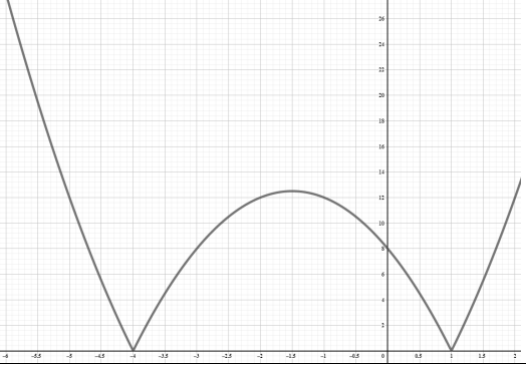
(a) Sketch the graph of y = |2cos2x| + 1 for 0 ≤ x ≤ π. (b) Hence, using the same axes, sketch a suitable straight line to find the number of solutions for the equation |2cos2x| − x/π = 1 for 0 ≤ x ≤ π. State the number of solutions.
Medium7 marks- (a)
Sketch the graph of y = |2cos2x| + 1 for 0 ≤ x ≤ π.
[4]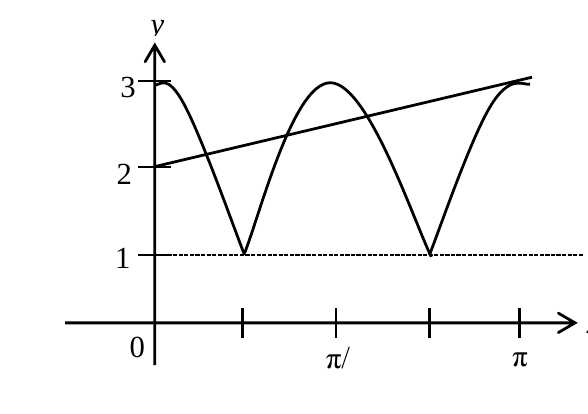
- (b)
Sketch a suitable straight line and state the number of solutions.
[3]
Diagram 1 shows roads of schools in a town area that form a quadrilateral OABC (printed as 'rectangle'). School M is at the middle of schools A and C, and OM : OB = 2 : 3. Given OA→ = 3x + 2y, OC→ = 9x + 2y and CB→ = 3ry, where r is a constant, (a) express in terms of x and/or y, (i) AC→, (ii) OM→; (b) express OB→ in terms of (i) x and y, (ii) x, y and r. Hence, find the value of r. (x and y are vectors.)
Medium8 marks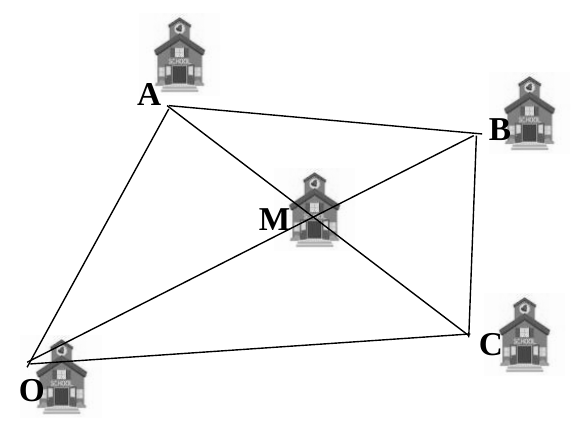
- (a)(i)
Express AC→ in terms of x and/or y.
[1] - (a)(ii)
Express OM→ in terms of x and/or y.
[2] - (b)(i)
Express OB→ in terms of x and y.
[2] - (b)(ii)
Express OB→ in terms of x, y and r. Hence, find r.
[3]
Diagram 2 shows a piece of wire bent to form the perimeter OPQR of a sector of a circle, centre O, radius x cm, where angle POR is θ radian. The wire is of length 100 cm while x and θ may vary. (a) Show that the area of the sector, A cm², can be expressed as A = 50x − x². (b) Hence, find (i) the value of x for which the area enclosed by the wire is a maximum, (ii) the corresponding value of θ in radian.
Medium8 marks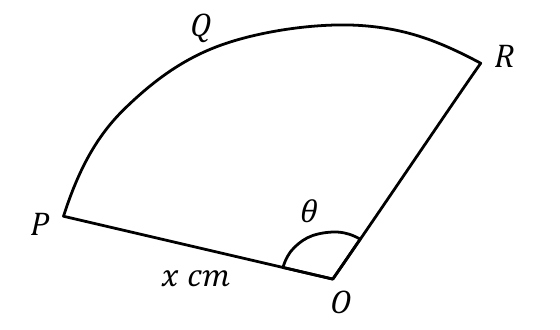
- (a)
Show that A = 50x − x².
[2] - (b)(i)
Find the value of x for which the area is a maximum.
[4] - (b)(ii)
Find the corresponding value of θ in radian.
[2]
Section B
Diagram 3 shows part of the curve y = (x − 6)² and a straight line y = mx + c intersecting at the point (4, 6). Given that ∫₀⁴ (mx + c) dx = 16. Calculate (a) the value of c and of m, (b) the area of the shaded region, (c) the volume generated, in terms of π, when the shaded region is revolved through 360° about the x-axis.
Medium10 marks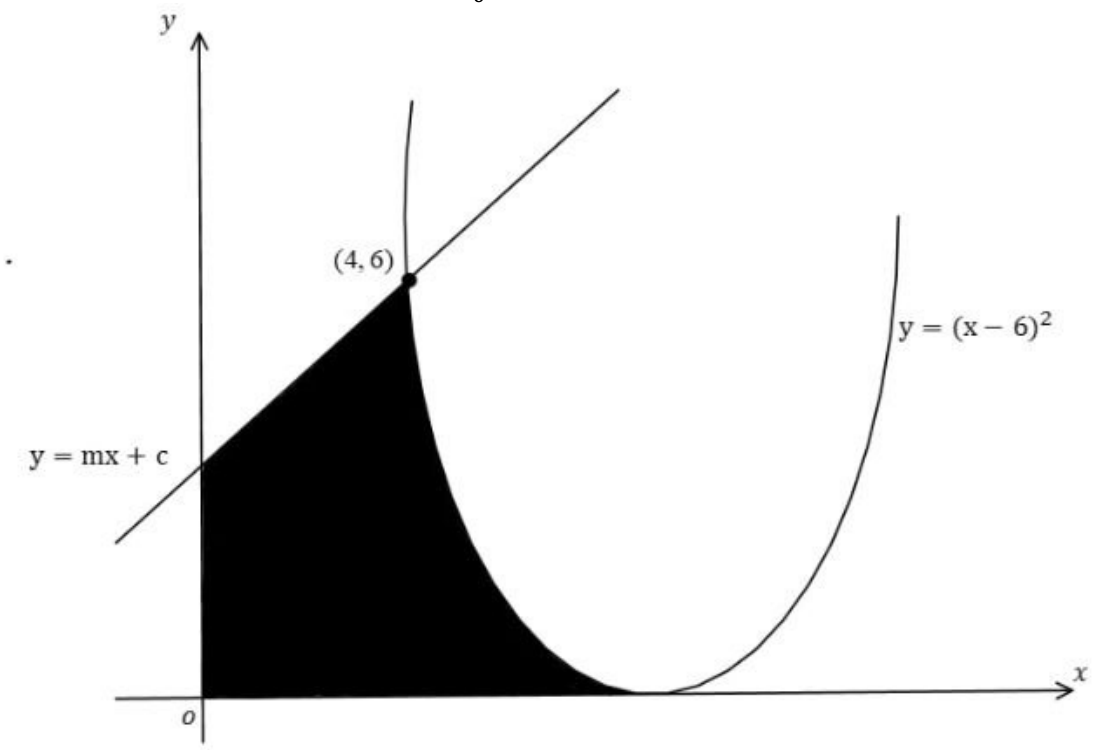
- (a)
Calculate the value of c and of m.
[4] - (b)
Calculate the area of the shaded region.
[3] - (c)
Calculate the volume generated, in terms of π.
[3]
Diagram 4 shows triangle PQR with P(8, 7), R(−2, 5) and F(2, 1). The straight line PQ is perpendicular to the straight line RE. The straight lines PF and RE intersect at point G. (F lies on RQ and PF is perpendicular to RQ.) Given that PG : GF = 2 : 1, find (a) the coordinates of G, (b) the equation of straight line PQ, (c) the equation of straight line RQ, (d) the equation of the locus of a moving point W such that its distances from points P and R are in the ratio 3 : 2.
Medium10 marks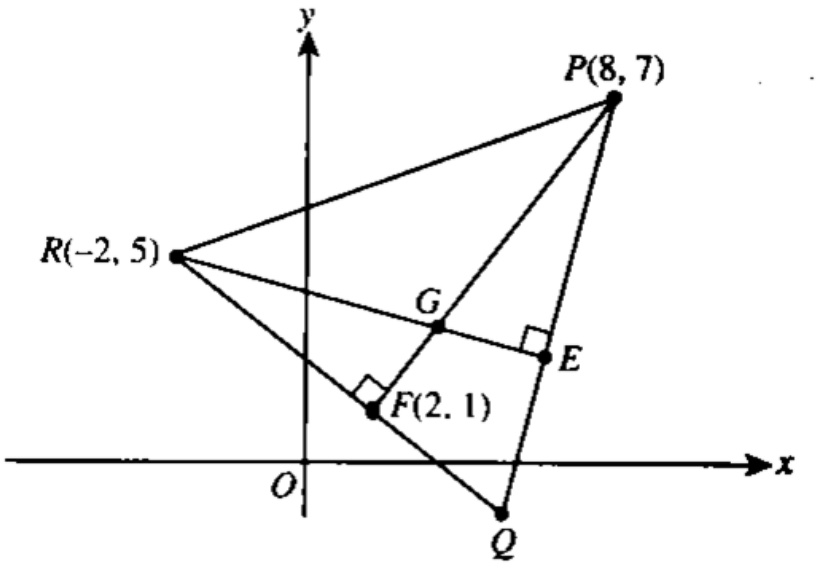
- (a)
Find the coordinates of G.
[2] - (b)
Find the equation of straight line PQ.
[3] - (c)
Find the equation of straight line RQ.
[2] - (d)
Find the equation of the locus of W with PW : WR = 3 : 2.
[3]
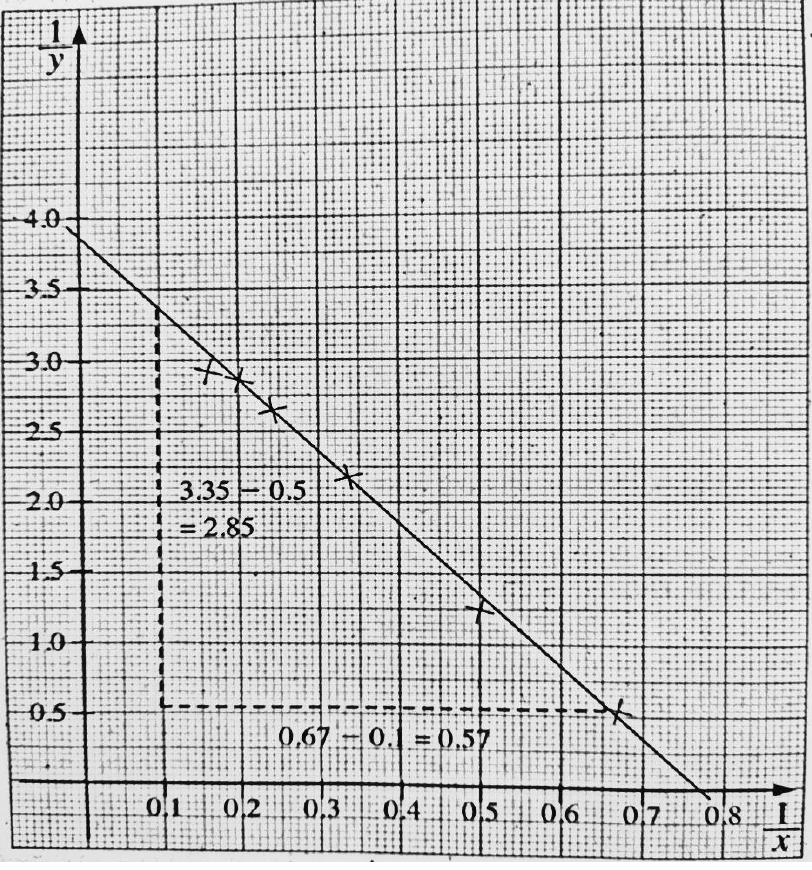
Use the graph paper to answer this question. Table 1 shows the values of two variables, x and y, obtained from an experiment: x = 1.5, 2.0, 3.0, 4.0, 5.0, 6.0; y = 2.020, 0.770, 0.465, 0.385, 0.351, 0.339. Variables x and y are related by the equation nx = py + xy, where n and p are constants. (a) Based on the table, construct a table for the values of 1/y and 1/x. (b) Plot 1/y against 1/x using a scale of 2 cm to 0.1 unit on the 1/x axis and 2 cm to 0.5 unit on the 1/y axis. Hence draw the line of best fit. (c) Using the graph in (b), find the value of (i) n, (ii) p.
Medium10 marks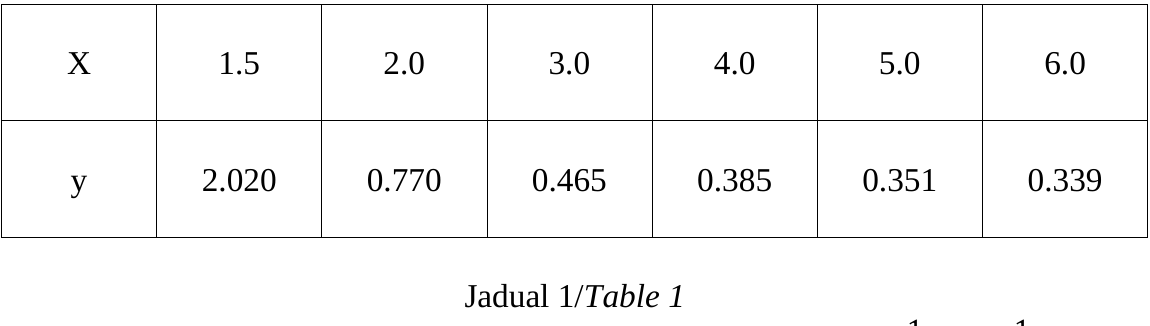
- (a)
Construct a table of 1/x and 1/y.
[2] - (b)
Plot 1/y against 1/x and draw the line of best fit.
[3]
- (c)
Using the graph, find (i) n, (ii) p.
[5]
(a) The probability that a student walks to school is p. A sample of 6 students is selected at random. (i) If the probability that all the students walk to school is 0.04666, find the value of p. (ii) Find the probability that more than 4 students walk to school. (b) Diagram 5 shows a standard normal distribution graph (upper tail area 40.9% shaded) representing the volume of chili sauce in bottles produced by a factory. It is given that the mean is 900 m³ and the variance is 289 m⁶ (units as printed). If the percentage of volume more than V is 40.9%, find (i) the value of V, (ii) the probability that the volume is between 866 m³ and 951 m³.
Medium10 marks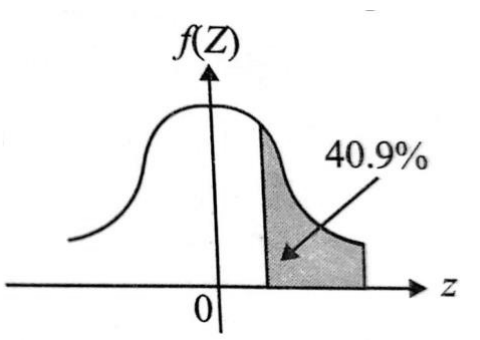
- (a)(i)
Find p if P(all 6 walk) = 0.04666.
[3] - (a)(ii)
Find P(more than 4 students walk to school).
[2] - (b)(i)
Find the value of V.
[2] - (b)(ii)
Find P(866 < X < 951).
[3]
Section C
Diagram 6 shows a combination of triangles ABC, BCD and ACD on the horizontal plane. Given that ∠ACB and ∠BCD are obtuse. DB = 8 cm, BC = 6 cm, AC = 10 cm and ∠BDC = 40°. If the area of triangle ABC is 22 cm², calculate (a) ∠ACB, (b) the length, in cm, of AB, (c) ∠DBA, (d) the area, in cm², of triangle ABD.
Medium10 marks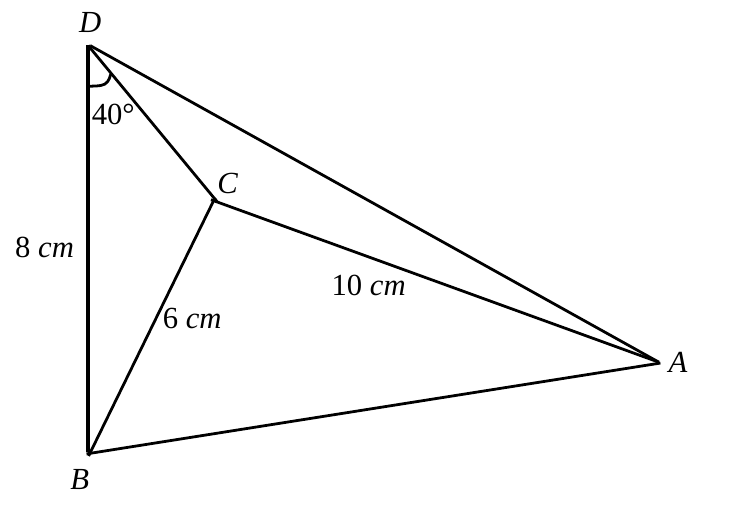
- (a)
Calculate ∠ACB.
[2] - (b)
Calculate the length of AB in cm.
[2] - (c)
Calculate ∠DBA.
[4] - (d)
Calculate the area of triangle ABD in cm².
[2]
A particular kind of cake is made using three ingredients P, Q and R. Table 2 shows the price indices for the year 2018 based on the year 2014 and the weightage of the ingredients: P index 98 weightage y + 2; Q index 123 weightage y + 4; R index x weightage 5. (a) State the percentage of decrease of ingredient P from year 2014 to year 2018. (b) The price of ingredient Q in the year 2018 if the price in the year 2014 is RM10.50. (c) The price index of ingredient R for 2018 based on the year 2016 is 125 and for 2016 based on the year 2014 is 92. Find the value of x. (d) The cost of making this type of cake in year 2014 is RM55.00 and it has increased to RM62.15 in year 2018. Find the value of y.
Medium10 marks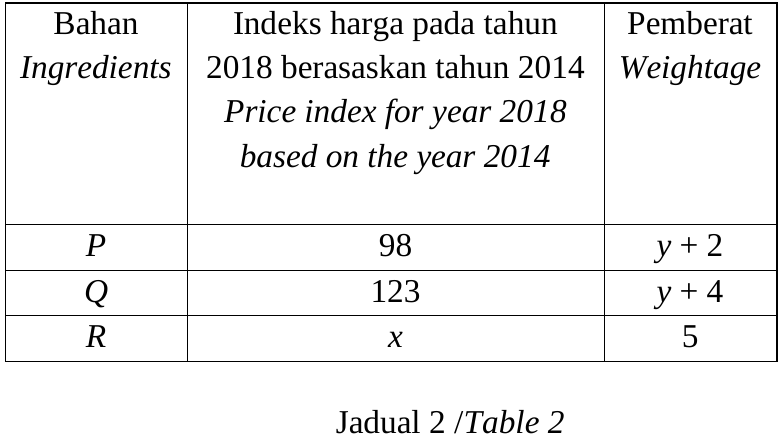
- (a)
State the percentage decrease of ingredient P.
[1] - (b)
Find the price of Q in 2018.
[2] - (c)
Find the value of x.
[3] - (d)
Find the value of y.
[4]
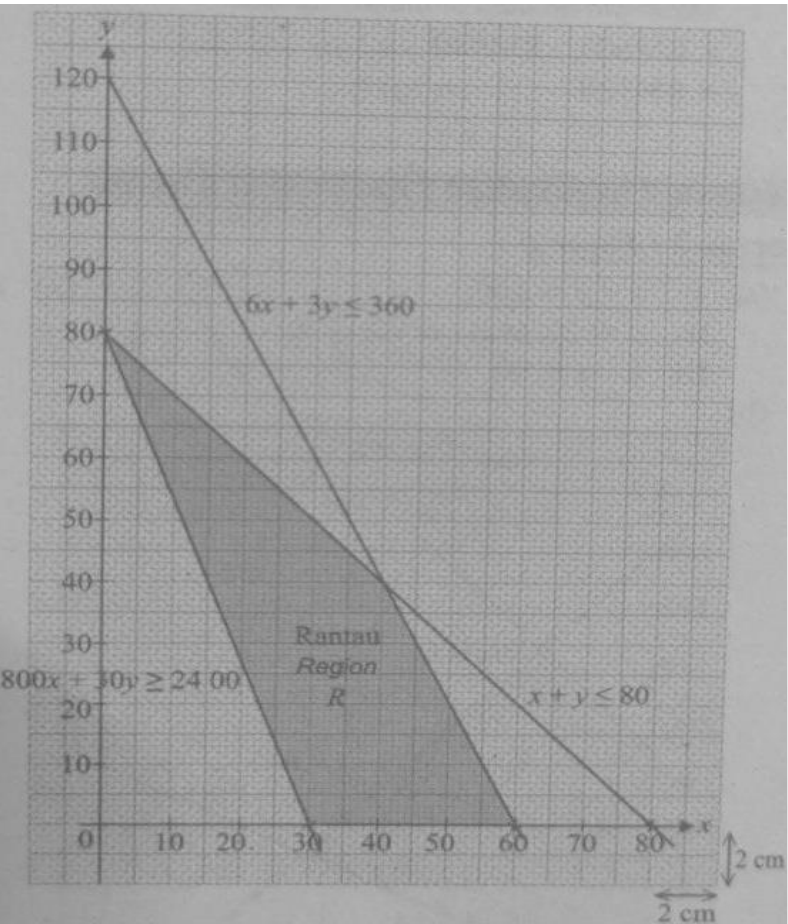
Use graph paper to answer this question. Mr Ammar used x hectares of land for planting corn and y hectares for planting papaya trees. He employs at most 360 labourers and allocates a capital of at least RM24 000. Each hectare of corn orchard needs 6 labourers and each hectare of papaya orchard needs 3 labourers. The total land for corn and papaya is not more than 80 hectares. The expenses for a hectare of corn orchard is RM800 and for a hectare of papaya orchard RM300. (a) Write three linear inequalities, other than x ≥ 0 and y ≥ 0, that satisfy all the above constraints. (b) Using a scale of 2 cm to 10 units on both axes, construct and shade the region R which satisfies all of the above constraints. (c) Using the graph, find (i) the maximum area of land for planting corn, if the area of land for planting papaya trees is 20 hectares, (ii) the maximum profit, if the profit from selling corn is RM700 and papaya is RM250 for each hectare.
Medium10 marks- (a)
Write three linear inequalities.
[3] - (b)
Construct and shade the region R (scale 2 cm to 10 units on both axes).
[3]
- (c)(i)
Find the maximum area of land for corn when the papaya area is as stated.
[1] - (c)(ii)
Find the maximum profit.
[3]
A particle moves along a straight line and passes through a fixed point O. Its velocity, v m s⁻¹, is given by v = mt² + nt, where m and n are constants and t is the time, in seconds, after passing through O. It is given that the particle stops instantaneously when t = 5 s and its acceleration is 3 m s⁻² when t = 1 s. [Assume motion to the right is positive] Find (a) the values of m and of n, (b) the range of values of t when the particle moves to the right, (c) the distance, in m, travelled by the particle during the 2nd second.
Medium10 marks- (a)
Find the values of m and n.
[5] - (b)
Find the range of t when the particle moves to the right.
[2] - (c)
Find the distance travelled during the 2nd second.
[3]