Write your answer on paper. Then open the answer to check it.
Section A
The straight line y = 16 − px intersects the curve y = x² + 8x + 32 as shown in Diagram 1. Find the range of values of p so that both the straight line and the curve must meet.
Easy4 marks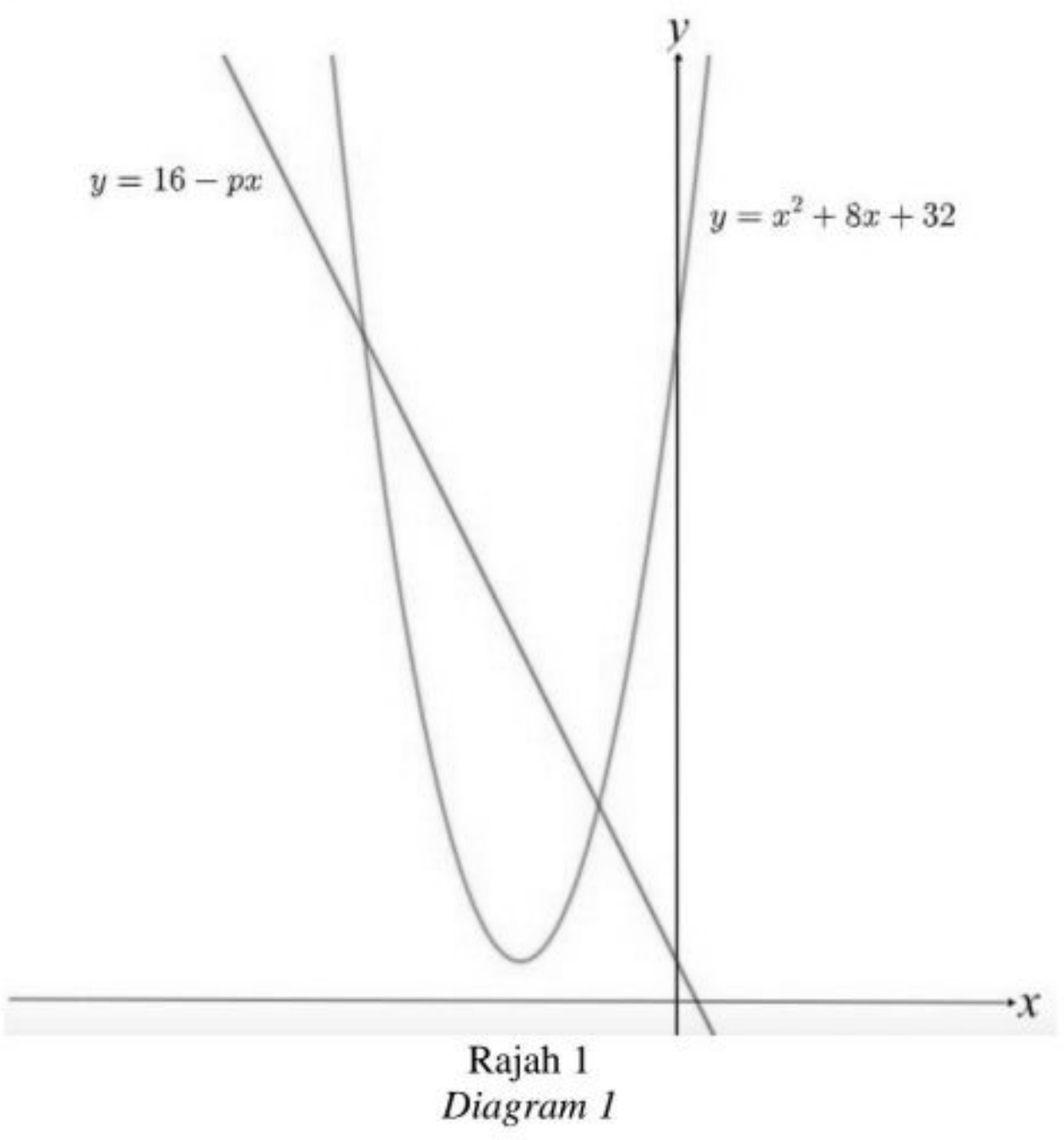
Find the range of values of p so that the line and the curve must meet.
[4]
Differentiate (3x + 1)²/(1 − 2x) with respect to x.
Easy3 marksDifferentiate (3x + 1)²/(1 − 2x) with respect to x.
[3]
The weights of Form 2 students in a school are normally distributed with mean μ and standard deviation σ. If 10% of the students have a minimum weight of 75 kg and 35% of the students have a weight of at least 40 kg, find the values of μ and σ.
Medium5 marksFind the values of μ and σ.
[5]
(a) Determine whether 768p, 192p², 48p³, 12p⁴, … is a geometric progression. (b) Ben starts on an annual salary of RM18000 with a pay rise of RM1800 each year until his salary reaches RM36000, then no more rises. Kent starts on RM a with a pay rise of RM1000 each year until RM36000, first reached in year 15, then no more rises. Who receives more total earnings after year 15?
Medium7 marks- (a)
Determine whether the progression is geometric. Give your justification.
[2] - (b)
Who will receive more total earnings after year 15? Give your justification.
[5]
Diagram 2 shows part of the curve y = 3x². P, Q and R show areas under the graph and OA : OB = 5 : 2, with B(2k, 0) and C(8, 0). (a) Show that the area of Q is −10k² + 40k and find k if the area of Q is 40 unit². (b) Hence, find the area of R.
Easy5 marks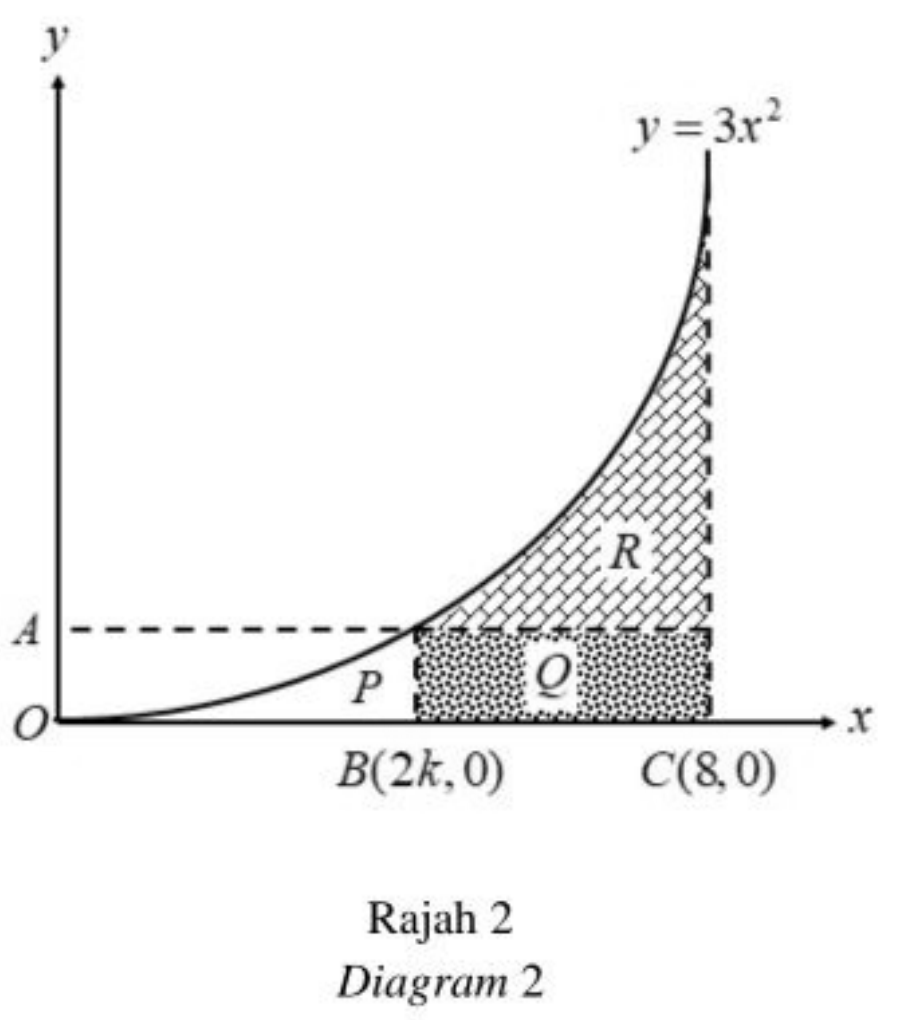
- (a)
Show that the area of Q is −10k² + 40k and find the value of k if the area of Q is 40 unit².
[3] - (b)
Hence, find the area of R.
[2]
Diagram 3 shows the graph of f(x) = 2/(2 − x), x ≠ 2. (a) Determine that f has an inverse using the horizontal line test and justify your answer. (b) Find (i) f⁻¹, (ii) f⁻¹(−6).
Easy5 marks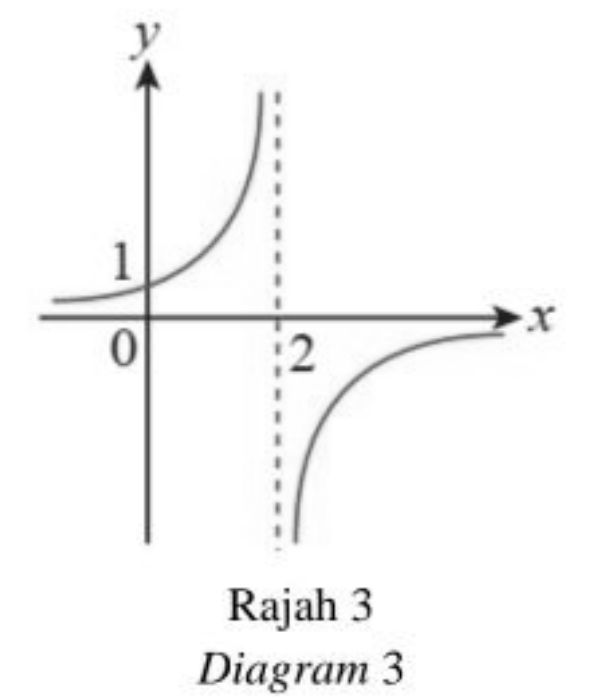
- (a)
Show that f has an inverse using the horizontal line test; justify.
[1] - (b)(i)
Find f⁻¹.
[2] - (b)(ii)
Find f⁻¹(−6).
[2]
Diagram 4 shows part of the graph of the total population of bacteria y against hours x, with points (6, 10) and (16, 100). x and y are related by y = pq^x, where p and q are constants. (a) Sketch the straight line graph of log₁₀ y against x. (b) Based on the graph in (a), find the values of p and q.
Easy5 marks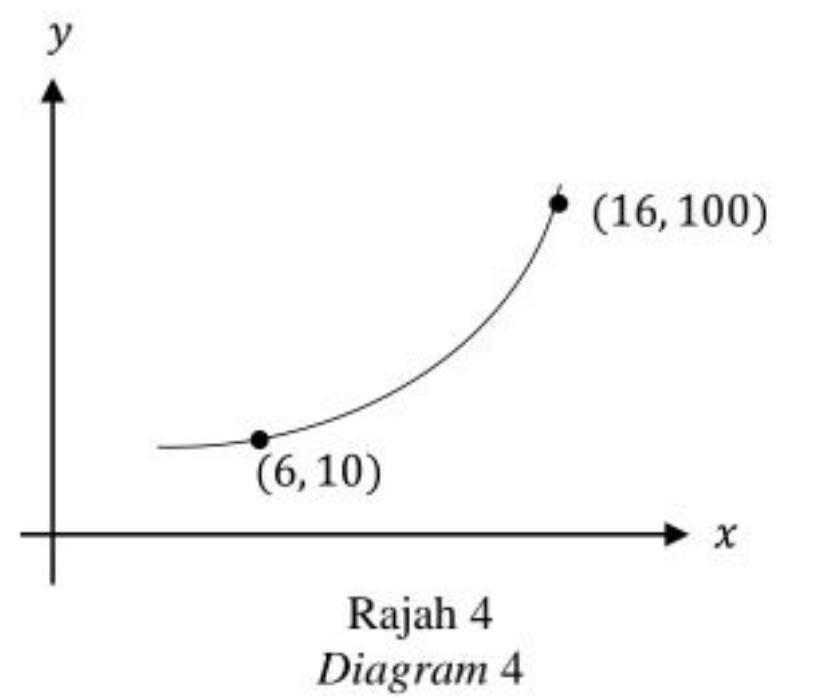
- (a)
Sketch the straight line graph of log₁₀ y against x.
[2] - (b)
Find the values of p and q.
[3]
(a) Given 25(5^(2x−3)) = 1, find the value of x. (b) Given x = 1/(4 + 3√2) and y = 1/(4 − 3√2), find the value of xy² + x²y.
Medium6 marks- (a)
Find the value of x.
[2] - (b)
Find the value of xy² + x²y.
[4]
Diagram 5 shows a logo of three equal sectors AOB, COD and EOF with centre O and radius r/3 cm, ∠AOB = ∠COD = ∠EOF. Calculate ∠AOB in radians. Show that the area of the shaded region is (π/18 − √3/12) r² cm². Hence, find the area of the shaded region when r = 30 cm.
Medium6 marks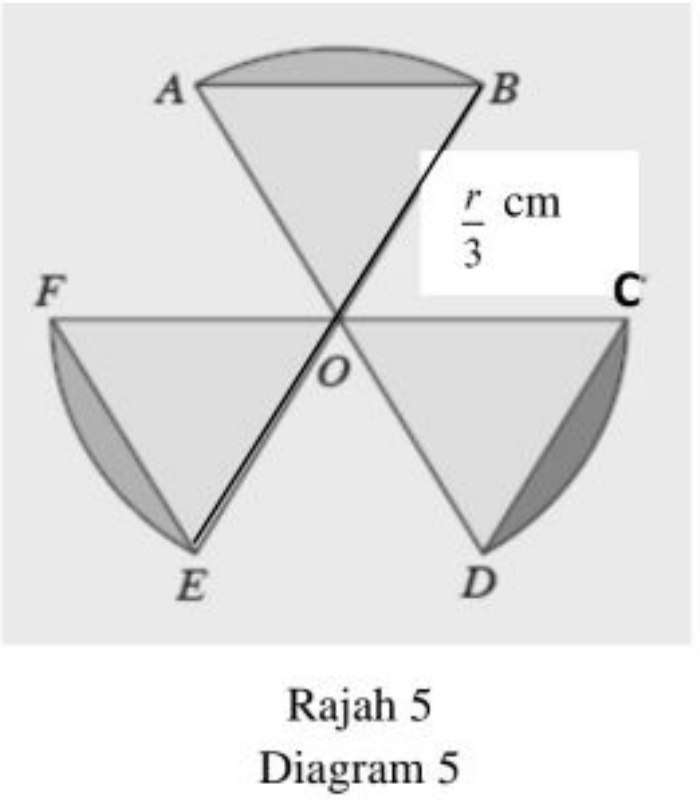
Calculate ∠AOB in radians; show the shaded area is (π/18 − √3/12)r² cm²; find the area when r = 30 cm.
[6]
Diagram 6 shows roads of a village forming quadrilateral PQRS. A mosque M is at the junction of SQ and PR. Kamal's house K is on road SP. Given SP = 4SK and PM : MR = 3 : 1, road SR is represented by vector x and road SP by vector 4y. (a) Express in terms of x and y: (i) KR→, (ii) SM→. (b) Given PQ→ = px − 2y and SM→ = qSQ→ where p and q are constants, find p and q.
Medium7 marks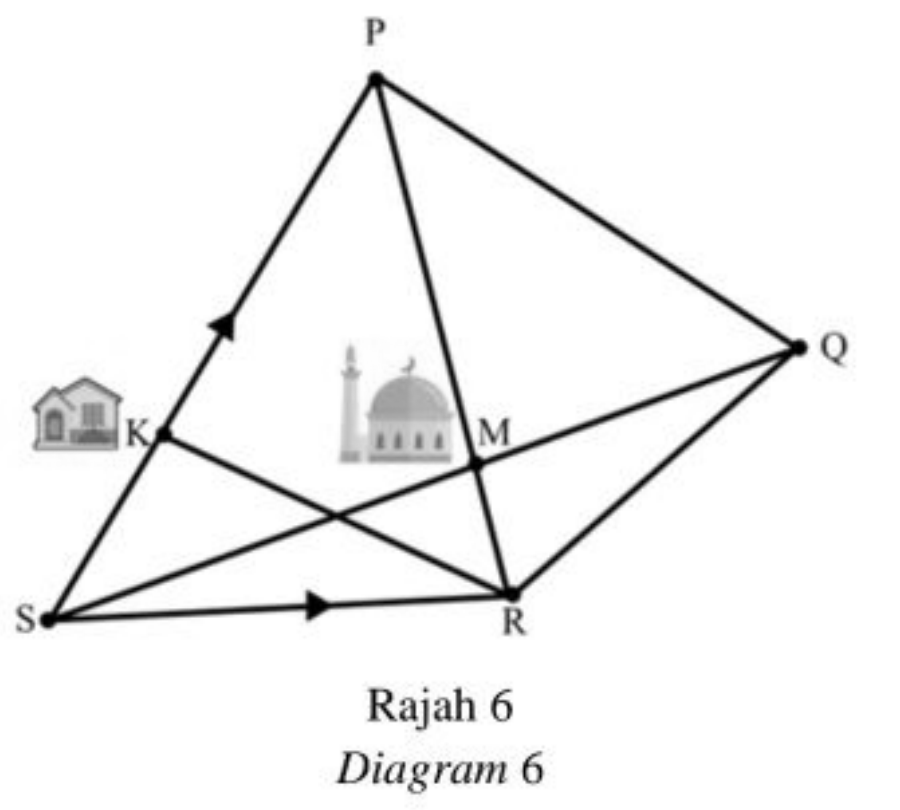
- (a)(i)
Express KR→ in terms of x and y.
[1] - (a)(ii)
Express SM→ in terms of x and y.
[2] - (b)
Find the values of p and q.
[4]
(a) Derive the formula cos 2A using the compound angle formula. (b) Solve the equation 3cos²x − 3sin²x = 8 sin x cos x for 0° ≤ x ≤ 360°.
Medium6 marks- (a)
Derive the formula cos 2A using the compound angle formula.
[2] - (b)
Solve 3cos²x − 3sin²x = 8 sin x cos x for 0° ≤ x ≤ 360°.
[4]
(a) Khalis chooses a shirt and a trouser from 6 shirts and 4 trousers. Find the number of possible ways. (b) Fairus has 8 beads of different colours and makes a necklace. Find the number of different necklaces that can be made using at least 6 of the 8 beads.
Easy5 marks- (a)
Find the possible number of ways.
[2] - (b)
Find the number of different necklaces using at least 6 of the 8 beads.
[3]
Section B
Diagram 7 shows quadrilateral PQRS with P(0, 2), Q(2k, 4k), R(7k, k), S(4k, L − 2). Point M(9, h + k) lies on QR and QM = MR. The distance ratio QM : MR is m : n. (a) State the smallest value of m and n. (b) Express h in terms of k. (c) Find the possible values of L when the area of PQRS is 105 unit², hence state the coordinates of S.
Medium8 marks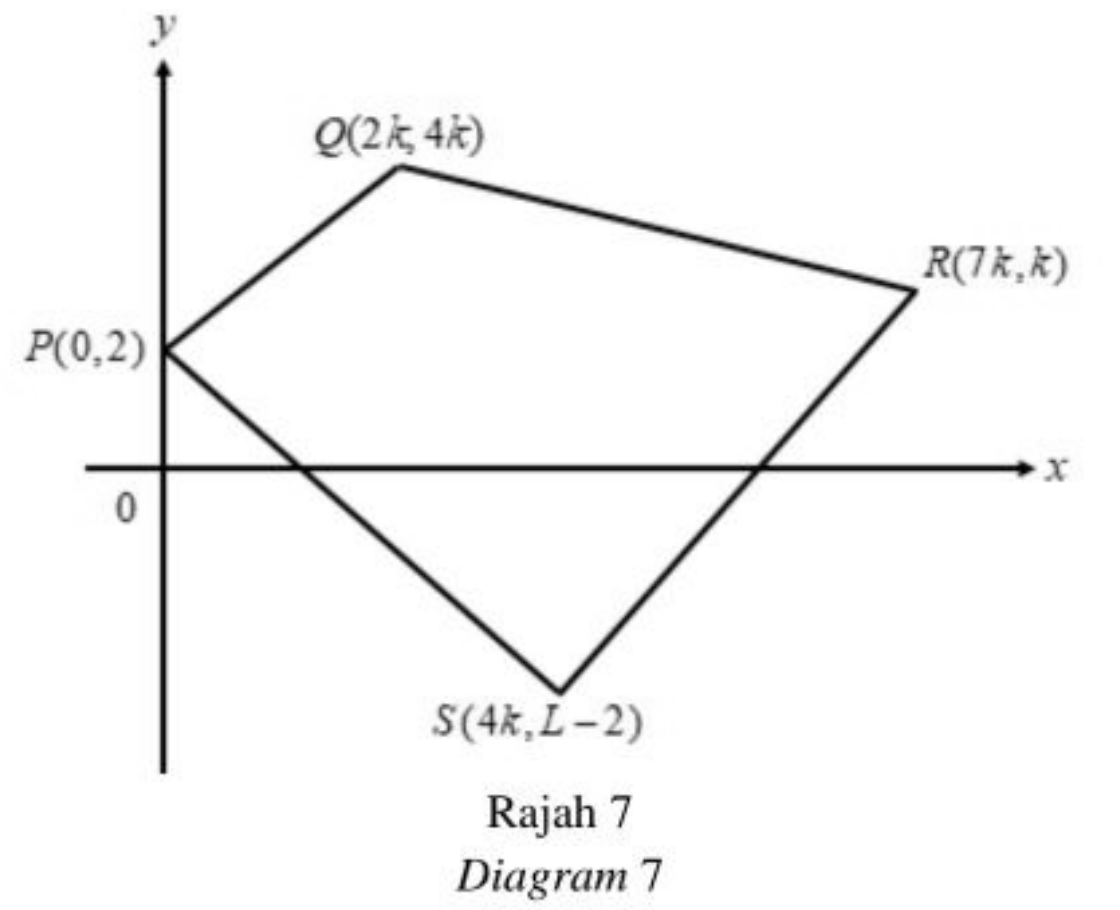
- (a)
State the smallest value of m and n.
[1] - (b)
Express h in terms of k.
[3] - (c)
Find the possible values of L when the area of PQRS is 105 unit²; hence state the coordinates of S.
[4]
Diagram 8 shows a solid made of a cone on top of a cylinder of radius x cm. The slant height of the cone is 3x cm and the volume of the cylinder is 32π cm³. (a) Prove that the total surface area L cm² is L = 4π(x² + 16/x). (b) Calculate the minimum value of the radius of the cylinder. (c) Given the total surface area changes at the rate 42π cm² s⁻¹, find the rate of change of the radius when the radius is 4 cm.
Medium8 marks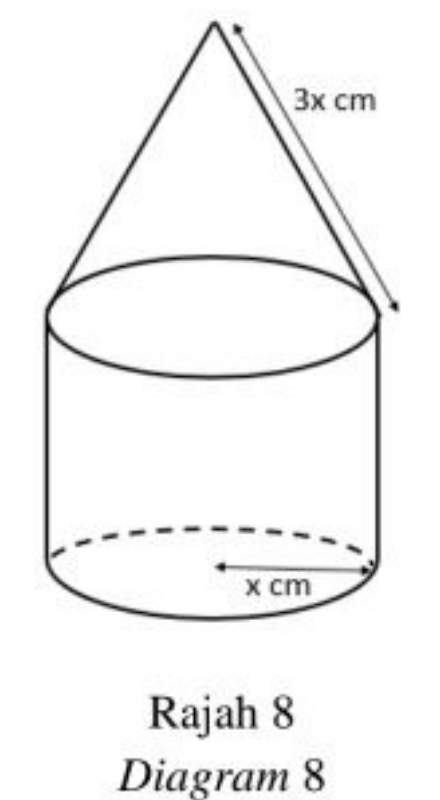
- (a)
Prove that L = 4π(x² + 16/x).
[3] - (b)
Calculate the minimum value of the radius of the cylinder.
[2] - (c)
Find the rate of change of the radius when the radius is 4 cm.
[3]
(a) Given 2^x = 4^y = 8^z, express y in terms of x and z. (b) The temperature of an aluminium cube decreases from 120°C to T°C following T = 100(0.95)^x after x seconds. Calculate (i) the temperature after 4 seconds, (ii) the time t in seconds for the temperature to decrease from 120°C to 90°C.
Medium8 marks- (a)
Express y in terms of x and z.
[4] - (b)(i)
Calculate the temperature after 4 seconds.
[1] - (b)(ii)
Calculate the time t for the temperature to decrease from 120°C to 90°C.
[3]