Write your answer on paper. Then open the answer to check it.
Section A
A cube-shaped ice sculpture (Diagram 1) has a volume of 125000 cm³. After the party its volume is 64000 cm³. Find the small change in the volume, in cm³, of the ice sculpture.
Easy3 marks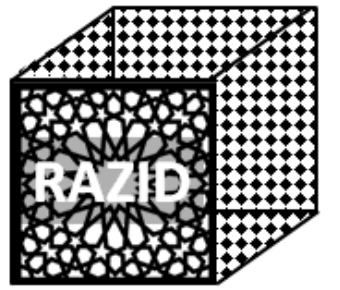
Find the small change in the volume, in cm³, of the ice sculpture.
[3]
A slice of pizza is a sector with centre O and radius 7.34 cm (Diagram 2). The arc length PQ is 9.24 cm. Use π = 3.142.
Easy4 marks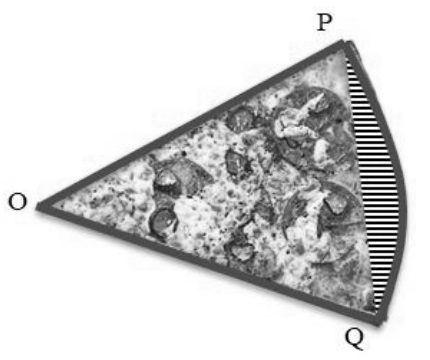
- (a)
Find the angle POQ, in degrees.
[2] - (b)
Hence calculate the perimeter, in cm, of the shaded segment.
[2]
Diagram 3 shows part of the Klang Valley rail transit map on a Cartesian plane. A new straight rail is built so that any point on it is always equidistant from Chow Kit station (−1.5, 2.5) and Ampang Park station (2, 4). Batu Caves station is at (−4, 12) and Dang Wangi station is at (2.5, −2).
Medium6 marks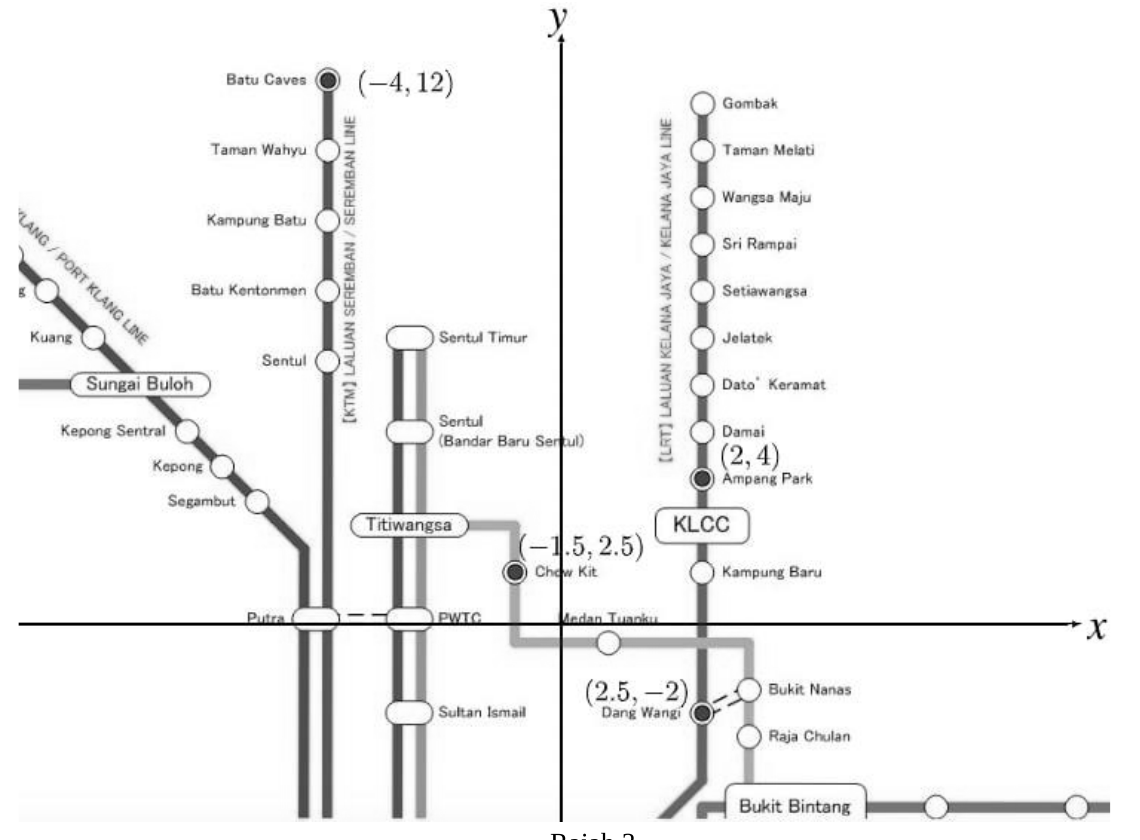
- (a)
Find the locus of the future rail.
[4] - (b)
Between Batu Caves Station and Dang Wangi Station, which station will the new rail pass through? Justify your answer.
[2]
A college lecture hall has 10 rows of seats (Diagram 4). The first row has 7 seats and each later row has 4 more seats than the row before.
Easy5 marks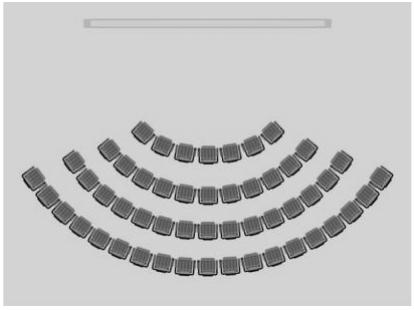
- (a)
How many seats are there in the last row?
[2] - (b)
A seminar will be held in this hall. Determine whether the hall can accommodate 260 participants. Give your justification.
[3]
(a) Given d/dx (4x − 3)⁶ = 24(4x − 3)⁵, find ∫ 3(4x − 3)⁵ dx. (b) Given d/dx [x²/(x + 3)] = x(x + 6)/(x + 3)², find the value of ∫ from 1 to 2 of 2x(x + 6)/[2(x + 3)²] dx.
Medium6 marks- (a)
Given d/dx (4x − 3)⁶ = 24(4x − 3)⁵, find ∫ 3(4x − 3)⁵ dx.
[2] - (b)
Given d/dx [x²/(x + 3)] = x(x + 6)/(x + 3)², find the value of ∫ from 1 to 2 of 2x(x + 6)/[2(x + 3)²] dx.
[4]
Diagram 5 shows the function f: x → 3x − 5, with input 3 and output m.
Easy5 marks- (a)
Find the value of m.
[1] - (b)
Given g(x) = p − qx and gf(x) = 6 − 9x, find the values of p and q.
[4]
The variables x and y are related by y = 10^(hx + 5k), where h and k are constants. Diagram 6 (answer space) shows the plot of Y against 6x, where Y = log₁₀ y. Plotted points: (1, 12.8), (2, 10.6), (3, 8.8), (4, 6), (5.5, 3), (6, 2) approximately.
Medium6 marks- (a)
Draw the line of best fit on Diagram 6.
[1]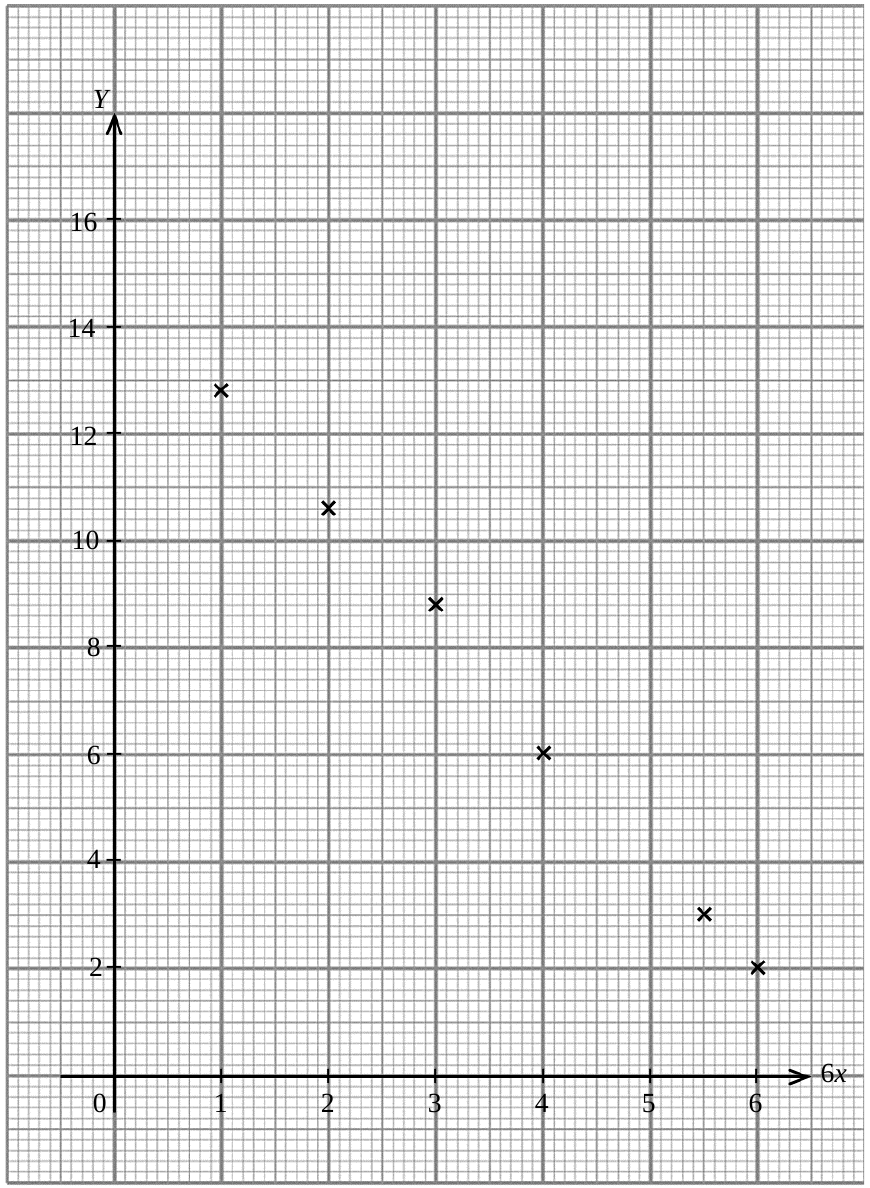
- (b)
Hence, using the graph in (a), find the value of (i) h, (ii) k.
[5]
Diagram 7 shows a triangular prism with length CE = 3 cm; its cross-section is an equilateral triangle of area √8 cm². A cylindrical tank of height h and radius r holds 3√2 πr² cm³ of water. (a) The prism is placed in the tank and the tank becomes full. Find the height of water displaced by the prism in terms of r. (b) Later a cube of side √2 x is placed in the cylinder; the height of water it displaces is 1.08 times that displaced by the prism. Find x and h when r = 3 cm, to 1 decimal place.
Medium7 marks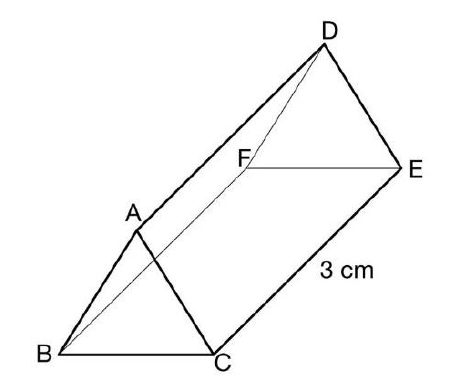
- (a)
Find the height of the water displaced by the prism in terms of r.
[4] - (b)
Find the values of x and h when the radius is 3 cm, to 1 decimal place.
[3]
Diagram 8 shows the graph of f(x) = 4(x − 1)² + 4, where a = 4, h = 1 and k = 4.
Medium6 marks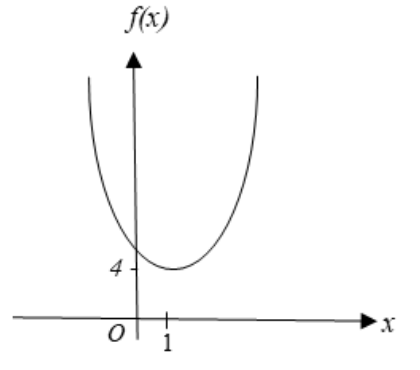
- (a)
Determine the minimum point and the equation of the axis of symmetry.
[2] - (b)
Make a generalisation about the shape and position of the graph f(x) = 2(x − 1)² + 6 when the values of a, h or k change. Hence sketch the graph.
[4]
Diagram 9 shows the positions and directions of Ahmad's and Ben's sailing boats in a competition. The water velocity is v = (2i + ½j) m s⁻¹. Ahmad and Ben sail with velocities a = (5i + 3j) m s⁻¹ and b = (3i + 2j) m s⁻¹ respectively. Both boats move in the direction of the water current.
Medium6 marks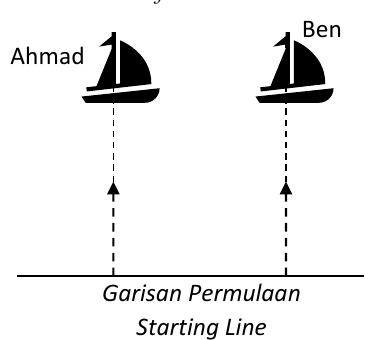
- (a)
How many times is the resultant velocity of Ahmad's boat compared to the resultant velocity of Ben's boat?
[4] - (b)
Chong's boat moves off track with velocity c = (3i − 3/2 j) m s⁻¹. Find the resultant velocity and the magnitude of the velocity of Chong's boat.
[2]
A and B are two angles in the same quadrant between 0° and 360°, with cos A = 8/17 and tan B = −3/4. Without using a calculator, find (a) tan(A − B), (b) cosec(½A).
Easy5 marks- (a)
Find tan(A − B).
[3] - (b)
Find cosec(½A).
[2]
Diagram 10 shows six workstations P, Q, R (top row) and S, T, U (bottom row) in a company. Six employees (Aliff, Balqis, Christine, Danial, Emeer and Faiz) are placed in the workstations, one worker per workstation. Calculate the number of ways to place all the employees (a) if no conditions are imposed, (b) if Aliff and Balqis cannot be placed in workstations that share an edge.
Medium6 marks- (a)
No conditions imposed.
[2] - (b)
Aliff and Balqis cannot be placed in workstations that share an edge.
[4]
Section B
Diagram 11 shows four events: I time taken to wait for a bus; II number of times 6 is obtained when a dice is thrown five times; III number of red cars among seven cars in a parking area; IV height of form five students at SMK Manjoi. Table 1: discrete random variable X with P(X = r) = (p − 3)/5, (p − 2)/8, 3/16, (2p − 7)/20, (p + 1)/16 for r = 0, 1, 2, 3, 4.
Medium8 marks- (a)
Classify events I, II, III and IV in Diagram 11 as discrete random variables or continuous random variables by completing Diagram 12.
[2]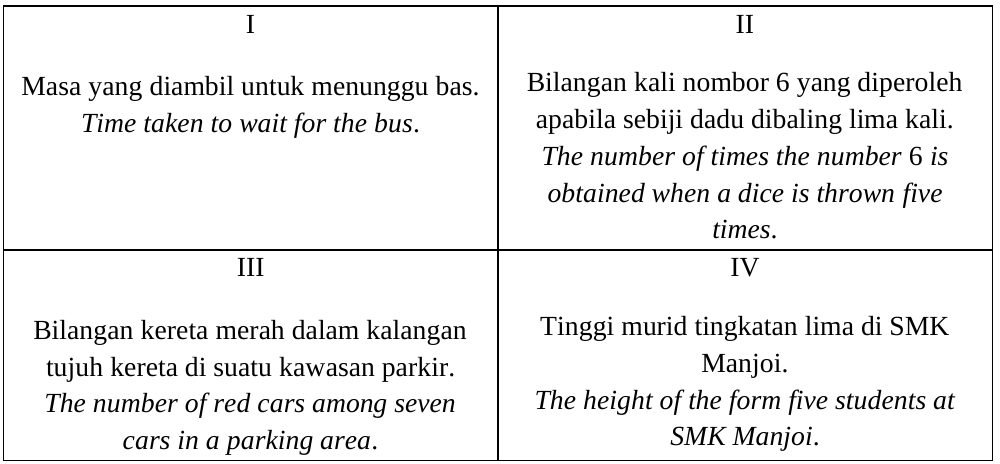
- (b)(i)
Find the value of p. (Table 1)
[2]
- (b)(ii)
Calculate P(X < 1 ∪ X ≥ 3).
[2] - (b)(iii)
Sketch the probability distribution graph for X on Diagram 13.
[2]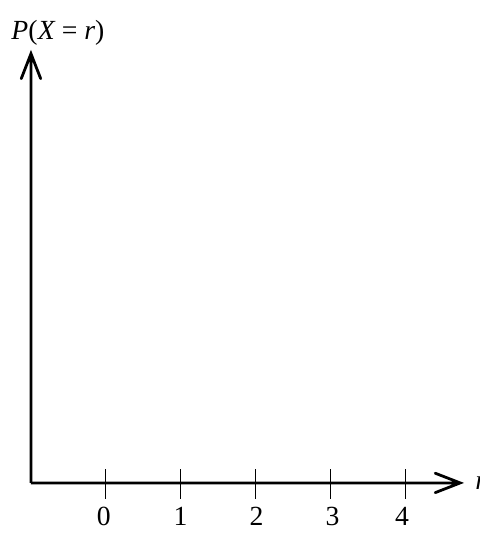
(a) Complete Table 2 to derive the formula for the sum of the first n terms, Sₙ, of a geometric progression. (b) Damia is offered an initial salary of RM 18 000 per year with a 5% yearly increment from the basic salary. She plans to save 25% of her salary after working for 5 years. Calculate her total savings, correct to the nearest RM.
Hard8 marks- (a)
Complete Table 2 to derive the formula for Sₙ.
[4]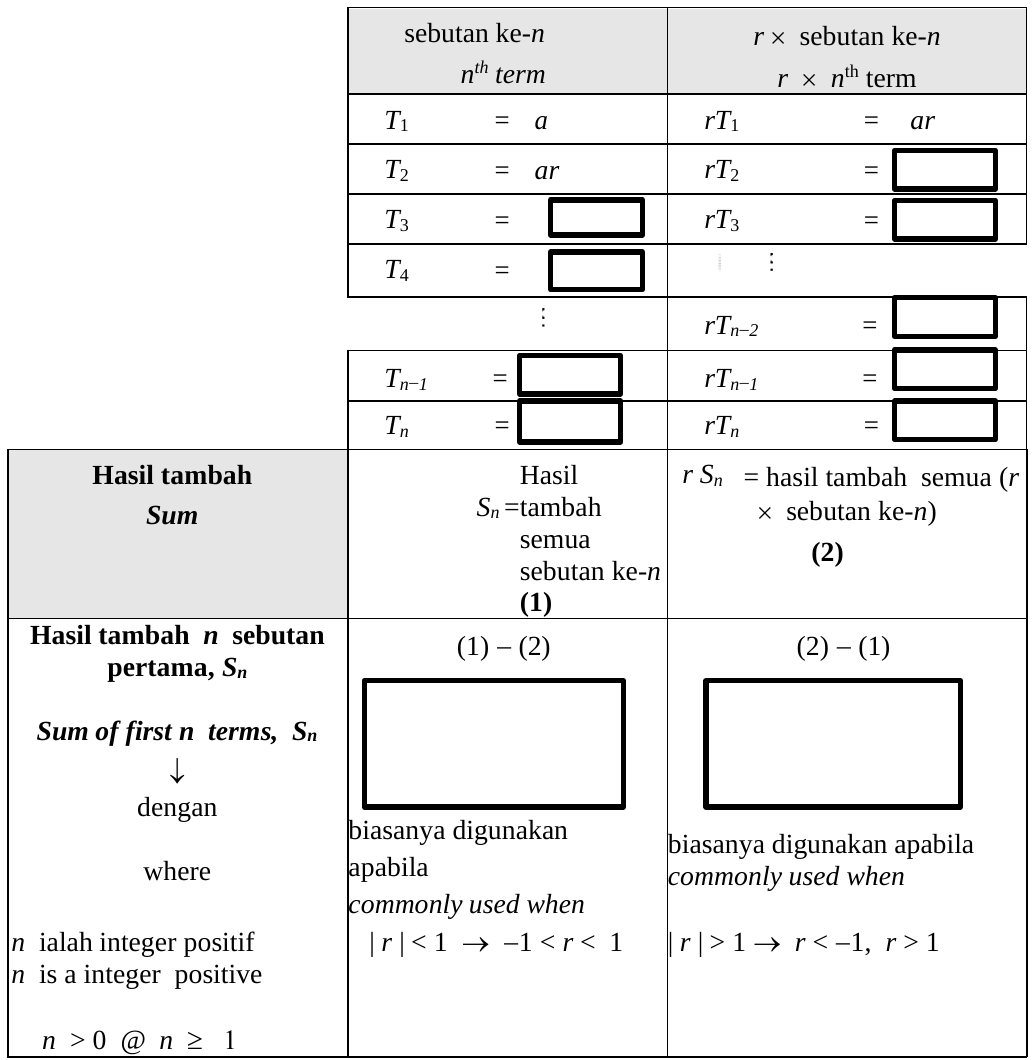
- (b)
Calculate Damia's total savings after 5 years, to the nearest RM.
[4]
Given the curve y = x(2x − 3)² − 4.
Medium8 marks- (a)
Find dy/dx and d²y/dx².
[2] - (b)
Hence, find the coordinates of the turning points and determine the maximum and minimum points of the curve.
[6]