Write your answer on paper. Then open the answer to check it.
Section A
Solve the following system of linear equations using the elimination method: 2x − 3y + z = 16; 3x − y + 2z = 19; 4x + 3y + 3z = 18.
Medium5 marksSolve the system by elimination.
[5]
Diagram 2 shows the graph of the function y = p/x + 1, x ≠ 0, where p is a constant. The graph passes through the point (3, 5). (a) Find the value of p. (b) Hence, if y = f(x) and function g: x → (x − 1)² + 2, find (i) f⁻¹(x), (ii) f⁻¹g(2).
Easy5 marks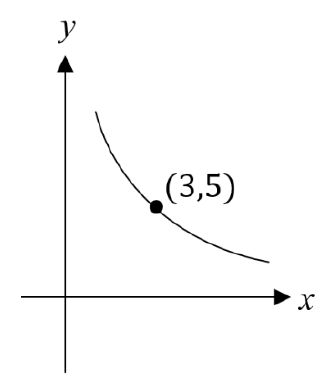
- (a)
Find the value of p.
[2] - (b)(i)
Find f⁻¹(x).
[1] - (b)(ii)
Find f⁻¹g(2).
[2]
(a) Find the value of lim(x→6) (x − 6)/(x² − 36). (b) Calculate the coordinates of the point on the curve y = 4x² − 12x + 9 when the gradient of the tangent is 4.
Easy5 marks- (a)
Find lim(x→6) (x − 6)/(x² − 36).
[2] - (b)
Find the coordinates of the point on y = 4x² − 12x + 9 where the gradient is 4.
[3]
Simplify (2 − √3)/(2 + √3) + 8/√12.
Easy4 marksSimplify (2 − √3)/(2 + √3) + 8/√12.
[4]
(a) A four-digit number is formed using the digits 2, 3, 5, 7 and 8 without repetition. How many odd numbers that are more than 6000 can be formed? (b) A group of 6 students is to be chosen from 5 boys and 4 girls to participate in a performance. Find the number of different ways the students can be selected if at least 2 girls must be selected.
Medium6 marks- (a)
Number of odd four-digit numbers more than 6000.
[3] - (b)
Number of ways to choose 6 students with at least 2 girls.
[3]
Given α and β are the roots of the quadratic equation 3x² + 2x = 7, find the new quadratic equations which have the following roots: (a) α + 1, β + 1; (b) α/β, β/α.
Medium6 marks- (a)
Roots α + 1 and β + 1.
[3] - (b)
Roots α/β and β/α.
[3]
A straight line AB passes through a point (m, 0) and has a gradient of m. (a) Find the equation of the line in terms of m. (b) Find the values of m if the line AB passes through the point (1, −6). (c) Find the equation of the straight line AB if m is a positive constant. Hence, find the coordinates of the intersection points between the straight line AB and the curve x² − y = 7 − 6x.
Easy6 marks- (a)
Equation of AB in terms of m.
[1] - (b)
Values of m if AB passes through (1, −6).
[2] - (c)
Equation of AB for positive m; intersection points with x² − y = 7 − 6x.
[3]
Asman has just completed her diploma in banking. She was offered a job by two different banks. Bank P offered an initial salary of RM 45 000 per annum with a 5% yearly increment from the basic salary. Bank Q offered an initial salary of RM 47 000 per annum with an RM 2 000 increment yearly. Asman decided to choose the bank which offers higher income in 5 years. Determine which bank she should choose. Show calculation to support your answer. [Round off your answer to the nearest RM]
Medium6 marksDetermine which bank Asman should choose, with calculation.
[6]
Given d²y/dx² = x + 3, dy/dx = 5 and y = −11 when x = −2. Express y in terms of x.
Medium5 marksExpress y in terms of x.
[5]
It is given that cos α = −2/3 and sin β = 1/√6, where α and β are in the same quadrant. Without using a calculator, find the value of cos(α + β).
Medium5 marksFind cos(α + β).
[5]
Diagram 11 shows a piece of watermelon in the shape of a sector with centre O. The arc lengths AB and CD are 20 cm and 16 cm respectively; the portion ABCD cannot be eaten. AC = 2 cm and the length of the piece of watermelon is 10 cm. Find (a) the angle θ, (b) the volume of the portion that cannot be eaten.
Medium7 marks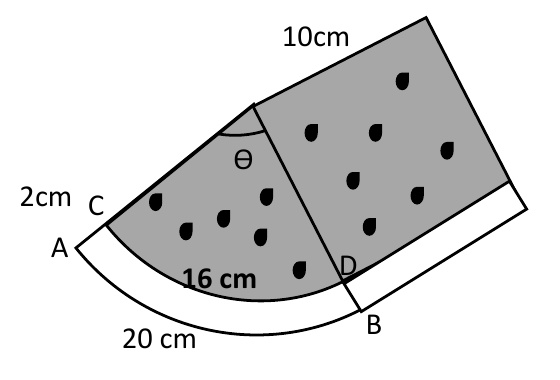
- (a)
Find the angle θ.
[4] - (b)
Find the volume of the portion that cannot be eaten.
[3]
Diagram 12 shows a standard normal distribution graph (the area to the right of z = k is shaded). Given P(z > k) = 0.7645. (a) Find the value of k. (b) The continuous random variable X is normally distributed with a mean of μ and a standard deviation of 4.2. Find the value of μ if the z-score of X = 56.4 is k.
Easy4 marks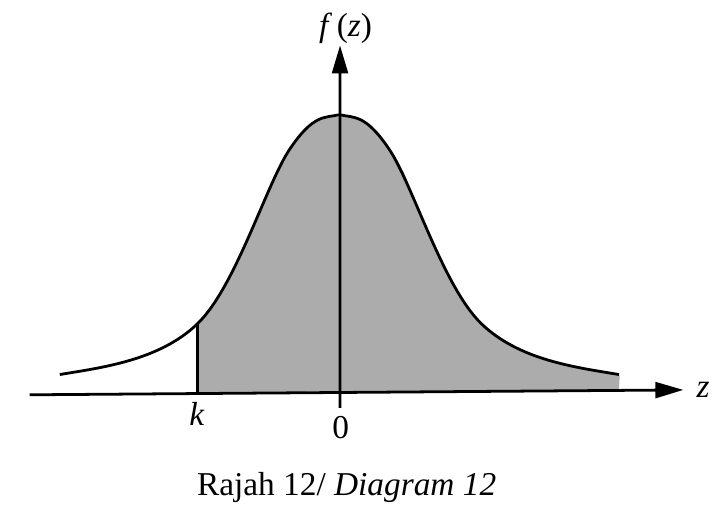
- (a)
Find the value of k.
[2] - (b)
Find μ if the z-score of X = 56.4 is k.
[2]
Section B
(a) Given p = (3, 4) and q = (6, 2k − 1) (column vectors), find the value of k such that p and q are parallel. (b) ABCD is a parallelogram. T is the midpoint of BC. Given AB→ = 2i + 3j and AT→ = i + j, where i and j are unit vectors parallel to the x-axis and y-axis. Find (i) AD→ in terms of i and/or j, (ii) the length of DT.
Medium8 marks- (a)
Find k such that p and q are parallel.
[3] - (b)(i)
Find AD→ in terms of i and/or j.
[2] - (b)(ii)
Find the length of DT.
[3]
Given y = √x(x − 1), find the value of dy/dx when x = 4. Hence, calculate (a) the small corresponding change in y when x increases from 4 to 4.01, (b) the corresponding rate of change in y at x = 4, if the rate of change in x is 0.4 units per second.
Medium8 marksFind dy/dx when x = 4.
[4]- (a)
Small change in y when x increases from 4 to 4.01.
[2] - (b)
Rate of change of y at x = 4 when dx/dt = 0.4 units per second.
[2]
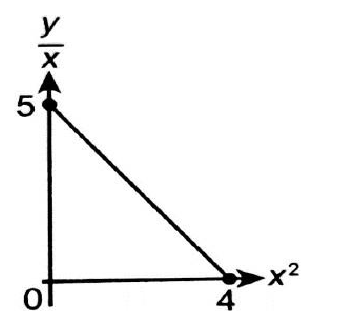
(a) The variables x and y are related by the equation y = kx³, where k is a constant. A straight line graph is obtained by plotting log₁₀y against log₁₀x as shown in Diagram 15(a) (the line passes through (0, 4) and (3, h)). (i) Convert the equation y = kx³ to linear form. (ii) Find the values of h and k. (b) Diagram 15(b) shows a line of best fit obtained by plotting y/x against x² (the line has y/x-intercept 5 and x²-intercept 4). Express y in terms of x.
Medium8 marks- (a)(i)
Linear form of y = kx³.
[2]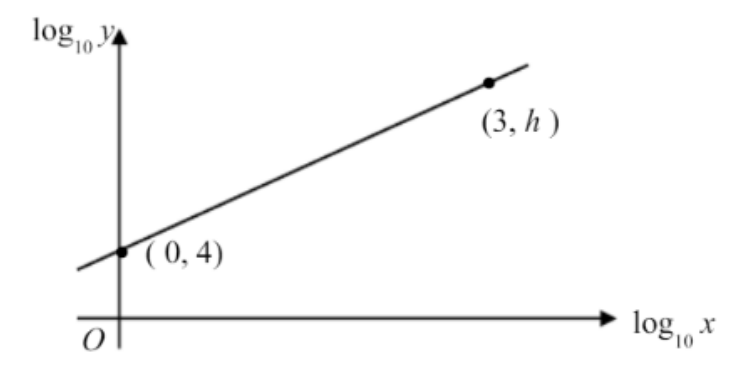
- (a)(ii)
Find h and k.
[4] - (b)
Express y in terms of x.
[2]