Write your answer on paper. Then open the answer to check it.
Section A
Mrs Ramizah plans to fence up a 112 m fence to plant vegetables on a piece of land of area 528 m² in her garden as shown in Diagram 1 (a rectangle 16p by q with an isosceles triangle on top whose two equal sides are 10p). Find the possible values of p and the corresponding value of q where p and q are integers.
Medium7 marks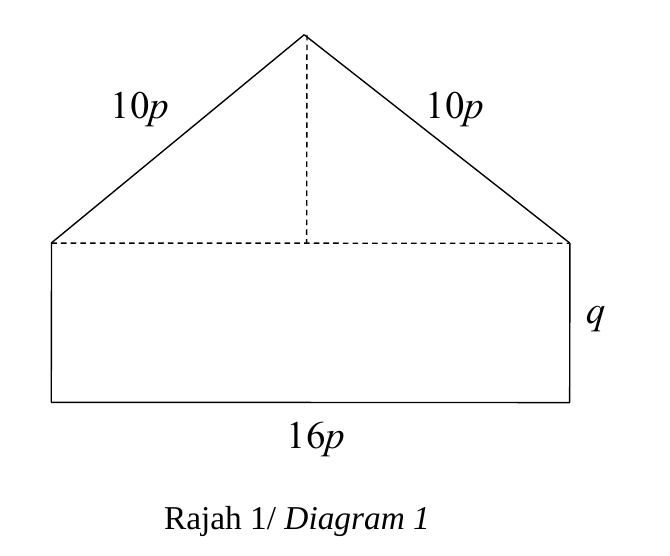
Find the possible values of p and the corresponding q (integers).
[7]
Rizuan is given a piece of wire of length 4 meters. He cuts the wire into several pieces. Each piece is bent to form a square. Diagram 2 shows the first three squares made by Rizuan (sides 2 cm, 5 cm and 8 cm). Find (a) how many squares can be made by Rizuan, (b) the length of the wire of the longest part.
Medium6 marks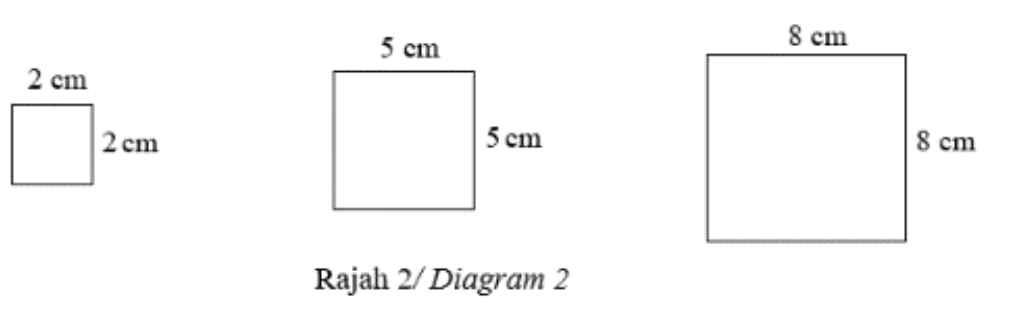
- (a)
Number of squares that can be made.
[4] - (b)
Length of wire of the longest part.
[2]
Diagram 3 shows a rectangle PQRS. T is a point which lies on QS such that QS = 4QT. (a) Given QP→ = 15x and QS→ = 15x + 7y, express the following vectors in terms of x and y: (i) QT→, (ii) PT→. (b) Given that the straight line PT is extended to the point U such that PU→ = −9x + ky, find the value of k.
Medium7 marks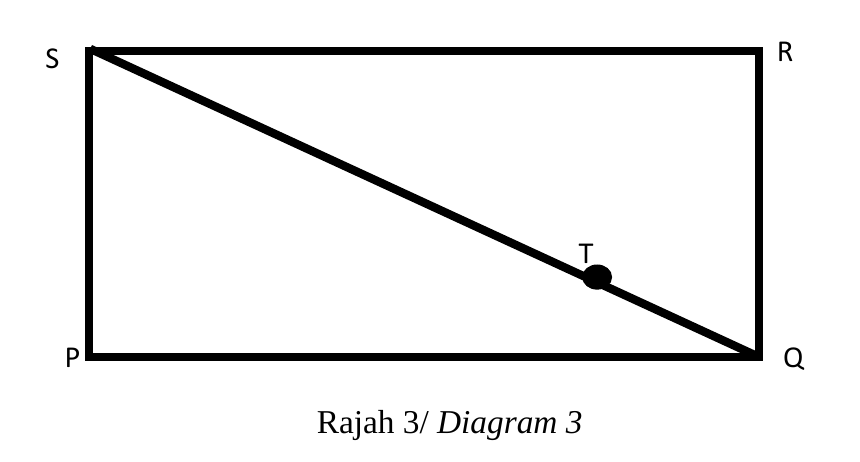
- (a)(i)
Express QT→ in terms of x and y.
[1] - (a)(ii)
Express PT→ in terms of x and y.
[2] - (b)
Find k.
[4]
(a)(i) Prove that cosec²x − 2sin²x − cot²x = cos 2x. (ii) Hence, solve the equation cosec²x − 2sin²x − cot²x + 1/4 = 0 for 0° ≤ x ≤ 360°. (b) Sketch the graph y = 3 cos 2x for 0 ≤ x ≤ 2π.
Medium8 marks- (a)(i)
Prove cosec²x − 2sin²x − cot²x = cos 2x.
[2] - (a)(ii)
Solve cosec²x − 2sin²x − cot²x + 1/4 = 0 for 0° ≤ x ≤ 360°.
[3] - (b)
Sketch y = 3 cos 2x for 0 ≤ x ≤ 2π.
[3]
Diagram 5 shows a design square tile ABCD. Given that the length of AB is 14 cm. The 4 shaded regions are identical. OPQ and BPQ are sectors with centre O and B respectively. If there are 150 same tiles on the floor, find the area covered by the shaded regions.
Medium6 marks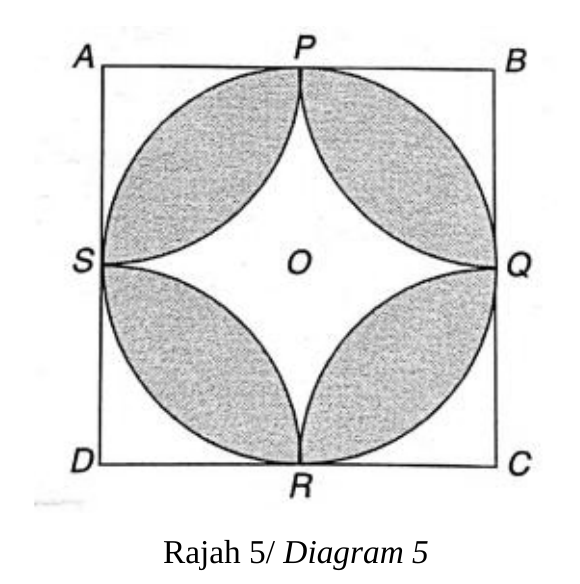
Area covered by the shaded regions of 150 tiles.
[6]
Diagram 6 shows the curve of a quadratic function f(x) = −x² + px − 15. The curve has a maximum point at G(3, h) and intersects the f(x)-axis at point F. (a) State the coordinates of F. (b) By using the completing the square method, find the value of h. (c) Determine the range of values of x if f(x) > −7.
Medium8 marks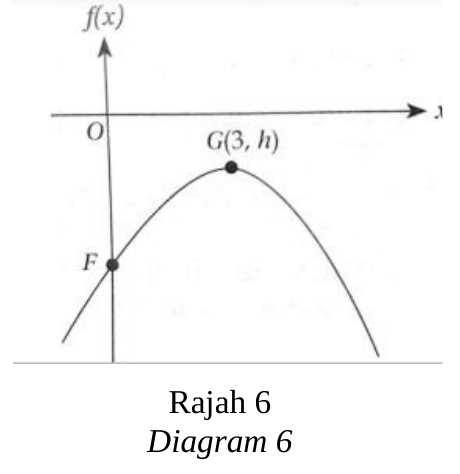
- (a)
State the coordinates of F.
[2] - (b)
Find h by completing the square.
[4] - (c)
Range of x if f(x) > −7.
[2]
It is given that x = 3^m and y = 3^n. Express (a) 27^(m + 2n) ÷ 9^m in terms of x and y; (b) log₈₁ (243x/y²) in terms of m and n.
Medium8 marks- (a)
Express 27^(m + 2n) ÷ 9^m in terms of x and y.
[3] - (b)
Express log₈₁ (243x/y²) in terms of m and n.
[5]
Section B
Table 8 shows the values of two variables, x and y, obtained from an experiment: x = 1.0, 2.0, 2.5, 3.0, 3.5, 4.0; y = 2.51, 4.78, 8.20, 14.21, 27.54, 63.10. The variables are related by the equation y = Q/(W^(x²)), where Q and W are constants. (a) Construct a suitable table and use graph paper to plot a graph of log₁₀y against x², using a scale of 2 cm to 2 units on the x²-axis and 2 cm to 0.2 units on the log₁₀y-axis. Hence draw the best fit line. (b) By using the graph in 8(a), find the values of (i) Q, (ii) W, (iii) y when x = 3.16.
Medium10 marks
- (a)
Construct a table of x² and log₁₀y, plot log₁₀y against x² and draw the line of best fit (graph paper provided).
[5]
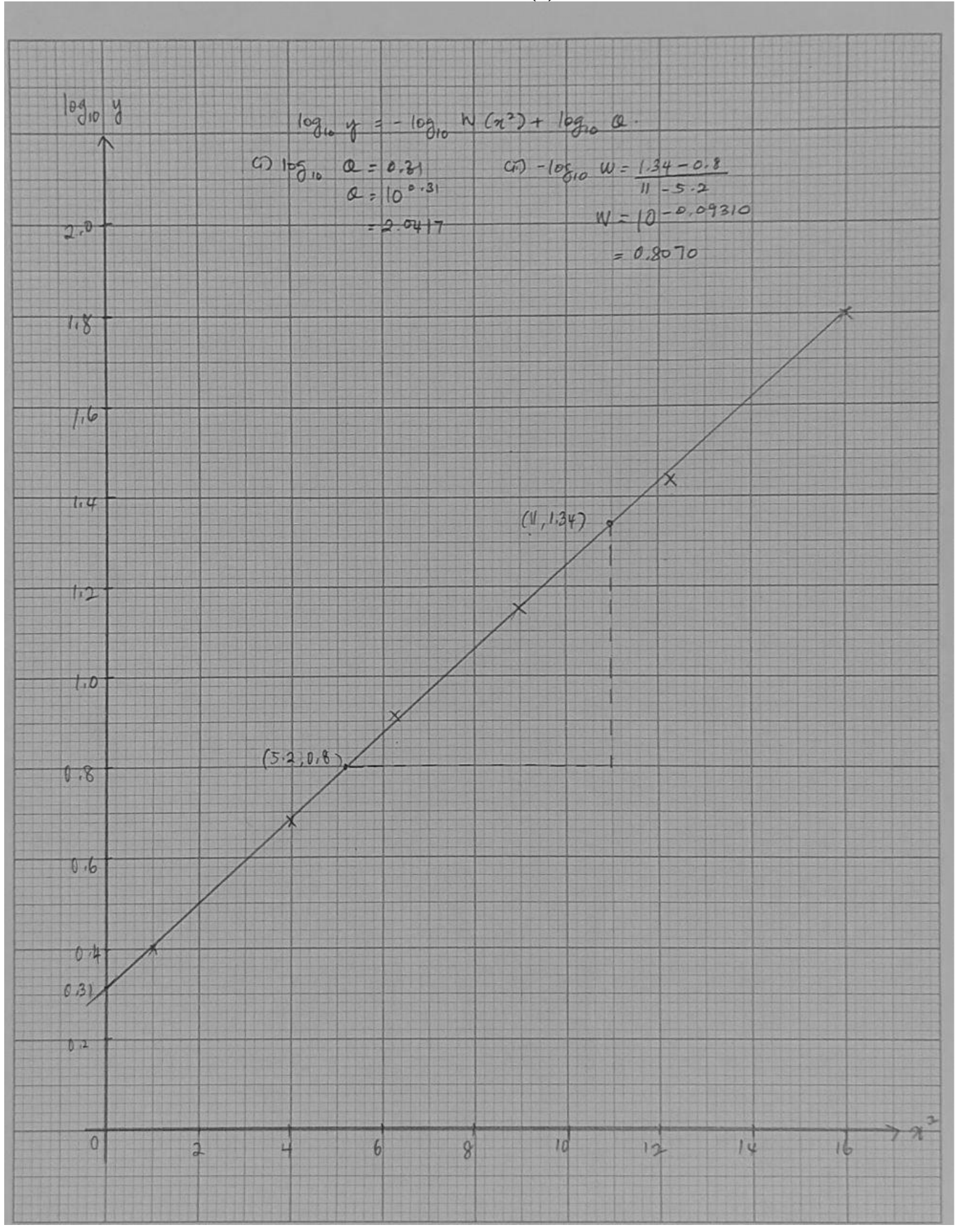
- (b)(i),(ii)
Find Q and W.
[4] - (b)(iii)
Find y when x = 3.16.
[1]
Diagram 9 shows part of the curve y = 2x² − 8 and the straight line y = 2x + 4. (a) Calculate the area of the shaded region. (b) The region enclosed by the curve, the x-axis, the y-axis and the straight line y = h is revolved through 360° about the y-axis. Find the volume of revolution, in terms of π.
Medium10 marks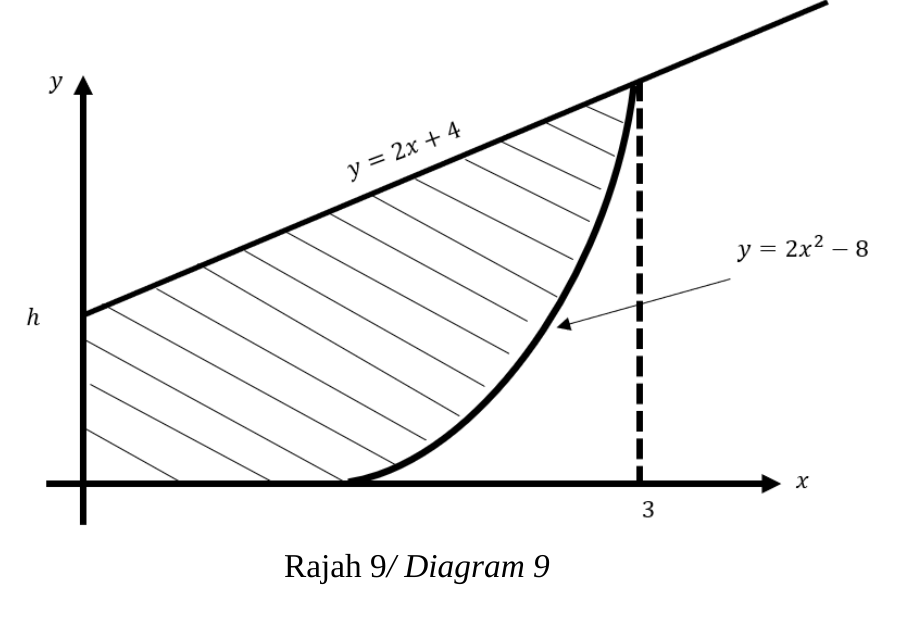
- (a)
Area of the shaded region.
[6] - (b)
Volume of revolution about the y-axis, in terms of π.
[4]
Solution by scale drawing is not accepted. Diagram 10 shows a trapezium-shaped mini garden PQRS. Points P and S lie on the y-axis and PQ is parallel to RS. Q is (4, 8), T is (4, −5) and S is (0, −11). Given that PQ is perpendicular to QR and the gradient of PQ is 3/2: (a) find the equation of QR; (b) find the coordinates of R such that ST : SR = 2 : 5; (c) find the area, in unit², of OQRS; (d) a point W(x, y) moves such that its distance from point Q is always 10 units: (i) find the equation of the locus of W; (ii) determine whether or not the locus intercepts the y-axis.
Medium10 marks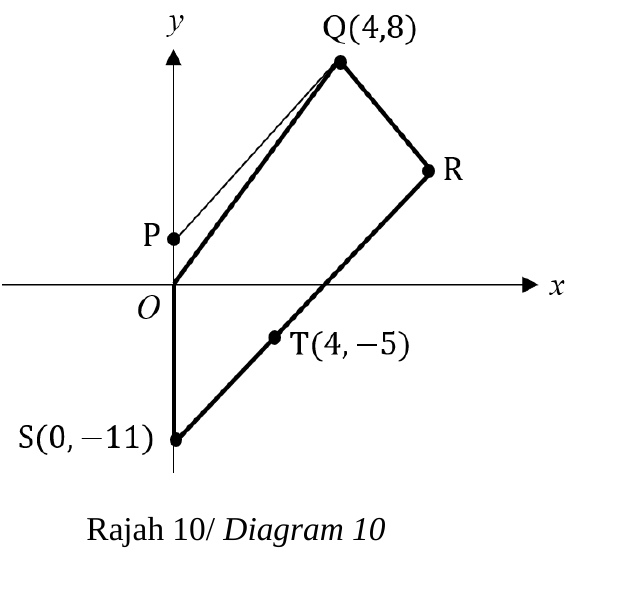
- (a)
Find the equation of QR.
[2] - (b)
Find the coordinates of R.
[2] - (c)
Find the area of OQRS.
[2] - (d)(i)
Equation of the locus of W.
[2] - (d)(ii)
Determine whether the locus intercepts the y-axis.
[2]
(a) In a village it is found that the probability of youth is p. It is given that the number of youths has a mean of 40 and a variance of 28. (i) Find the value of p. (ii) If 5 residents are selected at random from the area, find the probability that at least 3 of them are youths. (b) The masses of Musang King durians produced in an orchard are normally distributed with a mean of 3.8 kg and a standard deviation of 700 g. Calculate (i) the probability that a durian chosen at random from the orchard has a mass more than 4.5 kg; (ii) the value of m if 68% of the durians have masses less than m kg.
Medium10 marks- (a)(i)
Find p.
[2] - (a)(ii)
Probability that at least 3 of 5 are youths.
[3] - (b)(i)
P(mass > 4.5 kg).
[2] - (b)(ii)
Find m if 68% have mass less than m kg.
[3]
Section C
A particle moves along a straight line and passes through a fixed point O. Its displacement, s m, at t seconds after passing through O is given by s = 2t² − (1/3)t³ + 21t. Find (a) the initial velocity, in m s⁻¹, of the particle; (b) the maximum velocity, in m s⁻¹, of the particle; (c) the total distance, in m, travelled by the particle in the first 7 seconds.
Medium10 marks- (a)
Initial velocity (m s⁻¹).
[3] - (b)
Maximum velocity (m s⁻¹).
[3] - (c)
Total distance (m) in the first 7 seconds.
[4]
Table 13 shows the ingredients used to make a loaf of coconut bread: percentage increase in price in 2018 compared with 2015 and percentage in each loaf. Flour 20%, 70; Sugar 10%, p; Yeast 25%, 2p; Oil 15%, p; Coconut 25%, 2p. (a) If 2015 is taken as the base year, write the price index for each material in 2018. (b)(i) Calculate the composite index for the cost of production of the coconut bread in 2018 based on 2015. (ii) Hence, find the cost of production of the coconut bread in 2015 if its cost of production in 2018 is RM 23 320. (c) If the cost of producing a loaf of coconut bread in 2015 is RM 1.50, calculate the increase in the cost of producing a loaf in 2018.
Medium10 marks- (a)
Price index of each material in 2018.
[1] - (b)(i)
Composite index in 2018 based on 2015.
[3] - (b)(ii)
Cost of production in 2015 if the cost in 2018 is RM 23 320.
[2] - (c)
Increase in cost of one loaf in 2018.
[4]
Diagram 14 shows a triangle ABC with AB = 14 cm, BC = 10 cm and angle ABC = 55°. (a) Calculate the length, in cm, of AC. (b) A quadrilateral ABCD is then formed so that AC is a diagonal, angle ACD = 30° and AD = 8.6 cm. Calculate the two possible values for angle ADC. (c) Using the acute angle ADC from (b), calculate (i) the length, in cm, of CD; (ii) hence, find the area, in cm², of quadrilateral ABCD.
Medium10 marks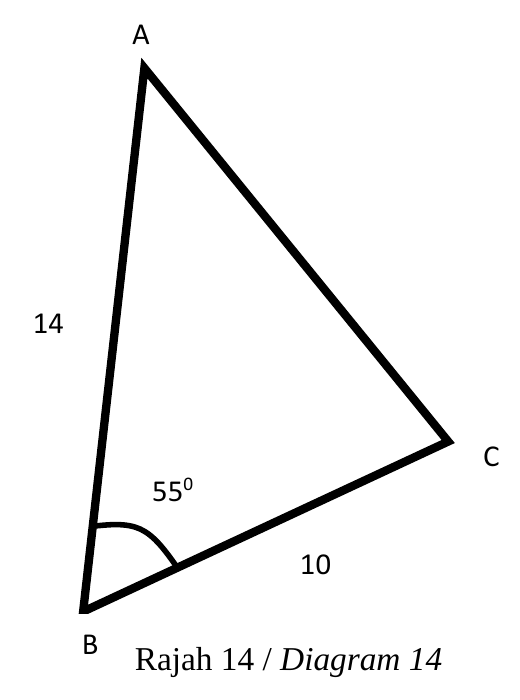
- (a)
Length of AC (cm).
[2] - (b)
Two possible values of angle ADC.
[2] - (c)(i)
Length of CD (cm).
[3] - (c)(ii)
Area of quadrilateral ABCD (cm²).
[3]
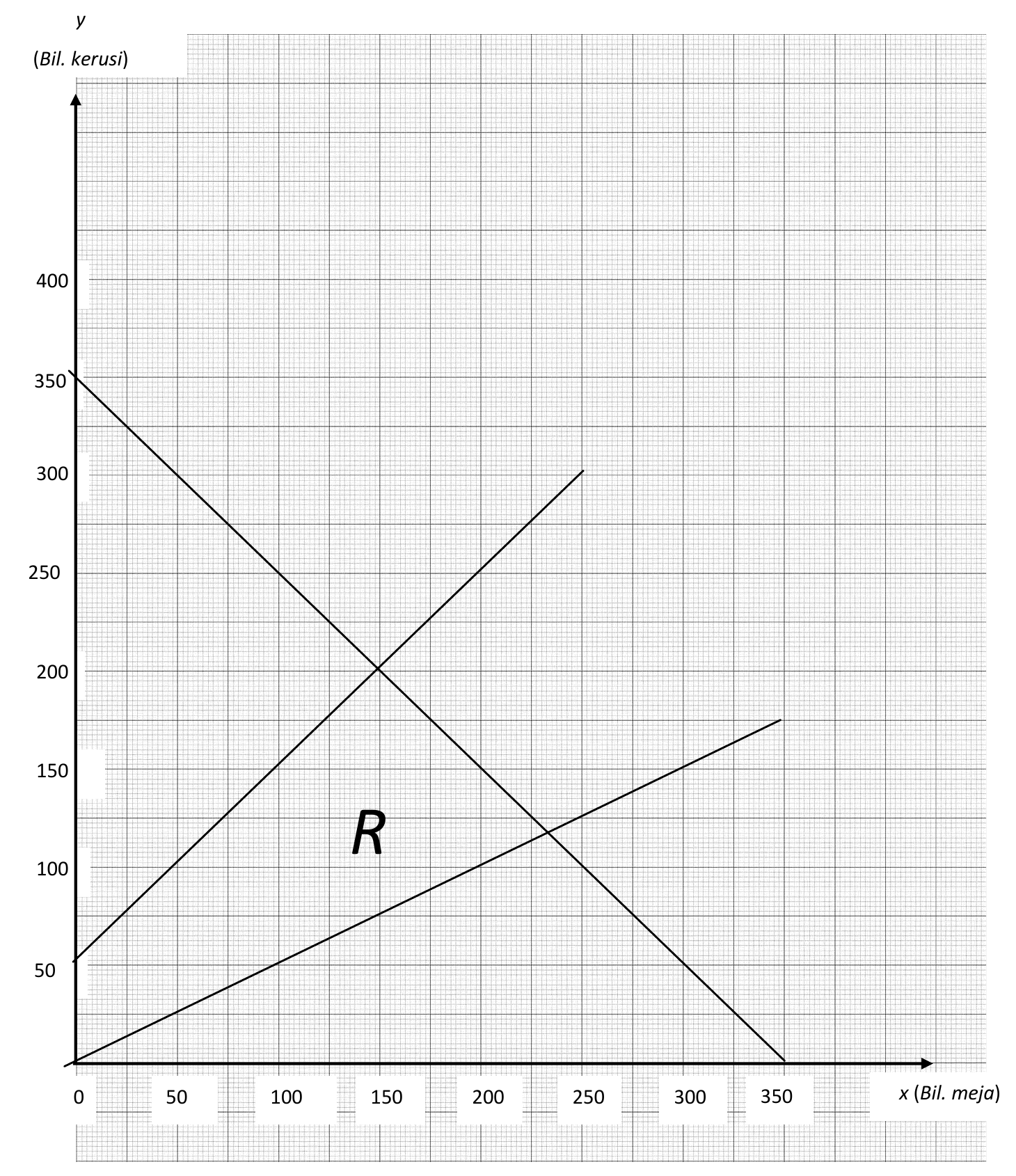
A school is about to buy x tables and y chairs for its school hall. The price of a table is RM 50 and a chair is RM 40. The hall can only accommodate 350 tables and chairs. The number of tables must not exceed twice the number of chairs. The number of chairs should not exceed the number of tables by 50. (a) Write down three inequalities, other than x ≥ 0 and y ≥ 0, that meet all of the above conditions. (b) Using a scale of 2 cm to 50 on both axes, construct and shade the region R which satisfies all of the above conditions. (c) Based on your graph, find (i) the maximum allocation to buy the tables and chairs; (ii) the range of the number of chairs that can be purchased if 150 tables have been purchased.
Medium10 marks- (a)
Three inequalities.
[3] - (b)
Construct and shade region R (graph paper provided).
[3]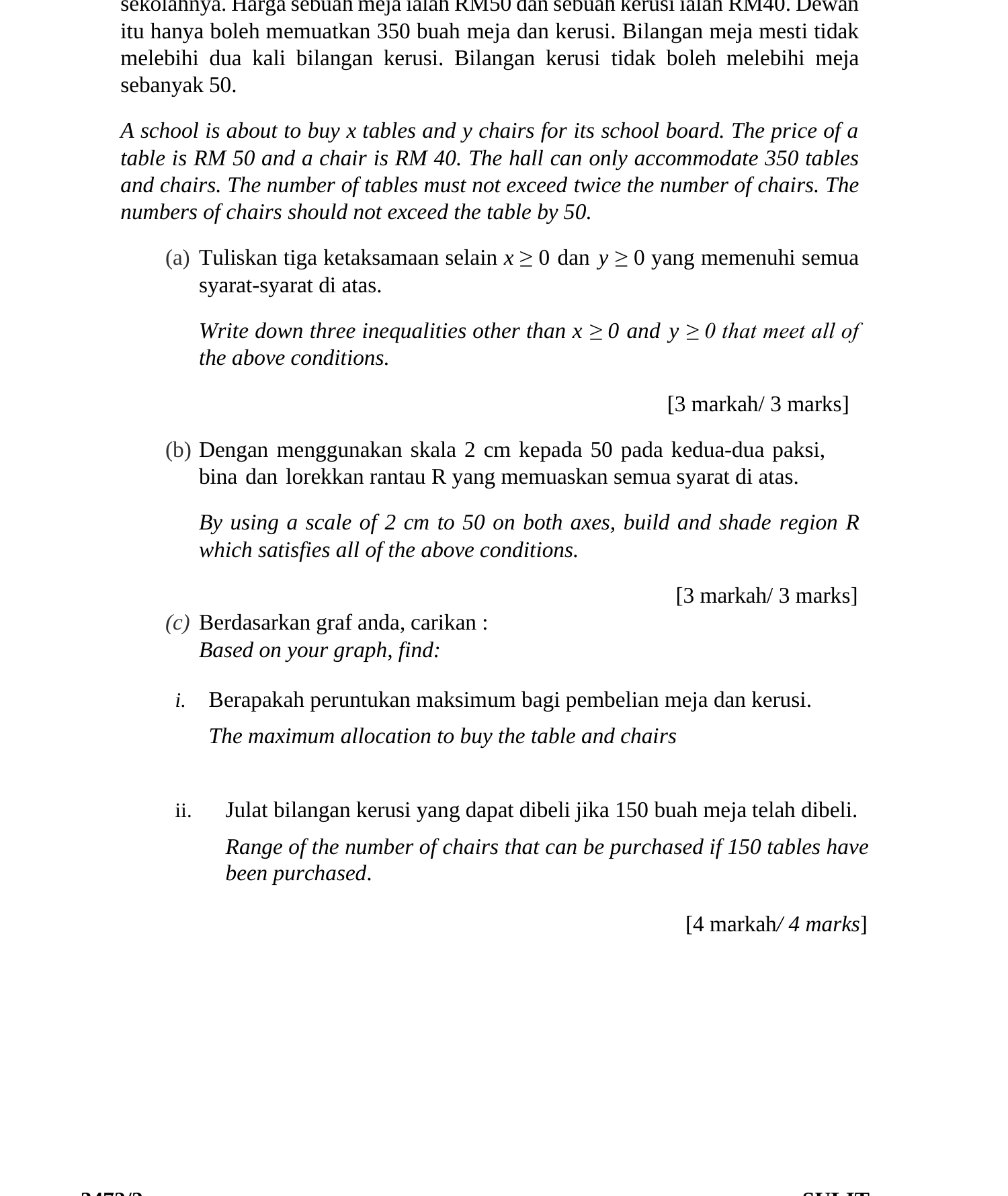
- (c)(i)
Maximum allocation.
[2] - (c)(ii)
Range of the number of chairs if 150 tables are bought.
[2]