Write your answer on paper. Then open the answer to check it.
Section A
An arithmetic progression has 12 terms. The sum of the odd terms is 114 and the sum of the even terms is 132. Find (a) the common difference, (b) the first term.
Medium5 marks- (a)
Find the common difference.
[3] - (b)
Find the first term.
[2]
Given the functions h(x) = (3 + 2x)/5 and k(x) = (5x − 3)/2. (a) Find hk(x) and kh(x). (b) Hence, verify that the function h(x) = (3 + 2x)/5 has the inverse function k(x) = (5x − 3)/2.
Medium6 marks- (a)
Find hk(x) and kh(x).
[4] - (b)
Hence, verify that k(x) is the inverse function of h(x).
[2]
Pak Ali wants to build a coop for his chickens and ducks. Diagram 3 shows a sketch of the coop (a rectangle of length x and width y) with a divider in the middle to separate the chickens and ducks. Pak Ali has allocated an area of 54 m² of his land to build the coop and he needs to fence the coop as shown in Diagram 3 using wire fencing with a length of 36 m. What are the length and width of the coop?
Medium7 marks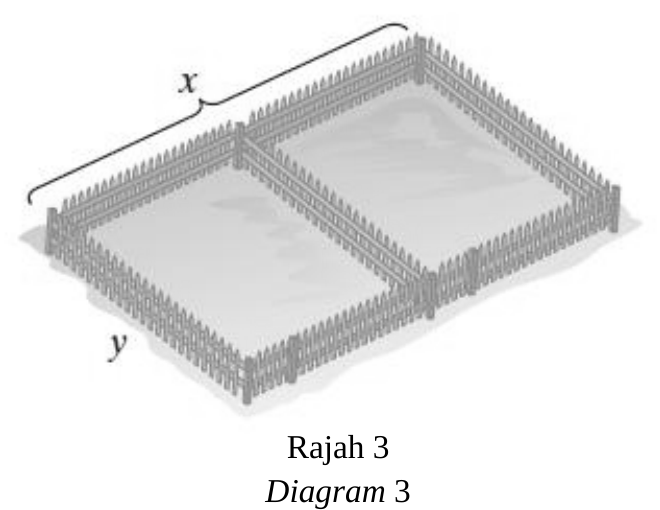
What are the length and width of the coop?
[7]
Diagram 4 shows the positions of four traffic lights A, B, C and D on the Cartesian plane (A on the y-axis at (0, 9)). Given that B(−3, p), C(3, 4) and D(7, 6) are collinear such that BC : CD = m : n. (a) Determine m : n. (b) Hence, find the value of p. (c) Find the area, in units², of triangle ABD.
Medium7 marks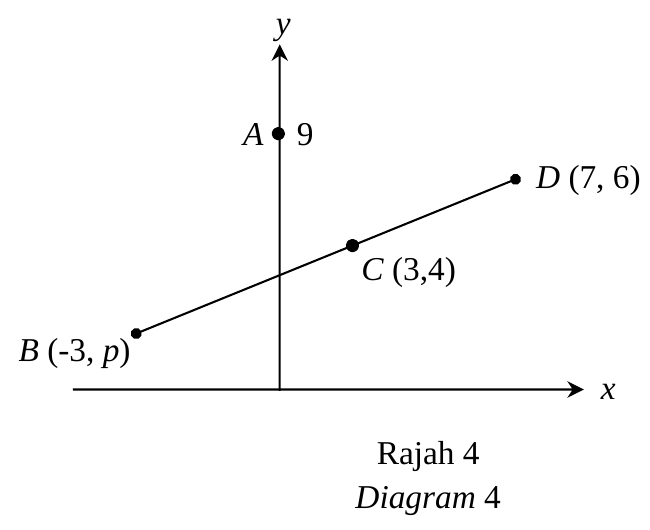
- (a)
Determine m : n.
[3] - (b)
Hence, find the value of p.
[2] - (c)
Find the area of triangle ABD in units².
[2]
Given the equation of a curve is y = x⁴ − 4x³ + 1. (a) Find the stationary points of the curve. (b) Hence, determine the nature of each stationary point by using the tangent sketching method.
Medium9 marks- (a)
Find the stationary points of the curve.
[3] - (b)
Determine the nature of each stationary point by the tangent sketching method.
[6]
Diagram 6 shows a sector of a circle with centre O, radius 6 cm and angle AOB = 2π/3 radians. (a) Calculate the arc length, the perimeter and the area of the sector. (b) Hence, find the length of the chord AB by using the cosine rule and give your answer in the form a√b.
Medium8 marks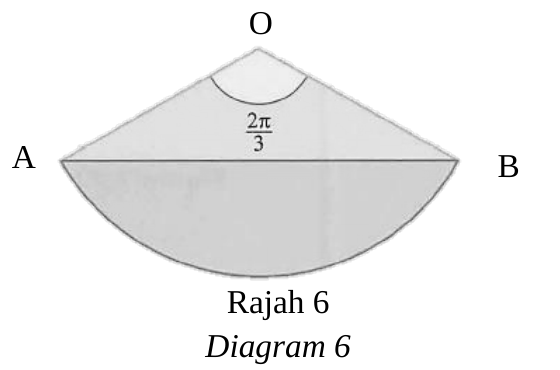
- (a)
Calculate the arc length, the perimeter and the area of the sector.
[4] - (b)
Find the length of chord AB by the cosine rule, in the form a√b.
[4]
(a) Sketch the graph of y = |−(3/2) cos 2x| − 1 for 0 ≤ x ≤ 3π/2. (b) Hence, using the same axes, sketch a suitable straight line to find the number of solutions for the equation 3π|−(3/2) cos 2x| − 4x = −2x for 0 ≤ x ≤ 3π/2. State the number of solutions.
Medium8 marks- (a)
Sketch the graph of y = |−(3/2) cos 2x| − 1 for 0 ≤ x ≤ 3π/2.
[4] - (b)
Sketch a suitable straight line on the same axes and state the number of solutions.
[4]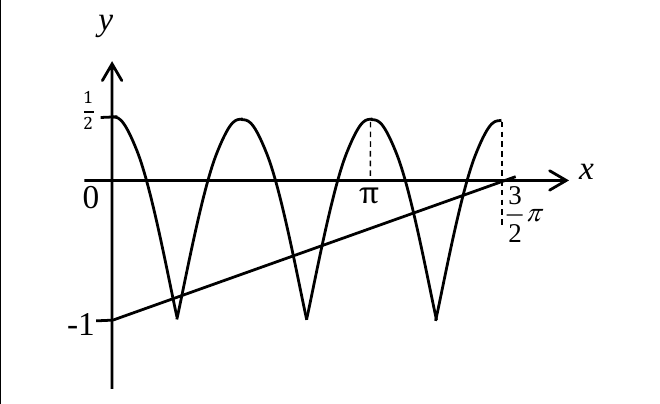
Section B
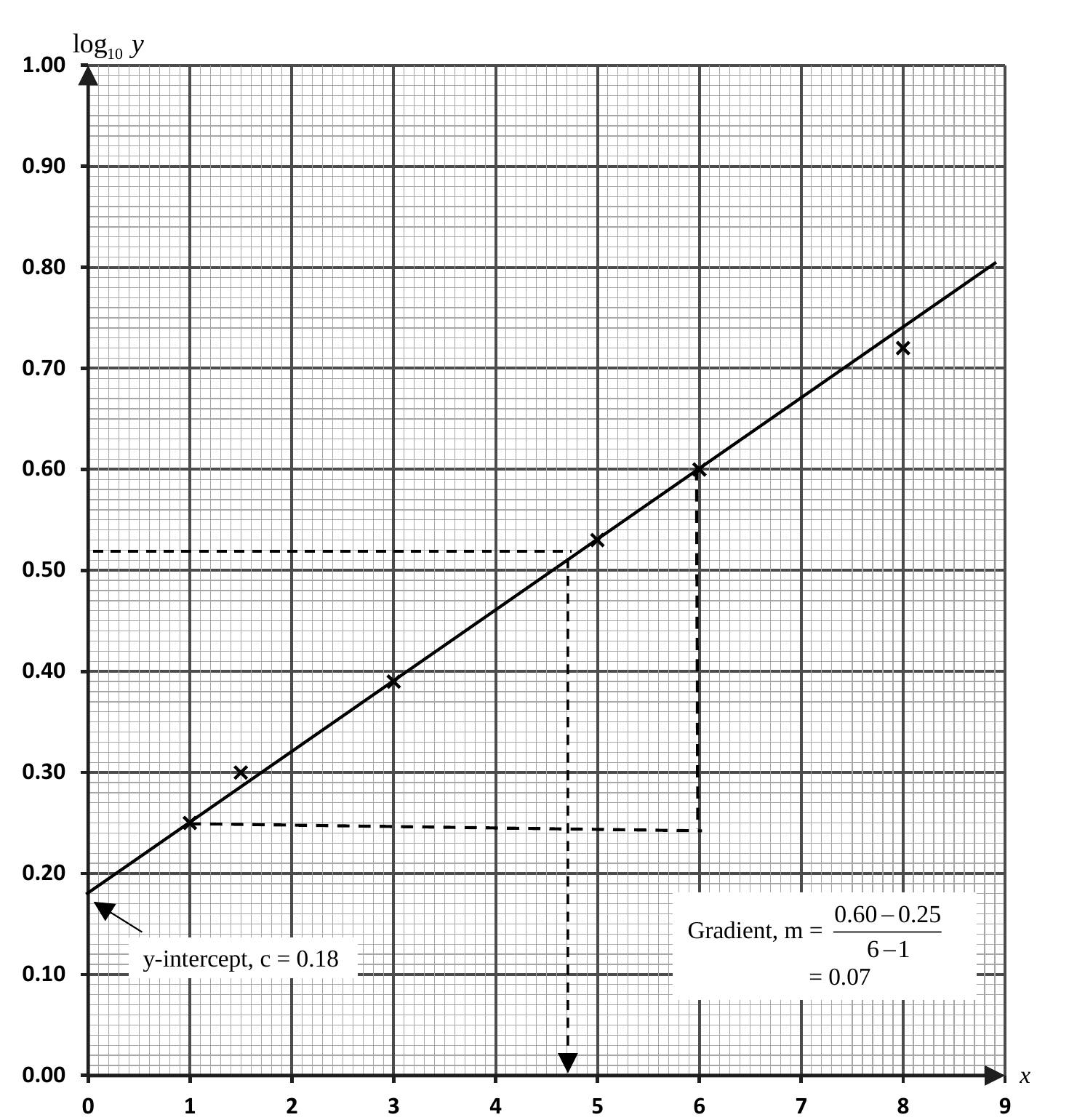
The table shows the values of two variables, x and y, obtained from an experiment. Variables x and y are related by the equation y = ab^(3x), where a and b are constants. x: 1, 1.5, 3, 5, 6, 8 y: 1.78, 2.00, 2.45, 3.39, 3.98, 5.25 (a) Based on the table, construct a table for the values of log₁₀ y. (b) Plot log₁₀ y against x, using a scale of 2 cm to 1 unit on the x-axis and 2 cm to 0.1 unit on the log₁₀ y-axis. Hence, draw the line of best fit. (c) Use the graph in (b) to find the value of (i) x when y = 3.2, (ii) b, (iii) a.
Medium10 marks- (a)
Construct a table for the values of log₁₀ y.
[1] - (b)
Plot log₁₀ y against x (2 cm to 1 unit on the x-axis, 2 cm to 0.1 unit on the log₁₀ y-axis) and draw the line of best fit.
[3]
- (c)
Use the graph to find (i) x when y = 3.2, (ii) b, (iii) a.
[6]
Diagram 9 shows a curve y = f(x) where f(x) = −x² − 7x − 10. The shaded regions lie between x = −7 and x = 0; region A is the part above the x-axis. Calculate (a) the total area of the shaded regions, (b) the volume of revolution, in terms of π, when the shaded region A is revolved through 360° about the x-axis.
Hard10 marks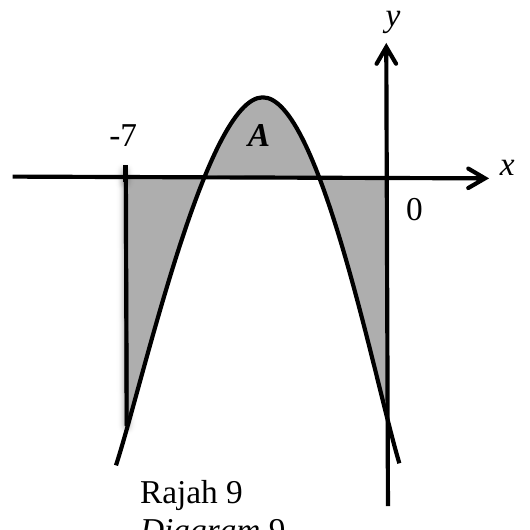
- (a)
Calculate the total area of the shaded regions.
[6] - (b)
Calculate the volume of revolution, in terms of π, when region A is revolved 360° about the x-axis.
[4]
Diagram 10 shows a quadrilateral PQRS with K on PS and L the intersection of PR and SQ. It is given that PK→ = 2x, PQ→ = 3y, PK : PS = 1 : 3 and 2QL = LS. (a) Express in terms of x and/or y: (i) SQ→, (ii) PL→. (b) Given that SR→ = 2ay − 2x and PR→ = (1/b) PL→, such that a and b are constants, find (i) SR→ in terms of b, x and y, (ii) the value of a and of b. (c) Given the area of triangle PQS is 120 unit², and the perpendicular distance from Q to PS is 5 unit, find |x|.
Medium10 marks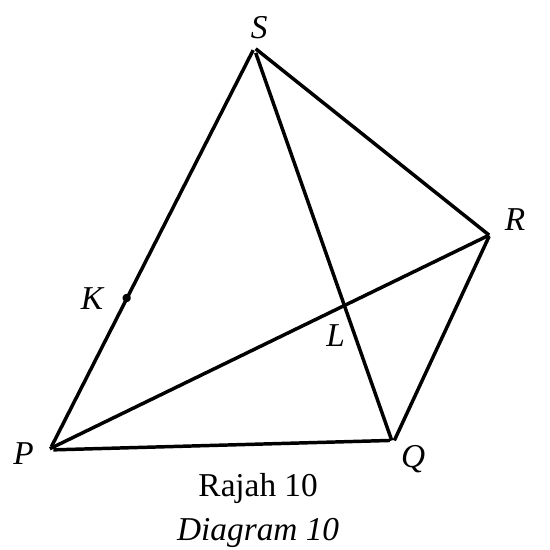
- (a)(i)
Express SQ→ in terms of x and/or y.
[1] - (a)(ii)
Express PL→ in terms of x and/or y.
[2] - (b)(i)
Find SR→ in terms of b, x and y.
[2] - (b)(ii)
Find the value of a and of b.
[3] - (c)
Find |x|.
[2]
(a) In a survey carried out in a school, it is found that 6 out of 10 students wear glasses. If 5 students from that school are chosen at random, calculate the probability that (i) exactly 3 students wear glasses, (ii) more than 3 students wear glasses. (b) A group of workers are given a medical check-up. The blood pressure of the workers has a normal distribution with a mean of 130 mmHg and a standard deviation of 16 mmHg. Blood pressure readings above 150 mmHg are classified as high blood pressure. (i) A worker is chosen at random from the group. Find the probability that the worker has a blood pressure between 110 mmHg and 152 mmHg. (ii) It is found that 123 workers have high blood pressure. Find the total number of workers in the group.
Medium10 marks- (a)(i)
Probability that exactly 3 of 5 students wear glasses.
[2] - (a)(ii)
Probability that more than 3 students wear glasses.
[3] - (b)(i)
Probability that blood pressure is between 110 and 152 mmHg.
[2] - (b)(ii)
Total number of workers if 123 have high blood pressure.
[3]
Section C
Solution by graph sketching is not accepted. Two particles, P and Q, move along a straight line. The velocity of particle P, vP m s⁻¹, is given by vP = 3t² − 15t + 18, while the velocity of particle Q, vQ m s⁻¹, is given by vQ = 22 − 15t, where t is the time, in seconds, after both particles pass through a fixed point O. Calculate (a) the maximum velocity, in m s⁻¹, of particle P, (b) (i) the time, in seconds, when particle P and particle Q collide, (ii) the total distance, in m, travelled by particle P in the first 4 seconds.
Hard10 marks- (a)
Calculate the maximum velocity of particle P.
[3] - (b)
(i) Time when P and Q collide. (ii) Total distance travelled by P in the first 4 seconds.
[7]
Solution by scale drawing is not accepted. Diagram 13 shows a quadrilateral PQRS. Point T is the intersection of straight lines PR and SQ. Given that PT = TQ, PS = 5.1 cm, SR = 7.7 cm, ST = 5.6 cm and TR = 3.3 cm. (a) Calculate (i) ∠PTQ, (ii) the length, in cm, of PT, (iii) the length, in cm, of PQ. (b) (i) Sketch a triangle P′R′S′ which has a different shape from triangle PRS such that P′R′ = PR, P′S′ = PS and ∠P′R′S′ = ∠PRS. (ii) Hence, state the size of ∠P′S′R′.
Medium10 marks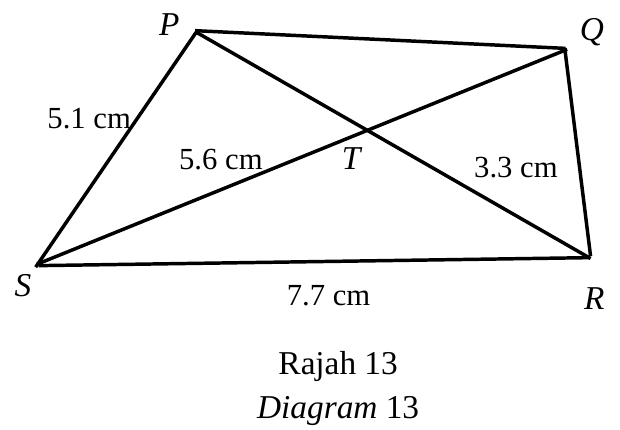
- (a)(i)
Calculate ∠PTQ.
[2] - (a)(ii)
Calculate the length of PT.
[3] - (a)(iii)
Calculate the length of PQ.
[2] - (b)(i)
Sketch triangle P′R′S′ (different shape, P′R′ = PR, P′S′ = PS, ∠P′R′S′ = ∠PRS).
[1]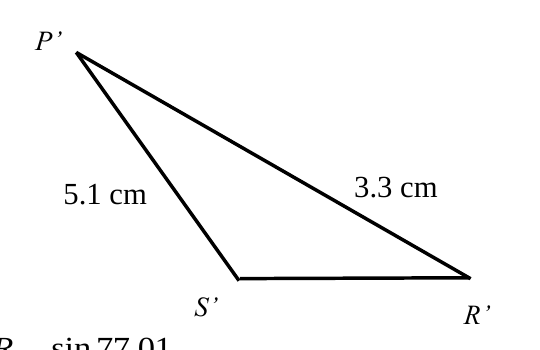
- (b)(ii)
State the size of ∠P′S′R′.
[2]
Table 14 shows information on four main ingredients (P, Q, R, S) used by Melissa to make a type of pudding to sell at a night market. Diagram 14 shows the recipe used (quantity in grams: P x, Q 80, R 40, S 140, total 1000). Table 14: Price per kg (RM), year 2019 / year 2022, price index in 2022 (2019 = 100): P 2.50 / 2.85 / 114; Q 6.00 / 7.80 / a; R 3.00 / b / 150; S c / 8.20 / 113. (a) Find the value of a, of b and of c. (b) Calculate the composite index for the cost of making the pudding in the year 2022 based on the year 2019. (c) In the year 2019, Melissa sold a pack of pudding at RM11.50 with a profit of 20%. Calculate the selling price of a pack of pudding if Melissa wants to obtain a profit of 25% in the year 2022.
Medium10 marks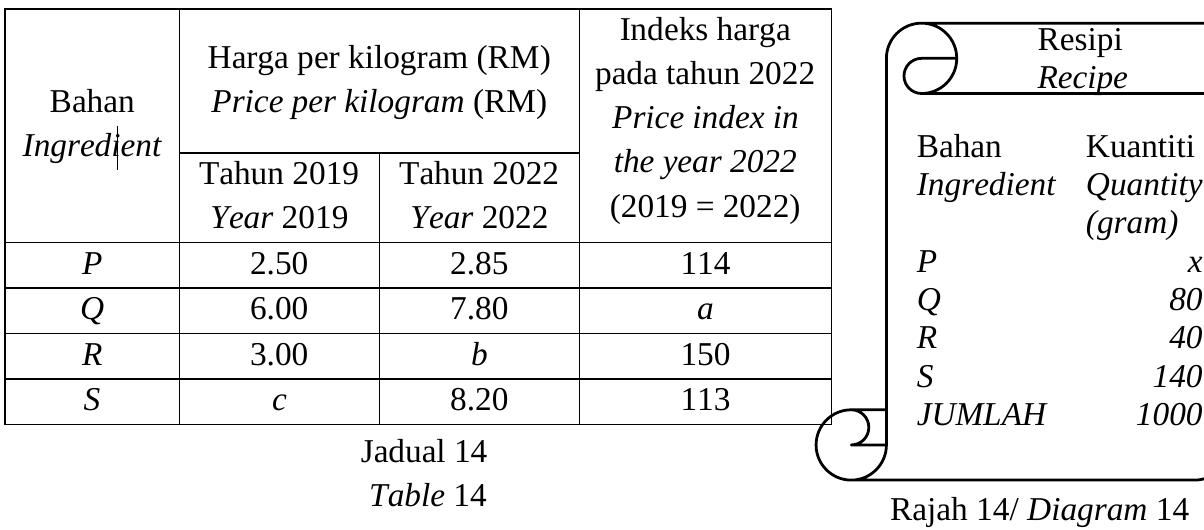
- (a)
Find the value of a, of b and of c.
[3] - (b)
Calculate the composite index for 2022 based on 2019.
[3] - (c)
Calculate the 2022 selling price for a profit of 25%.
[4]
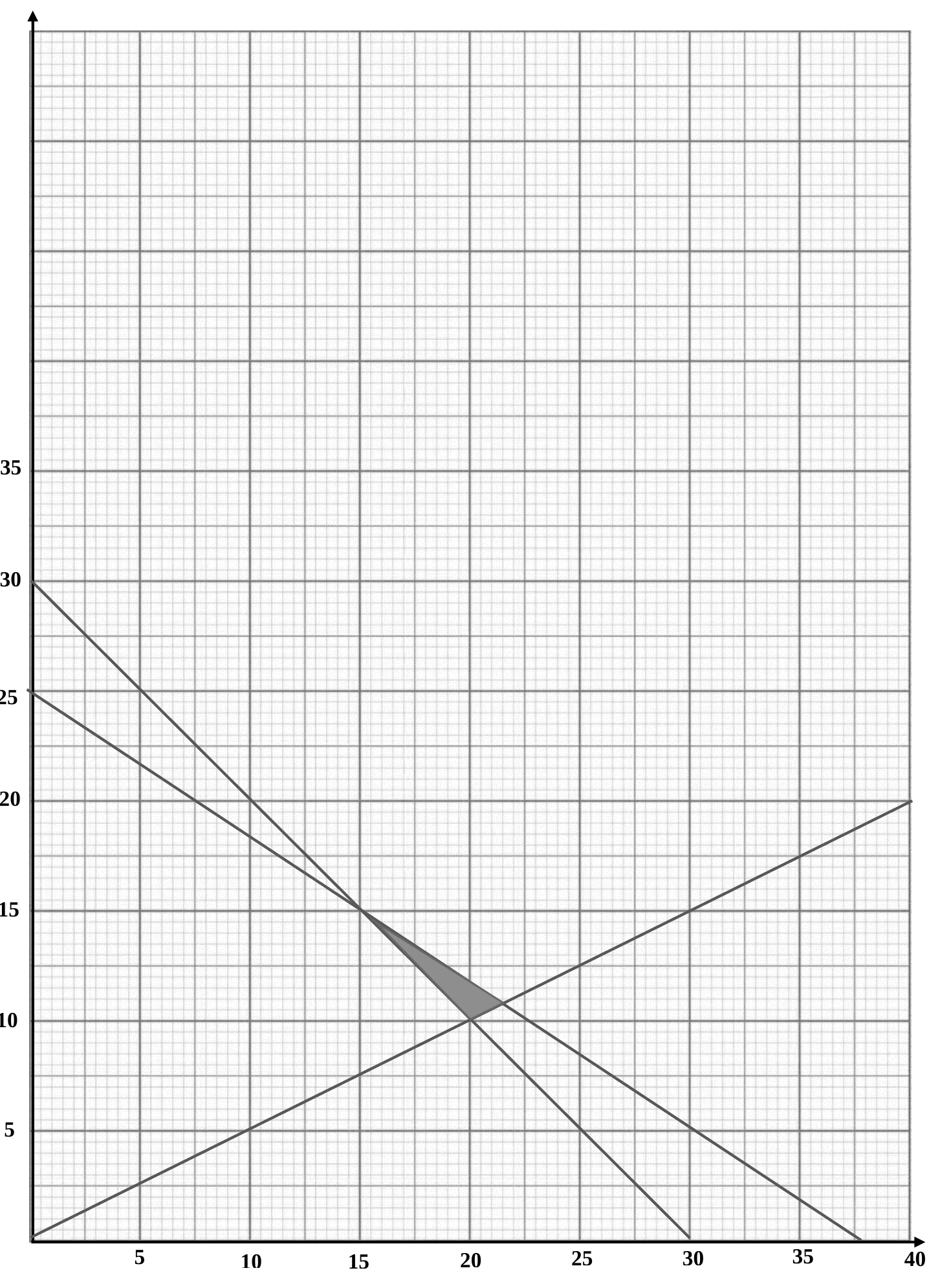
Mutalib is a shopkeeper. He buys two types of cat food for his shop, Whiskas at RM0.40 per packet and Pro Diet at RM0.60 per packet. Mutalib has RM15 and decides to buy at least 30 packets altogether. He ensures that the ratio of cat food of the Pro Diet type to the Whiskas type is at least 1 : 2. He buys x packets of Whiskas and y packets of Pro Diet. (a) Write three inequalities, other than x ≥ 0 and y ≥ 0, which satisfy all the above constraints. (b) Using a scale of 2 cm to 5 on both axes, construct and shade the region R which satisfies all the above constraints. (c) Use the graph constructed in (b) to answer: (i) Mutalib makes a profit of RM0.10 per packet on Whiskas and a profit of RM0.20 on Pro Diet. Assuming he can sell all the packets, find how many packets of each type he should buy to maximise his profit and find that profit.
Medium10 marks- (a)
Write three inequalities, other than x ≥ 0 and y ≥ 0.
[3] - (b)
Construct and shade the region R (scale 2 cm to 5 on both axes).
[3]
- (c)(i)
Find how many packets of each type to buy to maximise the profit, and the maximum profit.
[4]