Write your answer on paper. Then open the answer to check it.
Section A
(a) Given (p²/3)(3/y³)^p (y/2)^(p+2) = q/y², find the values of p and q. (b) Evaluate (log_√y 9)(log_x y)(log_3 x).
Medium7 marks- (a)
Given (p²/3)(3/y³)^p (y/2)^(p+2) = q/y², find the values of p and q.
[4] - (b)
Evaluate (log_√y 9)(log_x y)(log_3 x).
[3]
Solve the simultaneous equations 2y = 7 − x and |x + y| = 4.
Easy4 marksSolve the simultaneous equations 2y = 7 − x and |x + y| = 4.
[4]
Since 5 years ago, Suhaila has saved RM15 000 in her savings account with an interest rate of 4.5% per annum. The savings receive compound interest every 6 months for each year. Calculate (a) the amount of savings of Suhaila until now if she has never made any additional savings or withdrawals, (b) the amount of compound interest earned by her.
Easy5 marks- (a)
Calculate the amount of savings of Suhaila until now if she has never made any additional savings or withdrawals.
[3] - (b)
Calculate the amount of compound interest earned by her.
[2]
(a) Prove that sin(x + 45°) sin(x − 45°) = −½ cos 2x. (b) Given cos 2x = −5/13 where 90° ≤ x ≤ 180°, without using the calculator, find the value of tan x.
Medium7 marks- (a)
Prove that sin(x + 45°) sin(x − 45°) = −½ cos 2x.
[3] - (b)
Given cos 2x = −5/13 where 90° ≤ x ≤ 180°, without using the calculator, find the value of tan x.
[4]
The equation of locus of a moving point R is given by x² + y² − 9x + y + 18 = 0. Show that (a) the locus R intersects with x-axis at two different points, (b) the straight line y = −3x + 8 is a tangent to the locus R.
Medium7 marks- (a)
Show that the locus R intersects with x-axis at two different points.
[3] - (b)
Show that the straight line y = −3x + 8 is a tangent to the locus R.
[4]
(a) The inverse function h⁻¹ is defined by h⁻¹: x → 2/(3 − x), x ≠ k. Find (i) the value of k, (ii) h(x). (b) Given that f: x → ax + b, g⁻¹: x → (x + 5)/2 and fg⁻¹: x → 4 + 3x. Find the value of a and of b.
Medium6 marks- (a)
The inverse function h⁻¹ is defined by h⁻¹: x → 2/(3 − x), x ≠ k. Find (i) the value of k, (ii) h(x).
[3] - (b)
Given that f: x → ax + b, g⁻¹: x → (x + 5)/2 and fg⁻¹: x → 4 + 3x. Find the value of a and of b.
[3]
The variables x and y are related by equation 2y = (m − 1)x + 10/x, such that m is a constant. Diagram 1 shows a straight line graph of RS obtained by plotting xy against x². (The graph shows R(0, 5n) on the xy-axis, S on the x²-axis, and the line PQ perpendicular to RS.) (a) Express the equation 2y = (m − 1)x + 10/x in the linear form used to obtain the straight line graph as shown in Diagram 1. (b) Given the gradient of the straight line PQ is 1/3, find the value of m and of n.
Easy4 marks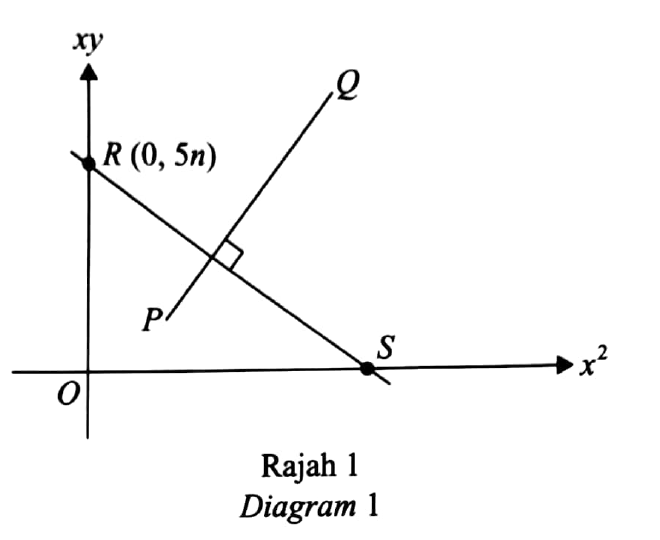
- (a)
Express the equation 2y = (m − 1)x + 10/x in the linear form used to obtain the straight line graph as shown in Diagram 1.
[1] - (b)
Given the gradient of the straight line PQ is 1/3, find the value of m and of n.
[3]
Diagram 2 shows triangle ABC. K is a point on line BC such that BK : KC = n : 2. Given that AB→ = 3x and AC→ = 6y. Express vector (a) BC→ in terms of x and y, (b) AK→ in terms of n, x and y.
Easy4 marks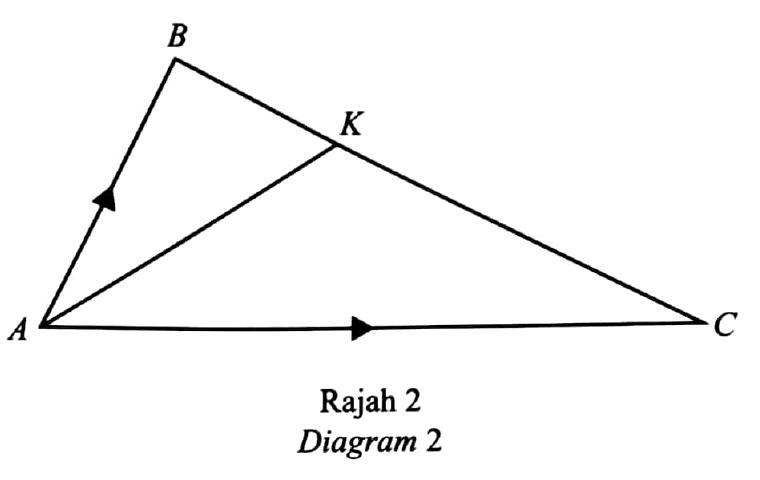
- (a)
Express vector BC→ in terms of x and y.
[1] - (b)
Express vector AK→ in terms of n, x and y.
[3]
Diagram 3 shows a sector QOR of a circle with centre O. Given the length of arc QR is 9 cm and OP = OS = PQ = SR = 7.5 cm, find (a) the value of β, in radians, (b) the area of the shaded region, in cm². Use π = 3.142.
Easy5 marks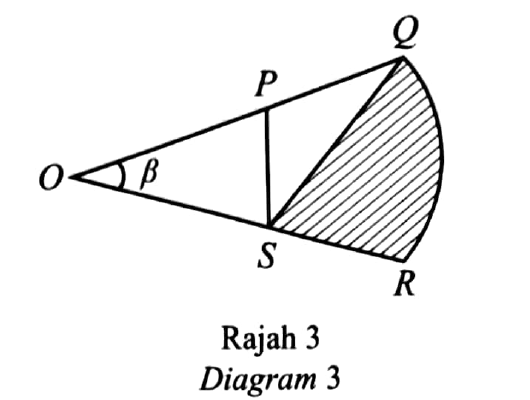
- (a)
Find the value of β, in radians.
[2] - (b)
Find the area of the shaded region, in cm².
[3]
(a) Find the range of values of x for 2x² + 5x ≤ 3. (b) The quadratic equation px² + 3qx + 4 = 0, where p and q are constants, has two equal roots. Express q in terms of p.
Easy4 marks- (a)
Find the range of values of x for 2x² + 5x ≤ 3.
[2] - (b)
The quadratic equation px² + 3qx + 4 = 0, where p and q are constants, has two equal roots. Express q in terms of p.
[2]
Diagram 4 shows the shaded region bounded by the curve y = g(x), the x-axis and the straight line x = 3. Given that the area of the shaded region is 10 units². (a) Find ∫₁³ [x − 2g(x)] dx. (b) Given g′(x) = 2x − 8, find g(x) in terms of x.
Easy6 marks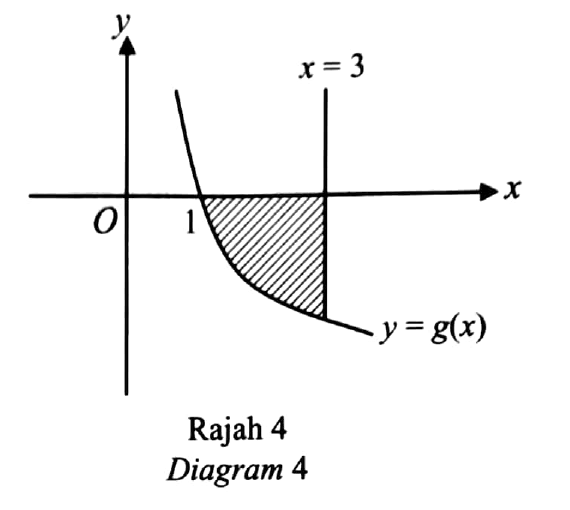
- (a)
Find ∫₁³ [x − 2g(x)] dx.
[3] - (b)
Given g′(x) = 2x − 8, find g(x) in terms of x.
[3]
The probability of a student cycles to school is p. A sample of 5 students is selected at random. (a) If the probability of all the 5 students cycle to school is 0.16807, find the value of p. (b) Find the probability that more than 3 students cycle to school.
Easy5 marks- (a)
If the probability of all the 5 students cycle to school is 0.16807, find the value of p.
[2] - (b)
Find the probability that more than 3 students cycle to school.
[3]
Section B
(a) Diagram 5 shows seven pieces of letter cards S P E C I A L. Five pieces of cards are chosen at random to form a code. Find the number of ways to arrange all the letters in a row if (i) all the vowels must be next to each other, (ii) at least 3 consonant letters are arranged side by side. (b) Given ⁿC_r = ⁿ⁻²C_r, express n in terms of r.
Medium8 marks
- (a)(i)
Five cards chosen from S P E C I A L (vowels E, I, A; consonants S, P, C, L). Number of ways to arrange the letters in a row if all the vowels must be next to each other.
[2] - (a)(ii)
Number of ways to arrange the letters in a row if at least 3 consonant letters are arranged side by side.
[3] - (b)
Given ⁿC_r = ⁿ⁻²C_r, express n in terms of r.
[3]
(a) It is given that x = t³ − 6 and dy/dt = (9/2)t⁵. Find (i) dx/dt, (ii) dy/dx, in terms of x. (b) Find the coordinates of the point on the curve y = (3 − 15x)³ such that the gradient of the normal to the curve at the point is 1/5.
Medium8 marks- (a)
It is given that x = t³ − 6 and dy/dt = (9/2)t⁵. Find (i) dx/dt, (ii) dy/dx, in terms of x.
[3] - (b)
Find the coordinates of the point on the curve y = (3 − 15x)³ such that the gradient of the normal to the curve at the point is 1/5.
[5]
(a) Given ax² + bx + c = 0. Derive the quadratic formula by using completing the square method. (b) By using the quadratic formula derived from 15(a), determine the roots of the quadratic equation 9x² − 6x + 5 = 0. Give your answer in terms of imaginary number, i with i = √−1.
Medium8 marks- (a)
Given ax² + bx + c = 0. Derive the quadratic formula by using completing the square method.
[5] - (b)
By using the quadratic formula derived from 15(a), determine the roots of 9x² − 6x + 5 = 0. Give your answer in terms of imaginary number, i with i = √−1.
[3]