Write your answer on paper. Then open the answer to check it.
Section A
Diagram 1 shows a triangle OPQ on a Cartesian plane and O is the origin. Given that R and S lie on the straight line OQ and PQ respectively where OR : RQ = 2 : 1 and QS = 5SP. It is given that OP→ = 6i and OR→ = 2i + 4j.
Medium8 marks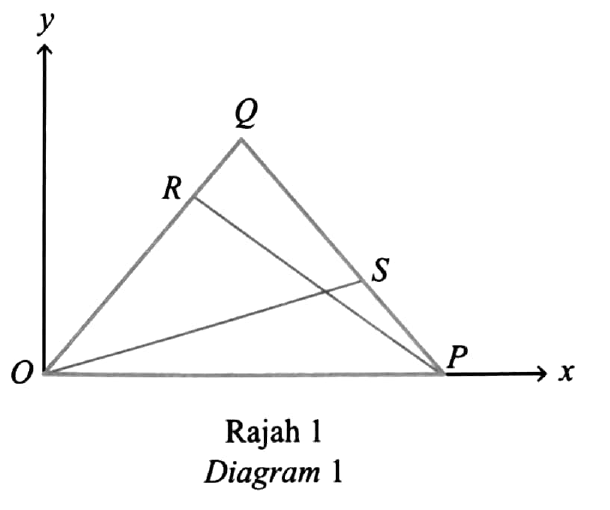
- (a)
Find the coordinates of the point: (i) Q, (ii) S.
[4] - (b)
Determine the unit vector in the direction of vector RS→. Give your answer in the simplest surd form.
[4]
(a) Given that the length of the two diagonals of a rhombus PQRS is (2 + √3) cm and (3 + √48) cm respectively. Calculate the area, in cm², of the rhombus PQRS. Give your answer in the form of a + b√3 where a and b are rational numbers. (b) Given that log_a P = ½(log_a 48 + log_a 0.25 − 5 log_a 3), find the value of P. Hence, find the value of log_a P when a = √2/3.
Medium7 marks- (a)
Calculate the area, in cm², of the rhombus PQRS. Give your answer in the form of a + b√3 where a and b are rational numbers.
[3] - (b)
Given that log_a P = ½(log_a 48 + log_a 0.25 − 5 log_a 3), find the value of P. Hence, find the value of log_a P when a = √2/3.
[4]
The sum of digits of a three-digit number, xyz, is 17 where x, y and z each represents the digit in hundreds, tens and ones for the number. The hundreds digit plus 2 times the tens digit is more than 2 times the ones digit by 4. If the digits in hundreds and ones are exchanged place, the new number is 79 less than 3 times of the original number, show that 97z = 299x + 20y − 79. Hence, find the original three-digit number.
Medium7 marksShow that 97z = 299x + 20y − 79. Hence, find the original three-digit number.
[7]
(a) The second, third and sixth terms of an arithmetic progression are three consecutive terms of a geometric progression. Find the common ratio of the geometric progression. (b) Rylar wanted to save money to buy his best friend a gift worth RM925. Diagram 2 shows his savings for the first 3 days (notes of money: day 1, day 2, day 3). He continued his savings in the form of an arithmetic progression. Find the amount he saved on the last day when his total savings was enough to buy the gift.
Medium7 marks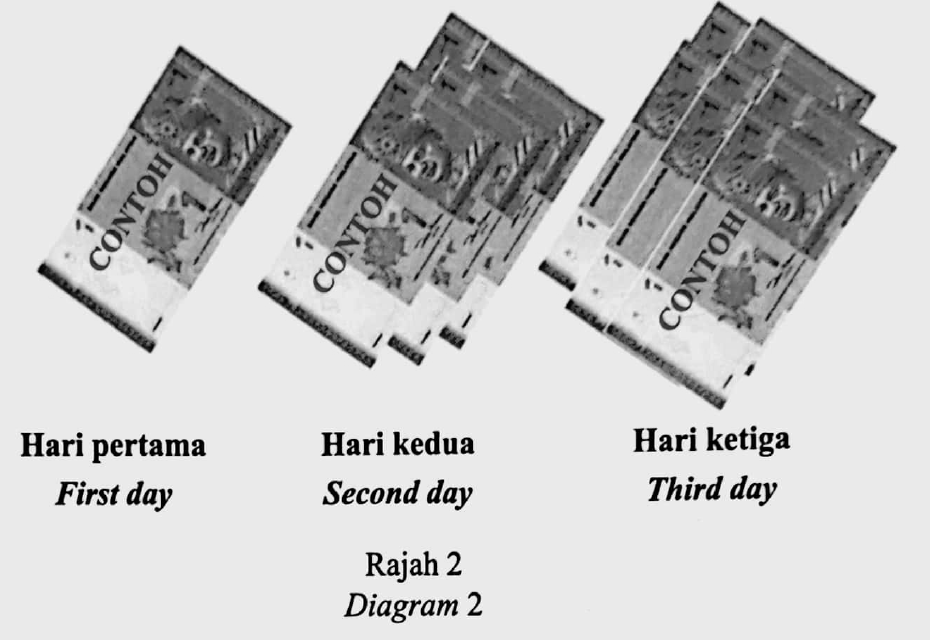
- (a)
Find the common ratio of the geometric progression.
[4] - (b)
Find the amount he saved on the last day when his total savings was enough to buy the gift.
[3]
Diagram 3 shows a logo in a regular heptagon shape ABCDEFG inscribed in a circle of radius 5 cm with centre O. To complete the logo, a black tie rope is needed to make the heptagon star and three arcs of the circle. Given π = 3.142. (a) Find, in radians, angle AOB. (b) Determine if a 1-metre long black tie rope is sufficient to make the logo. (c) Segments AG, BC and DE also will be painted with yellow paint. Calculate, in cm², the area to be painted.
Medium7 marks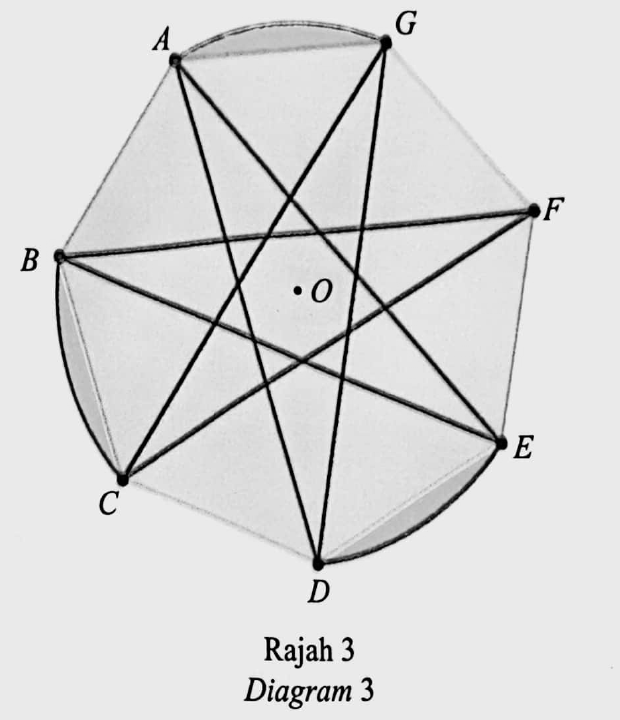
- (a)
Find, in radians, angle AOB.
[1] - (b)
Determine if a 1-metre long black tie rope is sufficient to make the logo.
[4] - (c)
Segments AG, BC and DE also will be painted with yellow paint. Calculate, in cm², the area to be painted.
[2]
Diagram 4 shows two curves y = x² and y = −x² + 4 are intersecting at point A. The straight line AB is parallel to the y-axis. Find (a) the equation of the straight line AB, (b) area, in unit², of the shaded region, (c) the volume generated when the region bounded by the curves y = x² and y = −x² + 4 is revolved 180° about the y-axis.
Medium8 marks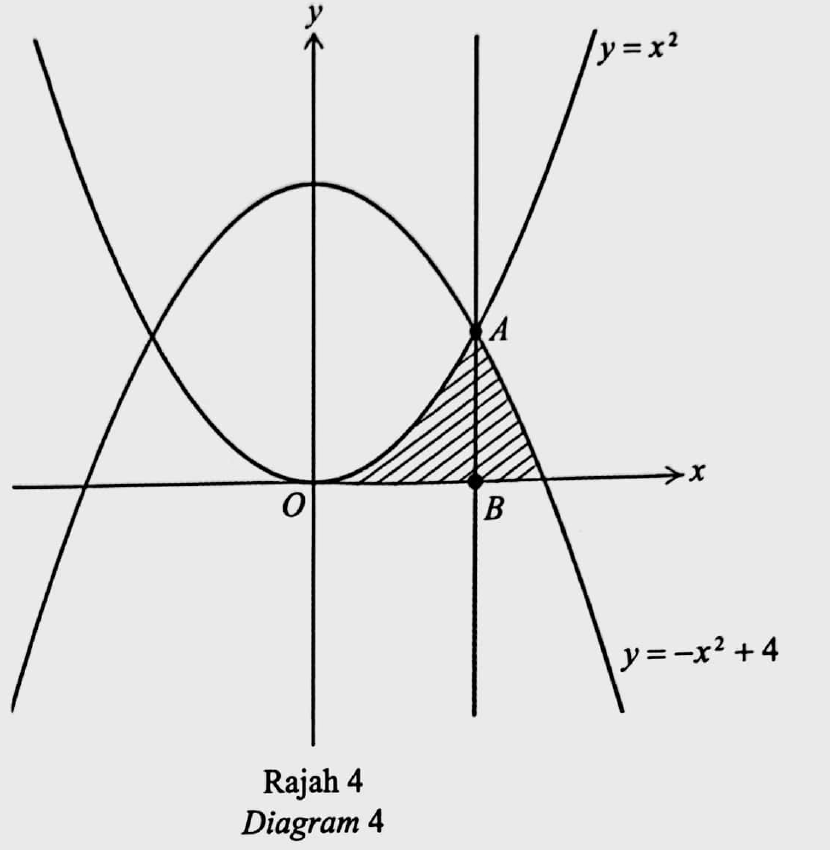
- (a)
Find the equation of the straight line AB.
[2] - (b)
Find the area, in unit², of the shaded region.
[3] - (c)
Find the volume generated when the region bounded by the curves y = x² and y = −x² + 4 is revolved 180° about the y-axis.
[3]
(a) Show that 2(cot x − tan x)/(sec x cosec x) = 2 cos 2x. (b) (i) Hence, sketch the graph of y = 2(cot x − tan x)/(sec x cosec x) for 0 ≤ x ≤ 2π. (ii) Determine the range of the number of solution, n, for the equation 2(cot x − tan x)/(sec x cosec x) = p, where p is a constant and −2 ≤ p ≤ 2.
Medium6 marks- (a)
Show that 2(cot x − tan x)/(sec x cosec x) = 2 cos 2x.
[2] - (b)(i)
Hence, sketch the graph of y = 2(cot x − tan x)/(sec x cosec x) for 0 ≤ x ≤ 2π.
[3]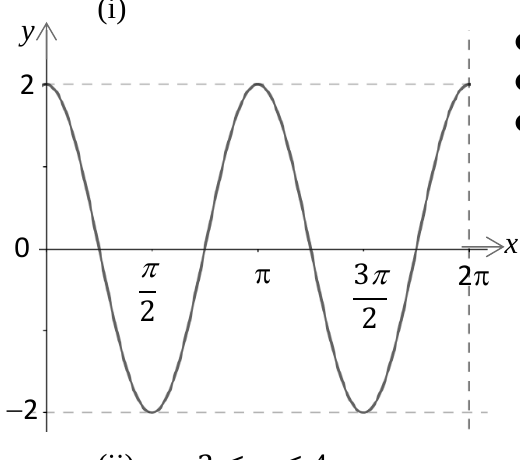
- (b)(ii)
Determine the range of the number of solution, n, for the equation = p, where p is a constant and −2 ≤ p ≤ 2.
[1]
Section B
(a) A box contains 2 types of sweets, A and B, in the ratio of 1 : 2. Five sweets are chosen one at a time at random, with replacement. Calculate the probability that (i) exactly 4 type B sweets are chosen, (ii) more than 2 type A sweets are chosen. (b) The lengths of a type of insects are normally distributed with a mean of 2 cm and a variance of 0.09 cm². Find (i) the percentage of insects that have a length of more than 2.28 cm, (ii) the value of m if 15% of the insects have a length of less than m cm.
Medium10 marks- (a)(i)
Calculate the probability that exactly 4 type B sweets are chosen.
[2] - (a)(ii)
Calculate the probability that more than 2 type A sweets are chosen.
[3] - (b)(i)
Find the percentage of insects that have a length of more than 2.28 cm.
[2] - (b)(ii)
Find the value of m if 15% of the insects have a length of less than m cm.
[3]
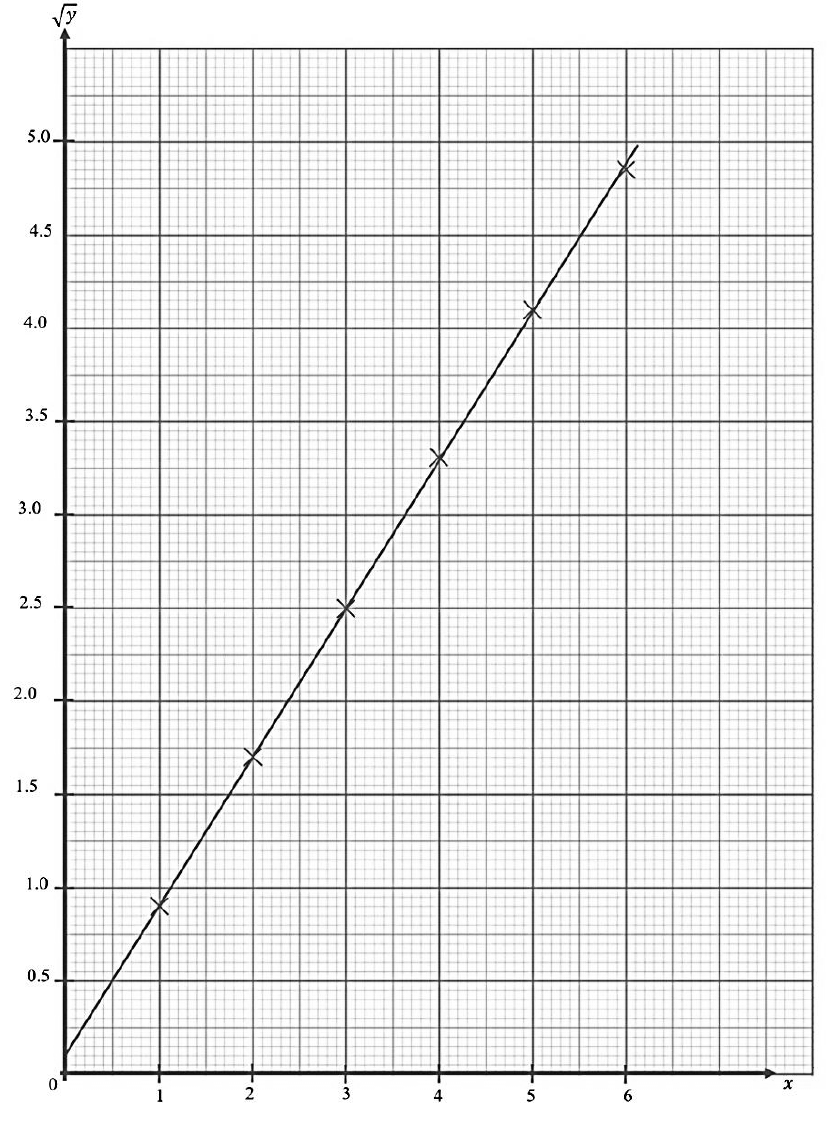
Use the graph paper provided on page 22. Table 1 shows the values of two variables, x and y obtained from an experiment. The variables x and y are related by the equation y = (16/p²)(x − q)², where p and q are constants. Table 1: x = 1, 2, 3, 4, 5, 6; y = 0.8281, 2.8561, 6.25, 10.89, 16.81, 23.52. (a) Plot the graph of √y against x by using a scale of 2 cm to 1 unit on the x-axis and 2 cm to 0.5 unit on the √y-axis. Hence, draw the line of best fit. (b) Using the graph in 9(a), find (i) the value of p and of q, (ii) the value of y when x = 1.7.
Medium10 marks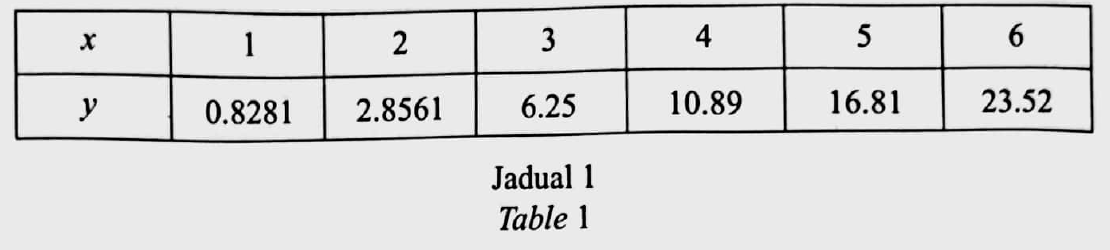
- (a)
Plot the graph of √y against x by using a scale of 2 cm to 1 unit on the x-axis and 2 cm to 0.5 unit on the √y-axis. Hence, draw the line of best fit.
[4]
- (b)(i)
Using the graph in 9(a), find the value of p and of q.
[5] - (b)(ii)
Using the graph in 9(a), find the value of y when x = 1.7.
[1]
Solution by scale drawing is not accepted. Diagram 5 shows a rectangle KLMN. Given that the coordinates of K, L, M and N are (−10, q), (p, −7), (8, 2) and (2, 10) respectively. (a) Find the value of p. (b) Find the equation of the straight line KL and the value of q. (c) Calculate the area, in unit², of the rectangle KLMN. (d) A fence is built with the condition that the distance between the fence and the points K and M is always in the ratio 3 : 2. Find the equation of the fence.
Medium10 marks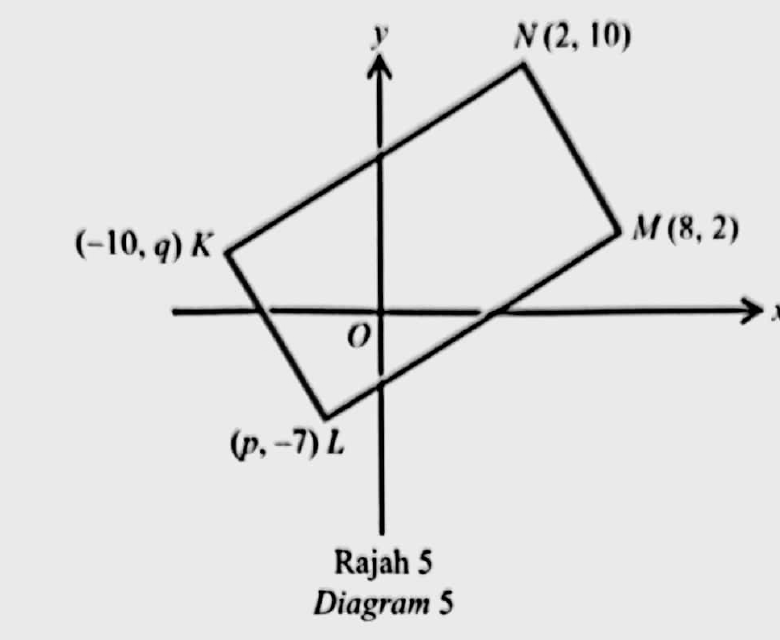
- (a)
Find the value of p.
[2] - (b)
Find the equation of the straight line KL and the value of q.
[3] - (c)
Calculate the area, in unit², of the rectangle KLMN.
[2] - (d)
Find the equation of the fence (distance to K : distance to M = 3 : 2).
[3]
(a) Given that f(x) = 2x/(3 − √(x + 9)), (i) find f(0), (ii) complete the Table 2(i) and Table 2(ii) given in the answer space. Give your answers correct to four decimal places. (iii) from the answer in the Table 2(i) and Table 2(ii), state the value of lim(x→0) 2x/(3 − √(x + 9)). (b) Given that y = x(x² − 4), express x d²y/dx² + dy/dx in terms of x. Hence, find the range of values of x such that x d²y/dx² + dy/dx > 0.
Medium10 marks- (a)(i)
Find f(0).
[1] - (a)(ii)
Complete Table 2(i) (x = −0.1, −0.01, −0.001, −0.0001, 0) and Table 2(ii) (x = 0.1, 0.01, 0.001, 0.0001, 0) for f(x), correct to four decimal places.
[2]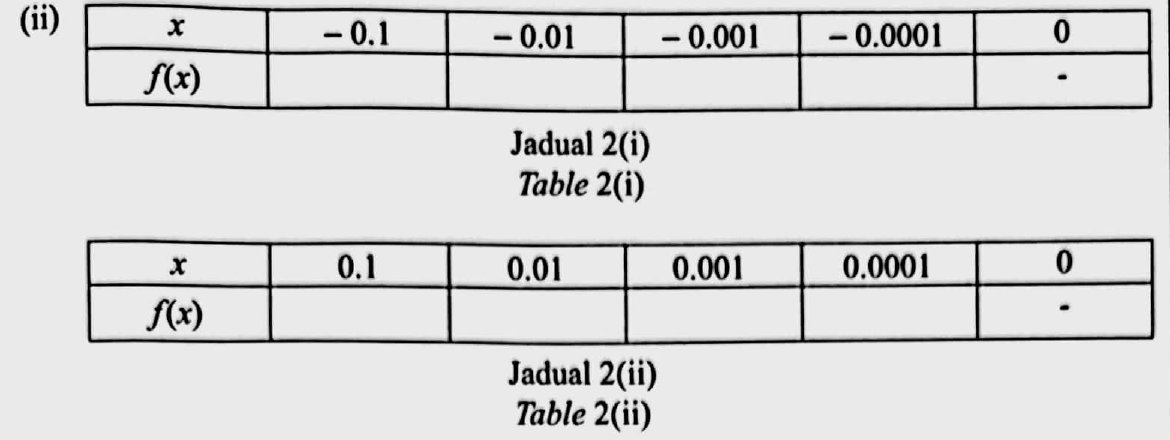
- (a)(iii)
State the value of lim(x→0) 2x/(3 − √(x + 9)).
[1] - (b)
Given that y = x(x² − 4), express x d²y/dx² + dy/dx in terms of x. Hence, find the range of values of x such that x d²y/dx² + dy/dx > 0.
[6]
Section C
Solution by scale drawing is not accepted. Diagram 6 shows a triangle PQR where angle R is an obtuse angle. Given that PQ = 7.2 cm, QR = 3.646 cm and PR = 4.992 cm. (a) Without finding any of the angle P, Q or R, calculate the area, in cm², of the triangle PQR. (b) Find ∠QPR. (c) The straight line PR is extended to point R′ with condition QR = QR′ and ∠QPR = ∠QPR′. (i) Sketch the triangle PQR′. (ii) Calculate ∠PR′Q. (iii) Find the shortest distance, in cm, from Q to the straight line PR′.
Medium10 marks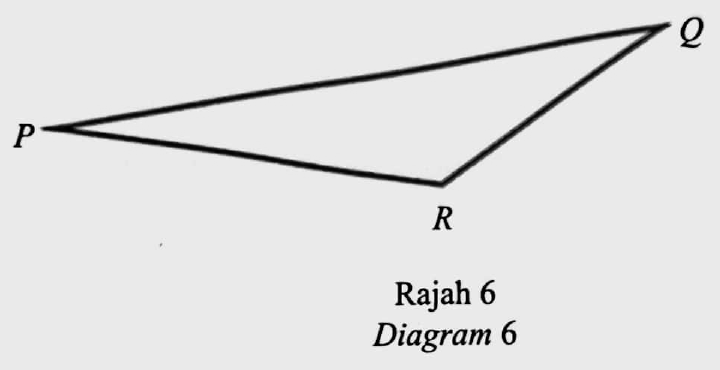
- (a)
Without finding any of the angle P, Q or R, calculate the area, in cm², of the triangle PQR.
[3] - (b)
Find ∠QPR.
[2] - (c)(i)
Sketch the triangle PQR′.
[1] - (c)(ii)
Calculate ∠PR′Q.
[2] - (c)(iii)
Find the shortest distance, in cm, from Q to the straight line PR′.
[2]
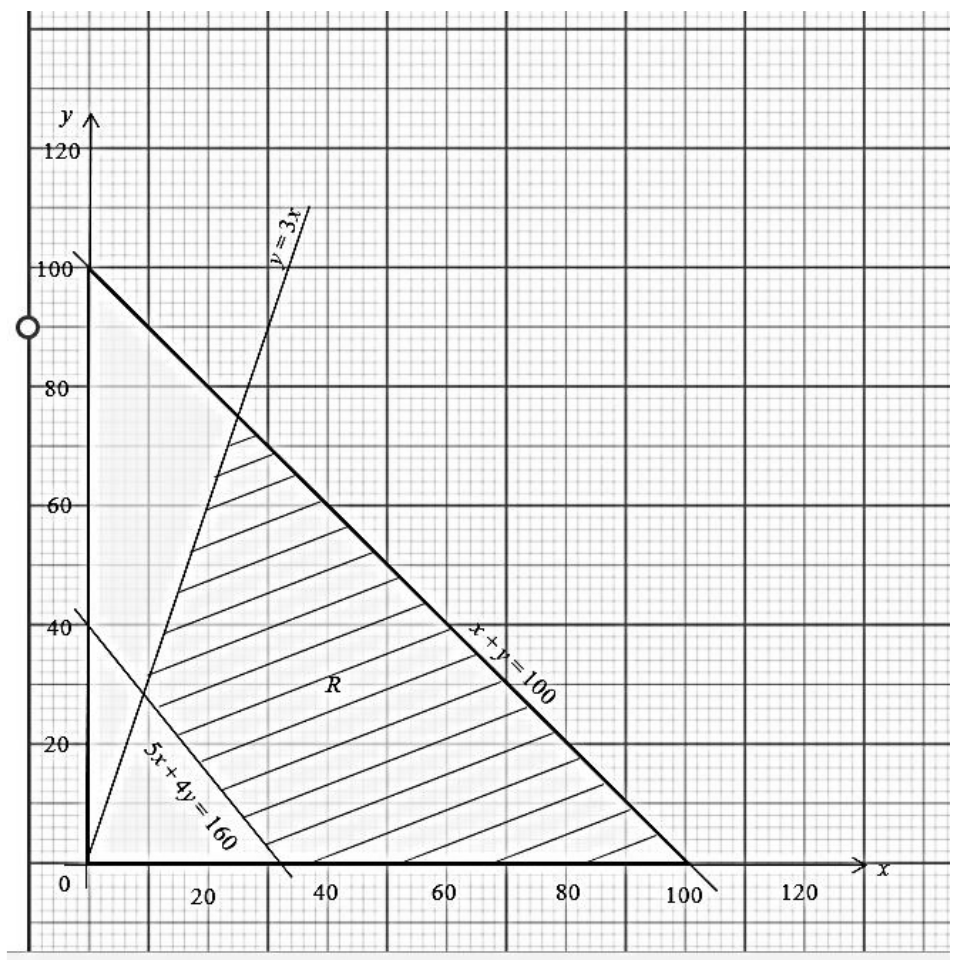
Use the graph paper provided on page 33. A fishmonger buys x kg of prawns and y kg of stingrays from a wholesaler. The price of prawns and stingrays are RM25 per kg and RM20 per kg respectively. The purchase of the prawns and stingrays are based on three constraints, two of the constraints are as follows: I The mass of stingrays is not more than 3 times the mass of prawns. II The total amount of prawns and stingrays purchased is RM800 or more. (a) Write two inequalities, other than x ≥ 0 and y ≥ 0, which satisfy the two constraints. (b) The third constraint is represented by the coloured region on the graph in page 33 (the region below the line through (100, 0) and (0, 100), shaded). Write in words the constraint. (c) Use the graph on page 33. Hence, construct and shade the region R which satisfies all the above constraints. (d) By using the graph constructed in 13(c), find (i) the minimum mass of prawns purchased if 20 kg of stingrays is purchased, (ii) the maximum amount of money paid by the fishmonger.
Medium10 marks- (a)
Write two inequalities, other than x ≥ 0 and y ≥ 0, which satisfy the two constraints.
[2] - (b)
The third constraint is represented by the coloured region on the graph in page 33. Write in words the constraint.
[1] - (c)
Use the graph on page 33. Hence, construct and shade the region R which satisfies all the above constraints.
[3]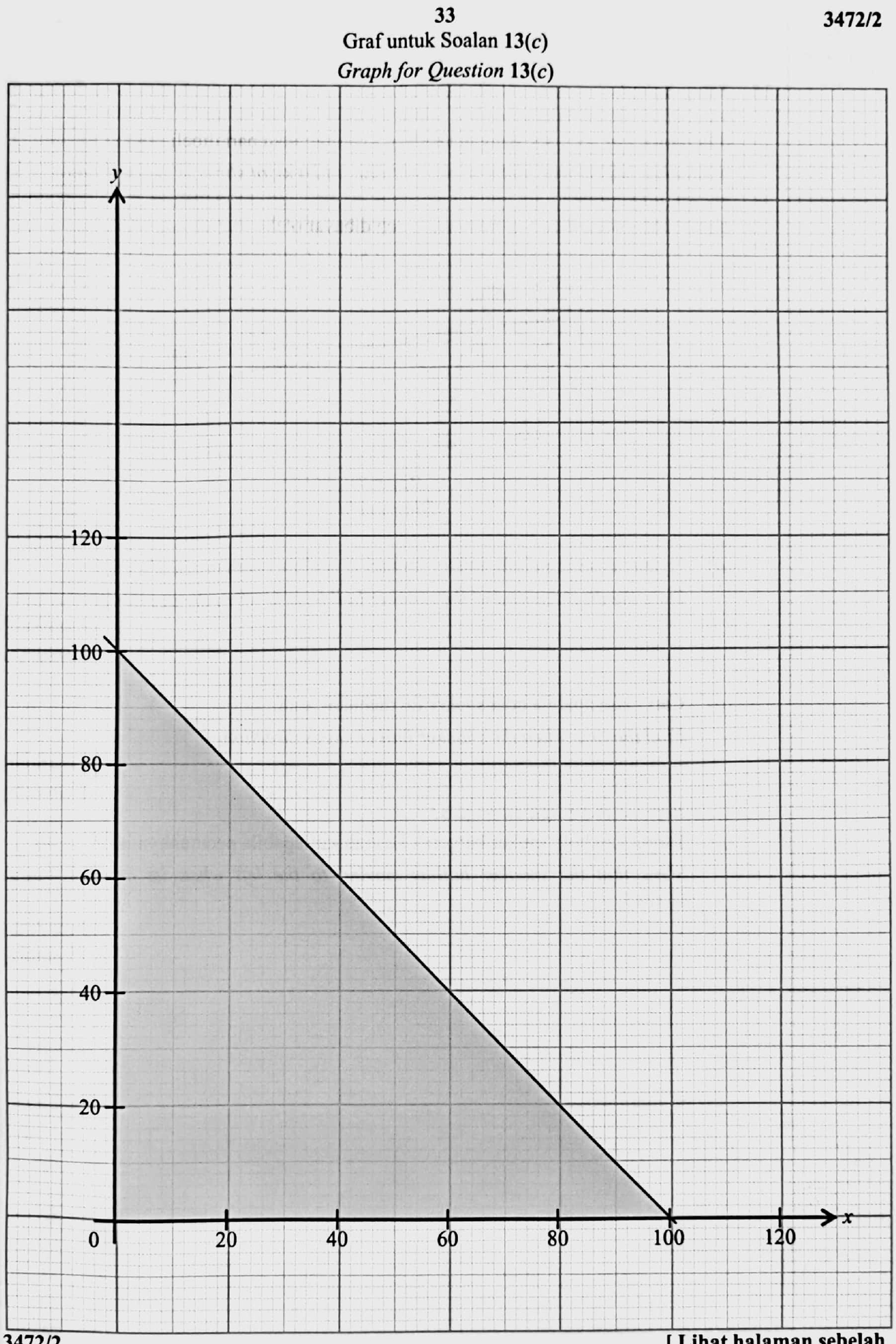
- (d)(i)
By using the graph constructed in 13(c), find the minimum mass of prawns purchased if 20 kg of stingrays is purchased.
[1] - (d)(ii)
By using the graph constructed in 13(c), find the maximum amount of money paid by the fishmonger.
[3]
A snooker ball moves along a straight line and passes through a fixed point O as shown in Diagram 7. Its initial velocity is 40 m s⁻¹. Its acceleration, a m s⁻², is given by a = 16t − 48, where t is the time, in seconds, after passing through O. (a) State the displacement of the snooker ball from O when the acceleration is zero. (b) Find the time when the snooker ball changes direction. (c) Show that the snooker ball is moving to the left when its acceleration is 16 m s⁻².
Medium10 marks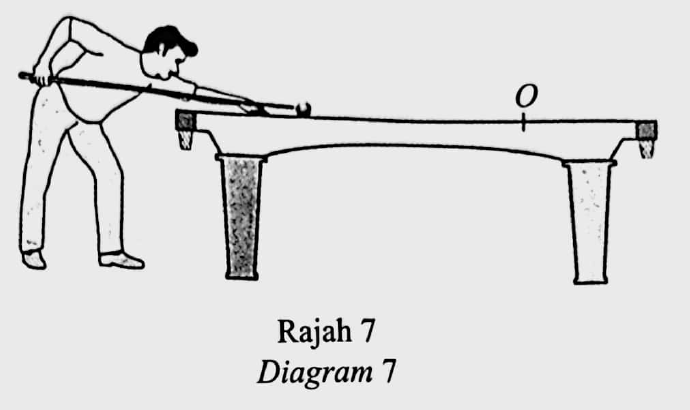
- (a)
State the displacement of the snooker ball from O when the acceleration is zero.
[4] - (b)
Find the time when the snooker ball changes direction.
[3] - (c)
Show that the snooker ball is moving to the left when its acceleration is 16 m s⁻².
[3]
Table 3 shows the price indices and the percentage of usage of four components, A, B, C and D in the production of a fan. Table 3: component A: price index 138 (year 2021 based on 2019), usage 10%; B: h, 30%; C: 145, 40%; D: 108, 20%. (a) Calculate the price of component C in the year 2021 if its price in the year 2019 is RM75. (b) Given that the composite index for the production cost of the fan in the year 2021 based on the year 2019 is 130, find the value of h. (c) From the year 2021 to the year 2025, the prediction to the price of component B will be increased by 15%, the price of component D will be decreased by 10% where the prices of component A and C will remain unchanged. (i) Find the composite index for the production cost of the fan in the year 2025 based on the year 2019. (ii) If the production cost of a fan in the year 2019 is RM128, calculate the corresponding production cost of a fan in the year 2025.
Medium10 marks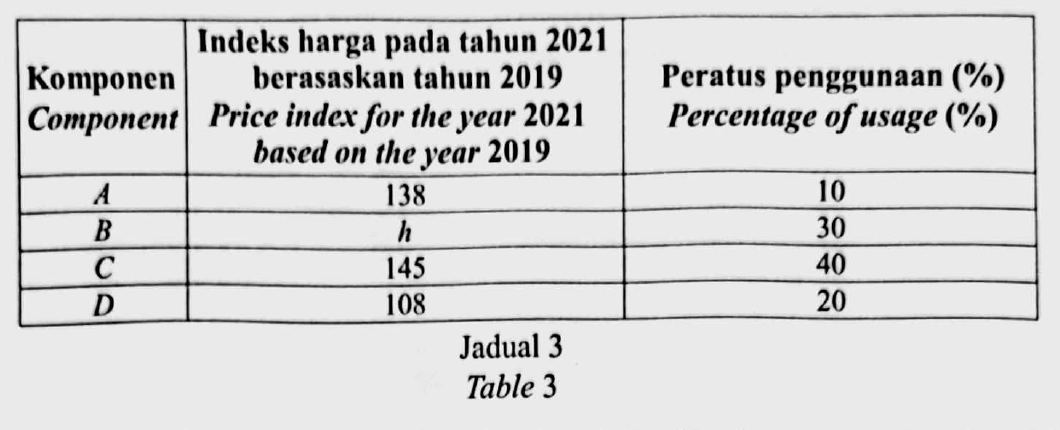
- (a)
Calculate the price of component C in the year 2021 if its price in the year 2019 is RM75.
[2] - (b)
Given that the composite index for the production cost of the fan in the year 2021 based on the year 2019 is 130, find the value of h.
[3] - (c)(i)
Find the composite index for the production cost of the fan in the year 2025 based on the year 2019.
[3] - (c)(ii)
If the production cost of a fan in the year 2019 is RM128, calculate the corresponding production cost of a fan in the year 2025.
[2]