Write your answer on paper. Then open the answer to check it.
Section A
Diagram 1 shows a triangle OPQ on a Cartesian plane and O is the origin. Given that R and S lie on the straight line OQ and PQ respectively where OR : OQ = 1 : 3 and PS = 3SQ. It is given that OP→ = 6i and OR→ = i + 4j. (a) Find the coordinates of the point: (i) Q, (ii) S. (b) Determine the unit vector in the direction of vector RS→. Give your answer in the simplest surd form.
Medium8 marks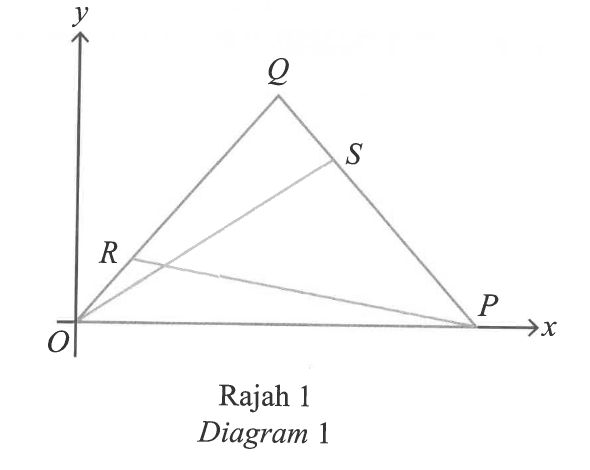
- (a)(i)
Find the coordinates of the point Q.
[2] - (a)(ii)
Find the coordinates of the point S.
[2] - (b)
Determine the unit vector in the direction of vector RS→. Give your answer in the simplest surd form.
[4]
(a) Given the sum of two parallel sides and the height of a trapezium PQRS are (5 + √3) cm and (2 + √27) cm respectively. Calculate the area, in cm², of the trapezium PQRS. Give your answer in the form of a + b√3 where a and b are rational numbers. (b) Given that x² + y² = 11xy, show that log_a (x − y) = ½ log_a x + ½ log_a y + log_a 3.
Medium7 marks- (a)
Calculate the area, in cm², of the trapezium. Give the answer in the form a + b√3.
[3] - (b)
Given x² + y² = 11xy, show that log_a (x − y) = ½ log_a x + ½ log_a y + log_a 3.
[4]
The sum of digits of a three-digit number, xyz, is 12 where x, y and z each represents the digit in hundreds, tens and ones for the number. The sum of hundreds digit and 3 times of the ones is 5 times the tens digit. If the digits in hundreds and ones are exchanged place, the new number is 96 less than 3 times of the original number, show that 97z = 299x + 20y − 96. Hence, find the original three-digit number.
Medium7 marksShow that 97z = 299x + 20y − 96. Hence, find the original three-digit number.
[7]
(a) The second, fourth and eleventh terms of an arithmetic progression are three consecutive terms of a geometric progression. Find the common ratio of the geometric progression. (b) Josey invites 55 friends to her house on her birthday. She wants to give each of her friends a present. Diagram 2 shows her purchase for the first 3 days (3, 7 and 11 presents on the first, second and third day). She continued buying in the form of an arithmetic progression. Find the number of presents that were bought on the last day when she had bought enough presents for all her friends.
Medium7 marks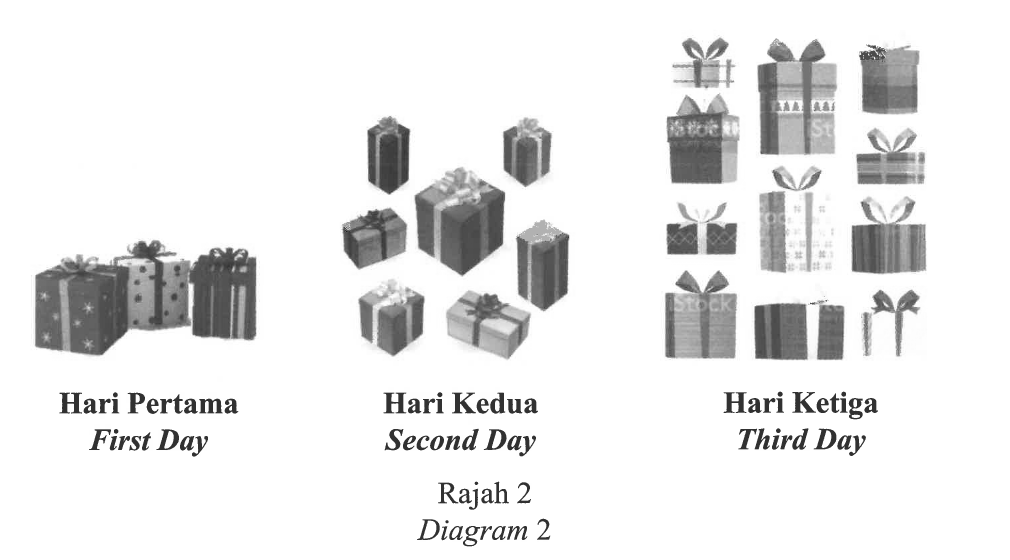
- (a)
The second, fourth and eleventh terms of an arithmetic progression are three consecutive terms of a geometric progression. Find the common ratio of the geometric progression.
[4] - (b)
Josey bought presents in an arithmetic progression (3, 7, 11, … on the first three days, Diagram 2). Find the number of presents bought on the last day when she had bought enough presents for all 55 friends.
[3]
Diagram 3 shows a logo in a regular hexagon shape ABCDEF inscribed in a circle of radius 5 cm with centre O. To complete the logo, a black tie rope is needed to make the hexagon star and three arcs of the circle. Given π = 3.142. (a) Find, in radians, angle AOB. (b) Determine whether a 0.8 metre long black tie rope is sufficient to make the logo. (c) Segments AB, CD and EF will be painted with yellow paint. Calculate, in cm², the area to be painted.
Medium7 marks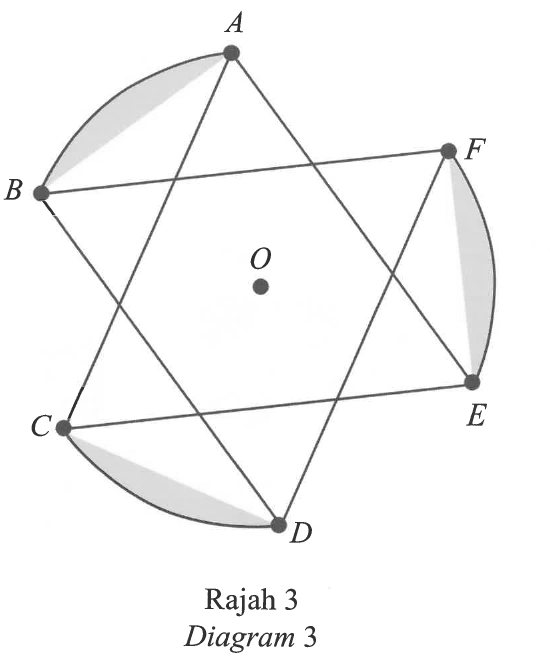
- (a)
Find, in radians, angle AOB.
[1] - (b)
Determine whether a 0.8 metre long black tie rope is sufficient to make the logo.
[4] - (c)
Segments AB, CD and EF will be painted yellow. Calculate, in cm², the area to be painted.
[2]
Diagram 4 shows two curves y² = x and y² = 4 − x intersecting at point Q. The straight line PQ is parallel to the x-axis. Find (a) the equation of the straight line PQ, (b) the area, in unit², of the shaded region, (c) the volume generated when the region bounded by the curves y² = x and y² = 4 − x is revolved 180° about the x-axis.
Medium8 marks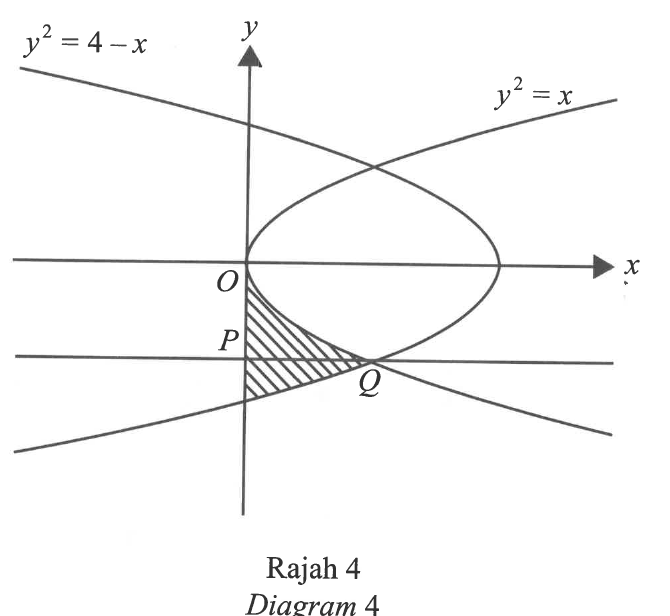
- (a)
Find the equation of the straight line PQ.
[2] - (b)
Find the area, in unit², of the shaded region.
[3] - (c)
Find the volume generated when the region bounded by the curves y² = x and y² = 4 − x is revolved 180° about the x-axis.
[3]
(a) Show that (1 − tan²x)/(1 + tan²x) = cos 2x. (b) (i) Hence, sketch the graph of y = cos 2x for 0 ≤ x ≤ 2π. (ii) Hence, using the same axes, draw a suitable straight line to find the number of solutions to the equation 1 − ((1 − tan²x)/(1 + tan²x)) − x = 0, for 0 ≤ x ≤ 2π. State the equation of the straight line and the number of solutions.
Medium6 marks- (a)
Show that (1 − tan²x)/(1 + tan²x) = cos 2x.
[2] - (b)(i)
Hence, sketch the graph of y = cos 2x for 0 ≤ x ≤ 2π.
[3] - (b)(ii)
Using the same axes, draw a suitable straight line and state its equation and the number of solutions.
[1]
Section B
A survey is carried out about the gender of the teachers in a district. (a) It is found that the mean number of the male teachers is 630 and the standard deviation is 21. (i) Find the percentage of female teachers in the district. (ii) When 10 teachers are chosen at random from the district, find the probability that at least three of them are male teachers. (b) The age of the teachers in the district follows a normal distribution with a mean of 38 years old and a standard deviation of 5 years. Find (i) the probability that a teacher chosen at random from the district is more than 35 years old, (ii) the value of n, if 20% of the teachers are younger than n years old.
Medium10 marks- (a)(i)
Find the percentage of female teachers in the district.
[3] - (a)(ii)
When 10 teachers are chosen at random, find the probability that at least three of them are male teachers.
[2] - (b)(i)
Find the probability that a teacher chosen at random is more than 35 years old.
[2] - (b)(ii)
Find the value of n, if 20% of the teachers are younger than n years old.
[3]
Use the graph paper provided on page 22 to answer this question. Table 1 shows the values of two variables, x and y obtained from an experiment. The variables x and y are related by the equation y = (36/p²)(x − p/(3q))², where p and q are constants. [Table 1: x = 1.5, 2, 3, 4, 5, 5.5; y = 1.04, 1.346, 2.074, 2.958, 4, 4.58] (a) Plot the graph of √y against x by using a scale of 2 cm to 1 unit on the x-axis and 2 cm to 0.2 units on the √y-axis. Hence, draw the line of best fit. (b) Using the graph in 9(a), find (i) the value of p and of q, (ii) the value of y when x = 3.7.
Medium10 marks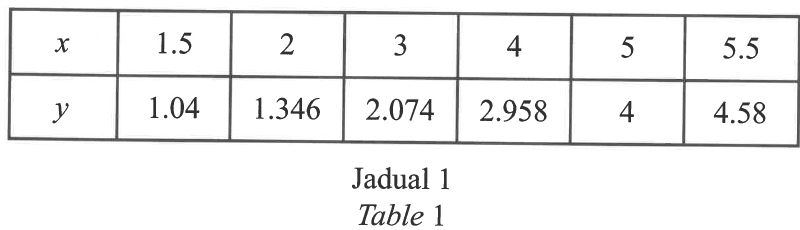
- (a)
Plot the graph of √y against x by using a scale of 2 cm to 1 unit on the x-axis and 2 cm to 0.2 units on the √y-axis. Hence, draw the line of best fit. (Graph paper provided; Table 1: x = 1.5, 2, 3, 4, 5, 5.5; y = 1.04, 1.346, 2.074, 2.958, 4, 4.58)
[4]
- (b)(i)
Using the graph, find the value of p and of q.
[5] - (b)(ii)
Using the graph, find the value of y when x = 3.7.
[1]
Solution by scale drawing is not accepted. Diagram 5 shows a kite KLMN. Given that the coordinates of K, L, M and N are (−1, 3), (−2, −4), (5, −5) and (p, 5) respectively. (a) Find the value of p. (b) Given that point T(2, q) lies on the straight line LN. Find the equation of the straight line LN and the value of q. (c) Calculate the area, in unit², of the kite KLMN. (d) A string is tied with the condition that the distance between the string and the point K and M is always in the ratio 3 : 1. Find the equation of the string.
Medium10 marks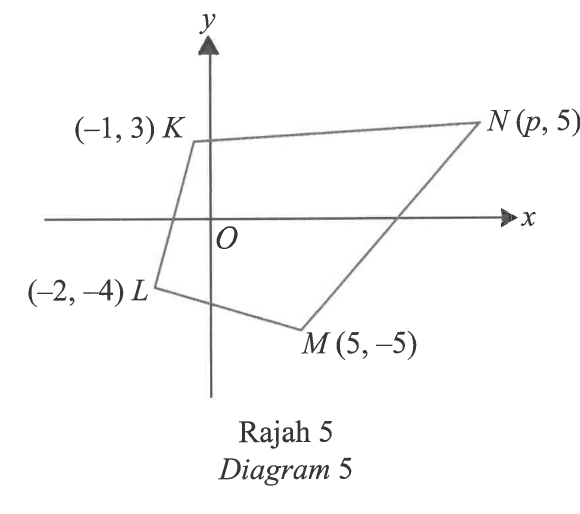
- (a)
Find the value of p.
[2] - (b)
Given that point T(2, q) lies on the straight line LN, find the equation of the straight line LN and the value of q.
[3] - (c)
Calculate the area, in unit², of the kite KLMN.
[2] - (d)
A string is tied with the condition that the distance between the string and the point K and M is always in the ratio 3 : 1. Find the equation of the string.
[3]
(a) Given that f(x) = 2x/(4 − √(x + 16)), (i) find f(0), (ii) complete the Table 2(i) and Table 2(ii) given in the answer space. Give your answers correct to four decimal places. (iii) from the answer in the Table 2(i) and Table 2(ii), state the value of lim(x→0) 2x/(4 − √(x + 16)). (b) Given that y = 2x(x + 3), express d²y/dx² + x dy/dx + y in terms of x. Hence, find the value of x such that d²y/dx² + x dy/dx + y = −2.
Medium10 marks- (a)(i)
Given f(x) = 2x/(4 − √(x + 16)), find f(0).
[1] - (a)(ii)
Complete Table 2(i) (x = −0.1, −0.01, −0.001, −0.0001, 0) and Table 2(ii) (x = 0.1, 0.01, 0.001, 0.0001, 0) with f(x), correct to four decimal places.
[2]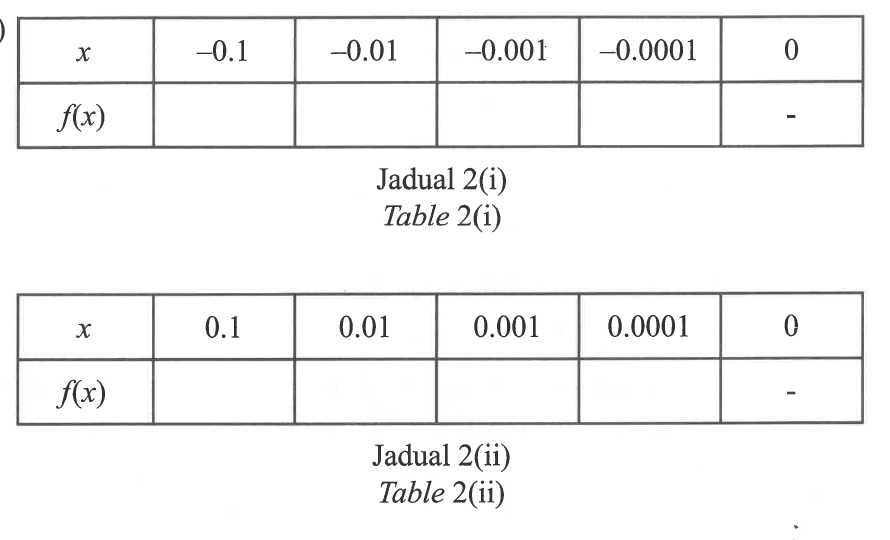
- (a)(iii)
From the tables, state the value of lim(x→0) 2x/(4 − √(x + 16)).
[1] - (b)
Given y = 2x(x + 3), express d²y/dx² + x dy/dx + y in terms of x. Hence, find the value of x such that d²y/dx² + x dy/dx + y = −2.
[6]
Section C
Solution by scale drawing is not accepted. Diagram 6 shows a triangle PQR where angle R is an obtuse angle. Given that PQ = 8.2 cm, QR = 3.6 cm and PR = 5.32 cm. (a) Without finding any of the angle P, Q or R, calculate the area, in cm², of the triangle PQR. (b) Find ∠QPR. (c) A triangle P′Q′R′ that is different shape and size to triangle PQR is formed with condition Q′R′ = QR, P′R′ = PR and ∠Q′P′R′ = ∠QPR. (i) Sketch the triangle P′Q′R′. (ii) Calculate ∠P′Q′R′. (iii) Find the shortest distance, in cm, from Q′ to the straight line P′R′.
Medium10 marks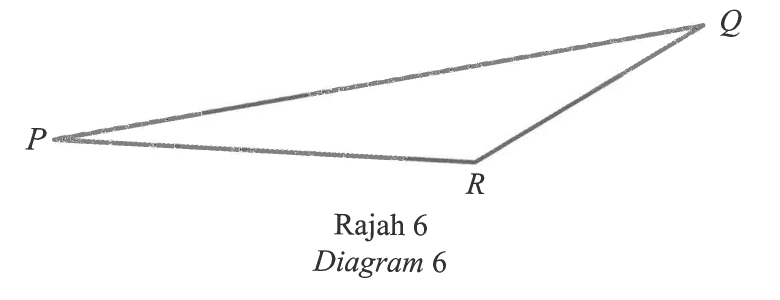
- (a)
Without finding any of the angles P, Q or R, calculate the area, in cm², of the triangle PQR.
[3] - (b)
Find ∠QPR.
[2] - (c)(i)
Sketch the triangle P′Q′R′.
[1] - (c)(ii)
Calculate ∠P′Q′R′.
[2] - (c)(iii)
Find the shortest distance, in cm, from Q′ to the straight line P′R′.
[2]
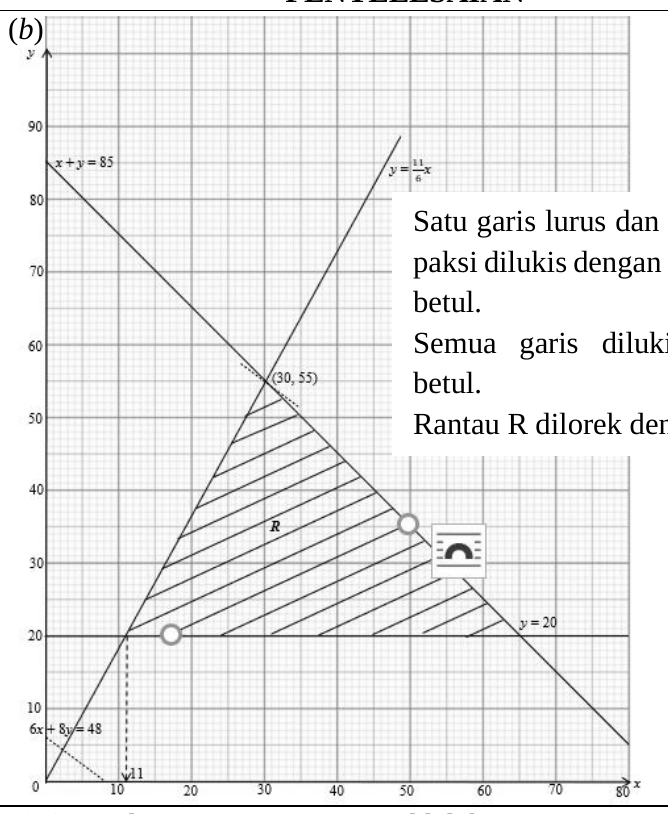
Use the graph paper provided on page 33 to answer this question. A theme park is having a special promotion during the holidays. A school organises a trip to the theme park for x boys and y girls. The number of students joining the trip is based on the following constraints: I The total number of students joining the trip is at most 85. II The number of girls is at least 20. III The number of girls is at most 11/6 times the number of boys. (a) Write three inequalities, other than x ≥ 0 and y ≥ 0, which satisfy all the above constraints. (b) Using a scale of 2 cm to 10 students on both axes, construct and shade the region R which satisfies all the above constraints. (c) By using the graph constructed in 13(b), find (i) the minimum number of boys, (ii) the maximum cost for the trip if the expenses of a boy is RM600 and the expenses of a girl is RM800.
Medium10 marks- (a)
Write three inequalities, other than x ≥ 0 and y ≥ 0, which satisfy all the above constraints.
[3] - (b)
Using a scale of 2 cm to 10 students on both axes, construct and shade the region R which satisfies all the above constraints. (Graph paper provided.)
[3]
- (c)(i)
Find the minimum number of boys.
[1] - (c)(ii)
Find the maximum cost for the trip if the expenses of a boy is RM600 and the expenses of a girl is RM800.
[3]
Diagram 7 shows a straight line AOB (A is 12 m to the left of O; B is 1 m before the right end). A particle moves along a straight line and passes through the fixed point O. Its velocity, v m s⁻¹, is given by v = 4 − 2t, where t is the time, in seconds, after leaving the point O. The particle stops instantaneously at a distance of 1 m on the right of point B. [Assume the motion to the right is positive.] Find (a) the acceleration, in m s⁻², of the particle, (b) the velocity, in m s⁻¹, of the particle when it passes through point B for the first time, (c) the time, in seconds, when the particle reaches point A, (d) the total distance, in m, travelled by the particle when it reaches point A.
Medium10 marks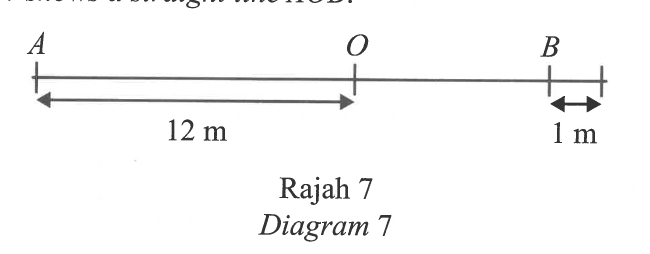
- (a)
Find the acceleration, in m s⁻², of the particle.
[1] - (b)
Find the velocity, in m s⁻¹, of the particle when it passes through point B for the first time.
[5] - (c)
Find the time, in seconds, when the particle reaches point A.
[2] - (d)
Find the total distance, in m, travelled by the particle when it reaches point A.
[2]
Table 3 shows the price indices and the percentage of usage of four components, A, B, C and D in the production of a scanner. [Component A: price index for 2021 based on 2019 = 128, usage 30%; B: h, 10%; C: 135, 40%; D: 133, 20%] (a) Calculate the price of component A in the year 2019 if its price in the year 2021 is RM32. (b) Given that the composite index for the production cost of a scanner in the year 2021 based on the year 2019 is 128.5, find the value of h. (c) From the year 2021 to the year 2025, the prediction to the prices of component B will be increased by 12%, the price of component C will be decreased by 10% where the prices of component A and D will remain unchanged. (i) Find the composite index for the production cost of a scanner in the year 2025 based on the year 2019. (ii) If the production cost of a scanner in the year 2019 is RM116, calculate the corresponding production cost of a scanner in the year 2025.
Medium10 marks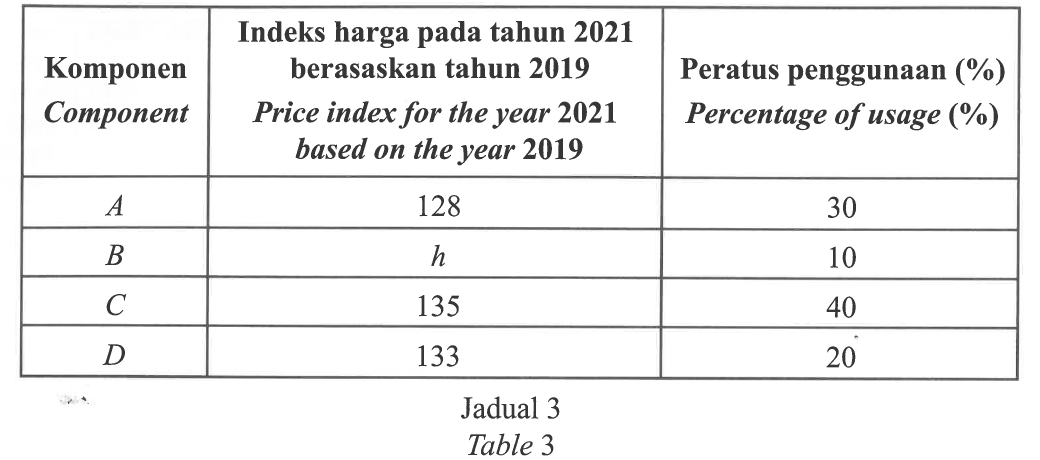
- (a)
Calculate the price of component A in the year 2019 if its price in the year 2021 is RM32.
[2] - (b)
Given that the composite index for the production cost in 2021 based on 2019 is 128.5, find the value of h.
[3] - (c)(i)
Find the composite index for the production cost of a scanner in the year 2025 based on the year 2019.
[3] - (c)(ii)
If the production cost of a scanner in the year 2019 is RM116, calculate the corresponding production cost in the year 2025.
[2]