Write your answer on paper. Then open the answer to check it.
Section A
Diagram 1 shows the graph y = 2x² + kx (a curve cutting the x-axis at x = −5 and at the origin). Based on the graph, a table of y/x against x is obtained: y/x = −6 when x = p, and y/x = q when x = −2. Calculate the values of k, p and q.
Easy5 marks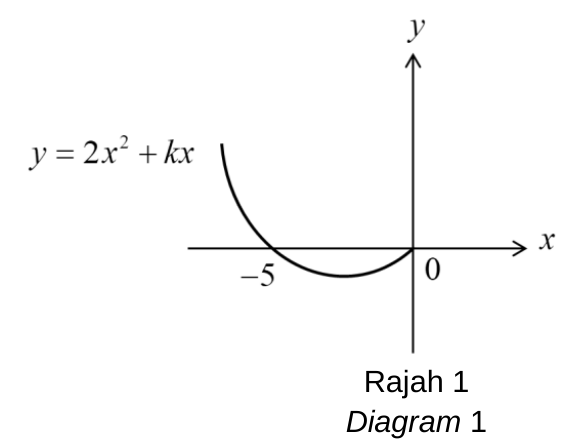
Calculate the values of k, p and q.
[5]
Diagram 2 shows the graph of the function m(x) = |5x − 4| for p ≤ x ≤ 2. The graph starts at the point (p, 19), touches the x-axis at x = q and ends at x = 2.
Easy5 marks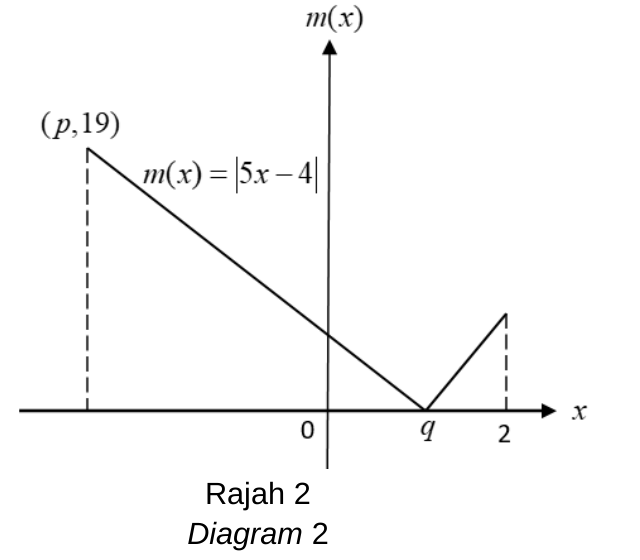
- (a)
Find the values of p and of q.
[3] - (b)
Hence, state the domain when the range is greater than 4.
[2]
(a) Given sec θ = 1/h where θ is an acute angle. Find sin²(θ/2). (b) Solve the equation 3 + 4 cos 2x = −sin x for 0° ≤ x ≤ 360°.
Medium6 marks- (a)
Given sec θ = 1/h where θ is an acute angle. Find sin²(θ/2).
[3] - (b)
Solve the equation 3 + 4 cos 2x = −sin x for 0° ≤ x ≤ 360°.
[3]
An arithmetic progression and a geometric progression have the same first term. Both have the same common difference and common ratio which is 1/2. The seventh term of the arithmetic progression is 13, while the eleventh term of the arithmetic progression is equal to the sum of the first n terms of the geometric progression.
Medium5 marks- (a)
Find the first term for both progressions.
[2] - (b)
Find the value of n.
[3]
(a) Show that 27^(y+1) + 3^(3y) can be written in the form a(bʸ), where a and b are constants. Hence, find the values of a and of b. (b) Solve the equation log_p (5 + x²) = log_√p (3 − x).
Medium5 marks- (a)
Show that 27^(y+1) + 3^(3y) can be written in the form a(bʸ), where a and b are constants. Hence, find the values of a and of b.
[2] - (b)
Solve the equation log_p (5 + x²) = log_√p (3 − x).
[3]
(a) Convert 0.168168168... to a fraction without using the progression method. (b) The solution of the equation √12 x − √5 x = √6 is (p√2 + √q)/7, where p and q are constants. Without using a calculator, find the values of integers p and q.
Medium5 marks- (a)
Convert 0.168168168... to a fraction without using the progression method.
[2] - (b)
The solution of √12 x − √5 x = √6 is (p√2 + √q)/7. Without using a calculator, find the values of integers p and q.
[3]
Mr. Salleh has a triangular piece of land. The two sides of the land have lengths (2x + 10) m and (5x − 20) m respectively. The angle between the two sides is 30°. Find the length of both sides of the land to the nearest integer, if the area of the land is 1700 m².
Easy5 marksFind the length of both sides of the land to the nearest integer.
[5]
Diagram 3 shows a flower vase where the interior side surface of the vase can be represented by the equation y = ax². The vase is 12 cm high, with a top diameter of 16 cm and a base diameter of 8 cm. Using the measurements given, find the volume, in cm³, of the flower vase. Show the answer in terms of π.
Medium5 marks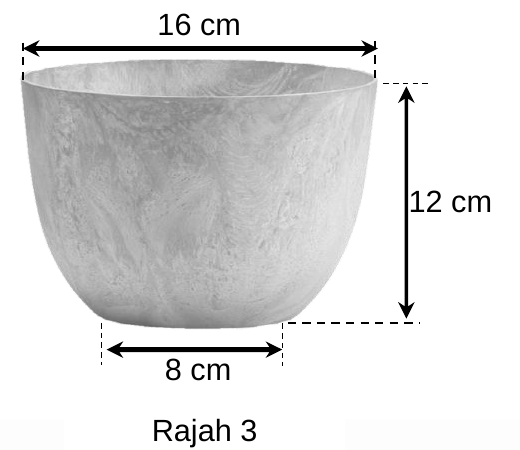
Find the volume, in cm³, of the flower vase. Show the answer in terms of π.
[5]
Diagram 4 shows vectors OQ→, OR→ and SO→ on a square grid with sides of 1 unit. Vector OQ→ goes 3 units left and 4 units up from O. (a) Find |−OQ→|. (b) Given that OQ→ = q and OR→ = r, express RQ→ in terms of q and r.
Easy4 marks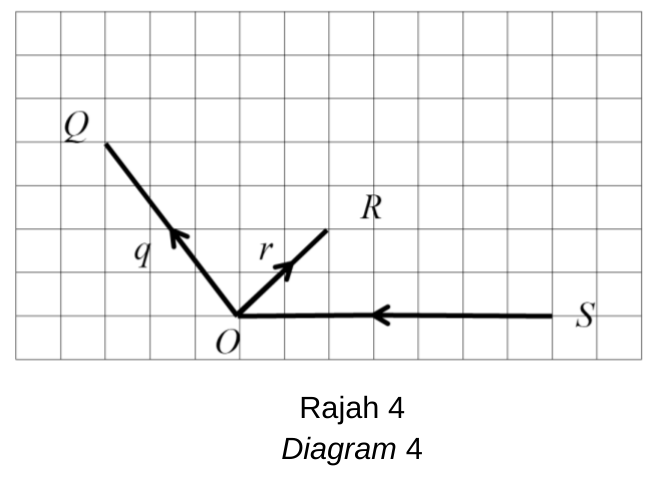
- (a)
Find |−OQ→|.
[2] - (b)
Given that OQ→ = q and OR→ = r, express RQ→ in terms of q and r.
[2]
(a) Find the number of even numbers that can be formed from all the numbers 2, 5, 7 and 9 with all the numbers other than 2 appearing exactly twice. (b)(i) Without using a calculator, find the value of ⁵C₃. (ii) Diagram 5 shows two parallel lines with 4 points (1, 2, 3, 4) and 6 points (P, Q, R, S, T, U) respectively. Find the number of different ways to form the triangles if these triangles are connected to the point number 3.
Medium7 marks- (a)
Find the number of even numbers that can be formed from all the numbers 2, 5, 7 and 9 with all the numbers other than 2 appearing exactly twice.
[3] - (b)(i)
Without using a calculator, find the value of ⁵C₃.
[2] - (b)(ii)
Find the number of different ways to form the triangles if these triangles are connected to the point number 3.
[2]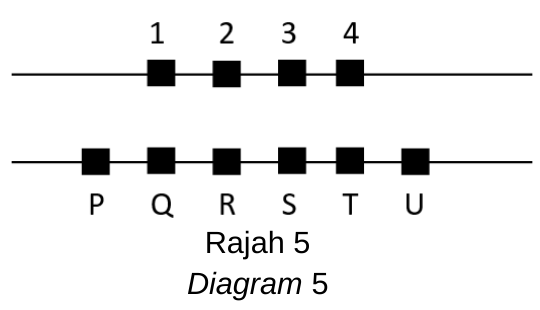
(a) Given two functions, y = f(u) and u = g(x). Using the idea of limits, prove that dy/dx = dy/du × du/dx. (b) Given y = 5t² + 2t and x = 1 − 2t. Find dy/dx in terms of x.
Medium6 marks- (a)
Using the idea of limits, prove that dy/dx = dy/du × du/dx.
[3] - (b)
Given y = 5t² + 2t and x = 1 − 2t. Find dy/dx in terms of x.
[3]
(a) Diagram 6 shows the graph of a binomial distribution X ~ B(4, p). The vertical axis is P(X = x). The bar heights are k at x = 0, 0.3025 at x = 1, 0.2432 at x = 2, 0.1875 at x = 3 and m at x = 4. Express (i) p in terms of m, (ii) P(X ≥ 1) in terms of k. (b) Diagram 7 shows the normal distribution graph for a random variable X ~ N(μ, 9); the axis of symmetry is at x = 15. State (i) the value of μ, (ii) the value of the standard deviation.
Easy6 marks- (a)(i)
Express p in terms of m.
[2]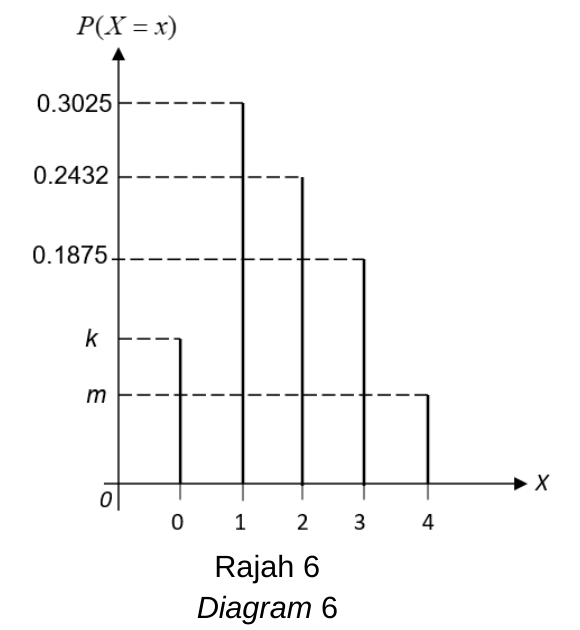
- (a)(ii)
Express P(X ≥ 1) in terms of k.
[2] - (b)(i)
State the value of μ.
[1]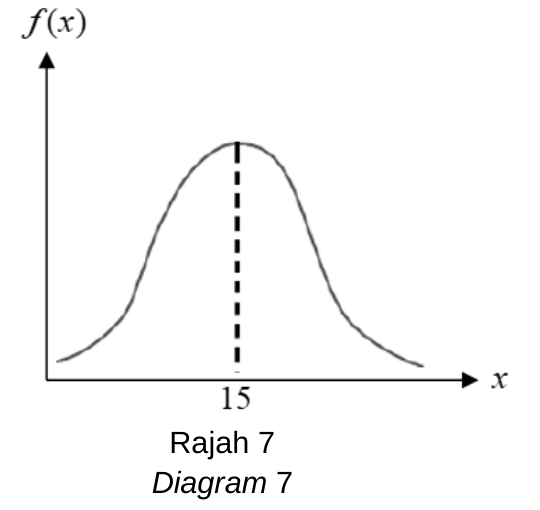
- (b)(ii)
State the value of the standard deviation.
[1]
Section B
(a) Find the range of values of x if y < 10 and 2x² − 3y + 4x = 0. (b) Given 2x² − 8x − 10 = a(x + b)² + c where a, b and c are constants. Find the values of a, b and c, hence find the minimum value of the expression 2x² − 8x − 10.
Medium8 marks- (a)
Find the range of values of x if y < 10 and 2x² − 3y + 4x = 0.
[4] - (b)
Find the values of a, b and c, hence find the minimum value of 2x² − 8x − 10.
[4]
Diagram 8 shows the quadrilateral ABCD. Point A lies on the y-axis. AB lies on the line y = 5, D = (−6, −1), and CD is perpendicular to BC. The equation of the straight line BC is y − 2x + 9 = 0.
Medium8 marks- (a)(i)
Find the equation of the straight line CD.
[2]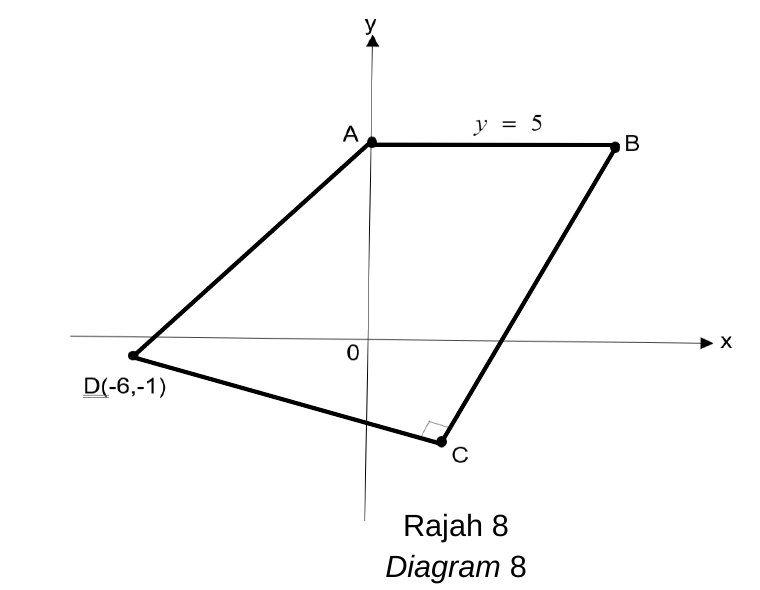
- (a)(ii)
Find the coordinates of point C.
[3] - (b)
Find the area of quadrilateral ABCD.
[3]
Diagram 9 shows a sector MJKL centred at M and two sectors PJM and QLM centred at P and Q respectively. Given that the major angle JML is 3.6 rad. In sectors PJM and QLM, PJ = PM = QL = QM = 5 cm and ∠JPM = ∠LQM = 1 rad. The shaded region is the sector MJKL less the two segments.
Medium8 marks- (a)
Find the radius of the sector MJKL.
[2]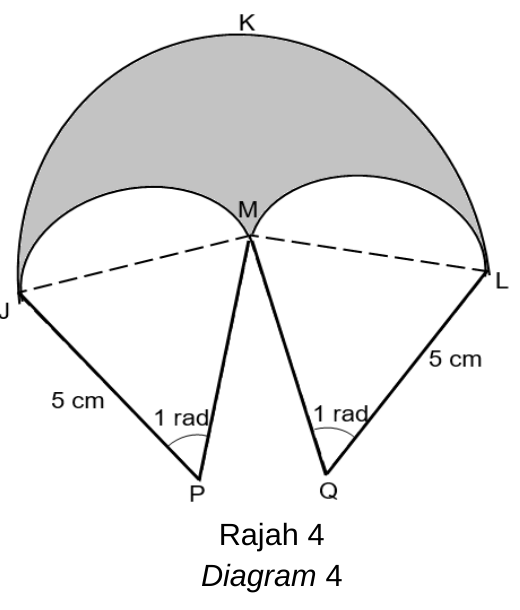
- (b)
Find the perimeter of the shaded region.
[2] - (c)
Find the area of the shaded region.
[4]