Write your answer on paper. Then open the answer to check it.
Section A
Find the value of a that makes the following system (x + 2y − 3z = 4; 3x − y + 5z = 2; 4x + y + (a² − 14)z = a + 2): (a) have no solution, (b) have an infinite solution.
Medium6 marks- (a)
Find the value of a for which the system has no solution.
[4] - (b)
Find the value of a for which the system has an infinite solution.
[2]
Given that f(x) = px + q and f³(x) = 8x + 14. (a) Find the values of p and of q. (b) Find f⁻¹(−6). (c) Express f⁴(x) and determine the general formula for fⁿ(x), where n is a positive integer.
Medium8 marks- (a)
Find the values of p and of q.
[3] - (b)
Find f⁻¹(−6).
[2] - (c)
Express f⁴(x) and determine the general formula for fⁿ(x), where n is a positive integer.
[3]
Diagram 1 shows a piece of cake cut uniformly by Farah from a cake with a diameter of 30 cm forming a sector of a circle. The arc length of the cake cut is 10.47 cm and the thickness of the cake is 8 cm. Find (a) the number of pieces of cake that Farah obtained from a cake, (b) the total surface area of the piece of cake.
Medium7 marks
- (a)
Find the number of pieces of cake that Farah obtained from a cake.
[3] - (b)
Find the total surface area of the piece of cake.
[4]
Diagram 2 shows cans filled with sand in order of mass in an arithmetic progression and hung on a bar. The mass of the lightest sand is 0.8 kg and the mass of the heaviest sand is 1.18 kg. The difference in mass of adjacent cans of sand is 0.02 kg. (a) Find (i) the number of cans used, (ii) the total mass of sand used. (b) The same force is used to swing all the cans. The time taken for each can to stop also changes in an arithmetic progression: the lightest can stops fastest, in 3.5 minutes, and the heaviest can takes the longest, X minutes. If the ratio of the common difference of the mass of the cans to the common difference of the time taken to stop is 1 : 25, find the value of X.
Medium7 marks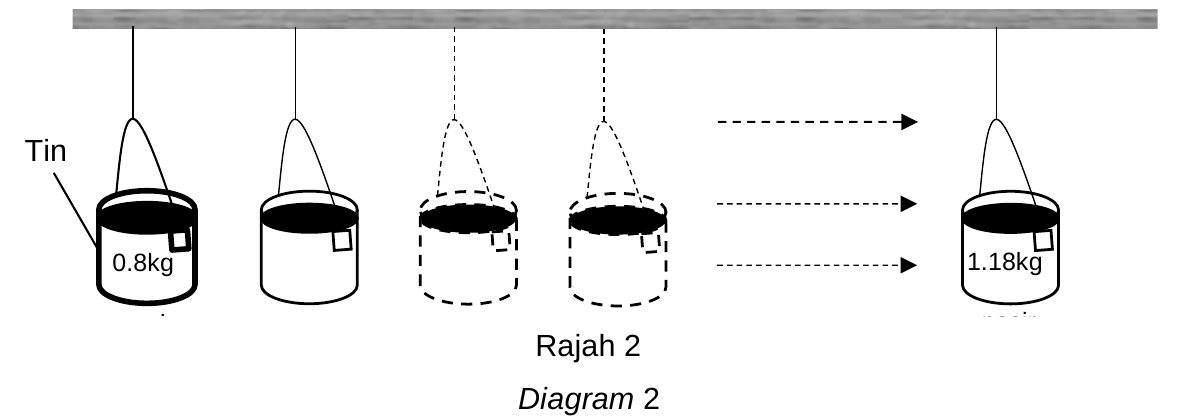
- (a)(i)
Find the number of cans used in this experiment.
[2] - (a)(ii)
Find the total mass of sand used.
[2] - (b)
Find the value of X.
[3]
Diagram 3 shows the graph of straight lines ACB and CDE in the Cartesian plane. Line ACB has equation y − 3x − 4 = 0, with B on the y-axis, A on the x-axis, D(0, 1) and E(2, −2). Point C is the midpoint of AB. (a) Given ED : EC = m : m + n, find the values of m : n. (b) A point P moves with the condition that its distance from point B is half of its distance from point E. Find the equation of the locus of P.
Medium6 marks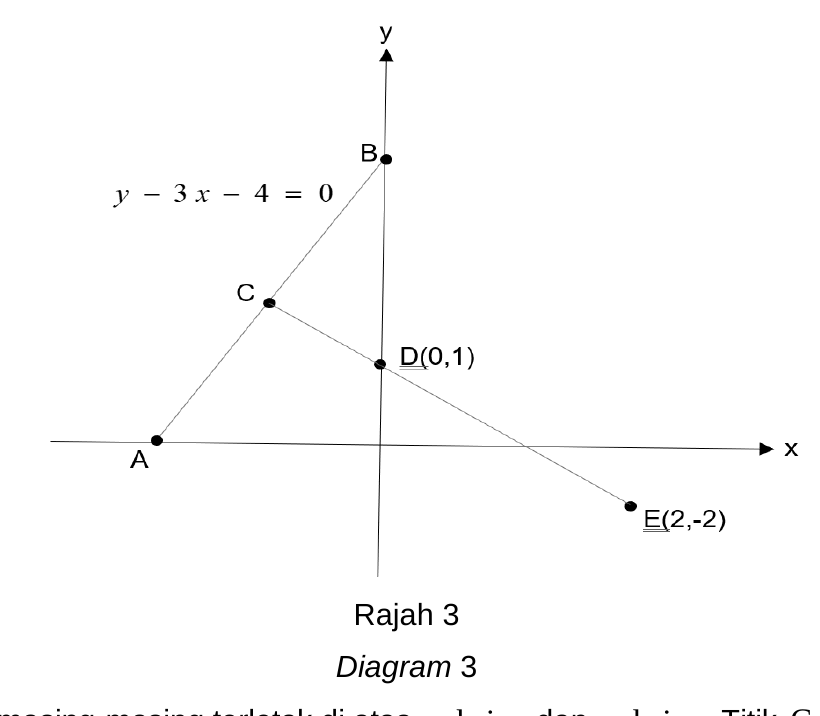
- (a)
Given ED : EC = m : m + n, find the values of m : n.
[3] - (b)
A point P moves with the condition that its distance from point B is half of its distance from point E. Find the equation of the locus of P.
[3]
Diagram 4 shows part of the graph of the function f(x) = 2x² − (n − 1)x + 7, where m and n are constants. The graph cuts the x-axis at x = m and x = n − 9. (a) Find the values of m and of n if m < 1. (b) Express f(x) in vertex form. Hence, state the equation of the axis of symmetry.
Medium8 marks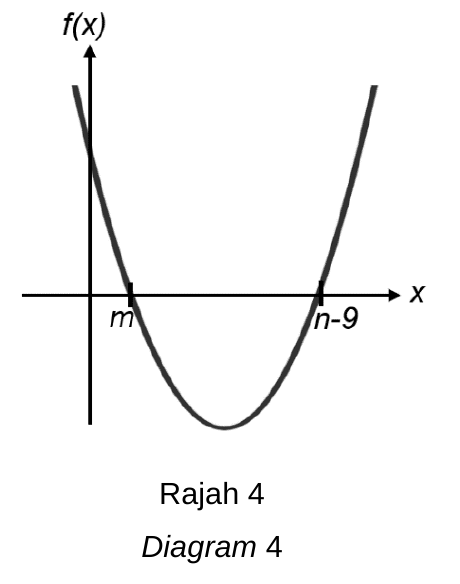
- (a)
Find the values of m and of n if m < 1.
[5] - (b)
Express f(x) in vertex form. Hence, state the equation of the axis of symmetry.
[3]
(a) Prove that (sin x − cos x)² = 1 − sin 2x. (b) Sketch the graph of the trigonometric function y = 1 − sin 2x for the domain 0 ≤ x ≤ 3π/2. (c) Hence, find (i) the maximum value of y in that domain, (ii) the number of solutions to the equation 1 − sin 2x = k + 1 for −1 < k − 1 < 0.
Medium8 marks- (a)
Prove that (sin x − cos x)² = 1 − sin 2x.
[2] - (b)
Sketch the graph of y = 1 − sin 2x for the domain 0 ≤ x ≤ 3π/2.
[3]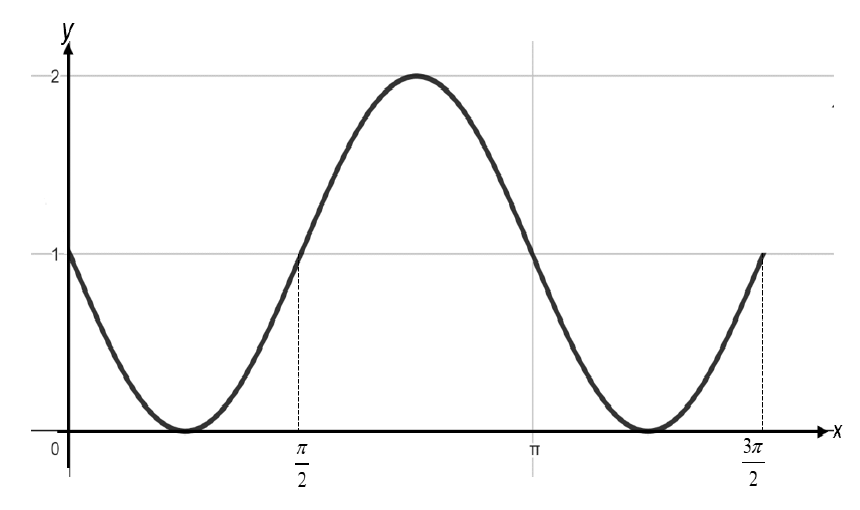
- (c)(i)
Find the maximum value of y in that domain.
[1] - (c)(ii)
Find the number of solutions to the equation 1 − sin 2x = k + 1 for −1 < k − 1 < 0.
[2]
Section B
In Diagram 5, OAB is a triangle. Given that OP→ = (2/3)OA→, AB→ = 2AQ→, OR→ = (4/5)OQ→, OA→ = 9h and OB→ = 4k (Q lies on AB and R lies on OQ). (a) Express, in terms of h and/or k, (i) PB→, (ii) OQ→. (b) Hence, prove that points P, R and B are collinear. (c) Given the area of triangle PAB is 12 cm², find the area of OAB.
Hard10 marks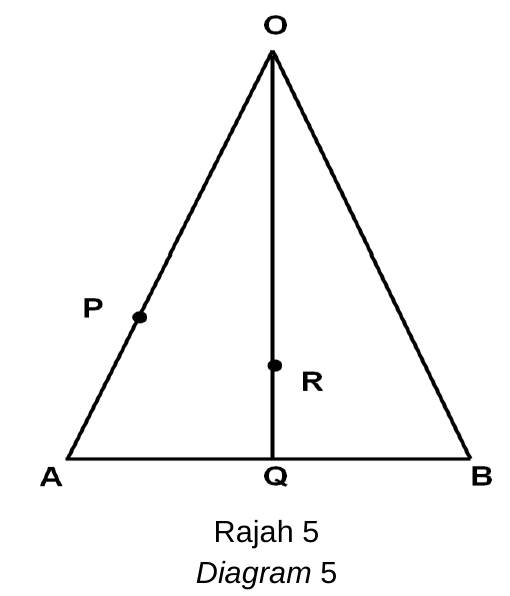
- (a)
Express, in terms of h and/or k, (i) PB→, (ii) OQ→.
[3] - (b)
Hence, prove that points P, R and B are collinear.
[4] - (c)
Given the area of triangle PAB is 12 cm², find the area of OAB.
[3]
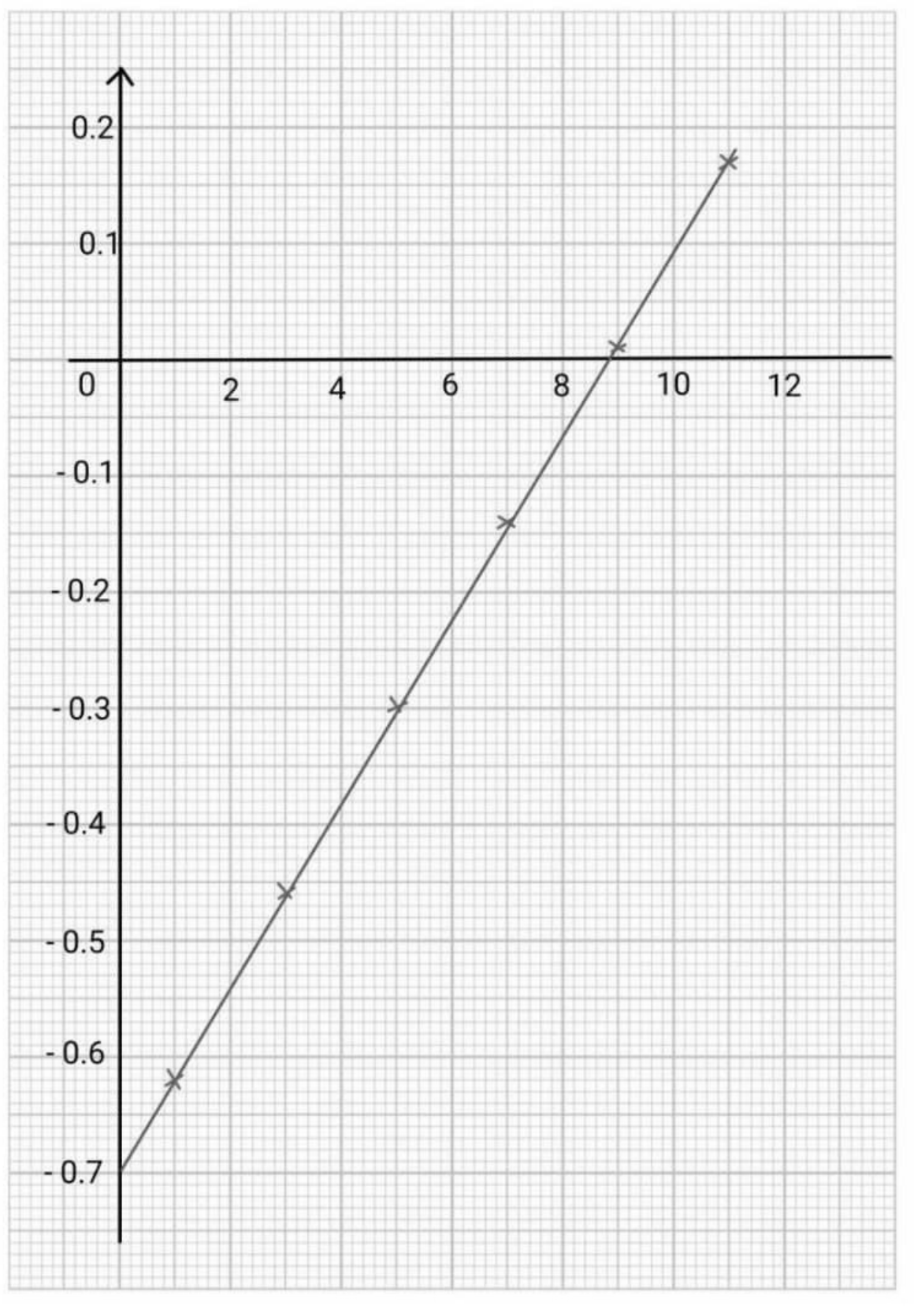
Use graph paper to answer this question. Table 1 shows the values of two variables, x and y, obtained from an experiment: x = 1, 2, 3, 4, 5, 6 and y = 0.24, 0.35, 0.5, 0.72, 1.03, 1.49. The variables x and y are related by the equation y = rs^(2x−1), where r and s are constants. (a) Based on Table 1, construct a table for the values of log₁₀ y and (2x − 1). (b) Plot log₁₀ y against (2x − 1) using a scale of 2 cm to 0.1 unit on the log₁₀ y-axis and 2 cm to 2 units on the (2x − 1)-axis. Hence, draw the line of best fit. (c) Use the graph in (b) to find the value of (i) r, (ii) s, (iii) log₁₀ y when x = 2.5.
Medium10 marks- (a)
Based on Table 1, construct a table for the values of log₁₀ y and (2x − 1).
[2] - (b)
Plot log₁₀ y against (2x − 1) using a scale of 2 cm to 0.1 unit on the log₁₀ y-axis and 2 cm to 2 units on the (2x − 1)-axis. Hence, draw the line of best fit.
[3]
- (c)
Use the graph in (b) to find the value of (i) r, (ii) s, (iii) log₁₀ y when x = 2.5.
[5]
(a) A survey on ex SMK Seri students shows that 70% of them furthered their study at local institutions. (i) If 10 ex-SMK Seri students are chosen at random, find the probability that not more than 2 students further their study at local institutions. (ii) It is found that 280 students furthered their study at local institutions. Find the total number of students involved in the survey. (b) The mass of students in a university is normally distributed with a mean of m kg and variance of 25 kg². Find (i) the value of m, if 8% of the students have mass more than 70 kg, (ii) the probability that a student chosen at random from the university has a mass less than 50 kg.
Medium10 marks- (a)(i)
If 10 ex-students are chosen at random, find the probability that not more than 2 further their study at local institutions.
[3] - (a)(ii)
280 students furthered their study at local institutions. Find the total number of students in the survey.
[2] - (b)(i)
Find the value of m, if 8% of the students have mass more than 70 kg.
[3] - (b)(ii)
Find the probability that a student chosen at random has a mass less than 50 kg.
[2]
(a) Diagram 7 shows that the arc OPQR is part of the graph x² + y² = 16, symmetrical about the x-axis. OPQR is a sector of a circle with centre O and ∠POR = 120°. Find the volume generated, in terms of π, when the sector OPQR is rotated through 180° about the x-axis. (b) Diagram 8 shows a curve f(x) = 2x² − 3x + 2 and a straight line AB which is normal to the curve at point A. The straight line AB is parallel to the straight line 5y = 10 − x. Find the equation of the tangent to the curve at point A.
Medium10 marks- (a)
Find the volume generated, in terms of π, when the sector OPQR is rotated through 180° about the x-axis.
[6]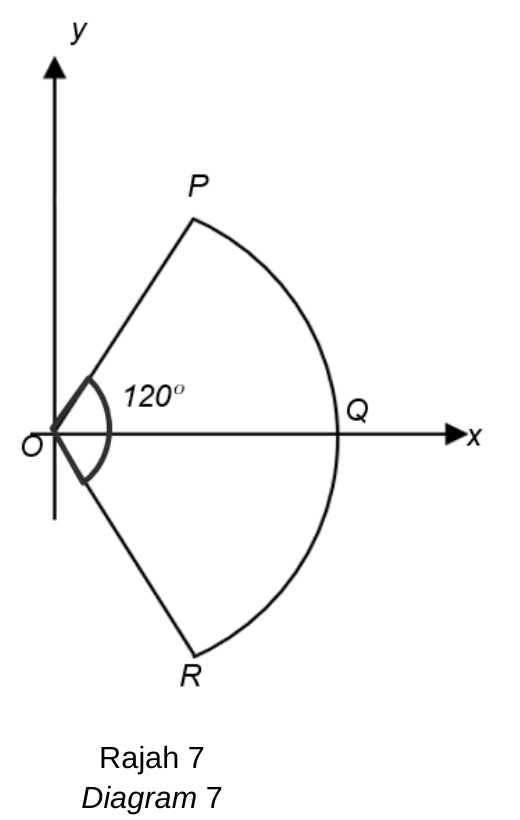
- (b)
Find the equation of the tangent to the curve at point A.
[4]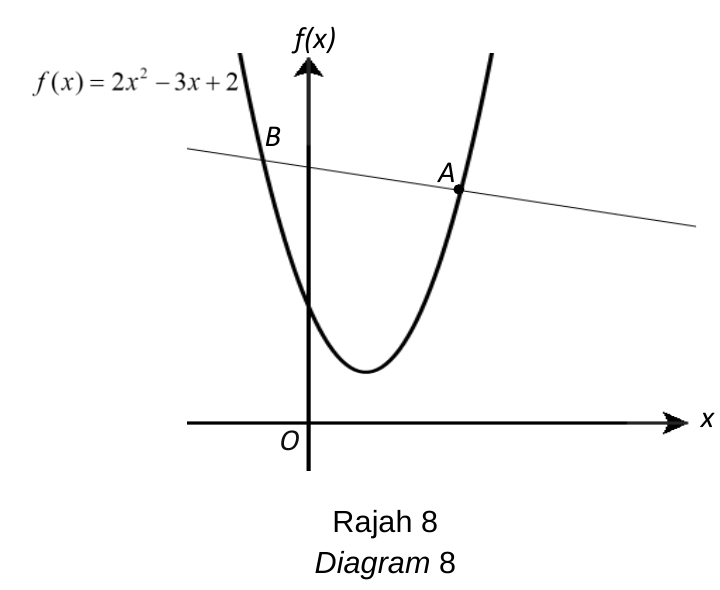
Section C
Diagram 9 shows a cuboid ABCDEFGH. Given EF = 14 cm, FG = 10 cm and CG = 8 cm. M is the midpoint of AD. Find (a) ∠FCM, (b) ∠CMF, (c) the area of triangle FCM, (d) the shortest distance from M to CF.
Medium10 marks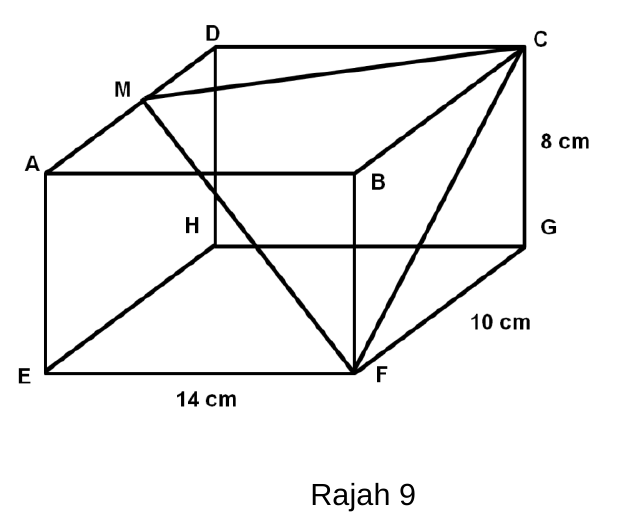
- (a)
Find ∠FCM.
[4] - (b)
Find ∠CMF.
[2] - (c)
Find the area of triangle FCM.
[2] - (d)
Find the shortest distance from M to CF.
[2]
Table 2 shows the price indices in the year 2023 based on the year 2022 (2022 = 100) for five types of materials used in making Biscoff Cake Chocolate: A 137, B 90, C h − 2, D 2h, E 125. (a) Find (i) the corresponding price of material A in the year 2022 if the price of material A in the year 2023 is RM20.00, (ii) the price of material E in the year 2022 and the year 2023 if the price of material E in the year 2023 is RM8.00 higher than its price in the year 2022. (b) The composite index for the prices of the materials in the year 2023 based on the year 2022 is 127. Find the value of h. (c) The composite index for the cost of making a Biscoff Cake Chocolate is expected to increase 43% from the year 2022 to the year 2024. Calculate the expected cost of making a Biscoff Cake Chocolate in the year 2024 if the corresponding cost in the year 2023 is RM85.00.
Medium10 marks- (a)
Find (i) the 2022 price of material A if its 2023 price is RM20.00, (ii) the 2022 and 2023 prices of material E if the 2023 price is RM8.00 higher than the 2022 price.
[4]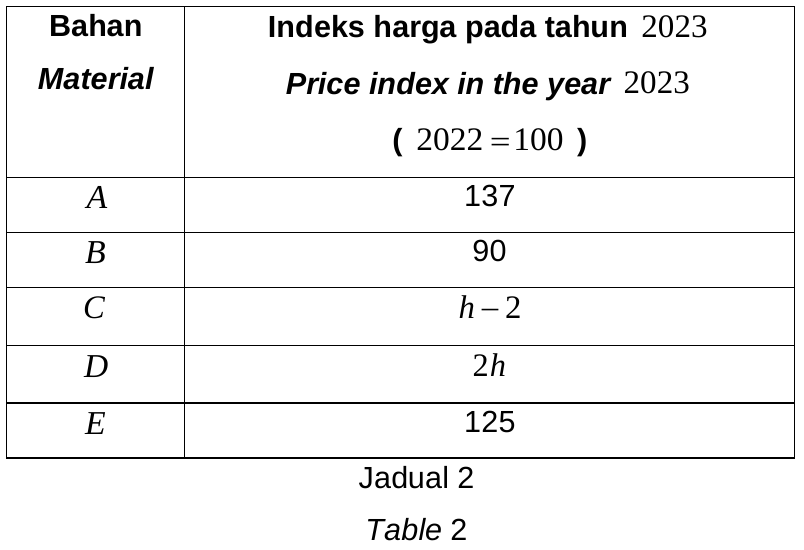
- (b)
The composite index for 2023 based on 2022 is 127. Find the value of h.
[2] - (c)
Calculate the expected cost of making a Biscoff Cake Chocolate in the year 2024 if the corresponding cost in the year 2023 is RM85.00.
[4]
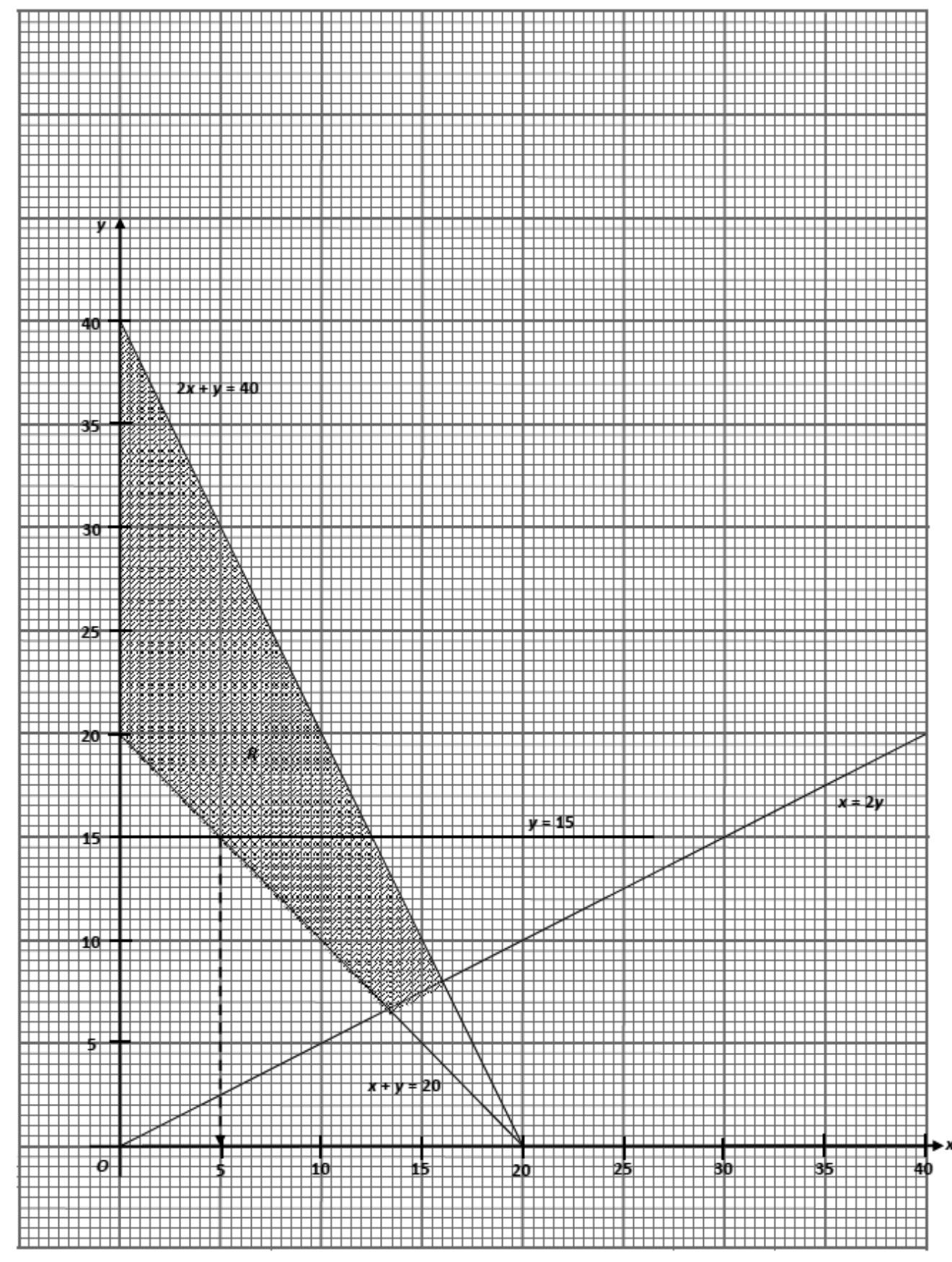
Amsyar allocates RM200 to buy x workbooks and y reference books. The total number of books purchased is not less than 20. The number of workbooks purchased is at most twice the number of reference books. The price of a workbook is RM10 and the price of a reference book is RM5. (a) Write three inequalities, other than x ≥ 0 and y ≥ 0, that satisfy all the above constraints. (b) Using a scale of 2 cm to 5 books on both axes, construct and shade the region R that satisfies all of the above constraints. (c) Amsyar bought 15 reference books. Using the graph constructed in (b), find the maximum money balance.
Medium10 marks- (a)
Write three inequalities, other than x ≥ 0 and y ≥ 0, that satisfy all the above constraints.
[3] - (b)
Using a scale of 2 cm to 5 books on both axes, construct and shade the region R that satisfies all of the above constraints.
[3]
- (c)
Amsyar bought 15 reference books. Using the graph in (b), find the maximum money balance.
[4]
A particle moves along a straight line and passes through a fixed point O. Its velocity v m s⁻¹ is given by v = 8 + 2t − t², where t is the time, in seconds, after passing through O. [Assume motion to the right as the positive direction.] Find (a) the initial velocity, in m s⁻¹, of the particle, (b) the value of t, in seconds, when the particle stops instantaneously, (c) the maximum velocity, in m s⁻¹, of the particle, (d) the total distance, in m, travelled by the particle in the first 6 seconds.
Medium10 marks- (a)
Find the initial velocity, in m s⁻¹, of the particle.
[1] - (b)
Find the value of t, in seconds, when the particle stops instantaneously.
[3] - (c)
Find the maximum velocity, in m s⁻¹, of the particle.
[3] - (d)
Find the total distance, in m, travelled by the particle in the first 6 seconds.
[3]