Write your answer on paper. Then open the answer to check it.
Section A
(a) Diagram 1 shows angle θ₁, angle θ₂ and straight line L₁ parallel to straight line L₂. By using the information, show that the gradients of both lines, m₁ and m₂, are the same. (b) Given four points P(−6, 1), Q(1, −2), R(0, 5) and S(−3, h). If PQ is perpendicular to RS, find the value of the constant h.
Easy5 marks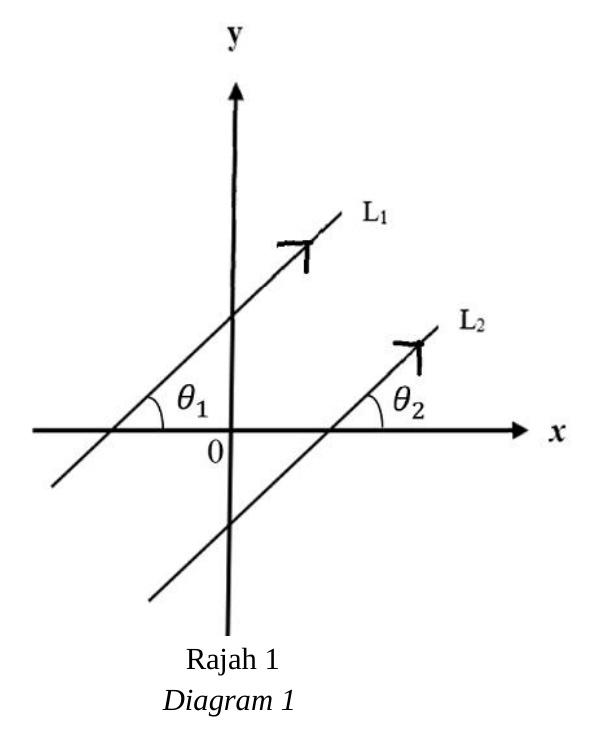
- (a)
Show that m₁ = m₂ using Diagram 1 (L₁ ∥ L₂, angles θ₁ and θ₂).
[2] - (b)
Find h if PQ ⊥ RS.
[3]
Diagram 2 shows a food company logo draft of a circle ABC centred at O. The radius of the circle is 6 cm and triangle ABC is an equilateral triangle. (a) Show that the area of sector OAB, L, is expressed as L = ½j²θ. (b) Hence, express the area of the yellow region in terms of π and √3.
Medium5 marks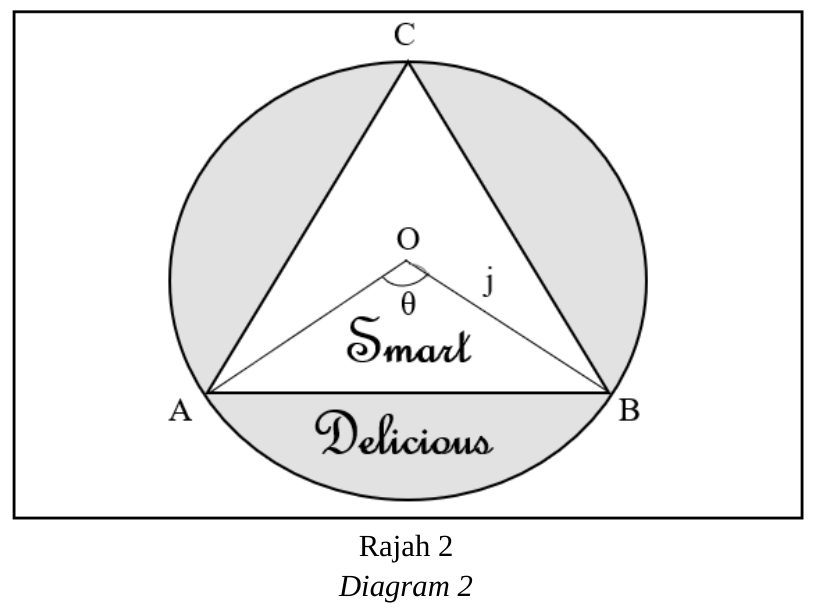
- (a)
Show that L = ½j²θ.
[2] - (b)
Express the area of the yellow region in terms of π and √3.
[3]
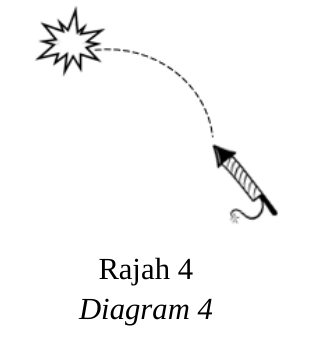
(a) Diagram 3 shows the graph of y = 2x² + 2x + 2 and the straight line OB. Find the range of values of the gradient, m, of the straight line OB. (b) The function T(x) = −5x² + 30x (Diagram 4) represents the height, in metres, of a firework x seconds after it was launched. The firework exploded at its highest point. By using the completing the square method, determine (i) when the firework exploded, (ii) the height at which the firework exploded.
Medium6 marks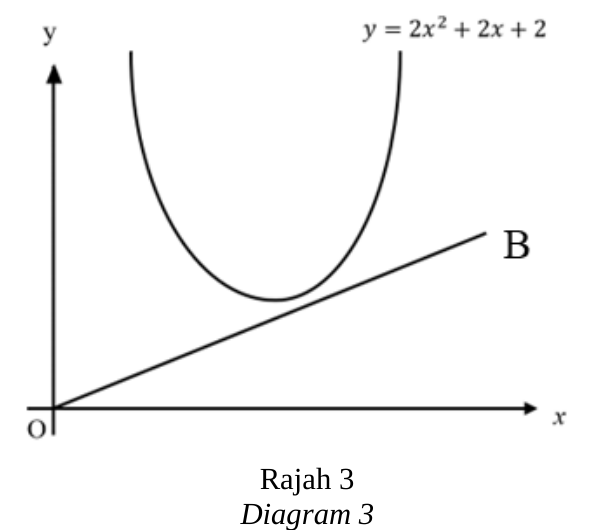
- (a)
Find the range of values of m for line OB (y = mx) that does not meet the curve.
[3] - (b)(i)
When did the firework explode? (completing the square)
[2] - (b)(ii)
What was the height at which the firework exploded?
[1]
(a) Explain the difference between infinite solutions and no solution for a system of linear equations with three variables. (b) Solve the following system of linear equations: x + y + z = 2, y − 3z = 1, 2x + y + 5z = 0.
Medium5 marks- (a)
Explain the difference between infinite solutions and no solution.
[1] - (b)
Solve x + y + z = 2, y − 3z = 1, 2x + y + 5z = 0.
[4]
(a) Solve the equation 16^(2x) (64) = 4^x. (b) Given that log₃ p + log₉ k = 3, form an equation in terms of p and k.
Easy5 marks- (a)
Solve 16^(2x)(64) = 4^x.
[2] - (b)
Form an equation in p and k from log₃ p + log₉ k = 3.
[3]
Diagram 5 shows a part of the curve y = −x³(x − 3) + 4. (a) Find the coordinates of the two stationary points, P and Q. (b) Hence, determine the nature of stationary point P by using the tangent sketching method.
Easy4 marks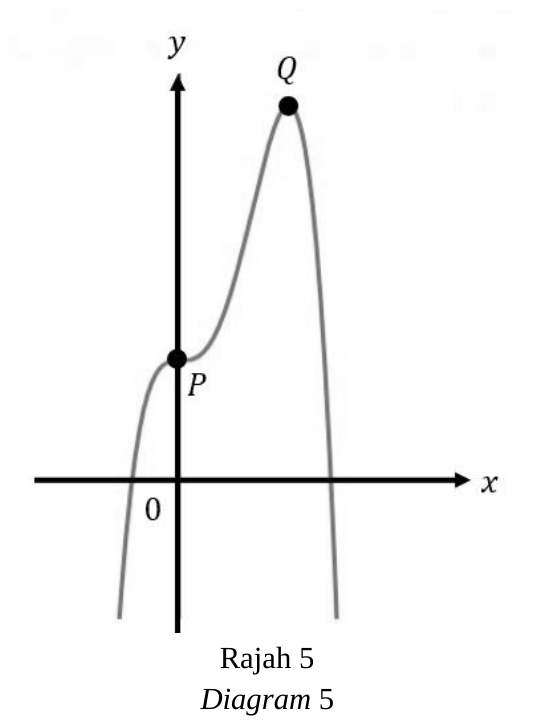
- (a)
Find the coordinates of the stationary points P and Q.
[2] - (b)
Determine the nature of P by the tangent sketching method.
[2]
(a) Given ∫ from −3 to 5 of f(x) dx = 7, find ∫ from −3 to 5 of [2f(x) − 3x] dx. (b) Diagram 6 shows the graph of a curve y = f(x) and a straight line y = g(x). Given ∫ from 0 to p of f(x) dx − ∫ from 0 to p of g(x) dx = 10, (i) on Diagram 6, shade the region represented by ∫₀ᵖ f(x) dx − ∫₀ᵖ g(x) dx, (ii) find ∫₀ᵖ f(x) dx in terms of p and q.
Medium6 marks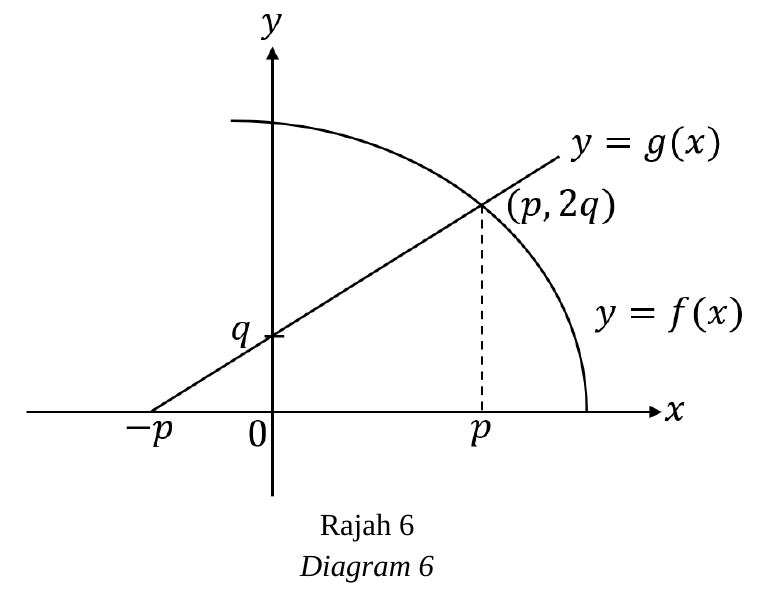
- (a)
Find ∫₋₃⁵ [2f(x) − 3x] dx given ∫₋₃⁵ f(x) dx = 7.
[3] - (b)(i)
Shade the region represented by ∫₀ᵖ f(x) dx − ∫₀ᵖ g(x) dx on Diagram 6.
[1]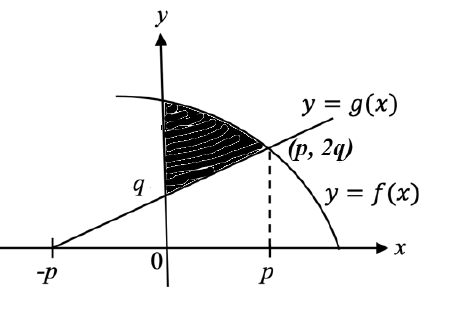
- (b)(ii)
Find ∫₀ᵖ f(x) dx in terms of p and q.
[2]
(a) Convert the non-linear equation y = p√x − q/x to the linear form Y = mX + c, where p and q are constants. Hence, state the Y-axis and X-axis of the linear equation. (b) The variables x and y satisfy the equation y⁴ = x e^A, where A is a constant. The graph of ln y against ln x is a straight line. (i) Find the gradient of the straight line. (ii) Given that the straight line intersects the ln y-axis at ln y = 0.5, find the value of A.
Medium6 marks- (a)
Convert to linear form; state the Y-axis and X-axis.
[2] - (b)(i)
Find the gradient of the straight line of ln y against ln x.
[2] - (b)(ii)
Find A given the ln y-intercept is 0.5.
[2]
Given PQ→ = 4i − 6j, PR→ = 2i + 4j and QR→ = −2i + 10j. T is on the line QR such that QT = 3TR. Find (a) the vector PT→ in terms of i and j, (b) the unit vector of PT→.
Medium5 marks- (a)
Find PT→ in terms of i and j.
[3] - (b)
Find the unit vector of PT→.
[2]
(a) Simplify (3 + 2√h)(14 + 2√h). (b) Diagram 7 shows a trapezium ABCD. The lengths of AD and BC are 6 + 4√h and 8 − 2√h respectively. The height of the trapezium is half of the length of AD and the area of trapezium ABCD is 27 + 17√h. Find the value of h.
Easy5 marks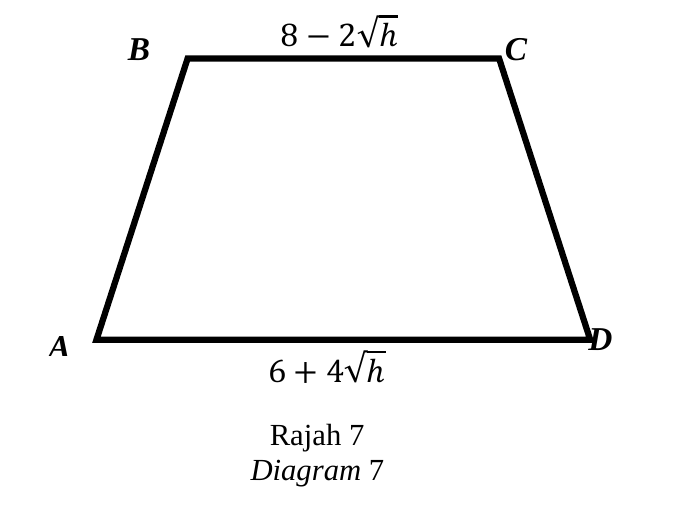
- (a)
Simplify (3 + 2√h)(14 + 2√h).
[2] - (b)
Find h from the area of the trapezium.
[3]
Diagram 8 shows the graph of the function f(x) = |m + 2x| for the domain 0 ≤ x ≤ 6. Find (a) the value of m and of n, (b) the range of the function, (c) the values of x if f(x) ≥ 2.
Medium6 marks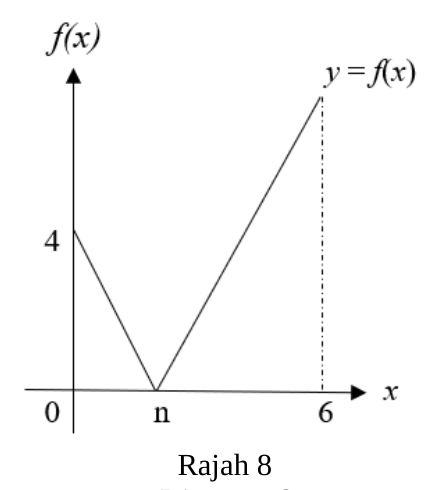
- (a)
Find m and n.
[3] - (b)
Find the range of the function.
[1] - (c)
Find the values of x if f(x) ≥ 2.
[2]
(a) Show that nC1 = n. (b) Find the number of ways for six students, Amin, Amutha, Budi, Ben, Chong and Danny, to sit at a round table if (i) Amin and Amutha must sit side by side, (ii) Amin and Amutha cannot sit side by side.
Medium6 marks- (a)
Show that nC1 = n.
[2] - (b)(i)
Number of ways if Amin and Amutha sit side by side.
[2] - (b)(ii)
Number of ways if Amin and Amutha cannot sit side by side.
[2]
Section B
(a) Sketch the graph of y = −3 cos 2x for 0 ≤ x ≤ 3π/2. (b) Hence, using the same axes, sketch a suitable graph to find the number of solutions for the equation π/x + 6 cos 2x = 0 for 0 ≤ x ≤ 3π/2. State the number of solutions. (c) Two solutions are obtained if y = 3p/2 is sketched on the same axes as in 13(b), where p is a constant. Find the values of p.
Medium8 marks- (a)
Sketch y = −3 cos 2x for 0 ≤ x ≤ 3π/2.
[3]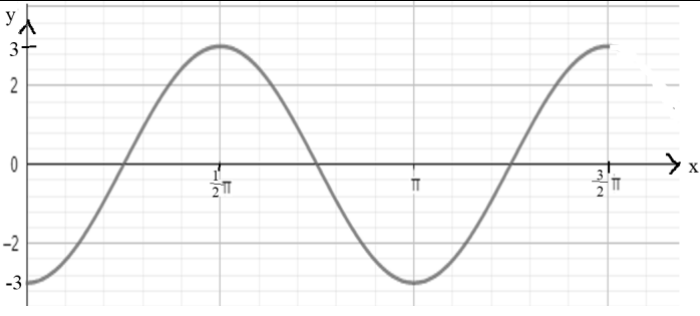
- (b)
Sketch a suitable graph on the same axes and state the number of solutions.
[3]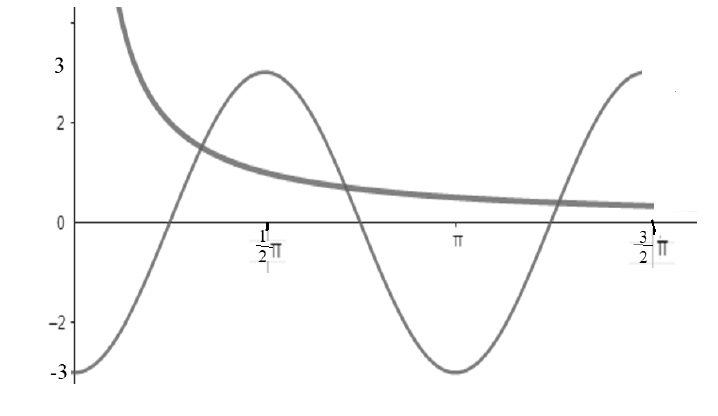
- (c)
Find the values of p for which y = 3p/2 gives two solutions.
[2]
(a) If a is the first term and r is the common ratio of a geometric progression, show that the sum to infinity of the progression is S∞ = a/(1 − r), |r| < 1. (b) Diagram 9 shows a pattern that repeats itself to infinity, consisting of squares and shaded triangles. The length of a side of the big square is 6 cm. Find (i) the base length of the 5th triangle, (ii) the area of the shaded region, in cm².
Medium8 marks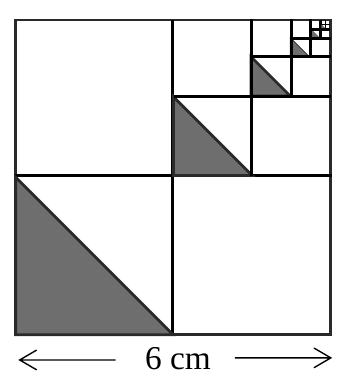
- (a)
Show that S∞ = a/(1 − r), |r| < 1.
[2] - (b)(i)
Base length of the 5th triangle.
[2] - (b)(ii)
Area of the shaded region in cm².
[4]
(a) Given that X is a discrete random variable such that X ~ B(6, p) and P(X = 6) = 1/64, find the value of p. (b) The probability distribution for a discrete random variable X = {0, 1, 2, 3, 4} is given by P(X = r) = m(2r + 1) for each r. (i) Find the value of m. (ii) Draw a graph for the probability distribution of X.
Medium8 marks- (a)
Find p given X ~ B(6, p) and P(X = 6) = 1/64.
[3] - (b)(i)
Find m.
[3] - (b)(ii)
Draw a graph of the probability distribution of X.
[2]