Write your answer on paper. Then open the answer to check it.
Section A
A fish moves in a circular manner with the equation of its locus given as 2x² + 11y² + 2x + 2y = 0. A boat moves along a straight line of equation x − 3y + 1 = 0 and intersects the circular motion of the fish. Find the points of intersection between the loci of the fish and of the boat.
Medium5 marksFind the points of intersection.
[5]
Diagram 1 shows a graph of y = 2x² + px + q (x-intercepts 2 and 5). (a) If α and β are the roots of the quadratic equation 2x² + px + q = 0, state (i) α + β, (ii) αβ. (b) Given the roots of 3x² + 2x = 6 are h and k, form a quadratic equation that has roots h/k and k/h. (c) Given the quadratic equation x² + (3h − 1)x = −2h − 10, where h is a constant, has two real and different roots, find the range of values of h.
Medium8 marks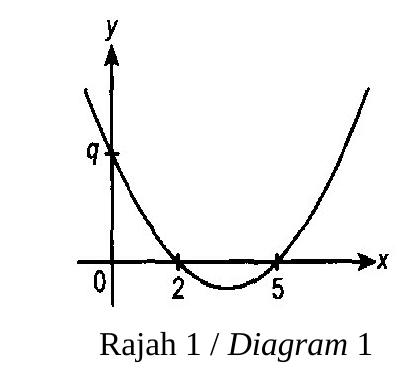
- (a)(i)
State α + β.
[1] - (a)(ii)
State αβ.
[1] - (b)
Form the quadratic equation with roots h/k and k/h.
[3] - (c)
Find the range of h for two real and different roots.
[3]
(a) Point R(x, y) moves such that its distance from point P and from point Q are always the same. Describe the locus of the moving point R. (b) Diagram 2 shows a right-angled triangle inscribed in a circle, with A(−5, 9), B(1, 1) and P(x, y) on the circumference. (i) Find the equation of the locus of the point P(x, y) that moves on the circumference of the circle. (ii) Find the y-intercept of the locus.
Medium8 marks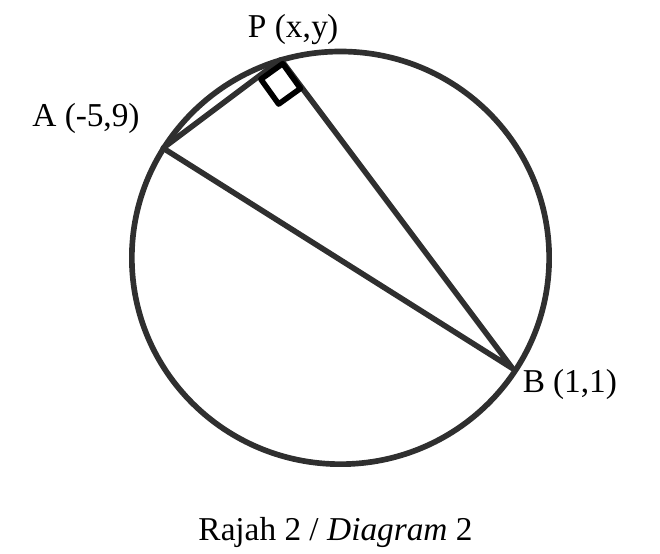
- (a)
Describe the locus of R.
[1] - (b)(i)
Find the equation of the locus of P.
[4] - (b)(ii)
Find the y-intercept of the locus.
[3]
(a) Given y = 2√x, (i) find dy/dx by using the first principle, (ii) hence, find the small change in y when x increases from 25 to 25.04. (b) The volume of a hemisphere is decreasing at a constant rate of 1.02 cm³ s⁻¹. Find the radius of the hemisphere at the instant when the radius is decreasing at a rate of 0.1 cm s⁻¹.
Medium8 marks- (a)(i)
Find dy/dx by first principles.
[3] - (a)(ii)
Find the small change in y when x increases from 25 to 25.04.
[2] - (b)
Find the radius of the hemisphere.
[3]
Diagram 3 shows a cyclic quadrilateral ABCD. O is the centre of the circle. Given that the radius of the circle is 6 cm and ∠ADC = 130°. [Use π = 3.142] Find (a) ∠AOC, in radians, (b) the arc length ABC, (c) the area of the shaded region.
Medium7 marks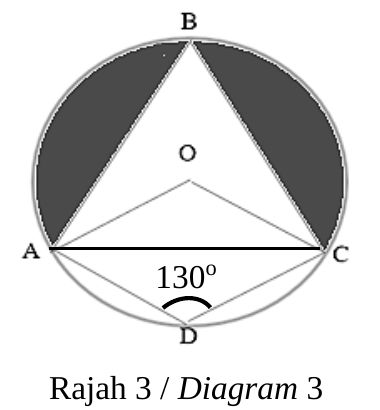
- (a)
Find ∠AOC in radians.
[1] - (b)
Find the arc length ABC.
[2] - (c)
Find the area of the shaded region.
[4]
(a) Prove that cos(A + B)/(sin A sin B) = cot A cot B − 1. (b) Solve the equation tan(45° + x) = 4 tan(45° − x) for 0° ≤ x ≤ 360°.
Medium7 marks- (a)
Prove cos(A + B)/(sin A sin B) = cot A cot B − 1.
[2] - (b)
Solve tan(45° + x) = 4 tan(45° − x) for 0° ≤ x ≤ 360°.
[5]
In an arithmetic progression, the sum of the first seven terms is 511 and the sum of the next 12 terms is −150. Find (a) the first term and the common difference of the arithmetic progression, (b) the value of n if Tₙ = −8.
Medium7 marks- (a)
Find the first term and the common difference.
[5] - (b)
Find n if Tₙ = −8.
[2]
Section B
Use graph paper to answer this question. Table 1 shows the values of two variables, x and y, obtained from an experiment: x = 0.34, 0.43, 0.55, 0.85, 1.08, 1.42; y = 47.68, 25.12, 12.58, 4.17, 2.51, 1.38. The variables x and y are related by the equation y = p/x^(1/q), where p and q are constants. (a) Based on the table, construct a table for the values of log₁₀ x and of log₁₀ y. (b) Plot log₁₀ y against log₁₀ x, using a scale of 2 cm to 0.1 unit on the x-axis and 2 cm to 0.2 unit on the y-axis. Hence, draw a straight line of best fit. (c) Using the graph in (b), find the value of (i) p, (ii) q.
Medium10 marks
- (a)
Construct the table of log₁₀ x and log₁₀ y.
[2] - (b)
Plot log₁₀ y against log₁₀ x and draw the line of best fit.
[3]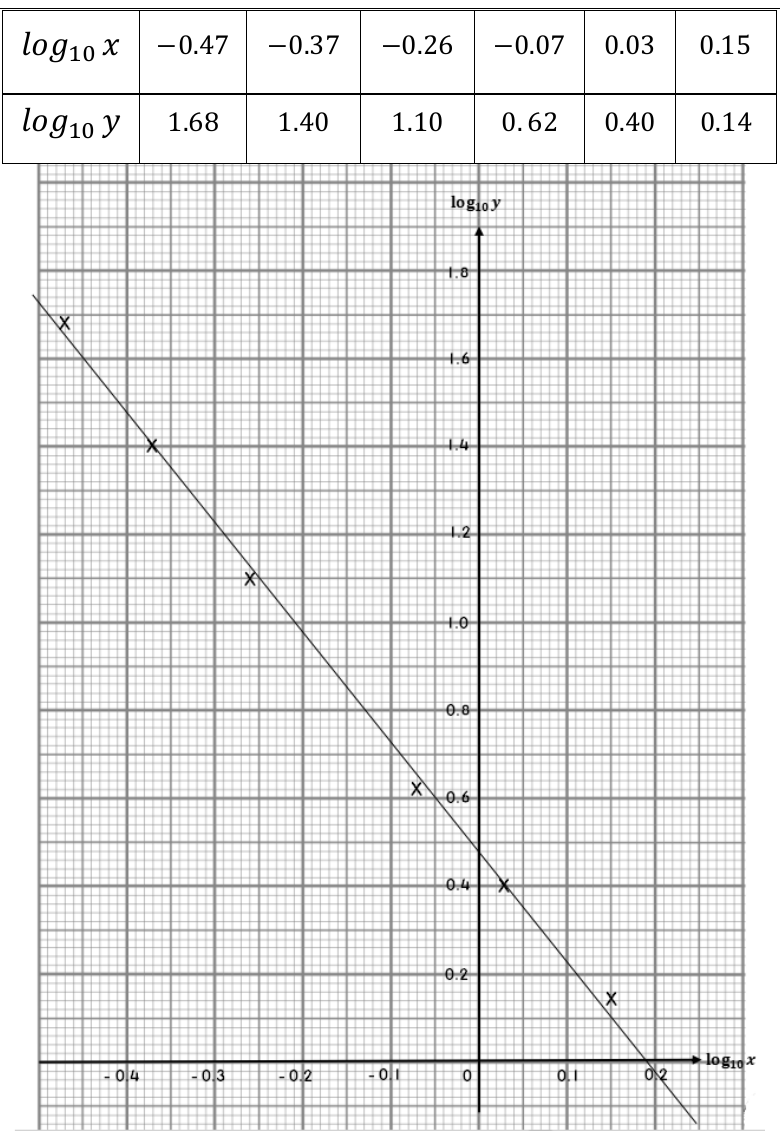
- (c)
Find p and q from the graph.
[5]
Diagram 4 shows triangle AOX and triangle AOY. Given OA→ = **a**, OY→ = **b**, and M is a point on AY such that AM = (2/5)AY. (a) Express in terms of **a** and/or **b**: (i) AY→, (ii) OM→. (b) AY and OX intersect at M. Given OX→ = k OM→ and AX→ = h OY→, express (i) OX→ in terms of k, **a** and/or **b**, (ii) AX→ in terms of h, **a** and/or **b**. Hence, find the value of h and of k. (c) State OM:MX.
Medium10 marks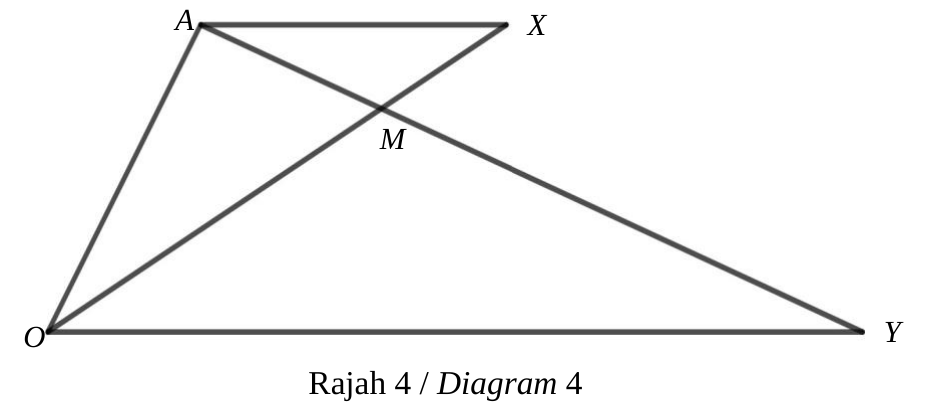
- (a)(i)
Express AY→ in terms of a and b.
[2] - (a)(ii)
Express OM→ in terms of a and b.
[1] - (b)(i)
Express OX→ in terms of k, a and b.
[1] - (b)(ii)
Express AX→ in terms of h, a and b.
[1] - (b) Hence
Find the value of h and of k.
[4] - (c)
State OM:MX.
[1]
Diagram 5 shows the curve y = x² + 3 and the tangent to the curve at the point A(1, 4). Find (a) the equation of the tangent at point A, (b) the area of the shaded region, (c) the volume generated, in terms of π, when the region bounded by the curve, the y-axis and the straight line y = 5 is rotated through 180° about the y-axis.
Medium10 marks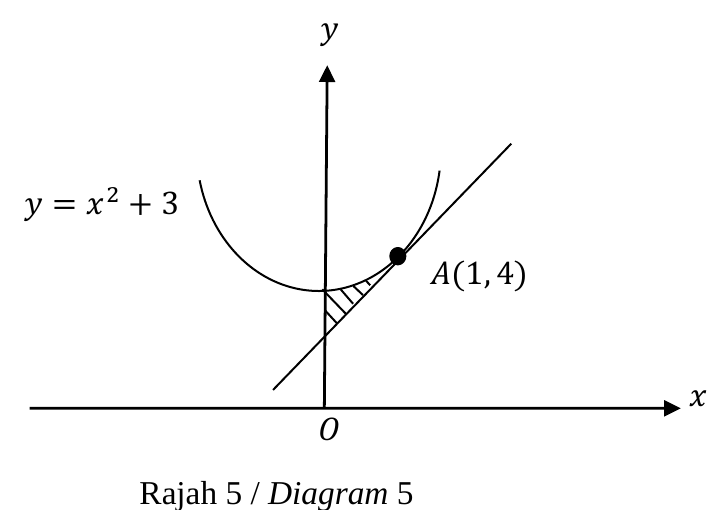
- (a)
Find the equation of the tangent at A.
[3] - (b)
Find the area of the shaded region.
[4] - (c)
Find the volume generated in terms of π.
[3]
(a) To determine whether a large stock of resistors from an electronic factory is accepted or rejected, a random sample of 30 resistors is tested. The stock is accepted if no defective resistor is found and rejected if 2 or more defective resistors are found. If only one defective resistor is found, a second random sample of 30 resistors is tested and the stock is accepted if the second sample contains no defective resistor. If the stock actually contains 1% defective resistors, find the percentage of stock that is rejected and the number of resistors accepted if 1000 resistors are produced by the factory. (b) The number of Form 5 students in SMK Johan is 200. The mass of the students is normally distributed with a mean of 50 kg and a variance of 25 kg². The school cooperative estimates sports shirt sizes S, M and L from the mass of students. (i) The cooperative ordered 20 S-size sports shirts. What is the maximum mass of the students who wear size S? (ii) L-size shirts are for students of 53.73 kg and above. Calculate the minimum number of L-size sports shirts the cooperative will order.
Medium10 marks- (a)
Find the percentage rejected and the number of resistors accepted out of 1000.
[4] - (b)(i)
Maximum mass of students who wear size S.
[3] - (b)(ii)
Minimum number of L-size shirts.
[3]
Section C
Diagram 6 shows a building in the shape of a pyramid with base QTS. Given QT = 60 m, TS = 80 m and QS = 100 m. The vertex P is 90 m vertically above T. A group of workers has to paint the inclined wall PQS. (a) Find the side length in m of (i) PS, (ii) PQ. (b) Calculate ∠PSQ. (c) By using Heron's formula, find the area of the painted inclined wall. (d) (i) Sketch a triangle P′Q′S′ which has a different shape from triangle PQS such that P′Q′ = PQ, P′S′ = PS and ∠P′S′Q′ = ∠PSQ. (ii) Find ∠P′Q′S′.
Hard10 marks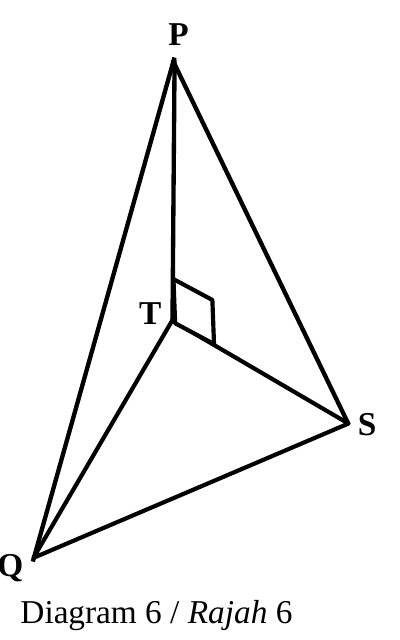
- (a)(i)
Find PS.
[1] - (a)(ii)
Find PQ.
[1] - (b)
Calculate ∠PSQ.
[2] - (c)
Find the area using Heron's formula.
[2] - (d)(i)
Sketch triangle P′Q′S′.
[1]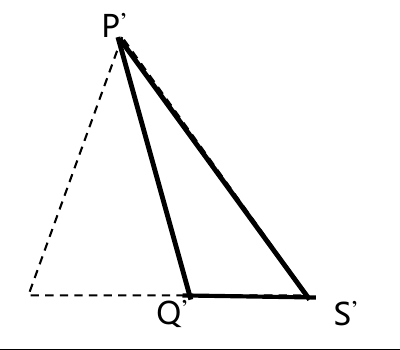
- (d)(ii)
Find ∠P′Q′S′.
[3]
A liquid is formed by mixing three raw materials K, L and M in the ratio 5:3:4. Diagram 7 shows the price indices of the materials for the year 2015 based on 2013 (K = 140, L = 110, M = 105). (a) (i) If the price of 1 litre of raw material K for 2015 is RM7.60, calculate the corresponding price for 2013. (ii) Calculate the composite index for the raw materials in 2015 using 2013 as the base year. (b) The composite index for the raw materials increases by 20% from 2015 to 2017. Calculate (i) the composite index for 2017 based on 2013, (ii) the cost of the raw materials to produce 1 container of liquid in 2017 if the corresponding cost in 2013 is RM600. (c) If the price index of material L for 2015 based on 2014 is 120, calculate the price index for 2014 based on 2013. State your interpretation of the index number obtained.
Medium10 marks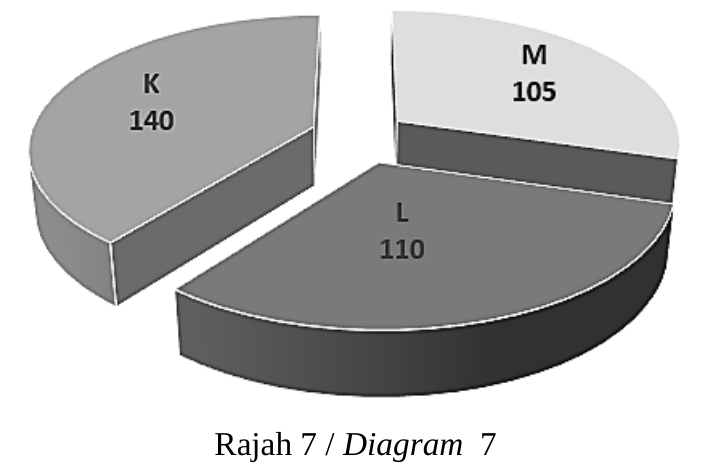
- (a)(i)
Price of 1 litre of K in 2013.
[1] - (a)(ii)
Composite index for 2015 based on 2013.
[2] - (b)(i)
Composite index for 2017 based on 2013.
[2] - (b)(ii)
Cost of raw materials in 2017.
[2] - (c)
Price index of L for 2014 based on 2013; interpretation.
[3]
A particle moves along a straight line and passes through a fixed point O with a velocity of −6 m s⁻¹. Its acceleration, a m s⁻², at t seconds after passing through O is given by a = 8 − 4t. [Assume the movement to the right is positive.] (a) Find the maximum velocity, in m s⁻¹, of the particle. (b) Find the time, in seconds, when the particle passes the fixed point O again. (c) Sketch the velocity-time graph for the movement of the particle for 0 ≤ t ≤ 3. (d) Hence, find the total distance, in m, travelled by the particle in the first 3 seconds.
Medium10 marks- (a)
Find the maximum velocity.
[3] - (b)
Find the time when the particle passes O again.
[3] - (c)
Sketch the velocity-time graph for 0 ≤ t ≤ 3.
[1]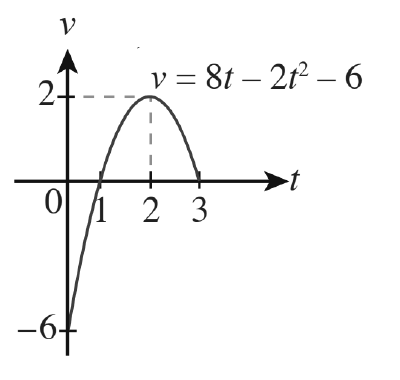
- (d)
Find the total distance in the first 3 seconds.
[3]
A company wants to send workers to attend two types of computer courses, A and B. The number of participants for course A is x and for course B is y. The fees for course A and course B are RM500 and RM400 respectively. The selection of participants is based on these constraints: I: the total number of participants is at least 50. II: the number of participants for course B is not more than three times the number of participants for course A. III: the maximum allocation for the courses is RM36 000. (a) Write three inequalities, other than x ≥ 0 and y ≥ 0, which satisfy all the above constraints. (b) Using a scale of 2 cm to 10 participants on both axes, construct and shade the region R which satisfies all of the above constraints. (c) Use your graph from 15(b) to answer: (i) Find the maximum number of participants of course A if the number of participants of course B is 55. (ii) Find the minimum allocation for the courses.
Hard10 marks- (a)
Write three inequalities for the constraints.
[3] - (b)
Construct and shade the region R.
[3]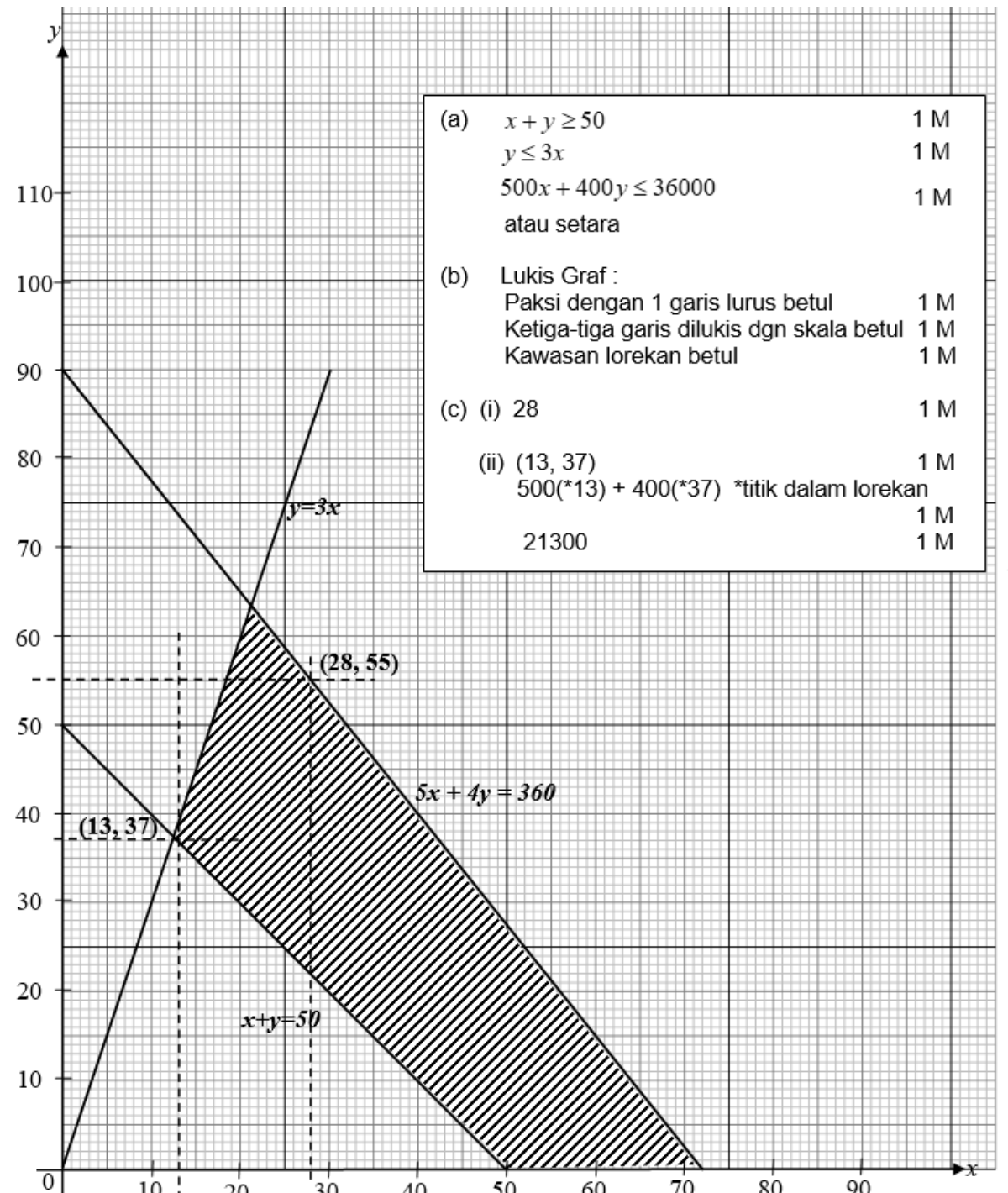
- (c)(i)
Maximum number of participants of course A when B = 55.
[1] - (c)(ii)
Minimum allocation for the courses.
[3]