Write your answer on paper. Then open the answer to check it.
Section A
(a) Given that 81ˣ = 243, find the value of 9²ˣ⁻¹. (b) (i) Prove that logₐ b = 1/(log_b a). (ii) Hence, simplify 3 log_b √a − 1/(logₐ b²).
Medium7 marks- (a)
Given that 81ˣ = 243, find the value of 9²ˣ⁻¹.
[2] - (b)(i)
Prove that logₐ b = 1/(log_b a).
[2] - (b)(ii)
Hence, simplify 3 log_b √a − 1/(logₐ b²).
[3]
(a) Given the functions f(x) = 3x + 2 and fg(x) = (2x + 5)/(x − 2), x ≠ 2, find gf(x). (b) Kedai Perabot Bahagia wants to give two types of offer to their customer which are 20% discount and RM100 rebate based on purchase RMx. Given the function f(x) represents the price after discount and the function g(x) represents the price after rebate. As the owner, you have to make a decision which give more profit to the store either the rebate RM100 is given before or after discount. Give justification of your decision by using composite function and state the chosen composite function.
Medium7 marks- (a)
Given f(x) = 3x + 2 and fg(x) = (2x + 5)/(x − 2), x ≠ 2, find gf(x).
[3] - (b)
Decide whether the RM100 rebate should be given before or after the 20% discount, using composite functions, and state the chosen composite function.
[4]
Hazim sells x banana cake, y orange cake and z chocolate cake. The cost of making a banana cake is RM4, an orange cake is RM6 and a chocolate cake is RM10. He produced 250 cakes in a certain month with a cost of RM1 550. The sales price for a banana cake is RM10, an orange cake is RM15 and a chocolate cake is RM20. Find the number of each cakes produced if the total sales for that month is RM3 450.
Medium7 marksFind the number of each cakes produced if the total sales for that month is RM3 450.
[7]
A rock is thrown upward from the top of a cliff facing the ocean. The path of the rock is represented by the function h(t) = −2t² + 8t + 25, where t is the time in seconds and h is the rock's height, in m, from the sea level. (a) (i) Express h(t) = −2t² + 8t + 25 as h(t) = a(t − p)² + q, where a, p and q are constants. (ii) Hence, determine the time, in seconds and the height, in m, when the rock reaches the maximum height. (b) Find time, in seconds, when the rock touches the sea level.
Medium6 marks- (a)(i)
Express h(t) = −2t² + 8t + 25 as h(t) = a(t − p)² + q, where a, p and q are constants.
[2] - (a)(ii)
Hence, determine the time, in seconds and the height, in m, when the rock reaches the maximum height.
[2] - (b)
Find time, in seconds, when the rock touches the sea level.
[2]
Diagram 1 shows a quadrilateral ABCD. The straight lines AC and BD intersect at point E. It is given that AB→ = **x**, BC→ = 4**y** and AB = (1/5)DC. (a) Express in terms of **x** and/or **y** (i) AC→, (ii) DB→. (b) It is given that CE→ = hCA→ and DE→ = kDB→, where h and k are constants. Express CE→ (i) in terms of h, **x** and **y**, (ii) in terms of k, **x** and **y**. Hence, find the value of h and of k.
Medium8 marks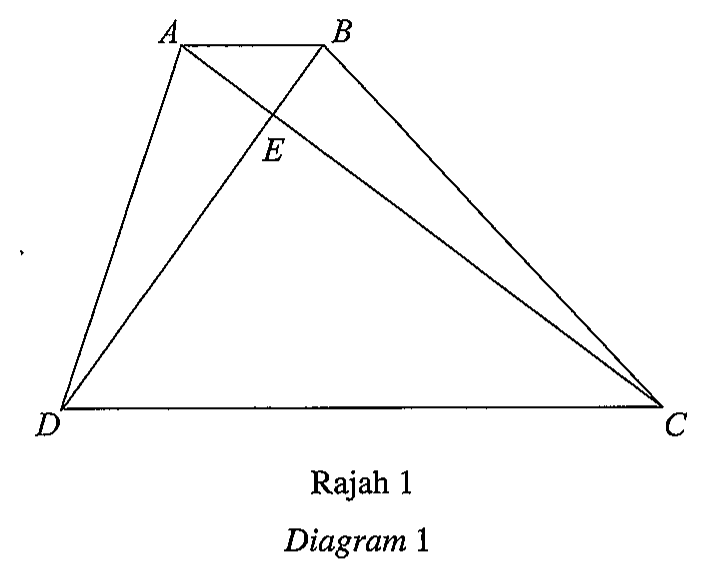
- (a)(i)
Express AC→ in terms of x and/or y.
[2] - (a)(ii)
Express DB→ in terms of x and/or y.
[1] - (b)(i)
Express CE→ in terms of h, x and y.
[1] - (b)(ii)
Express CE→ in terms of k, x and y. Hence, find the value of h and of k.
[4]
(a) (i) Prove that 2 sin(x + 90°) sin(x − 90°) + 1 = −cos 2x. (ii) Hence, solve the equation 2 sin(x + 90°) sin(x − 90°) + 1 = 1/2 for 0° ≤ x ≤ 360°. (b) Sketch the graph of y = |2 cos 2x| for 0 ≤ x ≤ (3/2)π.
Medium8 marks- (a)(i)
Prove that 2 sin(x + 90°) sin(x − 90°) + 1 = −cos 2x.
[2] - (a)(ii)
Hence, solve the equation 2 sin(x + 90°) sin(x − 90°) + 1 = 1/2 for 0° ≤ x ≤ 360°.
[3] - (b)
Sketch the graph of y = |2 cos 2x| for 0 ≤ x ≤ (3/2)π.
[3]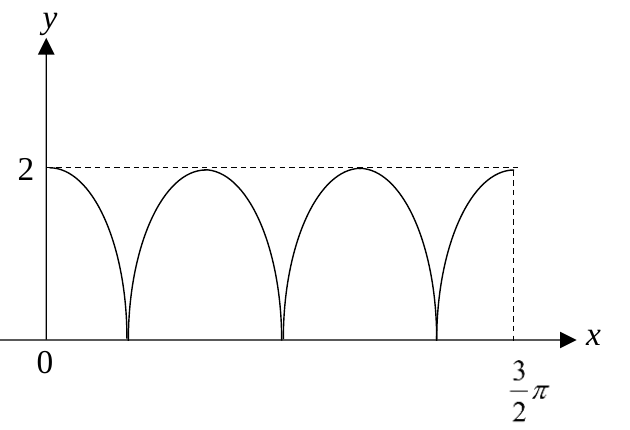
Diagram 2 shows a straight line AB intersects the curve y = g(x) at point B. A is the point (0, 1) on the y-axis and B is (2, 6). The gradient function of the curve is −2x. (a) Find the equation of the curve. (b) Calculate the volume generated, in terms of π, when the region bounded by the curve, the straight line AB and straight line y = 1 is revolved through 360° about the y-axis.
Medium7 marks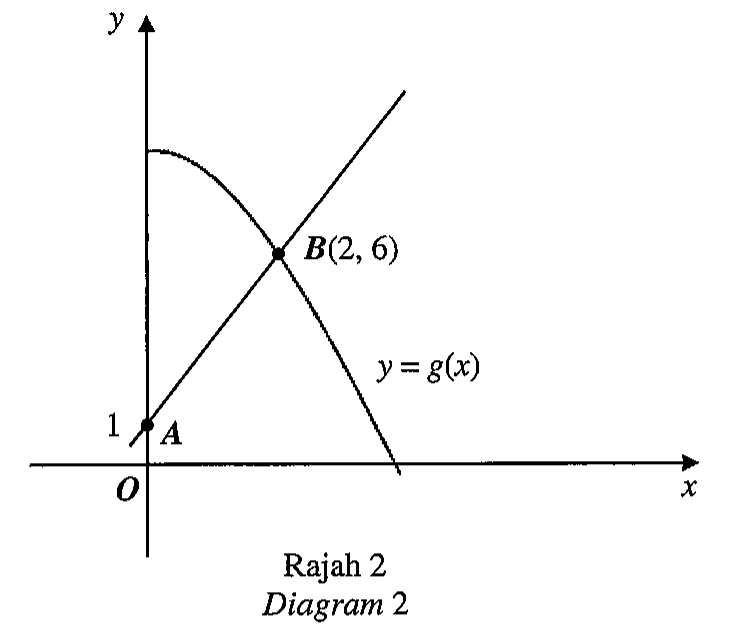
- (a)
Find the equation of the curve.
[3] - (b)
Calculate the volume generated, in terms of π, when the region bounded by the curve, the straight line AB and straight line y = 1 is revolved through 360° about the y-axis.
[4]
Section B
Nursery Rafflesia has 200 mango saplings. The height, in cm, of the saplings is normally distributed with a mean of 50 cm and a standard deviation of 40.5 cm. (a) State (i) the type of random variable for the normal distribution, (ii) the notation used to represent the normal distribution. (b) If one sapling is chosen at random from the nursery, find the number of saplings which have a height less than 50 cm or more than 80 cm. (c) Find the value of q if 15% of the saplings has a height between q cm and 80 cm.
Medium10 marks- (a)(i)
State the type of random variable for the normal distribution.
[1] - (a)(ii)
State the notation used to represent the normal distribution.
[1] - (b)
If one sapling is chosen at random from the nursery, find the number of saplings which have a height less than 50 cm or more than 80 cm.
[5] - (c)
Find the value of q if 15% of the saplings has a height between q cm and 80 cm.
[3]
Solution by scale drawing is not accepted. Diagram 3 shows quadrilateral OPQR with O the origin, R(10, 2), Q(v, w) and points A, B(1, 4) and C(7, 10) which are collinear. Given the equation of the straight line PQ is y = (2/3)x + 26/3. (a) If BC : AC = 3 : 4, find the coordinates of A. (b) It is given that the vertical distance of point P from x-axis is 6 units. Show that the straight line OP is perpendicular to the straight line PQ. (c) Given the area of quadrilateral OPQR is 114 m², find the value of v and of w.
Medium10 marks- (a)
If BC : AC = 3 : 4, find the coordinates of A.
[2]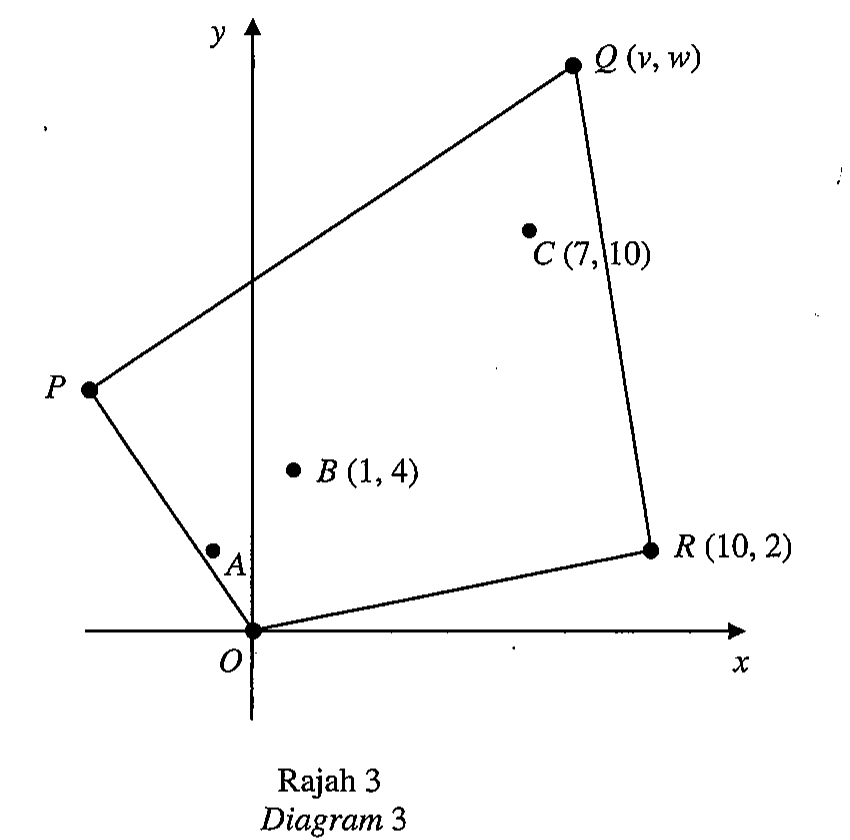
- (b)
Given that the vertical distance of point P from x-axis is 6 units, show that the straight line OP is perpendicular to the straight line PQ.
[3] - (c)
Given the area of quadrilateral OPQR is 114 m², find the value of v and of w.
[5]
Table 1 shows the values of two variables, x and y, obtained from an experiment. The variables x and y are related by the equation y = hx^(2k+1), where h and k are constants. x: 10, 17.78, 25.12, 63.1, 141.25, 398.11; y: 10, 13.80, 19.95, 39.81, 83.18, 158.49. (a) Based on Table 1, construct a table for the values of log₁₀ x and log₁₀ y. (b) Plot a graph of log₁₀ y against log₁₀ x using a scale of 2 cm to 0.5 units on the log₁₀ x-axis and 2 cm to 0.2 units on the log₁₀ y-axis. Hence, draw the line of best fit. (c) Based on the graph in 10(b), find the value of (i) h, (ii) k.
Medium10 marks- (a)
Based on Table 1, construct a table for the values of log₁₀ x and log₁₀ y.
[2]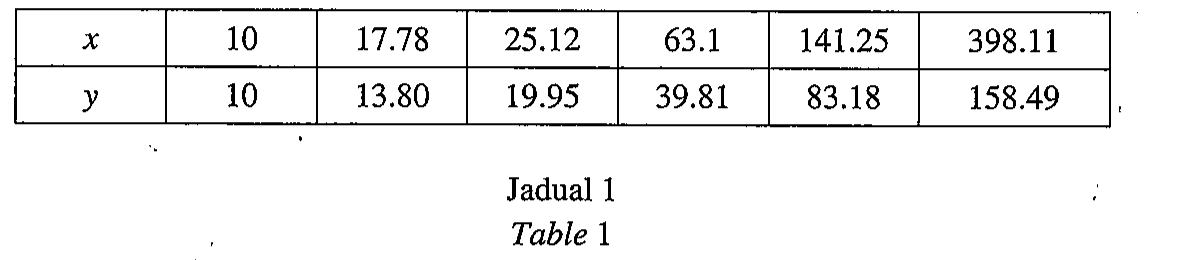
- (b)
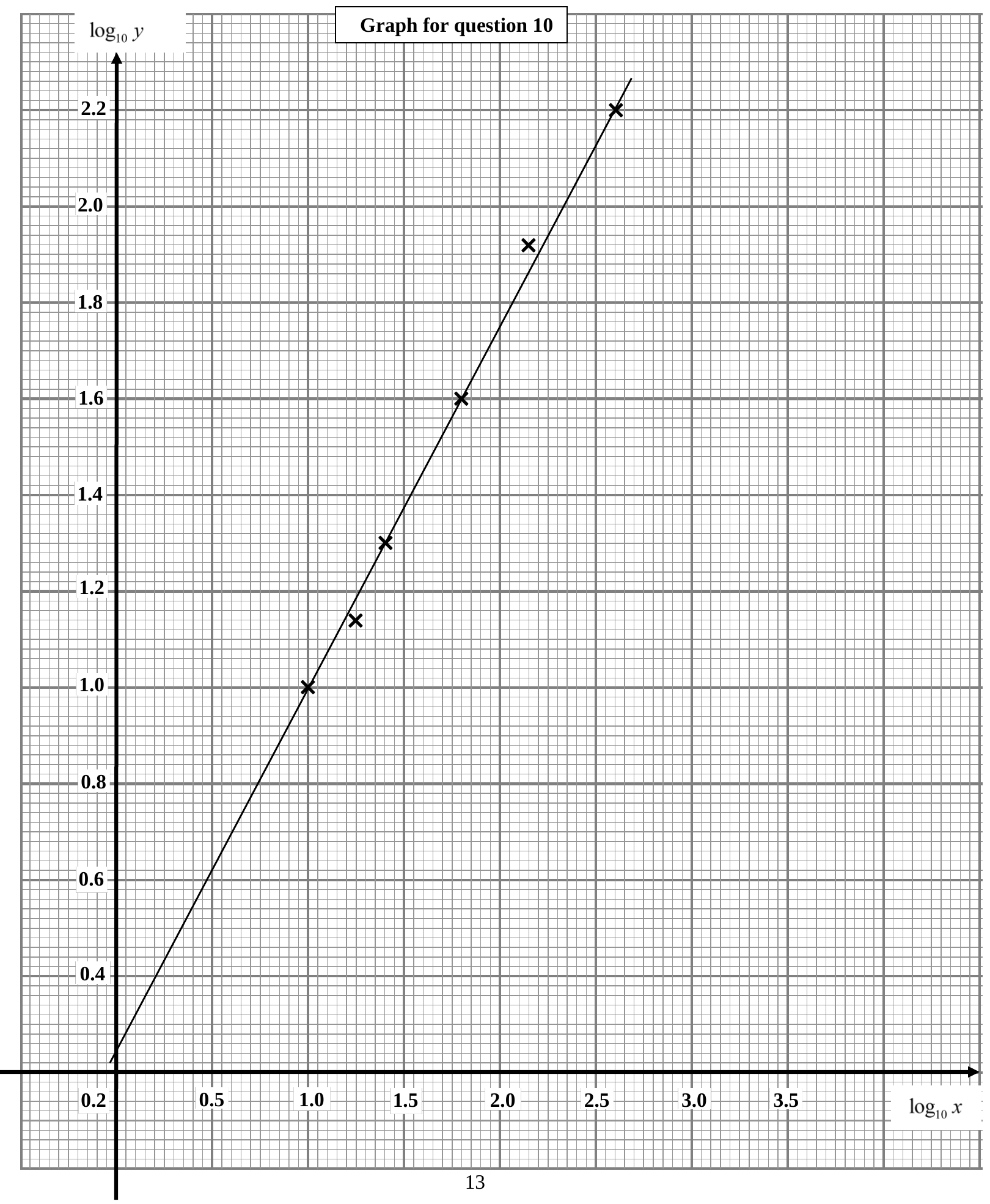
Plot a graph of log₁₀ y against log₁₀ x using a scale of 2 cm to 0.5 units on the log₁₀ x-axis and 2 cm to 0.2 units on the log₁₀ y-axis. Hence, draw the line of best fit.
[3]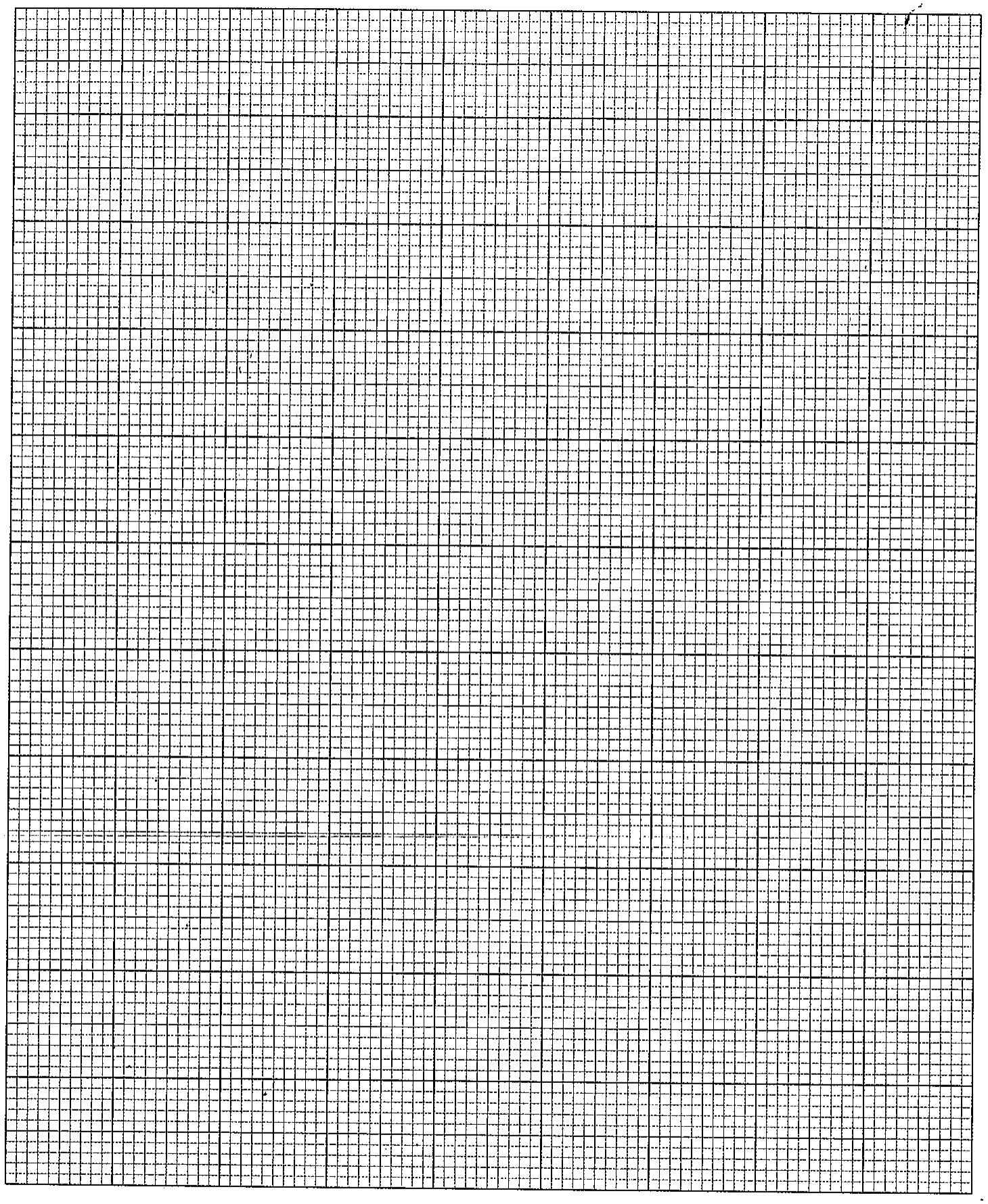
- (c)(i)
Based on the graph, find the value of h.
[3] - (c)(ii)
Based on the graph, find the value of k.
[2]
Diagram 4(a) shows a closed cuboid with a square base, x cm and the height, h cm. Diagram 4(b) shows a right pyramid with a square base, x cm and the height, h cm. [Volume of right pyramid = (1/3) × base area × height] It is given that total surface area of the cuboid is 96 cm². (a) (i) Show that the sum of volume of cuboid and right pyramid is V = 32x − (2/3)x³. (ii) Find the value of x when V is maximum. Hence, find the maximum value of V. (b) If there is a small change in V by 0.84 cm³, find the percentage change in x when x = 3.
Hard10 marks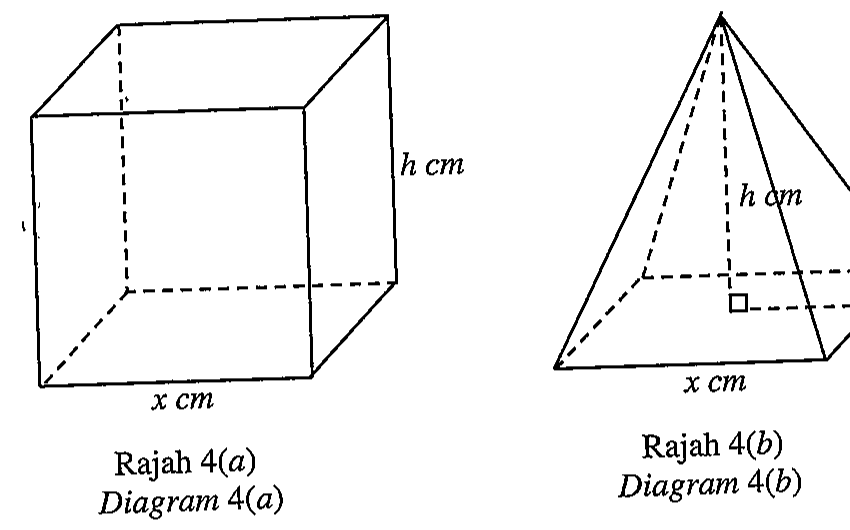
- (a)(i)
Show that the sum of volume of cuboid and right pyramid is V = 32x − (2/3)x³.
[3] - (a)(ii)
Find the value of x when V is maximum. Hence, find the maximum value of V.
[4] - (b)
If there is a small change in V by 0.84 cm³, find the percentage change in x when x = 3.
[3]
Section C
Table 2 shows the information related to the price, price index and the weightages of four materials used in making a type of shoe. Material A: price 2021 RM13.00, 2022 RMx, index 120, weightage 2. B: RM10, RM15, index 145, weightage p. C: RM8.50, RM11.90, index 140, weightage 2p. D: RM7.00, RM8.75, index y, weightage 3. (a) Find the value of x and of y. (b) Given the composite index for the cost of making the shoe in the year 2022 based on the year 2021 is 135. (i) Find the value of p. (ii) Given that the selling price of a pair of shoes in the year 2023 is RM162. The prices of all the materials increased by 25% from the year 2022 to the year 2023. If the company get a profit of 20% in the year 2021, find the cost price, in RM, of a pair of shoes in that year.
Medium10 marks- (a)
Find the value of x and of y.
[3]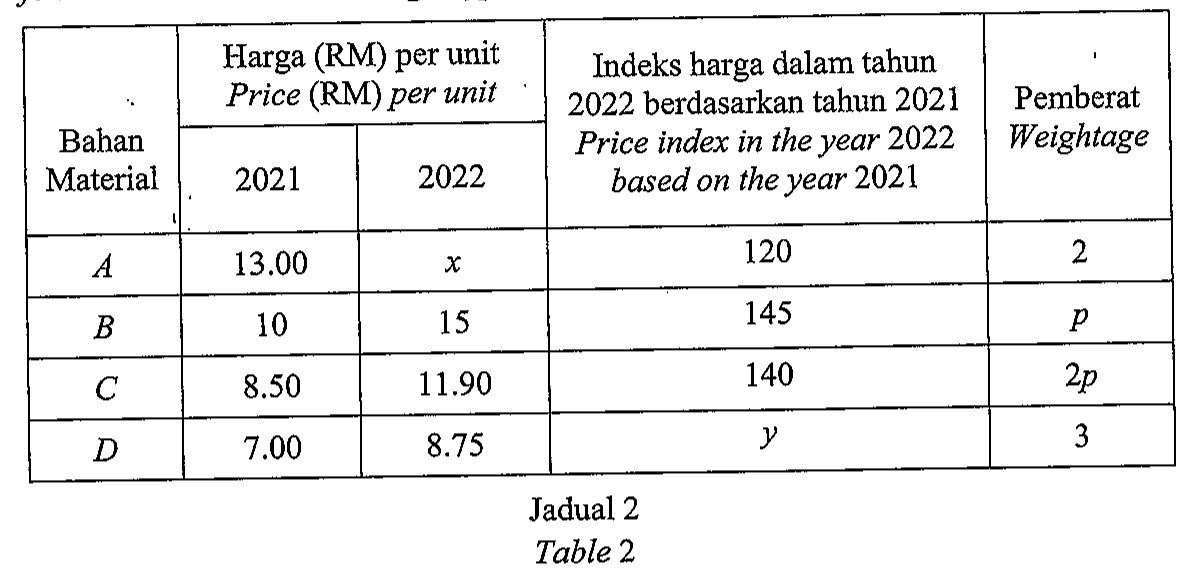
- (b)(i)
Given the composite index for the cost of making the shoe in the year 2022 based on the year 2021 is 135, find the value of p.
[3] - (b)(ii)
Given that the selling price of a pair of shoes in the year 2023 is RM162 and the prices of all the materials increased by 25% from 2022 to 2023, and the company gets a profit of 20% in the year 2021, find the cost price, in RM, of a pair of shoes in that year.
[4]
Diagram 5 shows the initial position and direction of the movement of particle A and particle B along a straight line. P and O are 10 m apart; A moves to the right from O and B moves to the left from P. Particle A starts moving from point O and particle B starts moving from point P simultaneously. After t seconds, velocity v m s⁻¹ of particle A is given by v_A = t² − kt + 6, such that k is a constant, while the displacement, s_B m of particle B is given by s_B = t³/3 − t² − 8t. Acceleration of particle A is 3 m s⁻² when t = 4 s. (a) Find the value of k. (b) Determine the range values of t when the particle A moves to the left. (c) Calculate (i) the distance, in m, of particle B from O when t = 5 s, (ii) time, in seconds, when particle B overtakes particle A.
Medium10 marks- (a)
Find the value of k.
[3]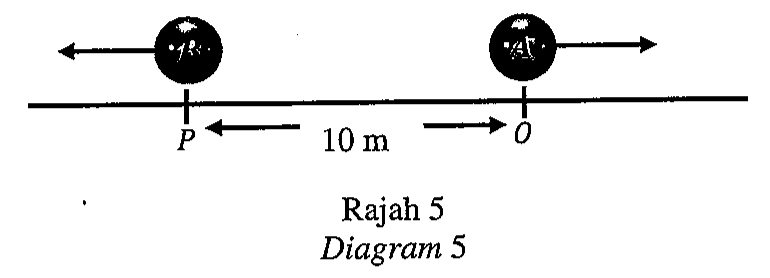
- (b)
Determine the range values of t when the particle A moves to the left.
[2] - (c)(i)
Calculate the distance, in m, of particle B from O when t = 5 s.
[2] - (c)(ii)
Calculate the time, in seconds, when particle B overtakes particle A.
[3]
Solutions by scale drawing is not accepted. Diagram 6 shows a triangle PQR with PR = 16 cm and QR = 7.3 cm. It is given that the area of triangle PQR is 32.5 cm² and ∠PRQ is an obtuse angle. (a) Find (i) ∠PRQ, (ii) the length, in cm, of PQ, (iii) ∠RPQ. (b) Triangle P′Q′R′ has a different shape from triangle PQR such that P′R′ = PR, Q′R′ = QR and ∠Q′P′R′ = ∠QPR. (i) Sketch triangle P′Q′R′. (ii) State the size of ∠P′R′Q′. (iii) Calculate the area, in cm², of triangle P′Q′R′.
Medium10 marks- (a)(i)
Find ∠PRQ.
[2]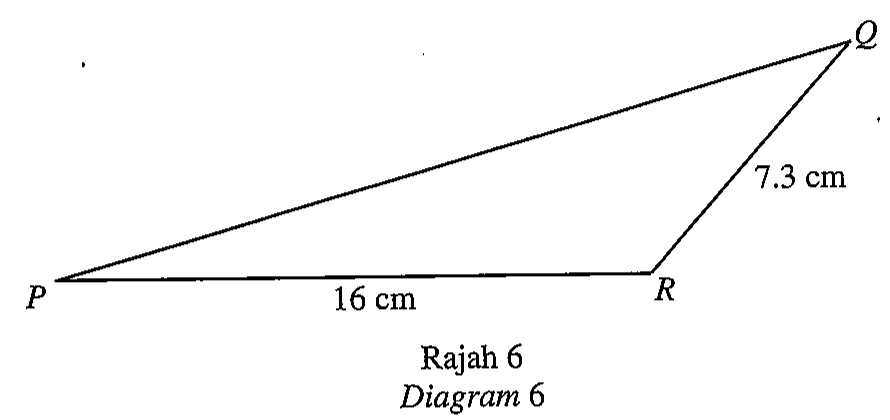
- (a)(ii)
Find the length, in cm, of PQ.
[2] - (a)(iii)
Find ∠RPQ.
[2] - (b)(i)
Sketch triangle P′Q′R′.
[1]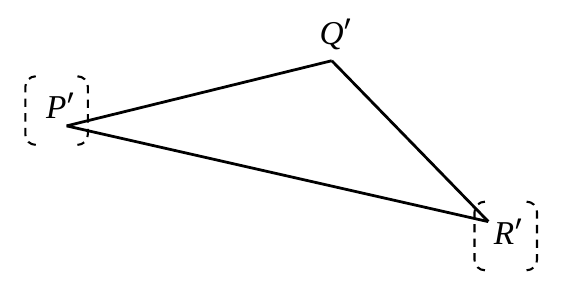
- (b)(ii)
State the size of ∠P′R′Q′.
[1] - (b)(iii)
Calculate the area, in cm², of triangle P′Q′R′.
[2]
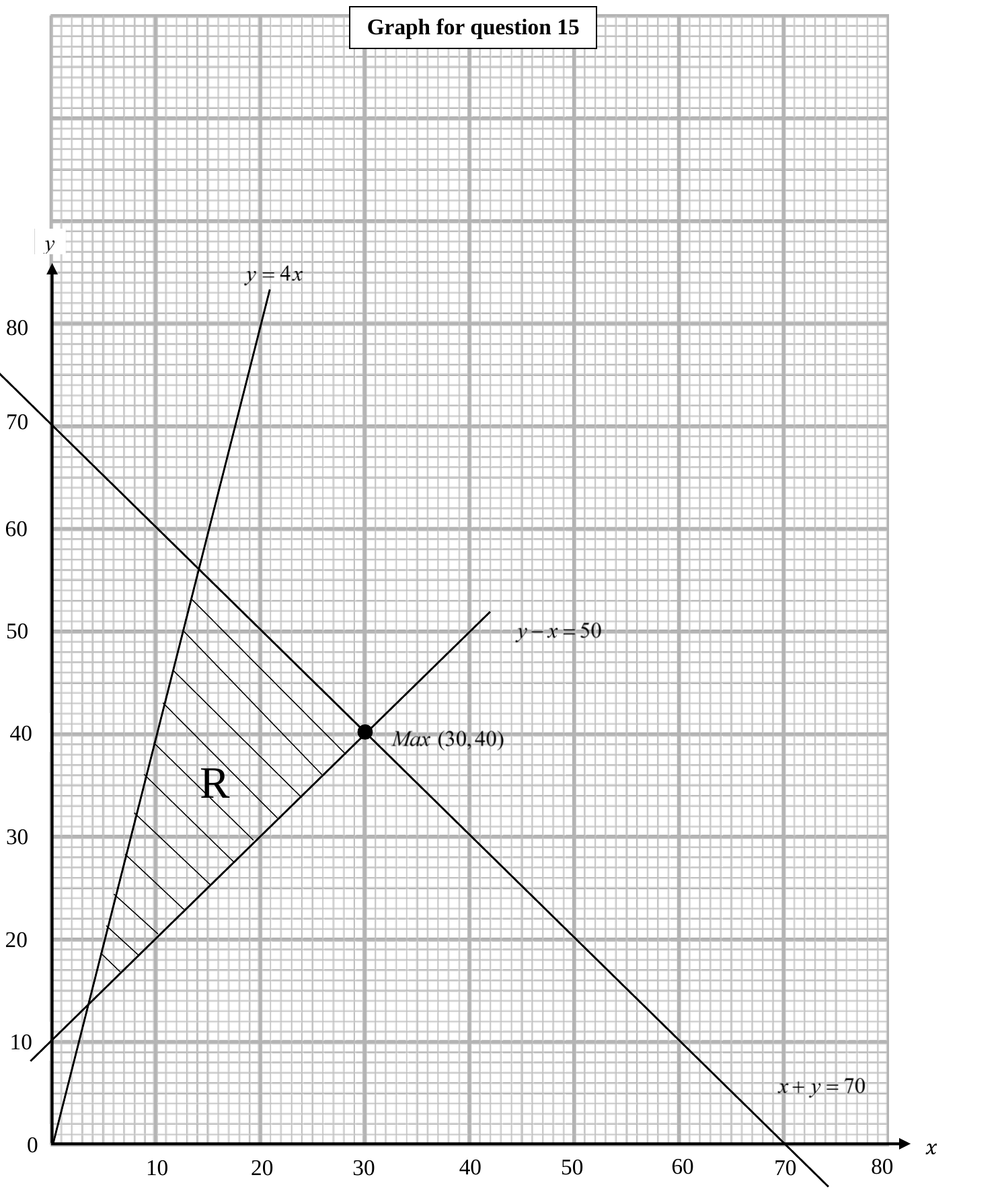
Cikgu Abdul plans to purchase x uniform and y T-shirts for a group of students in his school. The purchase is based on the following constraints: I The total number of clothes purchased cannot be more than 70 pieces. II The number of uniform is at least 25% of the number of T-shirts purchased. III The number of T-shirts must exceed the number of uniform by at least 10 pieces. (a) Write three inequalities other than x ≥ 0 and y ≥ 0 that satisfy all the above constraints. (b) Using a scale of 2 cm to 10 clothes on both axes, construct and shade the region R that satisfies all the above constraints. (c) Use the graph constructed in 15(b) to answer the following questions. (i) State the range of the number of T-shirts purchased if the number of uniform purchased is 25 pieces. (ii) Find the maximum allocation, in RM, required if the prices of a uniform and a T-shirts are RM80 and RM40 respectively.
Medium10 marks- (a)
Write three inequalities other than x ≥ 0 and y ≥ 0 that satisfy all the above constraints.
[3] - (b)
Using a scale of 2 cm to 10 clothes on both axes, construct and shade the region R that satisfies all the above constraints.
[3]
- (c)(i)
State the range of the number of T-shirts purchased if the number of uniform purchased is 25 pieces.
[1] - (c)(ii)
Find the maximum allocation, in RM, required if the prices of a uniform and a T-shirts are RM80 and RM40 respectively.
[3]