Write your answer on paper. Then open the answer to check it.
Section A
Diagram 1 shows the function f which maps set K to set M and the function g which maps set M to set N (x → 8x − 5 → 24x + 15). Find (a) the function which maps set M to set K, in terms of x; (b) g(x).
Easy4 marks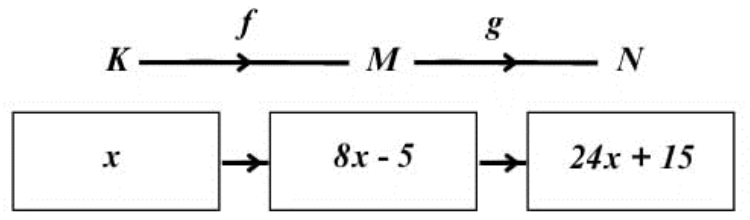
- (a)
The function which maps set M to set K, in terms of x.
[1] - (b)
g(x).
[3]
Encik Shuhaimi wants to buy goats, deer and cows. The total number of animals is 45. He allocated RM82,500. A goat costs RM1,000, a deer RM2,500 and a cow RM1,500. The total number of goats and deer is twice the number of cows. Two equations are given: x + y + z = 45 and 1000x + 2500y + 1500z = 82500. (a) Write the third equation. (b) Hence, find the number of each type of animal he will buy.
Medium5 marks- (a)
Write the third equation.
[1] - (b)
Hence, find the number of each type of animal (x goats, y deer, z cows).
[4]
Diagram 3 shows a hemispherical container. (a) Find the approximate change in the volume of the hemisphere when its radius changes from 15 cm to 15.02 cm. (b) The volume of a hemisphere decreases at a rate of 5.4π cm³ s⁻¹. Find the rate of change in the radius when the radius is 15 cm.
Medium6 marks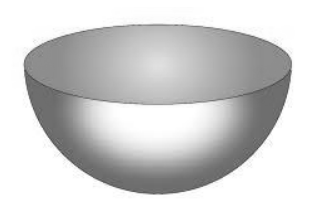
- (a)
Approximate change in volume when r changes from 15 cm to 15.02 cm.
[3] - (b)
Rate of change of the radius when r = 15 cm.
[3]
Given x = aᵖ and y = a^q. (a) Prove the division law of logarithm: log_a (x/y) = log_a x − log_a y. (b) Hence, show that log₂ P − log₂ Q = 2 log₄ (P/Q).
Medium6 marks- (a)
Prove log_a (x/y) = log_a x − log_a y.
[3] - (b)
Hence, show log₂ P − log₂ Q = 2 log₄ (P/Q).
[3]
(a) A committee of 7 members is to be selected from 6 male teachers and 5 female teachers. Find the number of different committees that can be formed if the number of male teachers must exceed the number of female teachers. (b) 4 male teachers and 3 female teachers are arranged in a row for a photography session. Find the number of ways they can be seated if the 4 male teachers must be seated together.
Medium6 marks- (a)
Number of different committees with more male than female teachers.
[3] - (b)
Number of ways if the 4 male teachers sit together.
[3]
Given a quadratic function f(x) = 9 − (x − 2)². (a) Sketch the graph of f(x) for −1 ≤ x ≤ 5. (b) If the graph is reflected about the x-axis, write the quadratic function of the curve.
Easy4 marks- (a)
Sketch the graph of f(x) for −1 ≤ x ≤ 5.
[3]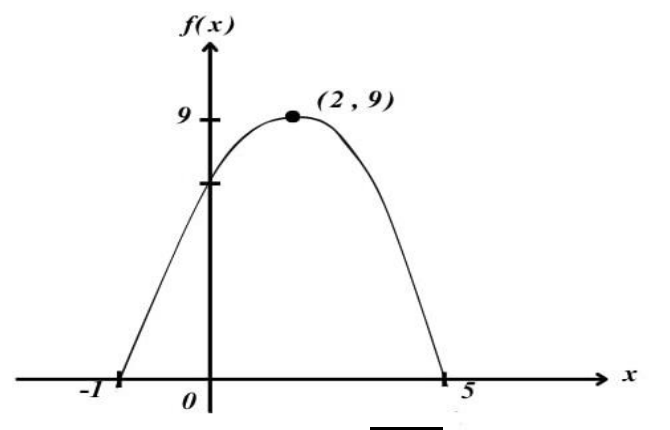
- (b)
Quadratic function of the reflected curve.
[1]
Diagram 7 shows a straight line AB on a Cartesian plane with A(x₁, y₁), B(x₂, y₂) and P(x, y) such that AP = m and PB = n. (a) Derive the formula for the divisor of a line segment on the Cartesian plane. (b) Hence, given that point P(h, 5) divides the line segment joining A(2, 2) and B(12, k) such that AP : PB = 3 : 2, find the values of h and k.
Medium6 marks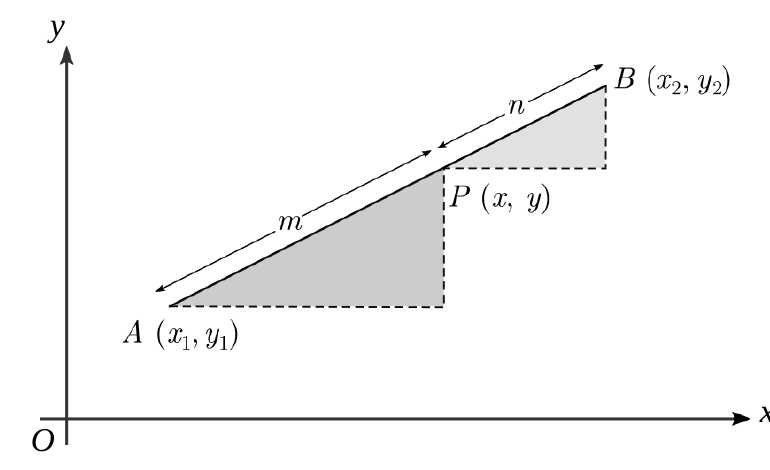
- (a)
Derive the section formula.
[3] - (b)
Find h and k.
[3]
Given a geometric progression a, ar, ar², ar³, ar⁴, ..., arⁿ⁻², arⁿ⁻¹. (a) Derive the formula for the sum of the first n terms, Sₙ = a(1 − rⁿ)/(1 − r). (b) Hence, state the range of values of r.
Medium4 marks- (a)
Derive Sₙ = a(1 − rⁿ)/(1 − r).
[3] - (b)
State the range of values of r.
[1]
Given ∫ from 3 to 5 of f(x) dx = 10 and ∫ from 3 to 5 of 3[f(x) − qx] dx = 6, find (a) the value of q, (b) (1/2) ∫ from 5 to 3 of f(x) dx + 10.
Easy5 marks- (a)
Find q.
[3] - (b)
Find (1/2)∫ from 5 to 3 of f(x) dx + 10.
[2]
Given cos x cos y = 1/4 and sin x sin y = 3/8. Find the value of (a) (i) cos (x − y), (ii) cos (x + y). (b) Hence, find the possible values of x and y between 0° and 90°.
Medium6 marks- (a)
Find (i) cos (x − y) and (ii) cos (x + y).
[3] - (b)
Hence, find the possible values of x and y between 0° and 90°.
[3]
Diagram 11 shows Ainul and Juliana wanting to swim from point A to point B across a river 15 m wide. (a) Ainul swims with constant velocity V = 13i − 8j m s⁻¹. There is a constant current U = 2i m s⁻¹ to the right. Find (i) the magnitude of Ainul's velocity, (ii) the unit vector in the direction of Ainul's velocity. (b) Juliana swims with constant speed V = 3.0 m s⁻¹. There is a constant current U = 2.0 m s⁻¹ to the right. (i) Find the resultant vector of Juliana's velocity. (ii) How far is Juliana from B when she reaches the other side of the river?
Medium7 marks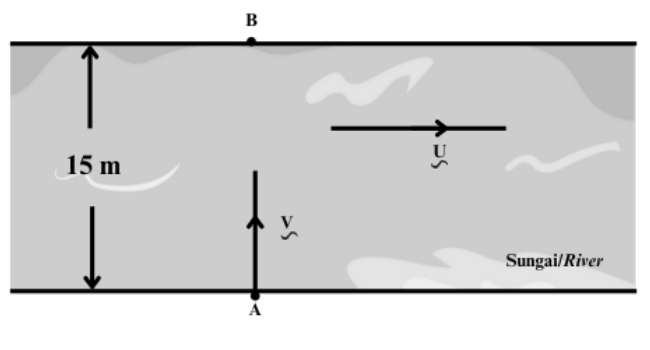
- (a)
(i) Magnitude of Ainul's velocity. (ii) Unit vector in the direction of Ainul's velocity.
[4] - (b)
(i) Resultant vector of Juliana's velocity. (ii) Distance of Juliana from B on reaching the other side.
[3]
Diagram 12 shows the graph of a normal distribution X ~ N(μ, σ²) with axis of symmetry AB at X = 10 and a shaded region to the right of X = 15. The area of the shaded region is 0.295. Find (a) the values of μ and σ, (b) hence, P(7 ≤ X ≤ 15).
Easy5 marks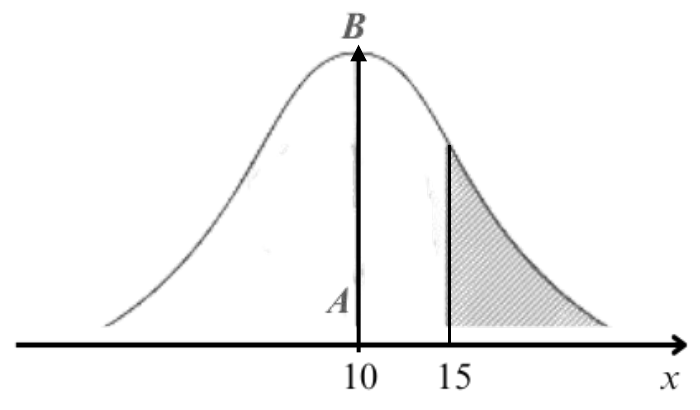
- (a)
Find the values of μ and σ.
[3] - (b)
Hence, find P(7 ≤ X ≤ 15).
[2]
Section B
Diagram 13 shows a sector of a circle with centre O. The shaded segment ABC has a height MC of 6 cm. AB is a chord of length 16 cm and M is the midpoint of AB. Use π = 3.142. Find (a) the value of r, (b) ∠AOB in radians, (c) the area, in cm², of the shaded segment.
Medium8 marks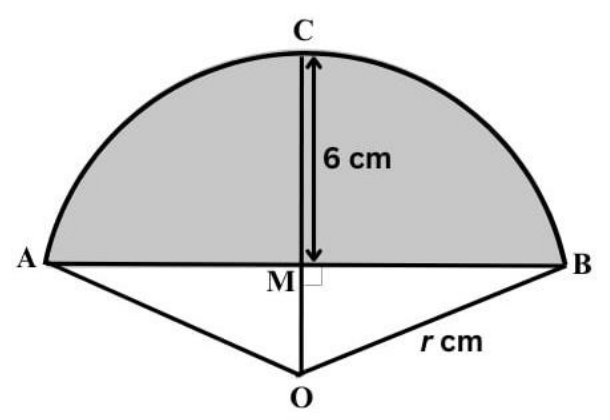
- (a)
Find r.
[3] - (b)
Find ∠AOB in radians.
[3] - (c)
Find the area of the shaded segment.
[2]
(a) Given the curve y = 5 + 6x² − x³ passes through point P(1, 10), find the equation of the tangent to the curve at P. (b) Find the coordinates of the turning points of the curve y = 5 + 6x² − x³.
Medium8 marks- (a)
Find the equation of the tangent at P(1, 10).
[4] - (b)
Find the coordinates of the turning points.
[4]
(a) Diagram 15 shows the straight line graph of y/x against 1/x². The straight line passes through (1, 5) and (3, p) and represents the equation y = 2/x + qx, where p and q are constants. Find the values of p and q. (b) If the non-linear equation y/(k^√x) = p, where k and p are constants, is converted to the linear form Y = mX + c, state Y, X, m and c in terms of x, y, k and p.
Medium8 marks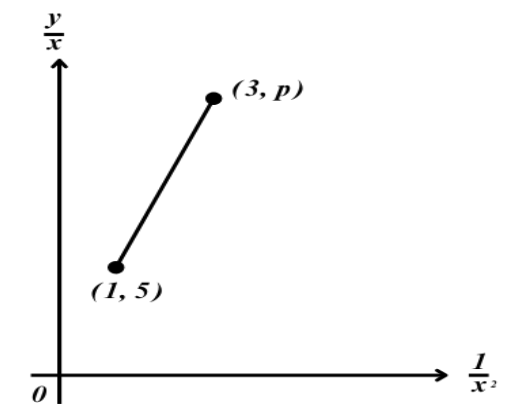
- (a)
Find p and q.
[4] - (b)
State Y, X, m and c.
[4]