Write your answer on paper. Then open the answer to check it.
Section A
Diagram 1 shows a function f(x) defined in a certain domain. The graph passes through (0, 3), has minimum point (1, 2), and passes through (2, 3) and (3, 6) (end point).
Easy3 marks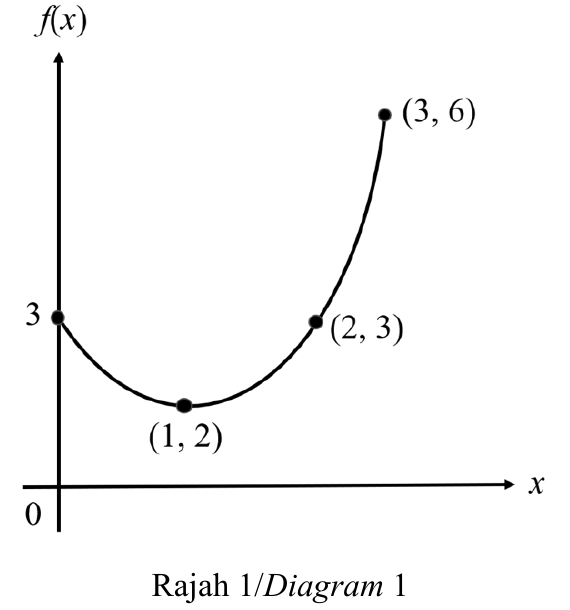
- (a)
State the type of relation of this function.
[1] - (b)
State the domain and range of this function.
[2]
(a) Simplify − log_m a − log_m b − log_m c as a single term. (b) Given 49m⁵nᶜ = (2401 m¹⁰ n⁴ × mᵇ n²)/(a m⁷ n), find the values of a, b and c.
Medium4 marks- (a)
Simplify − log_m a − log_m b − log_m c as a single term.
[1] - (b)
Given 49m⁵nᶜ = (2401 m¹⁰ n⁴ × mᵇ n²)/(a m⁷ n), find the values of a, b and c.
[3]
(a) Solve the equation e^(3x+2) = 10. (b) Solve the equation log₃(6 + 5x) / log₉(2 + x) = 4.
Medium6 marks- (a)
Solve the equation e^(3x+2) = 10.
[2] - (b)
Solve the equation log₃(6 + 5x) / log₉(2 + x) = 4.
[4]
A curve has a gradient function of 4x³ − px, where p is a constant. The tangent to the curve at point (2, 5) is perpendicular to the straight line x + 8y = 1. Find (a) the value of p, (b) the equation of the curve.
Medium6 marks- (a)
Find the value of p.
[3] - (b)
Find the equation of the curve.
[3]
Given the points P(1, p − 1) and R(9, 8), find the possible value/values of p for each case: (a) OP→ and OR→ are parallel. (b) |OP→| = |OR→|.
Easy4 marks- (a)
OP→ and OR→ are parallel.
[2] - (b)
|OP→| = |OR→|.
[2]
(a) Variables x and y are related by y = pqˣ, where p and q are constants. Diagram 6 shows the straight line obtained by plotting log₁₀ y against x (vertical intercept 3, x-intercept 7). Find the values of p and q. (b) Variables x and y are related by y = axᵇ, where a and b are unknown constants. Explain how a and b can be obtained from a suitable straight-line graph.
Easy4 marks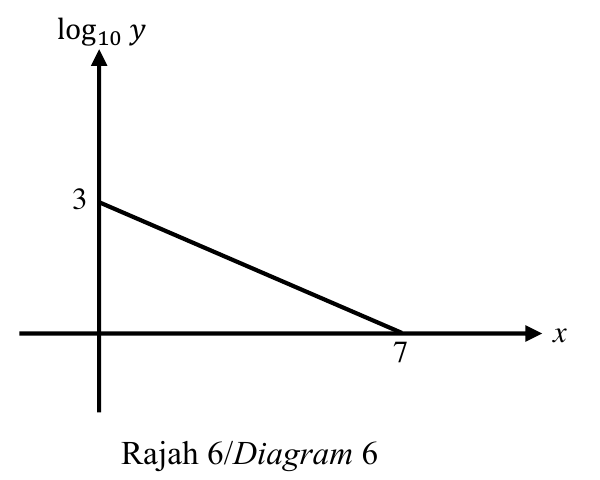
- (a)
Find the values of p and q from Diagram 6.
[3] - (b)
Explain how a and b can be obtained from a suitable straight-line graph.
[1]
Diagram 7 shows sector POQ and triangle MON inscribed in a circle with centre O. The radius of the circle and the radius of sector POQ are x cm and y cm respectively. The reflex angle at O is 280°. The perimeter of the minor sector MON is 33.97 cm and the area of the shaded region is 15.03 cm². [Use π = 3.142] (a) State ∠MON in radians. (b) Hence, calculate the value of x and of y to the nearest integer.
Medium7 marks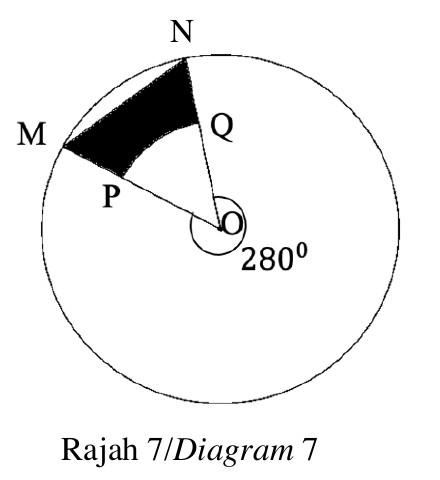
- (a)
State ∠MON in radians.
[1] - (b)
Hence, calculate the value of x and of y to the nearest integer.
[6]
Diagram 8 shows the graph of a binomial distribution X ~ B(n, p), with P(X = r) plotted for r = 0, 1, 2, 3, 4 (approximately 0.09, 0.30, 0.37, 0.20, 0.04). (a) List all the discrete random variable values, X, for the distribution. (b) Given P(X ≤ 3) = 0.959, find (i) the value of p, (ii) the mean and variance of the distribution.
Medium7 marks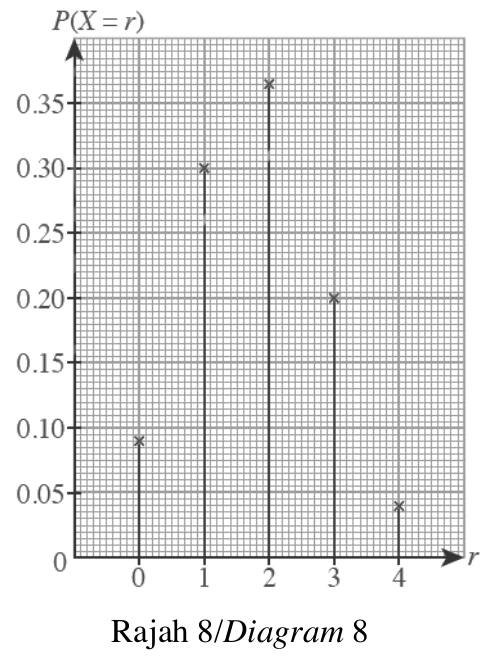
- (a)
List all the discrete random variable values, X, for the distribution.
[1] - (b)(i)
Given P(X ≤ 3) = 0.959, find the value of p.
[3] - (b)(ii)
Find the mean and variance of the distribution.
[3]
Given X ~ N(45, 90.25), find the value of k if P(40 < X < k) = 0.1025.
Easy3 marksGiven X ~ N(45, 90.25), find the value of k if P(40 < X < k) = 0.1025.
[3]
A committee consisting of Chairman, Deputy Chairman, Secretary, Treasurer and 6 committee members will be appointed from 12 candidates, 7 men and 5 women. (a) How many different ways can the committee be formed if (i) there are no conditions, (ii) Chairman and Deputy must be male while Secretary and Treasurer must be female? (b) All appointed committee members attend a dinner and sit at a round table with 10 chairs. Calculate the number of ways they can be arranged if the Chairman and Deputy Chairman must sit side by side.
Medium6 marks- (a)(i)
How many different ways can the committee be formed if there are no conditions?
[2] - (a)(ii)
Chairman and Deputy must be male, Secretary and Treasurer must be female: how many ways?
[2] - (b)
Calculate the number of ways they can sit at the round table with 10 chairs if Chairman and Deputy must sit side by side.
[2]
Diagram 11 shows a cylinder with a volume of (23 − 3√5)π cm³. The radius of the cylinder is (√20 + 3) cm. Find the height of the cylinder, h, and give your answer in the form a + b√c, where a, b and c are integers.
Easy5 marks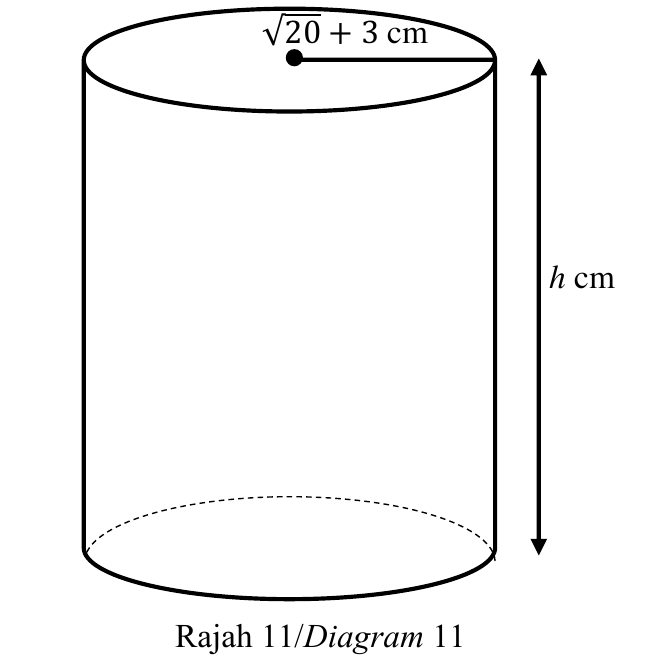
Find the height of the cylinder, h, in the form a + b√c.
[5]
(a) If a is the first term and d is the common difference of an arithmetic progression, show that the sum of the first n terms is Sₙ = (n/2)[2a + (n − 1)d]. (b) Given an arithmetic progression 5, 9, 13, 17, …, find the sum of the first n terms. (c) Hence, solve the equation 5 + 9 + 13 + 17 + … + x = 2277.
Medium9 marks- (a)
Show that Sₙ = (n/2)[2a + (n − 1)d].
[3] - (b)
Find the sum of the first n terms of 5, 9, 13, 17, …
[2] - (c)
Hence, solve 5 + 9 + 13 + 17 + … + x = 2277.
[4]
Section B
(a) Given cos(α + β) = 1/4 and sin α sin β = 1/2, find (i) cos α cos β, (ii) cos(α − β). (b) Solve the equation 4 sin θ = √2 sec θ for all angles between 0° and 360°. (c) In the answer space, label the angle (180° − p), if the reference angle is p.
Medium8 marks- (a)(i)
Find cos α cos β.
[2] - (a)(ii)
Find cos(α − β).
[2] - (b)
Solve 4 sin θ = √2 sec θ for 0° < θ < 360°.
[3] - (c)
Label the angle (180° − p) if the reference angle is p.
[1]
(a) Given that the straight line y = 0 is the tangent line to the curve f(x) = 2x² + (h − 1)x + 2k², where h and k are constants, express h in terms of k. (b) Given the quadratic function f(x) = −2x² + 4x + 30 defined in the domain −3 ≤ x ≤ 7, (i) by using completing the square, express f(x) in vertex form and state the turning point of f(x), (ii) express f(x) in intercept form and hence sketch the graph of f(x).
Medium8 marks- (a)
Express h in terms of k.
[2] - (b)(i)
Express f(x) in vertex form by completing the square and state the turning point.
[3] - (b)(ii)
Express f(x) in intercept form and sketch the graph of f(x).
[3]
Diagram 15 shows the straight line y = −2x + 3 intersecting the line x = β at A and the y-axis at B. Given that C is (β, 0) and ∠ABC = 90°, find (a) the value of β, (b) the coordinates of A, (c) the area of triangle ABC, (d) the equation of the locus of S if S moves such that its distance from point B is always the same as the distance between B and C.
Medium8 marks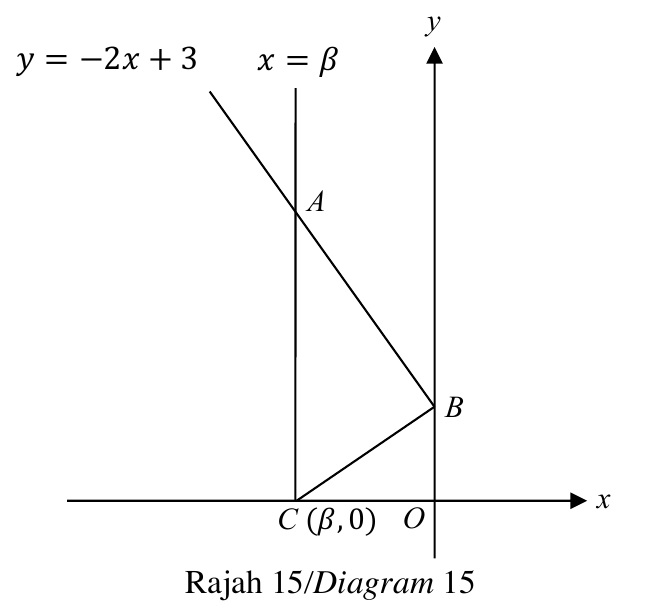
- (a)
Find the value of β.
[2] - (b)
Find the coordinates of A.
[1] - (c)
Find the area of triangle ABC.
[2] - (d)
Find the equation of the locus of S.
[3]