Write your answer on paper. Then open the answer to check it.
Section A
X is a discrete random variable such that X ~ B(8, p). It is given that the standard deviation is 4/3 and p < q. Find the value of p.
Easy3 marksFind the value of p.
[3]
Diagram 2 shows the graph of log₂ y against log₂ x which passes through point (4, 9) and the point (−2, 0) on the horizontal axis. Express y in terms of x.
Easy4 marks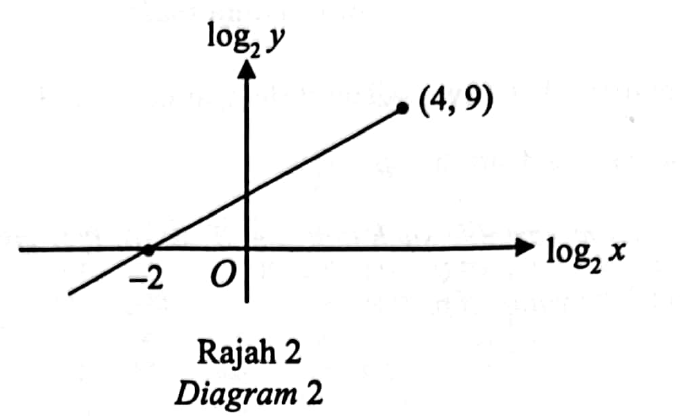
Express y in terms of x.
[4]
A coil of wire with the length of p cm is cut into 32 parts such that their lengths form an arithmetic progression. It is given that the length of the longest part is 105 cm and the sum of the lengths of the three shortest parts is 45 cm.
Medium6 marks- (a)
Find the length, in cm, of the shortest part.
[4] - (b)
Hence, calculate the value of p.
[2]
(a) Simplify 8^(x−1) ÷ 32^x into the form 1/(p(2^(nx))) such that p and n are integers. (b) A cylinder has a radius of 1/(√2 − 1) cm and height h cm. The volume of the cylinder is π(7 + 5√2) cm³. Calculate the value of h in terms of a + √b.
Medium6 marks- (a)
Simplify 8^(x−1) ÷ 32^x into the form 1/(p(2^(nx))) such that p and n are integers.
[3] - (b)
A cylinder has a radius of 1/(√2 − 1) cm and height h cm. The volume of the cylinder is π(7 + 5√2) cm³. Calculate the value of h in terms of a + √b.
[3]
It is given that a straight line y = mx − m intersects the curve y = 2x² + 3x − 3 at two different points, find the range of values of m.
Easy4 marksFind the range of values of m.
[4]
A golf player hits a golf ball 3 m on the left side of hole A. The locus of the golf ball is given by f(x) = −(1/2)x² + px + 2q such that p, q are constants and x is the horizontal displacement of the golf ball from hole A. The golf ball falls to the ground again 10 m towards the right from where the ball was hit.
Medium4 marks- (a)
Find the value of p and of q.
[2] - (b)
Hence, find the maximum height that the golf ball reached.
[2]
It is given ABCD is a parallelogram, where BC→ = k**i** − **j** and CD→ = −4**i** + k**j**. Find the length of the diagonal AC in terms of k.
Easy3 marksFind the length of the diagonal AC in terms of k.
[3]
Diagram 8 shows two sectors, PQR and SQT, with centres P and S respectively. The radii of the sectors PQR and SQT are 13.21 cm and 8 cm respectively. It is given that S is the midpoint of the straight line PRT and ∠QPR = 0.6 radian. Calculate (a) the arc length, in cm, of QT, (b) the area, in cm², of the shaded region.
Easy5 marks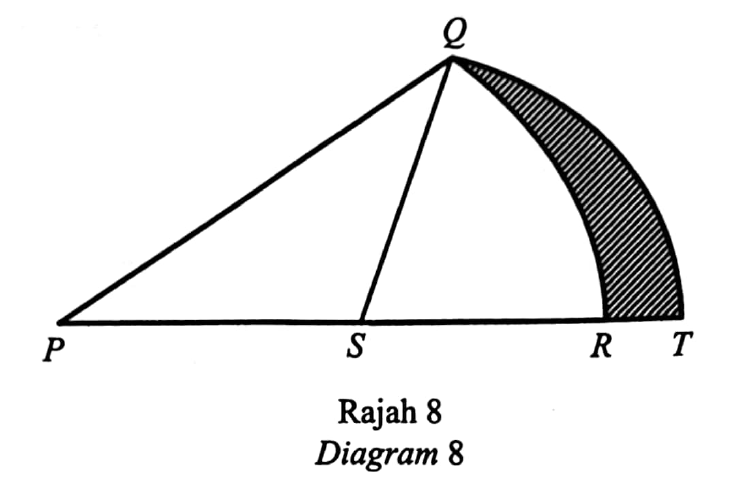
- (a)
Calculate the arc length, in cm, of QT.
[2] - (b)
Calculate the area, in cm², of the shaded region.
[3]
It is given that function f(x) = (x − 3)(x² − 9). Find (a) the gradient function of f(x), (b) the stationary points for f(x) and determine the nature of each stationary point, (c) the value of f(1.001) by using the concept of calculus.
Medium8 marks- (a)
Find the gradient function of f(x).
[2] - (b)
Find the stationary points for f(x) and determine the nature of each stationary point.
[3] - (c)
Find the value of f(1.001) by using the concept of calculus.
[3]
Diagram 10 shows a cross-section of a trapezium shaped container which has a parabolic inner surface and a flat cover. The inner surface of the container represented by the function y = ax². It is given that the length of AB and CD are 12 cm and 8 cm respectively, AP = QB = 1 cm and the height of the container is 8 cm. Find (a) the value of a, (b) the area, in cm², of the shaded region, (c) the maximum volume of the rice, in term of π, that can be stored in the container if the cover of the container is tightly closed.
Hard8 marks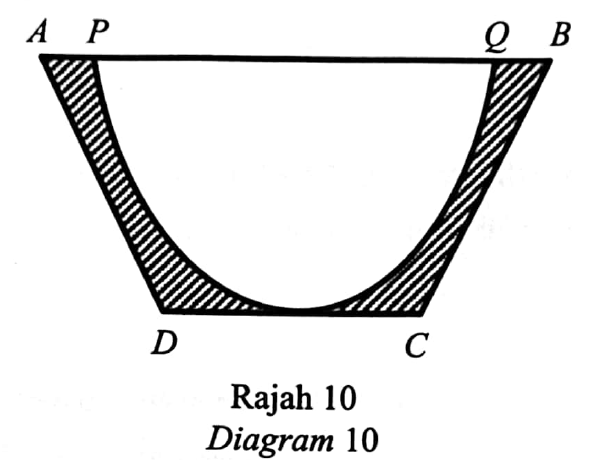
- (a)
Find the value of a.
[2] - (b)
Find the area, in cm², of the shaded region.
[4] - (c)
Find the maximum volume of the rice, in term of π, that can be stored in the container if the cover is tightly closed.
[2]
Solution by scale drawing is not accepted. Diagram 11 shows a triangle ABC where point D lies on the straight line BC. It is given that the ratio of the area of △ABD : the area of △ADC = 1 : 3. C is (9, 1) and D is (3, −2). (a) Find the coordinates of the point B. (b) P is a moving point such that PD is always perpendicular to PC. Find the equation of the locus of point P.
Medium5 marks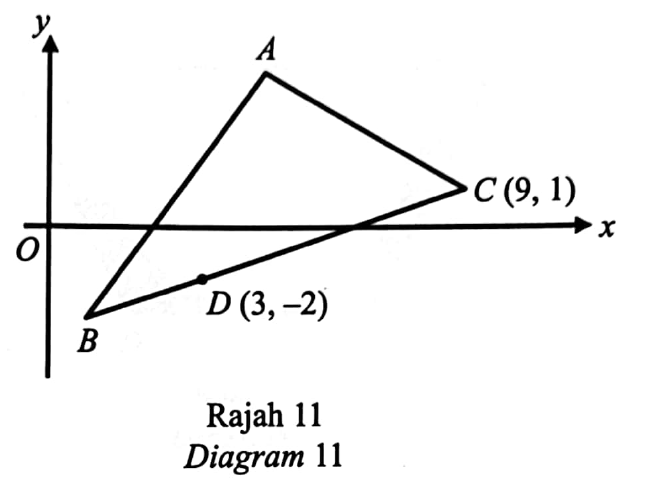
- (a)
Find the coordinates of the point B.
[3] - (b)
P is a moving point such that PD is always perpendicular to PC. Find the equation of the locus of point P.
[2]
(a) If ³⁰Cᵣ = ³⁰Cᵣ₊₄, find the value of r. (b) Diagram 12 shows two straight lines. Points A, B and C lie on the first straight line where points D, E, F, G and H lie on the second straight line. Find the number of triangles or quadrilaterals can be formed. (c) Find the number of even number in between 3 000 and 7 000 that can be formed by using the digits 2, 3, 4, 5, 6, 7 without repetition.
Medium8 marks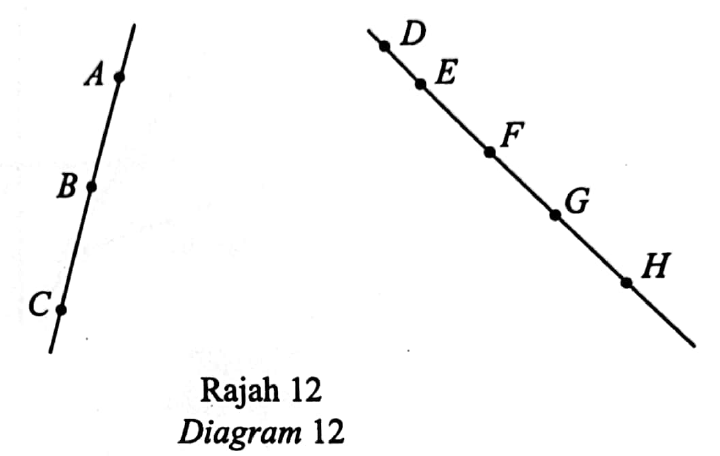
- (a)
If ³⁰Cᵣ = ³⁰Cᵣ₊₄, find the value of r.
[2] - (b)
Find the number of triangles or quadrilaterals can be formed.
[3] - (c)
Find the number of even number in between 3 000 and 7 000 that can be formed by using the digits 2, 3, 4, 5, 6, 7 without repetition.
[3]
Section B
(a) Diagram 13 shows a point P lying on the circumference of a unit circle. Based on the diagram, (i) derive the basic trigonometric identity sin²θ + cos²θ = 1, (ii) find the value of cos 2θ if x = 0.1736. (b) It is given that tan A = 3 and tan (A − B) = 2/3, where A is a reflex angle and B is an acute angle. Find (i) cot A, (ii) the value of tan B.
Medium8 marks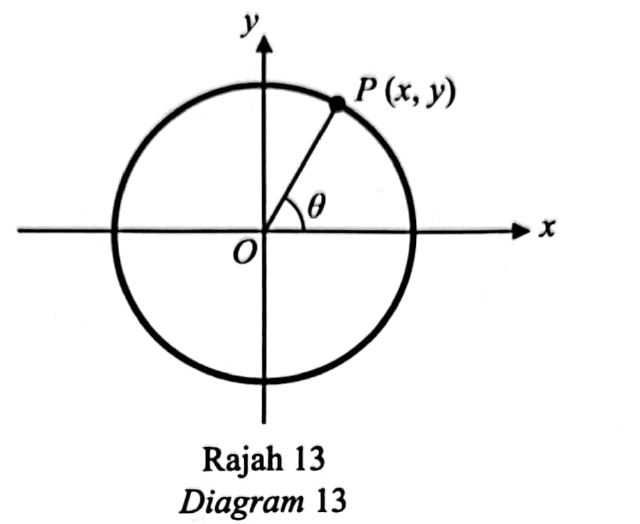
- (a)(i)
Derive the basic trigonometric identity sin²θ + cos²θ = 1.
[2] - (a)(ii)
Find the value of cos 2θ if x = 0.1736.
[2] - (b)(i)
Find cot A.
[1] - (b)(ii)
Find the value of tan B.
[3]
Diagram 14 shows the positions of four pesticide spraying robots on the Cartesian plane at points O, P, Q and R. It is given that OPQR forms a parallelogram and PR→ = −**i** − 15**j**; P is (5, 12). (a) Find (i) the value of |OP→ − QP→ + QR→ − OR→|, (ii) the coordinates of point Q. (b) Robot at point P moves to point T (2, 6) with a constant velocity (−5**i** + w**j**) m s⁻¹. It takes t seconds to reach point T. (i) Based on the given information, write a vector equation in terms of t and w. (ii) Hence, find the value of t and of w.
Medium8 marks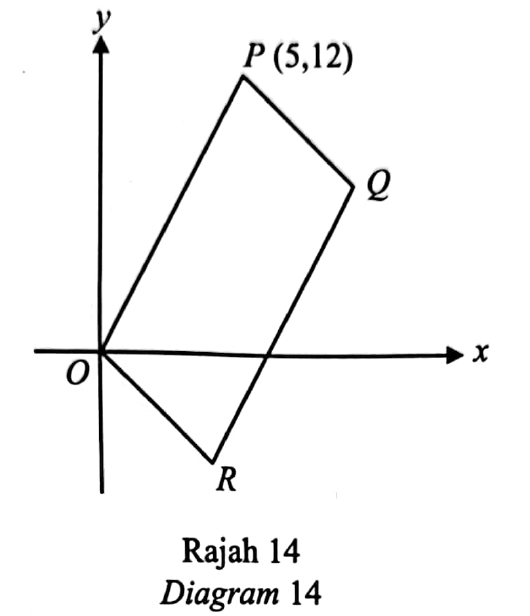
- (a)(i)
Find the value of |OP→ − QP→ + QR→ − OR→|.
[1] - (a)(ii)
Find the coordinates of point Q.
[4] - (b)(i)
Based on the given information, write a vector equation in terms of t and w.
[1] - (b)(ii)
Hence, find the value of t and of w.
[2]
Diagram 15 shows function f that maps x onto y and function g that maps y onto z; a maps to −2 under f and −2 maps to b under g. (a) (i) Express in terms of f and g the function that maps x onto z. (ii) State the value of g⁻¹g(−2). (b) It is given that f⁻¹(x) = (2x + 3)/(x − 2), x ≠ 2 and gf(x) = 3x − 6, find (i) the value of a, (ii) g(x).
Medium8 marks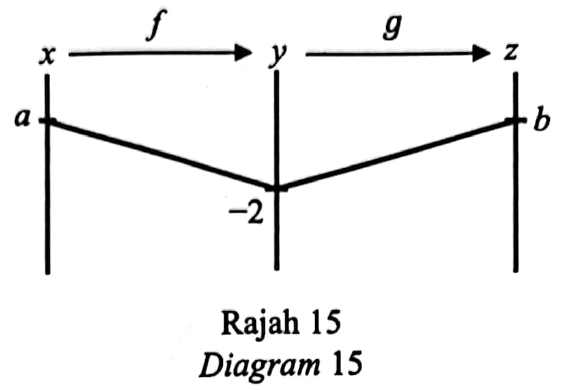
- (a)(i)
Express in terms of f and g the function that maps x onto z.
[1] - (a)(ii)
State the value of g⁻¹g(−2).
[1] - (b)(i)
Find the value of a.
[2] - (b)(ii)
Find g(x).
[4]