Write your answer on paper. Then open the answer to check it.
Section A
Find the range of values of x if the expression 6 − 7x − 3x² is always negative.
Easy3 marksFind the range of values of x if the expression 6 − 7x − 3x² is always negative.
[3]
Given y = t − 4t² and x = 5t + 4. By using the chain rule, find dy/dx in terms of x.
Easy4 marksGiven y = t − 4t² and x = 5t + 4. By using the chain rule, find dy/dx in terms of x.
[4]
(a) Diagram 1 shows the graph of binomial distribution X~B(4, p): P(X = r) marked at r = 0 to 4 with heights 16/81, 7/27, k, 16/81 and 1/81. Find the value of k and of p. (b) Given X~N(12.45, 25). Find the value of k when P(|X| ≥ k) = 0.7154.
Medium6 marks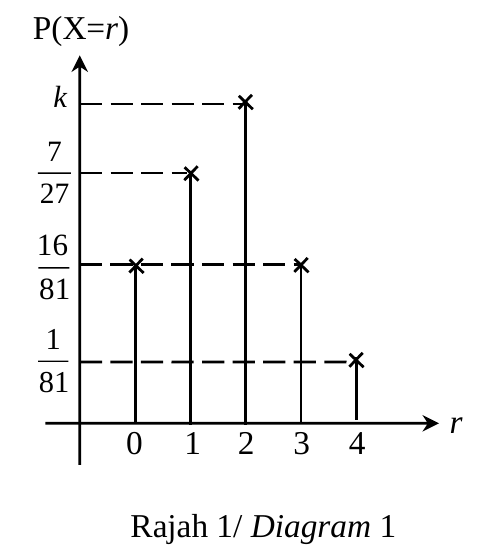
- (a)
Diagram 1 shows the graph of binomial distribution X~B(4, p). Find the value of k and of p.
[3] - (b)
Given X is a continuous random variable where X~N(12.45, 25). Find the value of k when P(|X| ≥ k) = 0.7154.
[3]
Diagram 2 shows the variables x and y are related by the equation y = 4x² − b/x such that a and b are constants. A straight line graph is obtained by plotting xy against x³. The line meets the xy-axis at 4 and passes through (a, 12). Find the value of a and of b.
Easy3 marks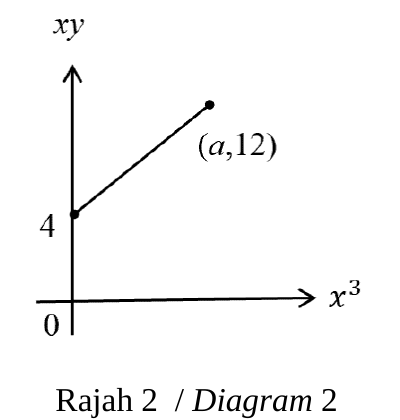
Find the value of a and of b (see Diagram 2).
[3]
(a) The second term of an arithmetic progression is 12 and the tenth term is 52. Find (i) the common difference, (ii) the first term. (b) m + 2, 2m + 4 and 5m + 4 are three consecutive terms of a geometric progression. Find the possible values of m.
Medium6 marks- (a)
The second term of an arithmetic progression is 12 and the tenth term is 52. Find (i) the common difference of the progression, (ii) the first term of the progression.
[3] - (b)
It is given that m + 2, 2m + 4 and 5m + 4 are three consecutive terms of a geometric progression. Find the possible values of m.
[3]
(a) The gradient function of a curve is 4x − 10 and the curve passes through (8, 4). Find the equation of the curve. (b) Given d/dx[5/(1 − x²)] = g(x), find ∫2g(x) dx. (c) Given ∫ₖ³... see parts.
Medium7 marks- (a)
Given that the gradient function of a curve is 4x − 10 and the curve passes through point (8, 4). Find the equation of the curve.
[3] - (b)
Given that d/dx[5/(1 − x²)] = g(x), find ∫2g(x) dx.
[1] - (c)
Given ∫ from 3 to k of f(y) dy = 3/2, find the value of k such that ∫ from 3 to k of [2 − f(y)] dy = 4.
[3]
(a) Solve 3^(3x) = 54 + 3^(3x−1). (b) Diagram 4 shows a right-angled triangle with sides 2 + √3 and 5 − 2√3. Given its area is q + √3/2, find the value of q.
Easy5 marks- (a)
Solve the equation 3^(3x) = 54 + 3^(3x−1).
[3] - (b)
Diagram 4 shows a right-angled triangle with perpendicular sides 2 + √3 and 5 − 2√3. Given that the area of the triangle is q + √3/2, find the value of q.
[2]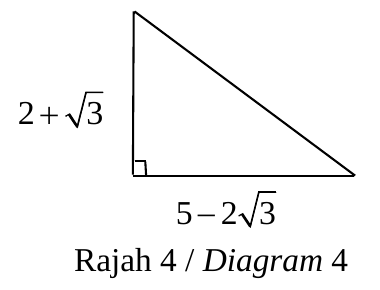
Given the functions r : x → 6x and s : x → 4/(x − 6), x ≠ a. (a) State the value of a. (b) Find the value of s(12). (c) Find the value of k if rs(k) = −12.
Easy4 marks- (a)
State the value of a.
[1] - (b)
Find the value of s(12).
[1] - (c)
Find the value of k if rs(k) = −12.
[2]
(a) Solve 2cos²2x + 3sin2x − 3 = 0 for 0° ≤ x ≤ 360°. (b) Given tan 2x = 5/12 such that x is a reflex angle, find the value of cos²x.
Medium7 marks- (a)
Solve the equation 2cos²2x + 3sin2x − 3 = 0 for 0° ≤ x ≤ 360°.
[4] - (b)
Given tan 2x = 5/12 such that x is a reflex angle. Find the value of cos²x.
[3]
Diagram 5 shows two sectors OPS and OQR with angle 1/3 rad and centre O. OP = 3k and PQ = 2k. (a) Find the value of k if the area of the shaded region PQRS is 24 cm². (b) Hence, calculate the perimeter of the shaded region.
Easy5 marks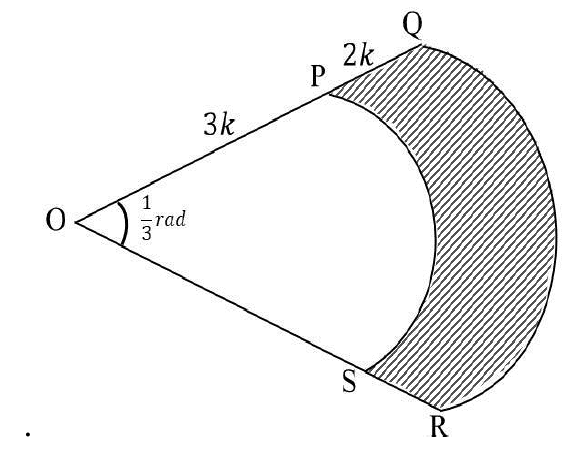
- (a)
Find the value of k if the area of the shaded region PQRS is 24 cm².
[3] - (b)
Hence, calculate the perimeter of the shaded region.
[2]
(a) Diagram 6 shows six letter cards I N D E K S. Find the number of different ways to arrange 4 letter cards in which the vowels are adjacent and the arrangement ends with a consonant. (b) Given the digits 1, 5, 7, 7, 7, 8, find (i) the number of different numbers greater than 500 000 that can be formed, (ii) the number of different 6-digit numbers that do not end with 81.
Medium6 marks- (a)
Find the number of different ways to arrange 4 letter cards (I, N, D, E, K, S) in which the vowels must be adjacent and the arrangement ends with a consonant letter.
[2] - (b)(i)
Given the digits 1, 5, 7, 7, 7, 8, find the number of different numbers greater than 500 000 that can be formed.
[2] - (b)(ii)
Find the number of different 6-digit numbers that do not end with 81.
[2]
Diagram 7 shows OLMN is a parallelogram such that OL→ = 4i + j and OM→ = 6i + 5j. Find (a) ON→. (b) A point P is given such that OP→ = −8i + 19j. (i) Find LN→ and NP→. (ii) Show that the points L, N and P are collinear.
Medium8 marks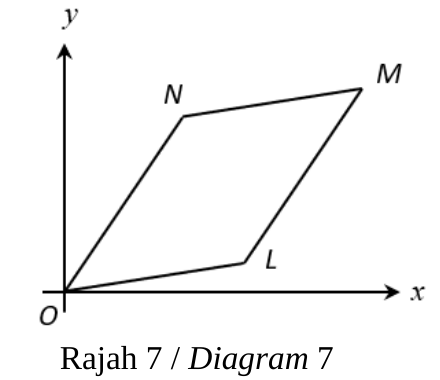
- (a)
Find ON→.
[2] - (b)(i)
Given OP→ = −8i + 19j. Find LN→ and NP→.
[3] - (b)(ii)
Show that the points L, N and P are collinear.
[3]
Section B
Diagram 8 shows a triangle PQR with P(−4, −3), R(3, 4). Line RQ intersects the x-axis at S(5, 0). (a) Given RS : SQ = 2 : 3, find (i) the coordinates of Q, (ii) the area of triangle PQR, in unit². (b) Z is a moving point such that its distance from P is always two times its distance from Q. Find the equation of the locus of Z.
Medium8 marks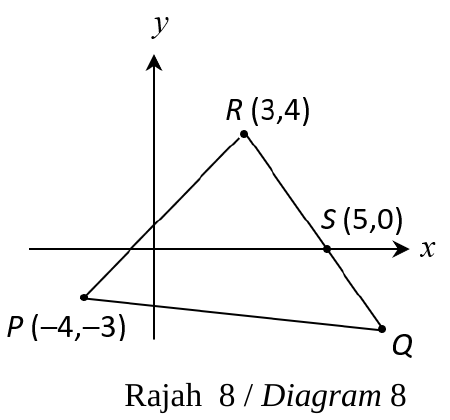
- (a)(i)
Given RS : SQ = 2 : 3, find the coordinates of Q.
[3] - (a)(ii)
Find the area of triangle PQR, in unit².
[2] - (b)
Z is a moving point such that its distance from point P is always two times its distance from point Q. Find the equation of the locus of point Z.
[3]
Diagram 9 shows a solid formed by joining a cylinder with radius x cm and a cone on top of it. The slant length of the cone is 2x cm and the volume of the cylinder is 192π cm³. (a) Show that the total surface area of the solid, A cm², is given by A = 3πx² + 384π/x. (b) Calculate the radius of the cylinder when the surface area of the solid is minimum. (c) The surface area is increasing at a rate of 84π cm² s⁻¹. Find the rate of change of the radius at the instant when the radius is 8 cm.
Medium8 marks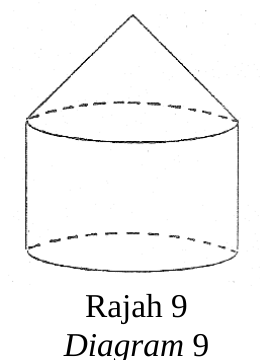
- (a)
Show that the total surface area of the solid, A cm², is given by A = 3πx² + 384π/x.
[2] - (b)
Calculate the radius of the cylinder when the surface area of the solid is minimum.
[3] - (c)
Given that the surface area of the solid is increasing at a rate of 84π cm² s⁻¹. Find the rate of change of the radius at the instant when the radius is 8 cm.
[3]
(a) Solve (i) x − 7√x = −12, (ii) log₄ x + log₁₆ 3x = −1. (b) Shahida's savings after n years in a bank is RM1500(1 + 0.08)ⁿ. Calculate the minimum number of years so that her savings exceed RM20 000.
Medium8 marks- (a)(i)
Solve x − 7√x = −12.
[2] - (a)(ii)
Solve log₄ x + log₁₆ 3x = −1.
[3] - (b)
Shahida's savings after n years in a bank is RM1500(1 + 0.08)ⁿ. Calculate the minimum number of years so that her savings exceed RM20 000.
[3]