Write your answer on paper. Then open the answer to check it.
Section A
Given that 1, x², x⁴, x⁶, … is a geometric progression and the sum to infinity is 9/8. Find (a) the common ratio in terms of x, (b) the positive value of x.
Medium3 marks- (a)
The common ratio in terms of x.
[1] - (b)
The positive value of x.
[2]
Diagram 1 shows a quadrilateral ABCD with vertices C(−2, 5) and D(−1, 1). Q lies on the y-axis and on line CB; angle DCB is a right angle (marked in the diagram). (a) Given CQ : QB = 1 : 3, find the coordinates of B. (b) Find the equation of BC.
Easy5 marks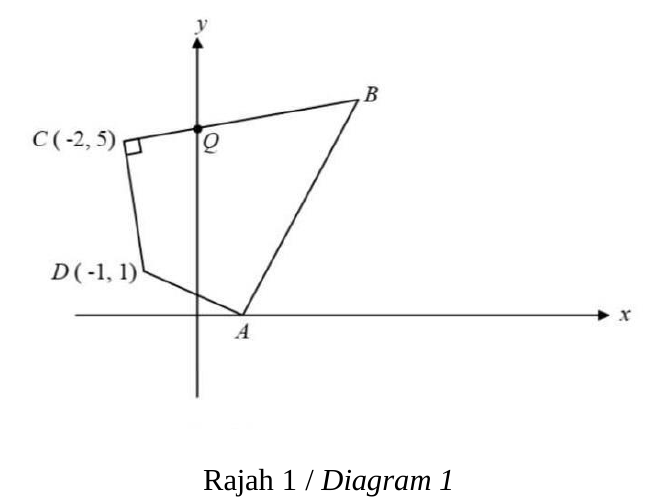
- (a)
Given CQ : QB = 1 : 3, find the coordinates of B.
[2] - (b)
Find the equation of BC.
[3]
The variables x and y are related by the equation y = hx/(kx + 3), where h and k are constants. If a graph of y against x is drawn, its curve passes through (4, 1), whereas a straight line with gradient 4/5 is obtained when a graph of 1/y against 1/x is drawn. Find the values of h and k.
Easy4 marksFind the values of h and k.
[4]
Represent −7π/3 rad on the Cartesian plane. Then, state its reference angle, α.
Easy2 marks
Represent −7π/3 rad on the Cartesian plane (blank axes provided). State the reference angle α.
[2]
Particle A moves from point P(−4, 5) with a constant velocity of (2**i** − **j**) m s⁻¹, while particle B moves from point Q(−8, 9) with a constant velocity of (3**i** − 2**j**) m s⁻¹. (a) Find the unit vector in the direction of PQ→. (b) Find the time t, in seconds, when particles A and B meet. (c) Find the meeting point of particles A and B.
Medium7 marks- (a)
Find the unit vector in the direction of PQ→.
[2] - (b)
Find the time t, in seconds, when particles A and B meet.
[3] - (c)
Find the meeting point of particles A and B.
[2]
Diagram 6 shows part of the graph of the function f(x) = (x + 2)² − 1 for x ≥ −2 (curve starting at (−2, −1), cutting the y-axis at 3). On the diagram provided in the answer space, (i) sketch the graph of f⁻¹(x), (ii) state the coordinates of the point corresponding to (−2, −1) on the graph of y = f⁻¹(x).
Easy4 marks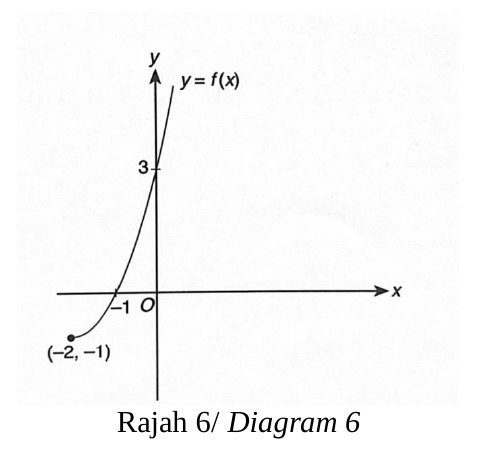
- (i)
Sketch the graph of f⁻¹(x) on the diagram provided.
[3] - (ii)
State the coordinates of the point corresponding to (−2, −1) on y = f⁻¹(x).
[1]
A quadratic function is given as f(x) = a(x − 2)² + k. The graph of f(x) passes through the point (0, 5) and has a tangent y = −3 at the minimum point. (a) Find the values of a and k. (b) Sketch the graph of f(x) = a(x − 2)² + k for the domain 0 ≤ x ≤ 4. Hence, state the change in the position of the graph when the value of h changes to 4.
Medium7 marks- (a)
Find the values of a and k.
[3] - (b)
Sketch the graph of f(x) for the domain 0 ≤ x ≤ 4 (blank axes provided). Hence, state the change in the position of the graph when the value of h changes to 4.
[4]
(a) List all possible outcomes of the following event in set notation: X is a random variable representing the number of times a picture (head) is obtained when a fair coin is tossed three times. (b) If a fair coin is tossed 6 times, find the probability that more than 3 heads are obtained.
Easy4 marks- (a)
List all possible outcomes of X in set notation.
[1] - (b)
If a fair coin is tossed 6 times, find the probability that more than 3 heads are obtained.
[3]
(a) Solve the equation 3^(x−1) = 1/9^x. (b) Given log₄[logₓ(2y − 5)] = 1/2, express y in terms of x. (c) Express x³ = e^(6x−9) in the form ln x = ax + b. Find the value of a and of b.
Medium8 marks- (a)
Solve 3^(x−1) = 1/9^x.
[3] - (b)
Given log₄[logₓ(2y − 5)] = 1/2, express y in terms of x.
[2] - (c)
Express x³ = e^(6x−9) in the form ln x = ax + b. Find a and b.
[3]
(a) The diagram shows a cube of volume 729 cm³ (the diagram is labelled 20 cm and the water level h cm). If the water level in the cube, h cm, is increasing at the rate of 0.8 cm s⁻¹, find the rate of increase of the volume of water. (b)(i) Given d/dx(5x²) = 10x, find ∫10x dx. (ii) The usage of water at school A is given by the function F = 100t³ + 20t², where F is the volume of water used, in litres, and t is the time, in days. If the rate of change of the water usage of school A changes according to dF/dt = 300t² + 50t, find the volume, in litres, used on the fourth day.
Medium7 marks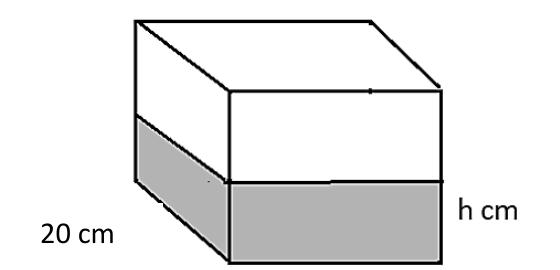
- (a)
Find the rate of increase of the volume of water.
[4] - (b)(i)
Find ∫10x dx.
[1] - (b)(ii)
Find the volume used on the fourth day.
[2]
(a) The President, the Vice President and 5 other committee members of an association attend a party. Find the number of ways the President and Vice President do not sit next to each other if they sit at a round table. (b) A travel company will arrange a holiday for 12 foreign tourists in Pangkor Island. The company has cars that can accommodate 4 passengers and vans that can accommodate 7 passengers. As a cost-saving measure, a van is filled first, followed by a car. Find the number of ways to bring the tourists on tour if (i) 3 cars are used, (ii) a van and at least one car are used, with the condition that the van must be fully filled first, followed by the car.
Medium7 marks- (a)
Number of ways the President and Vice President do not sit next to each other at a round table of 7.
[4] - (b)(i)
Number of ways if 3 cars are used.
[1] - (b)(ii)
Number of ways if a van and at least one car are used, van filled first.
[2]
The diagram shows a standard normal distribution graph (curve with −2σ, 0 and 2σ marked on the z-axis; σ written as δ). (a) State (i) the value of μ, (ii) P(−2σ < z < 2σ). (b) X is normally distributed with mean μ and variance σ² = 4 (as printed, 'σ = 4'). Find the mean μ if the z-score for X = 21 is 1.5.
Medium7 marks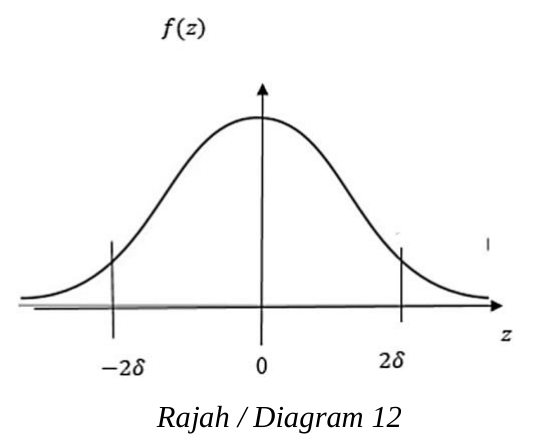
- (a)(i)
State the value of μ.
[1] - (a)(ii)
State P(−2σ < z < 2σ).
[2] - (b)
Find the mean μ if the z-score for X = 21 is 1.5.
[4]
Section B
A sailing boat moves along a path with locus equation 4x² + 3y² = 36. A speedboat moves along the straight line x − y = 2 and intersects the locus of the sailing boat. Find the points of intersection between the paths of the sailing boat and the speedboat by the graphical method for the domain −3 ≤ x ≤ 3 (printed as −3 ≤ x ≤ 4). Complete the table of values (x = −3, −2, −1, 0, 1, 2, 3; given: x − y = 2 → −1 at x = 0, and 4x² + 3y² = 36 → ±3.26 at x = 0) and draw the graphs on the graph paper provided.
Medium8 marks

Complete the table, plot both graphs and find the points of intersection (table and graph paper provided).
[8]
(a) The air pressure, in mm Hg, at an altitude of h km above sea level is given by P = 759e^(−0.325h). Find the height above sea level if the pressure at that altitude is 360 mm Hg. (b) A right-angled triangle ABC with width AB = (4 + 3√2) cm has an area of (10 + 8√2) cm². Find (i) the height BC, in cm, in the form a + b√2, (ii) the length, in cm, of AC. Give your answer correct to 3 significant figures.
Medium8 marks- (a)
Find h when P = 360.
[4] - (b)(i)
Find BC in the form a + b√2.
[2] - (b)(ii)
Find AC, correct to 3 significant figures.
[2]
Diagram 15 shows a circle with centre O inscribed in a sector PQR of a circle. The straight lines PQ and PR are tangents to the circle at points A and B. The perimeter of the quadrilateral PAOB is (4 + 4√3) cm, OP = 4 cm and BP > OB. (a) Calculate ∠QPR, in radians. (b) Find the perimeter, in cm, of the shaded region. (c) Find the area, in cm², of the shaded region.
Medium8 marks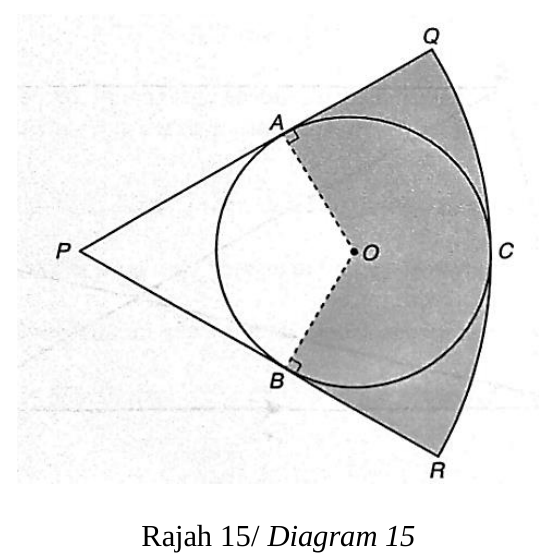
- (a)
Calculate ∠QPR, in radians.
[3] - (b)
Find the perimeter of the shaded region.
[3] - (c)
Find the area of the shaded region.
[2]