Write your answer on paper. Then open the answer to check it.
Section A
A system of linear equations in three variables is x + y + 2z = 4, 4x + 2y + 3z = 5, kx + y + z = 1. Given that the system has infinite solutions, (a) state the position of all the three planes in the three-dimensional space, (b) hence, find the value of k.
Medium5 marks- (a)
State the position of the three planes in three-dimensional space.
[1] - (b)
Hence, find the value of k.
[4]
The graph of the quadratic function g(x) = −3(x − 2)² + k passes through the point (0, −13). (a) Find the value of k. (b) Sketch the graph of the function g(x) for 0 ≤ x ≤ 4. (c) If the value of k changes to −6, generalize the effect of the change on (i) the shape and position of the graph, (ii) the equation of the axis of symmetry, (iii) its maximum value.
Medium7 marks- (a)
Find the value of k.
[1] - (b)
Sketch the graph of g(x) for 0 ≤ x ≤ 4.
[3] - (c)(i)
If k changes to −6, the effect on the shape and position of the graph.
[1] - (c)(ii)
The effect on the equation of the axis of symmetry.
[1] - (c)(iii)
The effect on its maximum value.
[1]
Diagram 1 shows a triangle ABC. Point E is the midpoint of BC and point D lies on AB such that AD : DB = 1 : 2 and N is the intersection point of AE and CD. It is given that AB→ = 14x and AC→ = 8y. (a) Express in terms of x and y, (i) AE→, (ii) CD→. (b) Given that AN→ = hAE→ and CN→ = kCD→, express AN→ in terms of (i) h, x and/or y, (ii) k, x and/or y. (c) Hence, find the value of h and of k.
Hard9 marks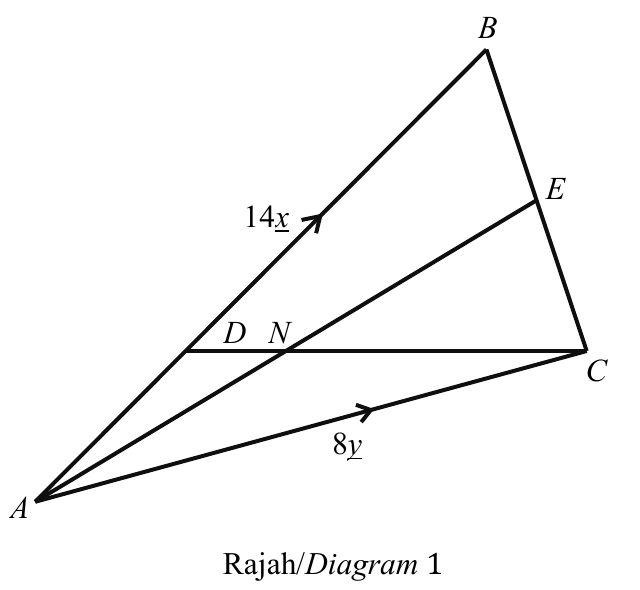
- (a)(i)
Express AE→ in terms of x and y.
[1] - (a)(ii)
Express CD→ in terms of x and y.
[2] - (b)(i)
Express AN→ in terms of h, x and y.
[1] - (b)(ii)
Express AN→ in terms of k, x and y.
[1] - (c)
Hence, find the value of h and of k.
[4]
Diagram 2 shows a vessel in the shape of an inverted cone with the base of 10 cm and the height of 20 cm. (a) If the height of the water in the vessel is h cm, show that the volume of water, V cm³, in the vessel is given by V = 1/48 πh³. (b) Hence, if the water flows out through the bottom of the vessel, (i) find the small change in the volume of water when h decreases from 5 cm to 4.99 cm. (ii) show that the approximate percentage decrease of p% in the height of the water will cause the approximate percentage decrease of 3p% in the volume.
Medium9 marks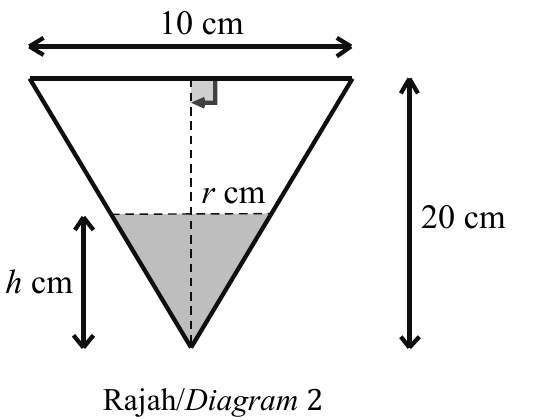
- (a)
Show that V = 1/48 πh³.
[3] - (b)(i)
Find the small change in the volume when h decreases from 5 cm to 4.99 cm.
[3] - (b)(ii)
Show that a decrease of p% in h causes a decrease of 3p% in the volume.
[3]
The number of bacteria in a refrigerated food is given by N(T) = 20T² − 80T + 500, where T is the temperature of the food in degrees Celsius with range 2 ≤ T ≤ 14. When the food is removed from the refrigerator, the temperature of the food is given by T(t) = 4t + 2, such that t is the time in hours with range 0 ≤ t ≤ 3. (a) Form a composite function to find the number of bacteria after t hours. (b) Find the time, in hours, when the bacterial count reaches 2000.
Medium5 marks- (a)
Form a composite function for the number of bacteria after t hours.
[2] - (b)
Find the time when the bacterial count reaches 2000.
[3]
Given a sequence with the sum of the first n terms Sₙ = 3n² + 7n. (a) Express Sₙ₋₁. (b) Find the nth term. (c) Show that this sequence is an arithmetic progression.
Medium8 marks- (a)
Express Sₙ₋₁.
[2] - (b)
Find the nth term.
[2] - (c)
Show that the sequence is an arithmetic progression.
[4]
(a) Given that cos α = −t for 90° < α < 180°. Express in terms of t, (i) sin 2α, (ii) tan ½α. (b) Prove that cos 2A/sin A + sin 2A/cos A = cosec A.
Medium7 marks- (a)(i)
Express sin 2α in terms of t.
[2] - (a)(ii)
Express tan ½α in terms of t.
[2] - (b)
Prove that cos 2A/sin A + sin 2A/cos A = cosec A.
[3]
Section B
Use a graph paper to answer this question. Table 1 shows the values of two variables, x and y, obtained from an experiment. The variables x and y are related by the equation y = mn^(x+1), where m and n are constants. Table: x = 1, 2, 4, 6, 8, 9; y = 6.92, 9.80, 19.40, 37.40, 74.00, 100.00. (a) Plot log₁₀y against (x + 1), using a scale of 2 cm to 2 units on the x-axis and 2 cm to 0.2 unit on the log₁₀y-axis. Hence, draw the line of best fit. (b) Use the graph in (a), find (i) m, (ii) n, (iii) x when log₁₀y = 1.7.
Medium10 marks
- (a)
Plot log₁₀y against (x + 1) and draw the line of best fit.
[4] - (b)(i)
Find m.
[2] - (b)(ii)
Find n.
[2] - (b)(iii)
Find x when log₁₀y = 1.7.
[2]
Diagram 3 shows a triangle EFG. The coordinates of point E are (h, 6) and the equations of the straight lines EG and FG are 5y = x + 22 and y = 2x + 8 respectively. (a) Find (i) the value of h, (ii) the coordinates of point G, (iii) the area of the triangle EFG. (b) A point P(x, y) moves such that it is always equidistant from two fixed points, E and the midpoint of EF. Find the equation of locus of P.
Medium10 marks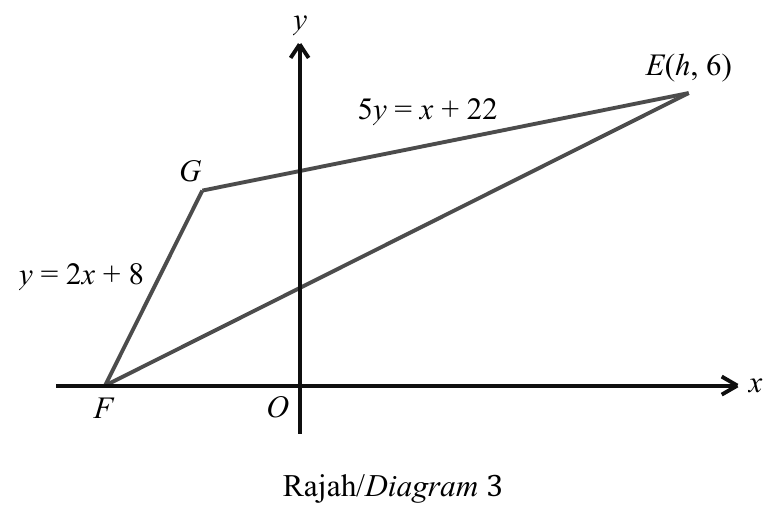
- (a)(i)
Find the value of h.
[1] - (a)(ii)
Find the coordinates of G.
[2] - (a)(iii)
Find the area of triangle EFG.
[3] - (b)
Find the equation of the locus of P.
[4]
Diagram 4 shows part of the curve x = y² + 5 and PQ is the tangent to the curve at point P(6, 1). Find (a) the equation of the tangent to the curve at point P, (b) the coordinates of point Q, (c) the area of the shaded region, (d) the generated volume, in terms of π, when the region bounded by the curve, the x-axis and the straight line x = 6, is revolved through 360° about the x-axis.
Medium10 marks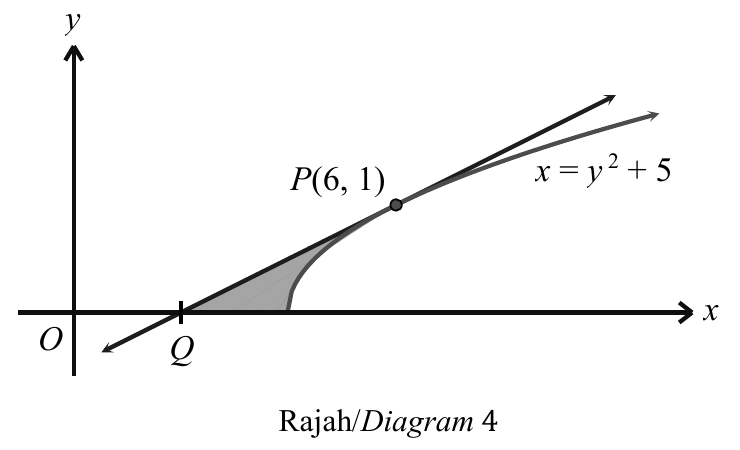
- (a)
The equation of the tangent to the curve at P.
[3] - (b)
The coordinates of Q.
[1] - (c)
The area of the shaded region.
[3] - (d)
The generated volume, in terms of π.
[3]
(a) Given that X is a discrete random variable such that X ~ B(n, 0.05). (i) Find the largest value of n such that P(X = 0) > 0.55. (ii) Using the value of n in (a)(i), find the probability such that X is at least 2. (b) The heights of students in a school are normally distributed with a mean of μ m and a standard deviation of σ m. (i) Given that 95% of the students are taller than 1.5 m and 15% of the students are taller than 1.8 m, find the value of μ and of σ. (ii) If the school has 2000 students, estimate the number of students with heights between 1.5 m and 1.8 m.
Medium10 marks- (a)(i)
Find the largest value of n such that P(X = 0) > 0.55.
[3] - (a)(ii)
Find the probability that X is at least 2.
[2] - (b)(i)
Find the value of μ and of σ.
[4] - (b)(ii)
Estimate the number of students with heights between 1.5 m and 1.8 m.
[1]
Section C
Diagram 5 shows a triangular-shaped seedbed plan ABC belonging to Mrs. Suraya. The plot AFG is planted with lemongrass, while the plot DCE is planted with pandan plants. AGDC, AFB and BEC are straight lines. The straight line FG is perpendicular to the straight line AB. Given that AD = 4.6 m, DC = 2.6 m, CE = 2.4 m, ∠BAC = 34.1° and sin ∠ACB = 49/50. (a) Calculate the length, in m, of (i) DE, (ii) EB. (b) The area of triangle AFG is equal to the area of triangle DEC. Calculate the area, in m², of the nursery site that is not planted with lemongrass and pandan plants. (c) Sketch the triangle A′B′C′ which has a different shape from triangle ABC, such that A′C′ = AC, B′C′ = BC and ∠B′A′C′ = ∠BAC.
Medium10 marks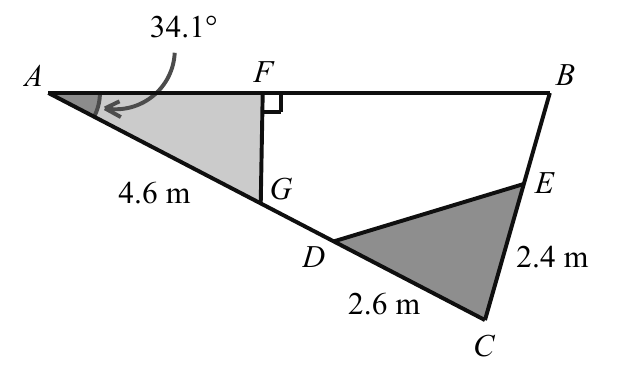
- (a)(i)
Calculate the length of DE.
[3] - (a)(ii)
Calculate the length of EB.
[2] - (b)
Calculate the area of the nursery site not planted with lemongrass and pandan.
[4] - (c)
Sketch triangle A′B′C′ with a different shape from ABC.
[1]
A particle moves in a straight line such that its velocity, v m s⁻¹, t seconds after passing through a fixed point O is given by v = −t² + 4t − 3. [Assume motion to the right is positive.] Find (a) the maximum velocity, in m s⁻¹, of the particle, (b) the initial acceleration, in m s⁻², of the particle, (c) the time, in seconds, when the particle stops instantaneously at t₁ and t₂, (d) the total distance, in m, travelled between the times t₁ and t₂.
Medium10 marks- (a)
The maximum velocity.
[2] - (b)
The initial acceleration.
[2] - (c)
The times when the particle stops instantaneously.
[3] - (d)
The total distance travelled between t₁ and t₂.
[3]
Table 2 shows the price indices for the year 2022 and 2024 based on the year 2020 of three materials A, B and C used in making a type of shoes. Material A: 105 (2022), 125 (2024). Material B: 106, 120. Material C: 110, m. (a) The price of material C in the year 2020 is RM15 and its price in the year 2024 is RM15.60. Find (i) the value of m, (ii) the price of material C in the year 2022. (b) The composite index for the production cost of the shoes in the year 2022 based on the year 2020 is 106.8. The ratio of materials A, B and C used is 4 : h : 6. (i) Find the value of h. (ii) Hence, find the corresponding price of the shoes in the year 2020 if the price of shoes in the year 2022 is RM58.20. (c) Calculate the price index of material B in the year 2024 based on the year 2022.
Medium10 marks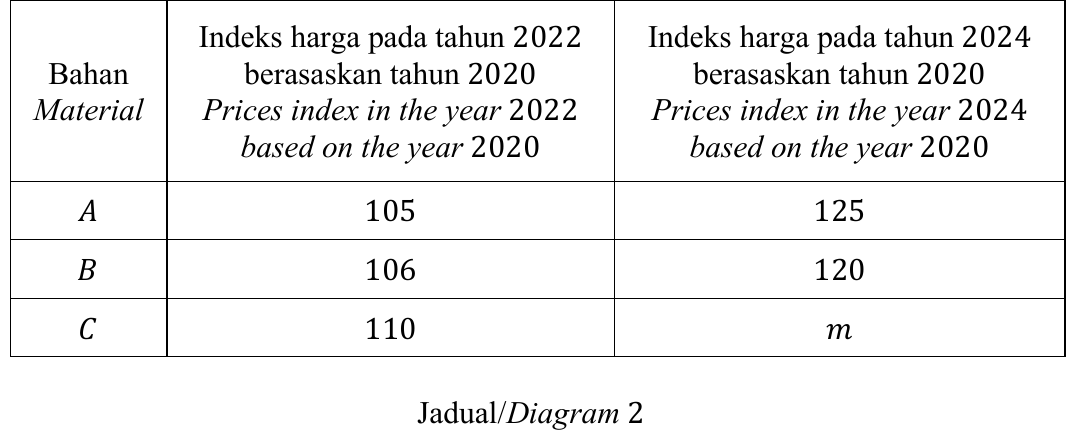
- (a)(i)
Find the value of m.
[2] - (a)(ii)
Find the price of material C in the year 2022.
[1] - (b)(i)
Find the value of h.
[3] - (b)(ii)
Find the corresponding price of the shoes in the year 2020.
[2] - (c)
Calculate the price index of material B in 2024 based on 2022.
[2]
Haikal's food stall sells beef burgers and chicken burgers. The stall can prepare to a maximum of 90 burgers in a day. The number of chicken burgers prepared exceeds the number of beef burgers by at most 30. The demand for the beef burgers is thrice less than the chicken burgers. (a) In a day, Haikal's food stall prepares x beef burgers and y chicken burgers. Write three inequalities, other than x ≥ 0 and y ≥ 0, which satisfy all the above constraints. (b) By using a scale of 2 cm to 10 burgers on both axes, construct and shade the region R which satisfies all the above constraints. (c) Use the graph constructed in (b) to answer: (i) State the maximum number of beef burgers prepared. (ii) The profits of selling a beef burger and a chicken burger are RM1.50 and RM3.00 respectively. Express the objective function, k, in terms of x and y. Hence, draw the objective function and find the maximum profit obtained.
Medium10 marks- (a)
Write three inequalities, other than x ≥ 0 and y ≥ 0.
[3] - (b)
Construct and shade the region R.
[3] - (c)(i)
State the maximum number of beef burgers prepared.
[1] - (c)(ii)
Express the objective function k; draw it and find the maximum profit.
[3]