Write your answer on paper. Then open the answer to check it.
Section A
Diagram 1 shows a three dimensional graph represented by the x-axis, y-axis and z-axis. The variables x, y and z are represented by the equations 4x − 3y + z = −10, 2x + y + 3z = 0, −x + 2y − 5z = 17. Mark the coordinates of P, which is the intersection point for the 3 equations in Diagram 1.
Medium6 marks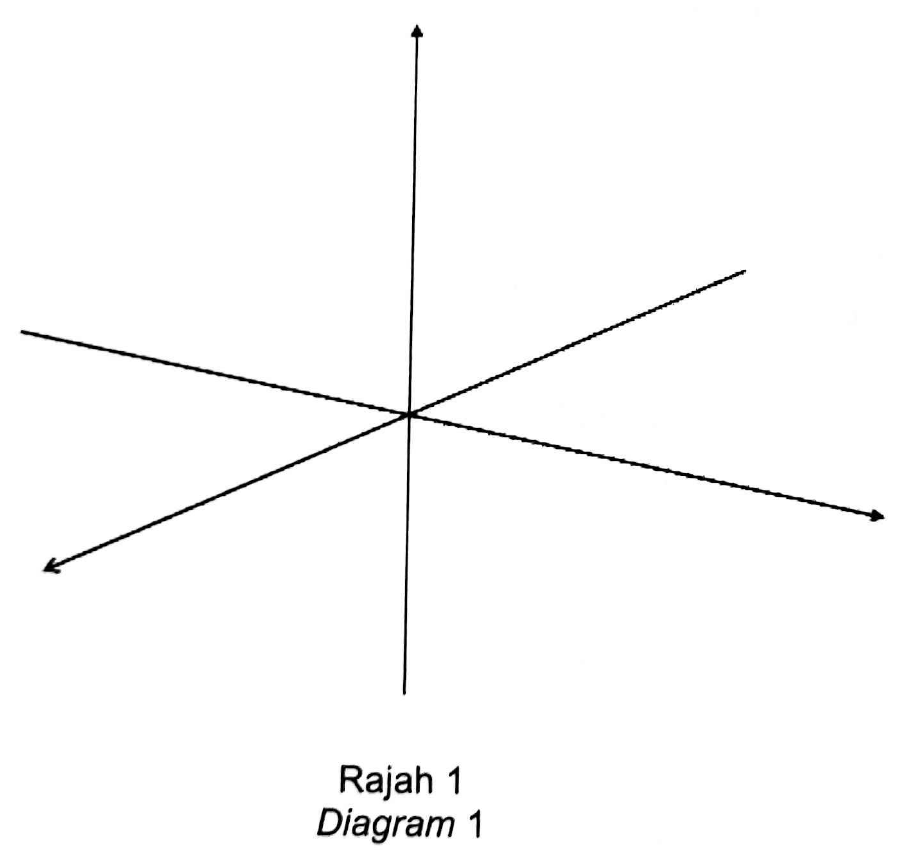
Mark the coordinates of P, the intersection point of the 3 equations, on Diagram 1.
[6]
Diagram 2 shows the curve y = abˣ, such that a and b are constants. The curve passes through P(1, 4) and Q(3, 32).
Easy5 marks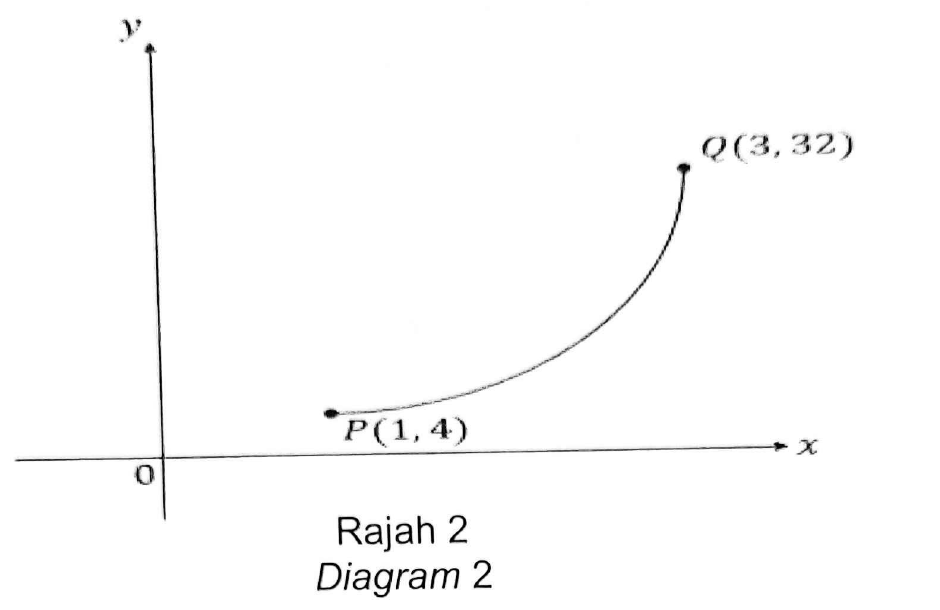
- (a)
When a straight line log₂ y against x is plotted, state the corresponding coordinates of P and of Q.
[2] - (b)
Hence, express y in index form.
[3]
Given the functions gⁿ(x) = −2(3 − 1/x), x ≠ 0, and h⁻ⁿ(x) = 4 − (2/3)x, where n is an integer and range 0 < n < 2. Find parts (a) to (c).
Medium6 marks- (a)
The function g⁻ⁿ(x).
[2] - (b)
The range of gⁿ(x) if x ≥ 5.
[2] - (c)
The value of x, if gⁿ(x) − 2 = h⁻ⁿ(3/2).
[2]
(a) Solve the quadratic equation 3x² − 5x + 3 = 0. Give the answer in the form a + bi. (b) The quadratic equation (x² + 1)h + k = (2h − k)x has two equal real roots, determine the ratio h : k.
Easy6 marks- (a)
Solve 3x² − 5x + 3 = 0. Give the answer in the form a + bi.
[3] - (b)
The equation (x² + 1)h + k = (2h − k)x has two equal real roots. Determine the ratio h : k.
[3]
(a) Solve 28√(3ˣ) − 3^(x+1) = 9 with the condition x > 0. (b) Given log₃ P = a and log₉ Q = b, express 25^(log₅(Q/P)) in terms of a and b.
Medium6 marks- (a)
Solve 28√(3ˣ) − 3^(x+1) = 9, x > 0.
[3] - (b)
Given log₃ P = a and log₉ Q = b, express 25^(log₅(Q/P)) in terms of a and b.
[3]
Diagram 3 shows a circle centred at O. Given that the ratio of the major arc PQ to the perimeter of the minor sector OPQ is 3 : 2, find the value of the angle θ in degrees.
Medium4 marks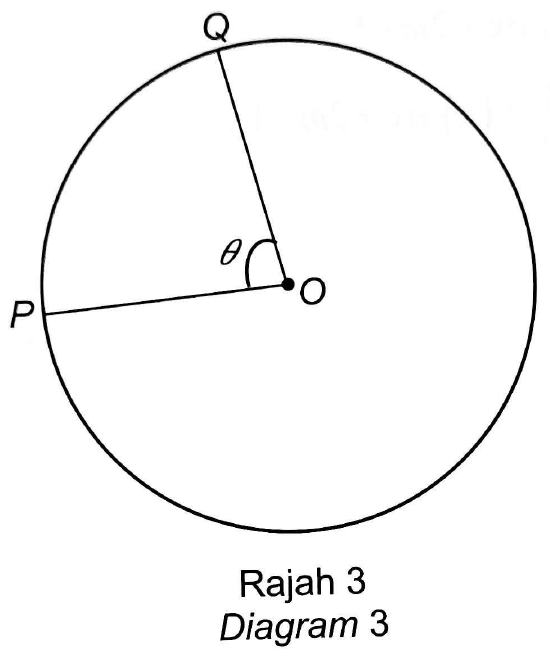
Find the value of θ in degrees.
[4]
Given the quadratic function f(x) = −2(x − 3)² − 3. (a) Find the value of ∫ₚᵖ f(x) dx. (b) Find the value of m, if ∫₁² f(x) dx = 2m − 1.
Medium4 marks- (a)
Find the value of ∫ₚᵖ f(x) dx.
[1] - (b)
Find the value of m, if ∫₁² f(x) dx = 2m − 1.
[3]
Given that A(−6, 12) and B(2, 3) are two points on the Cartesian plane and OC→ + 4OB→ = OA→, find (a) the coordinates of point C, (b) |AC→|, (c) the unit vector of AC→.
Easy5 marks- (a)
Coordinates of point C.
[2] - (b)
|AC→|.
[2] - (c)
The unit vector of AC→.
[1]
X is a continuous random variable which is normally distributed with a mean of 48 and a variance of 144. Find (a) the value of the Z-score when X is 63.2, (b) the value of k when P(X < k) = 0.3483.
Easy4 marks- (a)
The value of the Z-score when X is 63.2.
[2] - (b)
The value of k when P(X < k) = 0.3483.
[2]
In a survey conducted on students in a school, it was found that 1 out of 5 students do not have a smartphone. (a) If 6 students are randomly selected from the school, find the probability that at least 3 people do not have a smartphone. (b) If the number of students in the school is 705, calculate the standard deviation of the number of students who do not own a smartphone.
Medium4 marks- (a)
If 6 students are randomly selected, find the probability that at least 3 do not have a smartphone.
[3] - (b)
Calculate the standard deviation of the number of students who do not own a smartphone (705 students).
[1]
(a) Using trigonometric ratios for special angles without using a calculator, find the value of (i) cos(−225°), (ii) cot(5π/3). (b) Solve the trigonometric equation sin x (sin x − 2) = cos 2x for 0 ≤ x ≤ 2π. Give the answers in terms of π.
Medium8 marks- (a)(i)
cos(−225°), without a calculator.
[2] - (a)(ii)
cot(5π/3), without a calculator.
[2] - (b)
Solve sin x (sin x − 2) = cos 2x for 0 ≤ x ≤ 2π. Give the answers in terms of π.
[4]
(a) A box contains 10 ping pong balls labelled with different 1 digit numbers. Find (i) the number of ways to choose 4 ping pong balls from the box, (ii) the number of ways to choose 5 ping pong balls from the box, if all ping pong balls with prime numbers must be selected. (b) Diagram 4 shows eight labelled cards: A N U G E R A H. Calculate the number of different ways to arrange all the cards in one row if (i) there is no restriction, (ii) vowels must be arranged together.
Easy6 marks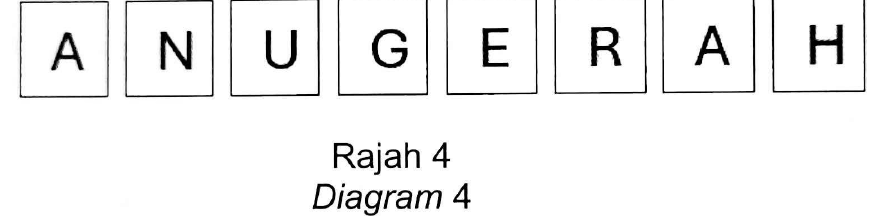
- (a)(i)
Number of ways to choose 4 ping pong balls from the box (10 balls).
[1] - (a)(ii)
Number of ways to choose 5 balls if all balls with prime numbers must be selected.
[2] - (b)(i)
Number of different ways to arrange all 8 cards in one row, no restriction.
[1] - (b)(ii)
Number of different ways to arrange the cards if vowels must be arranged together.
[2]
Section B
(a) In an arithmetic progression, the sum of the first four terms is 34 and the sum of the next four terms is 82. Find the first term and the common difference. (b) Two tanks, Tank 1 and Tank 2, contain 3500 litres and 2700 litres of oil respectively. Because of leakage, the oil is measured again every 20 minutes. The amount of oil follows a geometric pattern: Tank 1 decreases by 12% and Tank 2 by 9% every 20 minutes. If the observation starts at 1 o'clock in the afternoon, at what time will the amount of oil in Tank 1 be less than in Tank 2 for the first time? [Tank 1 and Tank 2 are the same specification.]
Medium8 marks- (a)
Find the first term and the common difference.
[3] - (b)
At what time will the amount of oil in Tank 1 first be less than in Tank 2?
[5]
(a) Diagram 5 shows two straight lines L₁ and L₂ with gradients m₁ and m₂ respectively (angles θ₁ and θ₂, points B and A on the x-axis, C the intersection). If L₁ and L₂ are perpendicular at point C, show that m₁ × m₂ = −1. (b) Given the coordinates of point P and point Q are (5, 2) and (3, 5) respectively. The straight line QR is perpendicular to line PQ and intersects the x-axis at point R. Find (i) the equation of straight line QR, (ii) the coordinates of point R.
Medium8 marks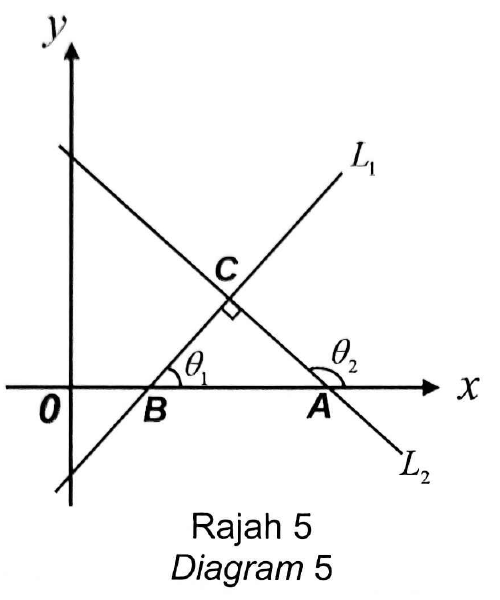
- (a)
Show that m₁ × m₂ = −1 if L₁ and L₂ are perpendicular at C.
[3] - (b)(i)
The equation of straight line QR.
[3] - (b)(ii)
The coordinates of point R.
[2]
(a)(i) Find f′(x) for f(x) = 3x² + 1 using differentiation by the first principles. (ii) Find the first derivative of the function f(x) = (1/2)x² − 3x. (b) The volume of a sphere decreases at a rate of 2.5π cm³ s⁻¹. Find the rate of change of the radius of the sphere when the radius is 5 cm. [Volume of a sphere, V = (4/3)πr³]
Medium8 marks- (a)(i)
Find f′(x) for f(x) = 3x² + 1 using the first principles.
[3] - (a)(ii)
Find the first derivative of f(x) = (1/2)x² − 3x.
[1] - (b)
Find the rate of change of the radius when r = 5 cm (volume decreases at 2.5π cm³ s⁻¹).
[4]