Write your answer on paper. Then open the answer to check it.
Section A
Vectors a and b are non-zero and not parallel. (a) Given (h − 3)a = (k + 2)b, where h and k are constants, find h and k. (b) Given a = 2i + kj and b = 17i + 5j, find the values of k if |b − a| = 17 units.
Medium5 marks- (a)
Given (h − 3)a = (k + 2)b, where h and k are constants, find h and k.
[2] - (b)
Given a = 2i + kj, b = 17i + 5j, find the values of k if |b − a| = 17 units.
[3]
Diagram 1 shows the location of four houses P, Q, R and S in a village on a Cartesian plane: S on the y-axis at (0, 6), Q(4, m), R(9, 12), P on the x-axis. The equation of the road connecting P to R is 6x − 3y = 18. (a) Write the equation in the form x/a + y/b = 1. State the coordinates of P. (b) Q lies between P and R such that 5PQ = QR. Find the value of m. (c) A lane connecting P to S is perpendicular to the road through P, Q and R. Find the gradient of the lane.
Easy5 marks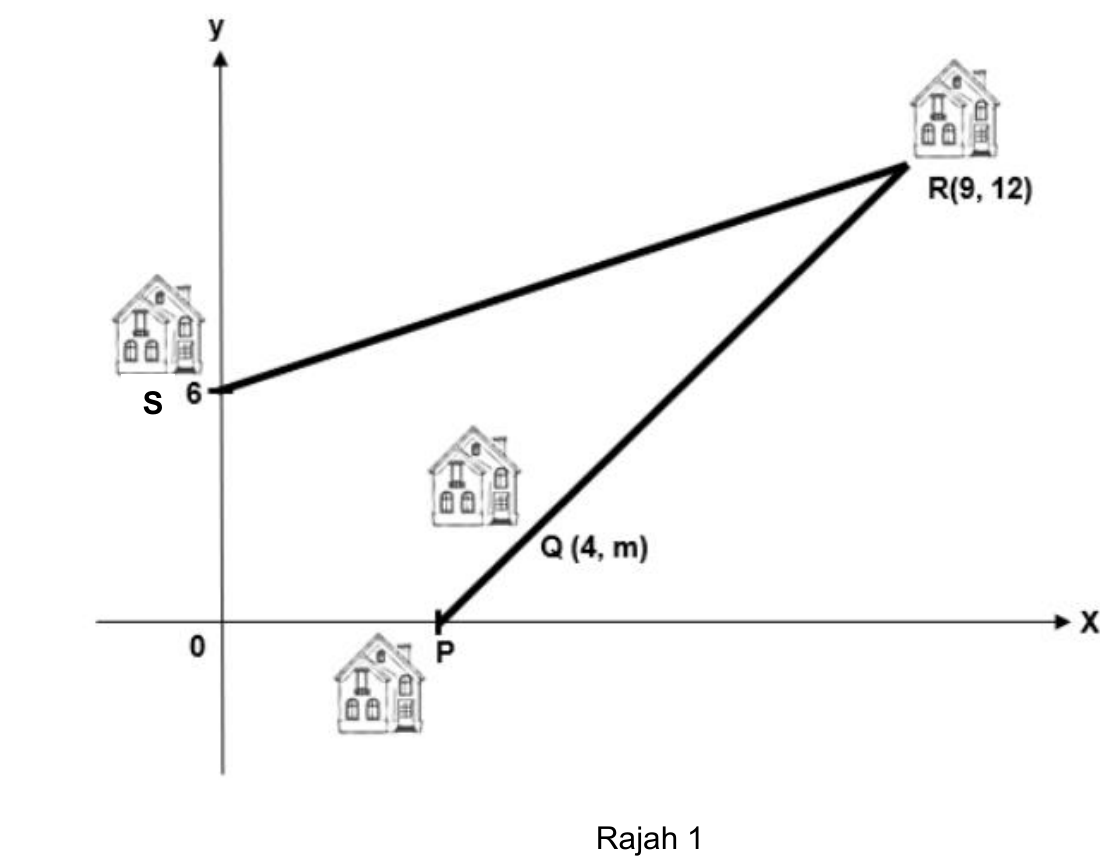
- (a)
Write 6x − 3y = 18 in the form x/a + y/b = 1. State the coordinates of house P.
[2] - (b)
Q is between P and R such that 5PQ = QR. Find the value of m.
[2] - (c)
Find the gradient of the lane PS, perpendicular to the road PQR.
[1]
(a) A function f is defined by f : x → x² − 3 for 0 ≤ x ≤ 3. (i) Draw the graph of f on the axes given in Diagram 2. (ii) Draw the graph of f⁻¹ on the same plane and state the domain of f⁻¹. (b) Given f(x) = 1/(2 − x), x ≠ 2, find the values of m such that f(m − 1) = ½ f⁻¹(m).
Medium6 marks- (a)(i)
Draw the graph of f(x) = x² − 3, 0 ≤ x ≤ 3, on Diagram 2.
[1]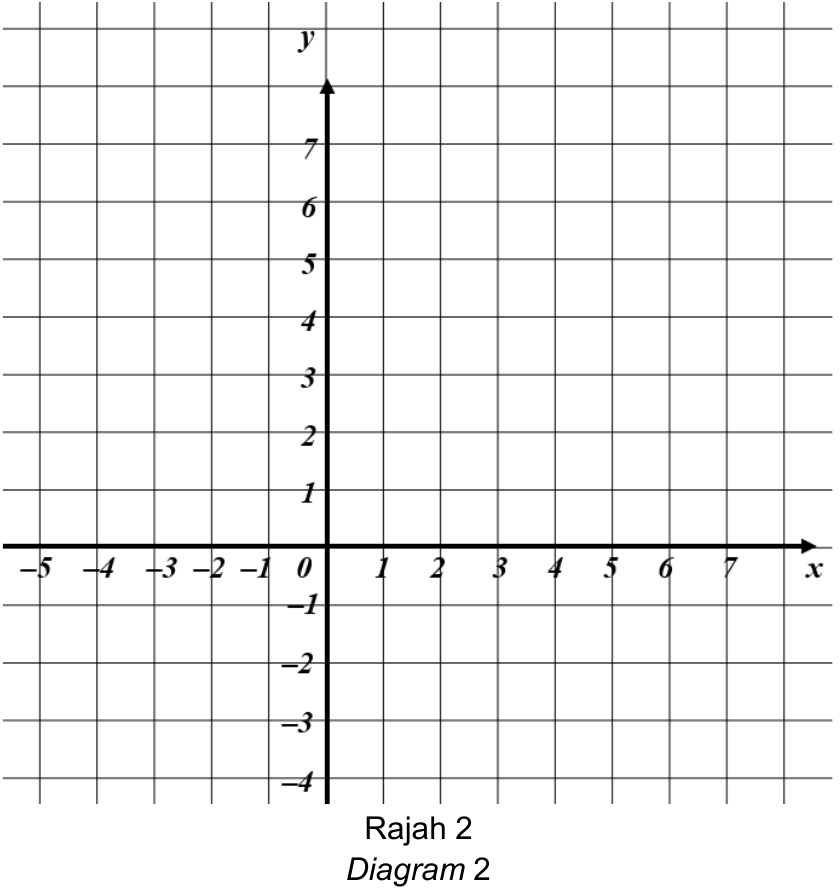
- (a)(ii)
Draw the graph of f⁻¹ on the same plane. State the domain of f⁻¹.
[2] - (b)
Given f(x) = 1/(2 − x), x ≠ 2, find the values of m such that f(m − 1) = ½ f⁻¹(m).
[3]
The quadratic equation x² − 8x + 7 = 0 has roots h and k, where h > k. (a) Find the value of h and of k. (b) Hence, form the quadratic equation which has roots h + 3 and 2k − 1.
Easy5 marks- (a)
Find the value of h and of k.
[2] - (b)
Form the quadratic equation which has roots h + 3 and 2k − 1.
[3]
(a) Convert log₆ 254 to natural logarithms and evaluate. (b) Given logₙ 2 = p and logₙ 3 = q, express log₃ 16n² in terms of p and q.
Easy5 marks- (a)
Convert log₆ 254 to natural logarithms and evaluate.
[2] - (b)
Given logₙ 2 = p and logₙ 3 = q, express log₃ 16n² in terms of p and q.
[3]
Diagram 3 shows a curve through the points (5, 2) and (11, 4). The variables x and y are related by the linear equation y² = Mx + N, where M and N are constants. (a) Find the value of M and of N. (b) Sketch a linear graph of y² against x.
Easy4 marks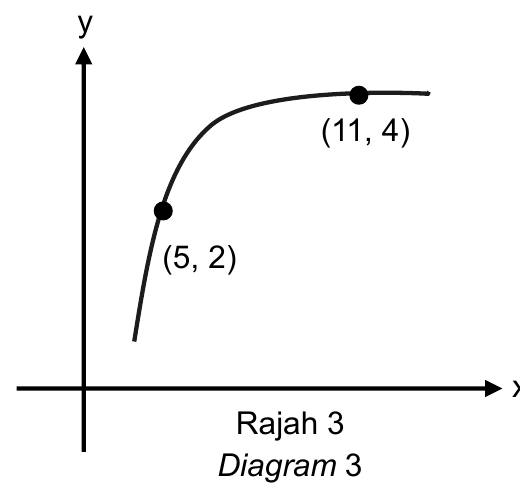
- (a)
Find the value of M and of N.
[2] - (b)
Sketch a linear graph of y² against x.
[2]
Alyaa sells chocolate bouquets during the semester break to cover her study fee of RM1 400. The price of a small bouquet is RM50, medium RM80 and large RM100. The cost of producing a small bouquet is RM30, medium RM50 and large RM65. Alyaa spent RM2 400 making the bouquets. The demand for small bouquets is 2 times the medium bouquets. What are the minimum numbers of bouquets of each size that Alyaa must sell so that she can pay her study fee?
Medium6 marksFind the minimum number of small, medium and large bouquets to be sold.
[6]
Diagram 5 shows part of the curve y = (2/5)x(8 − x)³ with stationary points M and N. (a) Find the coordinates of the two stationary points M and N. (b) Hence, determine the nature of stationary point N by using the tangent sketching method.
Medium7 marks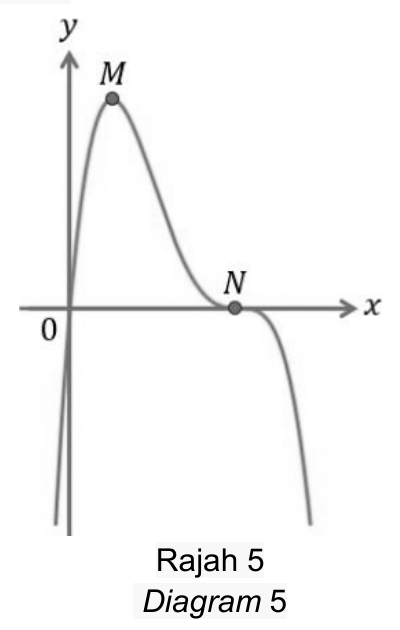
- (a)
Find the coordinates of the stationary points M and N.
[4] - (b)
Determine the nature of N by the tangent sketching method.
[3]
42% of pupils in a school use school buses. A sample of 3 pupils is randomly selected and X is the number who use school buses. (a) X ~ B(3, p). State the value of p. (b) Complete the binomial probability distribution table (Table 1: P(X = 0) = 0.20, P(X = 1) = 0.42, P(X = 2) and P(X = 3) blank). (c) Construct the graph for this distribution in Diagram 6 (blank axes).
Easy5 marks- (a)
State the value of p for X ~ B(3, p).
[1] - (b)
Complete Table 1 for P(X = 2) and P(X = 3).
[2]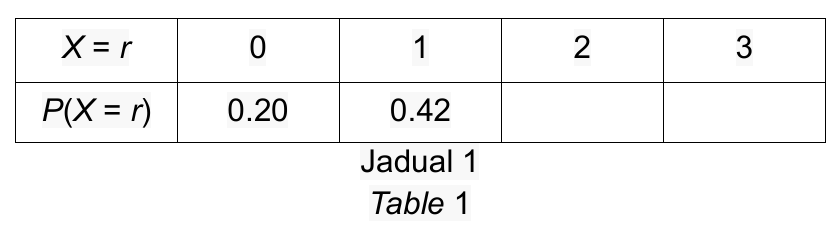
- (c)
Construct the graph of the distribution on Diagram 6.
[2]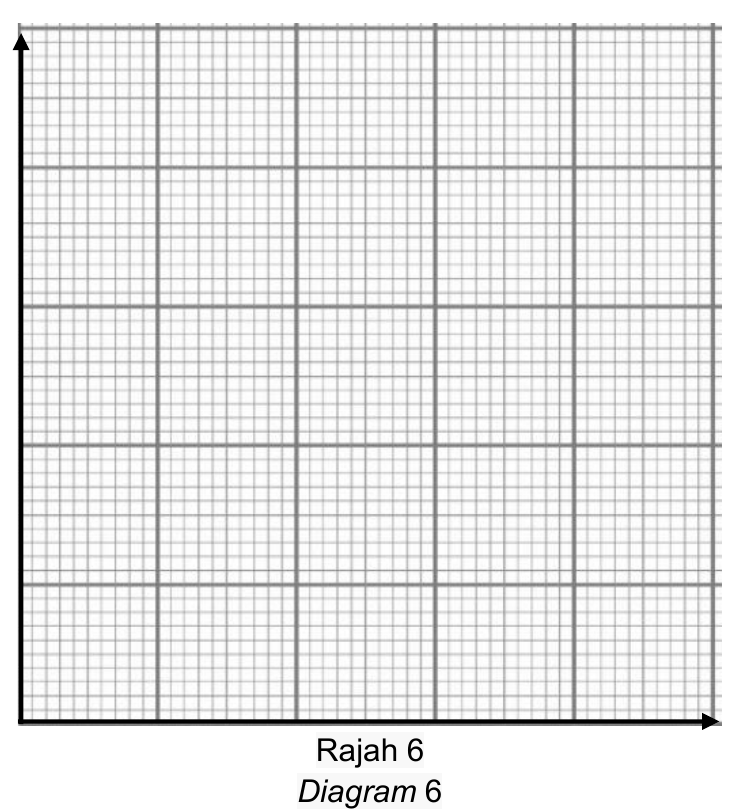
Diagram 7 shows part of the curve y = f(x) which passes through the points (h, 0) and (4, 7); the shaded region is bounded by the axes, the line y = 7 and the curve. (a) Given the area of the shaded region is 22 unit², find the value of ∫ from h to 4 of f(x) dx. (b) The rate of temperature increase, θ°, with respect to time t seconds is dθ/dt = ½(12 − t). Find θ in terms of t if θ = 4 when t = 6.
Medium5 marks- (a)
Find ∫ f(x) dx from h to 4, given the shaded area is 22 unit².
[2]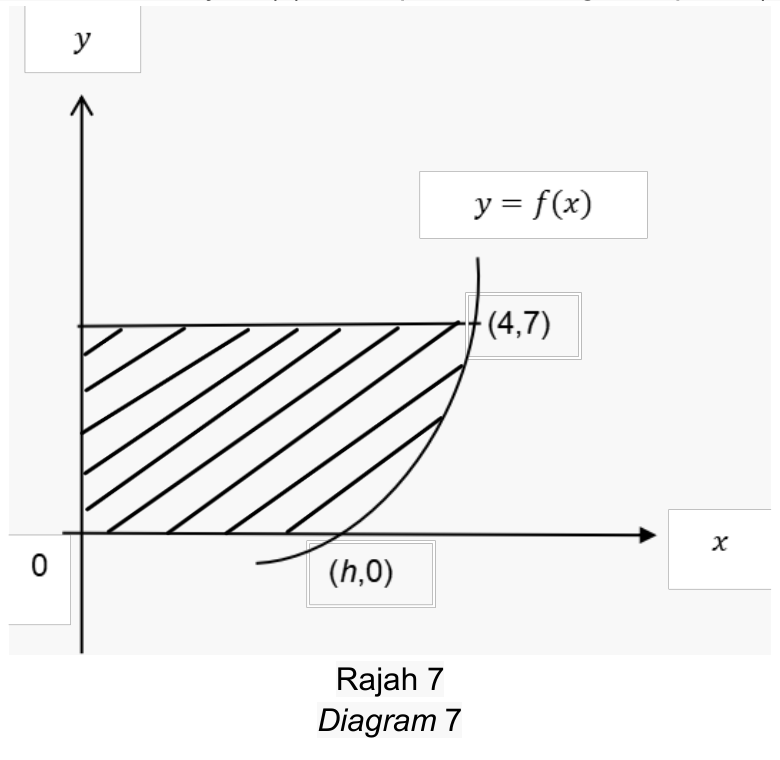
- (b)
Find θ in terms of t if dθ/dt = ½(12 − t) and θ = 4 when t = 6.
[3]
(a) Find the number of ways to arrange the letters of each word 'PARU' and 'PARA' if no repetition is allowed. Are the numbers of ways the same? Explain. (b) A team of five members is selected for an expedition from four swimmers and three mountain climbers. Find the number of ways the team can be formed if (i) there is no condition, (ii) swimmers must be more than mountain climbers.
Medium6 marks- (a)
Arrange the letters of PARU and PARA. Are the numbers the same? Explain.
[3] - (b)(i)
Number of ways with no condition.
[1] - (b)(ii)
Number of ways with more swimmers than mountain climbers.
[2]
Diagram 8 shows a sector OAB of a circle with centre O. The point C lies on OB such that OC : OB = 3 : 5 and angle OCA is a right angle. (a) Calculate the value of θ (angle AOB), in radians. (b) If the radius of sector OAB is 18 cm, calculate the area of the shaded region, in cm².
Easy5 marks- (a)
Calculate θ, in radians.
[2]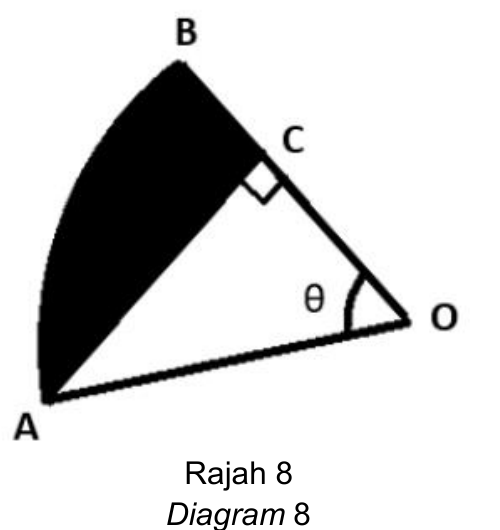
- (b)
Radius 18 cm. Calculate the area of the shaded region, in cm².
[3]
Section B
(a) Given sin A = 3/5 and cos B = −24/25, where A is an acute angle and B is a reflex angle, find (i) 1/sec A, (ii) cos(A − B), (iii) cos(A/2). (b) Solve the trigonometric equation 2 sin²x = 3 sin x + 2 for 0° ≤ x ≤ 360°.
Medium8 marks- (a)(i)
Find 1/sec A.
[1] - (a)(ii)
Find cos(A − B).
[2] - (a)(iii)
Find cos(A/2).
[2] - (b)
Solve 2 sin²x = 3 sin x + 2 for 0° ≤ x ≤ 360°.
[3]
(a) Determine whether √16 is a surd or not. Give your reason. (b) Solve ln(3x − 5) = 6. (c) Diagram 9 shows three circles. Circle J has radius 6 cm and circle K has radius 3 cm. The small circle has radius r cm. MN is a common tangent and all circles touch one another. Show that r = 6/(3 + 2√2).
Medium8 marks- (a)
Is √16 a surd? Give your reason.
[1] - (b)
Solve ln(3x − 5) = 6.
[2] - (c)
Show that r = 6/(3 + 2√2).
[5]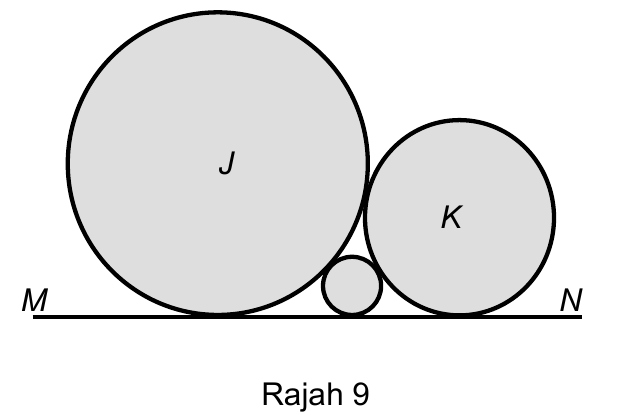
An engineer celebrates his 34th birthday on 31 December 2024. He is offered a senior engineer position by company A and company B and will start work on 1 January 2025. Company A offers RM7 500 a month with an annual increase of RM340. Company B offers RM7 800 a month with an annual increase of 4% of the salary of the previous year. (a) Based on the total salary offered by the two companies, which company would the engineer choose if he plans to retire at the age of 58 in that company? (b) Hence, find the engineer's last monthly salary if the company offers a monthly increase of 1% per month for him to continue working until the age of 60.
Medium8 marks- (a)
Which company should he choose (retire at 58)?
[4] - (b)
Find his last monthly salary if the monthly increase is 1% per month until age 60.
[4]