Write your answer on paper. Then open the answer to check it.
Section A
Diagram 1 shows the straight line 3x + 2y = 1 intersecting the curve 3x + y² = 16 at points A and B. Find the coordinates of A and B.
Medium6 marks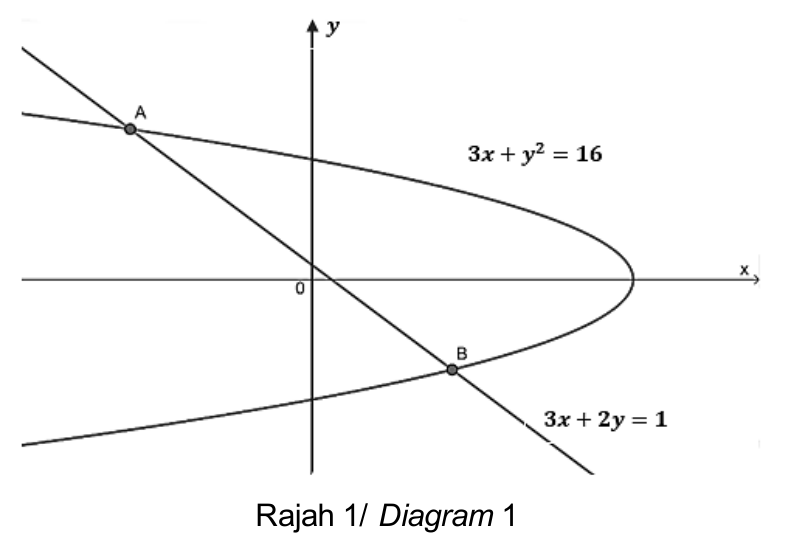
Find the coordinates of point A and point B.
[6]
The function f(x) = x² − 6kx + 10k² + 1 has a minimum value r² + 2k, where r and k are constants. (a) By completing the square, show that r = k − 1. (b) Hence, find the values of k and of r if the graph of the function is symmetrical about x = r² − 1.
Medium8 marks- (a)
By completing the square, show that r = k − 1.
[4] - (b)
Find k and r if the graph is symmetrical about x = r² − 1.
[4]
(a) Diagram 2(i) shows the graph of g(x) = |3x − 2| for the domain 0 ≤ x ≤ 4, with y-intercept 2 and the graph touching the x-axis at x = n. State the value of n. (b) Given f : x → px + q, p > 0 and f² : x → 4x + 9, find the value of p and of q. (c) In Diagram 2(ii), function f maps x to y and function g maps y to z (4 → 22 under f; 2 → 12 under g). Given f(x) = ax − 2 and g(y) = 12/(y − b), find (i) the value of a and of b, (ii) the function which maps x onto z.
Medium8 marks- (a)
State the value of n.
[1]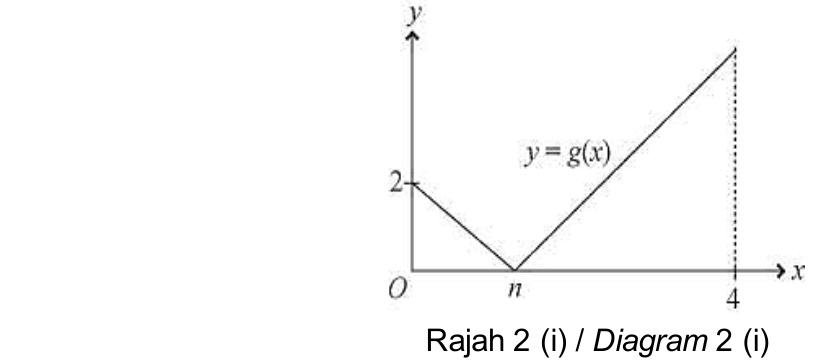
- (b)
Given f(x) = px + q, p > 0, f²(x) = 4x + 9, find p and q.
[2] - (c)(i)
Find the value of a and of b.
[3]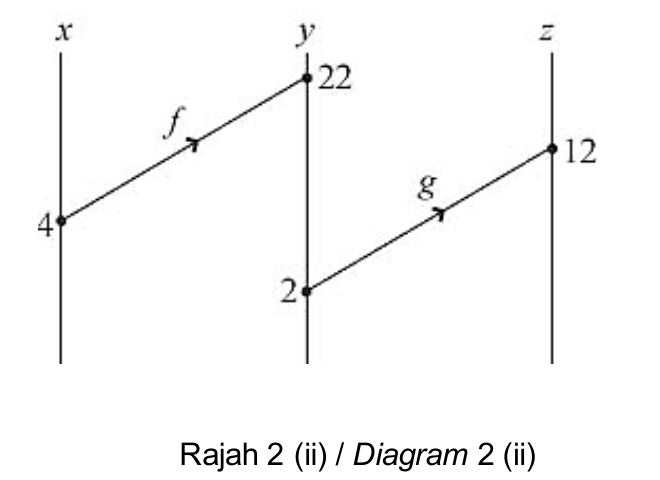
- (c)(ii)
Find the function which maps x onto z.
[2]
(a) Diagram 3 shows three right-angled triangles with base and height: (k cm, k cm), (k cm, (k + 1) cm), (k cm, (k + 2) cm). Show that the areas of the triangles follow an arithmetic progression. Hence, find the sum of the first n terms of this progression in terms of n, if k = 4. (b) A piece of string of length 45 m is cut into several pieces such that the lengths of the pieces form an arithmetic progression. The shortest piece is 50 cm and the longest is 4 m. Find the number of pieces.
Medium7 marks- (a)
Show the areas follow an AP; find Sₙ in terms of n if k = 4.
[5]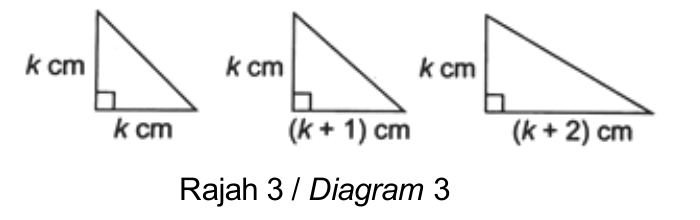
- (b)
Find the number of pieces of string.
[2]
Milk is poured into a hemispherical bowl of radius 4 cm at the rate of 3π cm³ s⁻¹. If the depth of the milk is h cm, its volume is V = π(4h² − h³/3). (a) Find the rate of change of h when the depth of the milk is 3/2 cm. (b) Given that the radius of the milk surface is r = √(8h − h²), determine the small change of the radius of the milk surface if the depth of milk decreases by 5% from h = 1 cm.
Medium7 marks- (a)
Find dh/dt when h = 3/2 cm.
[3] - (b)
Find the small change in r when h decreases 5% from h = 1 cm.
[4]
Diagram 4 shows two circles with centres A and B which intersect at C and D. The radius of the small circle (centre A) is 5 cm and the radius of the large circle (centre B) is 11 cm. BC and BD are tangents to the small circle. [Use π = 3.142] Find (a) ∠CAD, in radians, (b) Hence, the area, in cm², of the shaded region (the region common to both circles).
Medium7 marks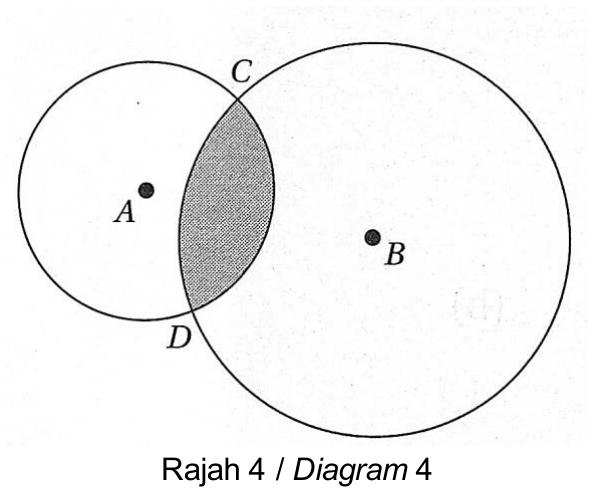
- (a)
Find ∠CAD, in radians.
[2] - (b)
Find the area of the shaded region, in cm².
[5]
(a) Prove that 1 + cos θ = sin²θ/(1 − cos θ). (b) Sketch the graph of the trigonometric function y = −6 cos 2x for the domain 0 ≤ x ≤ 2π.
Medium7 marks- (a)
Prove 1 + cos θ = sin²θ/(1 − cos θ).
[3] - (b)
Sketch y = −6 cos 2x for 0 ≤ x ≤ 2π.
[4]
Section B
(a) The tangents to two curves have gradients 4x − 5 and px − 3 respectively. The two curves intersect at right angles at the point (2, 3). (i) Calculate the value of p. (ii) Find the equation of the curve which has gradient of tangent 4x − 5. (b) Diagram 5 shows part of the curve y = √(x + 6), the straight line x = k and the straight line AC, where A is at x = 3 on the x-axis, C is on the curve directly above A and D is on the curve at x = k. When the shaded region is revolved through 360° about the x-axis, the volume generated is 42½π unit³. Find the value of k.
Hard10 marks- (a)(i)
Calculate p.
[2] - (a)(ii)
Find the equation of the curve with gradient 4x − 5.
[3] - (b)
Find k when the volume generated is 42½π unit³.
[5]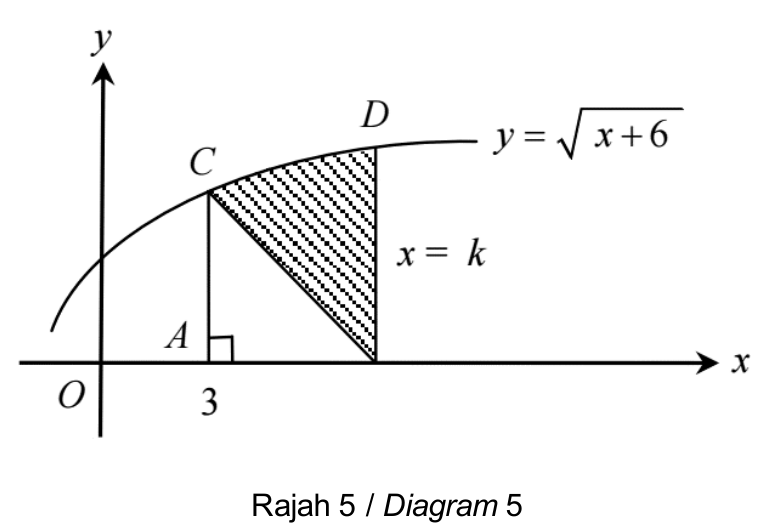
Point S moves along the circumference of a circle with centre P(−1, 3). The circumference passes through the points Q(3, 0) and R(−4, m). (a) Find (i) the equation of the locus of the point S, (ii) the values of m. (b) The tangent to the circle at Q cuts the y-axis at point T. Find the area of triangle PQT.
Medium10 marks- (a)(i)
Find the equation of the locus of S.
[3] - (a)(ii)
Find the values of m.
[2] - (b)
Find the area of triangle PQT.
[5]
(a) A durian is chosen randomly from several baskets. The probability that a chosen durian is rotten is 0.1. Find the standard deviation of the number of good durians in a sample of 500 durians. (b) The mass of mangosteens is normally distributed with mean 260 g and standard deviation 35 g. Table 1 shows the grades: A: X > 300; B: 200 < X ≤ 300; C: k < X ≤ 200 (X = mass in g). (i) If a mangosteen is chosen at random, calculate the probability that it is grade A. (ii) A basket has 600 mangosteens. Estimate the number of grade B mangosteens. (c) If 99% of the mangosteens can be graded and sold, calculate the minimum mass in grams of a mangosteen that can be graded and sold.
Medium10 marks- (a)
Find the standard deviation of the number of good durians in 500.
[2] - (b)(i)
Probability that a mangosteen is grade A.
[2]
- (b)(ii)
Estimate the number of grade B mangosteens in 600.
[3] - (c)
Find the minimum mass that can be graded and sold.
[3]
Table 2 shows values of two variables x and y from an experiment: x = 2.5, 3, 4, 5, 6, 7; y = 1.75, 1.8, 2, 2.3, 2.6, 3. The variables are related by y = p/x + (q/p)x, where p and q are constants. (a) Using a scale of 2 cm to 10 units on the x²-axis and 2 cm to 2 units on the xy-axis, plot xy against x². Hence, draw the line of best fit. (b) Using the graph in (a), find the value of (i) y when x² = 4, (ii) p and q.
Medium10 marks- (a)
Plot xy against x² and draw the line of best fit.
[5]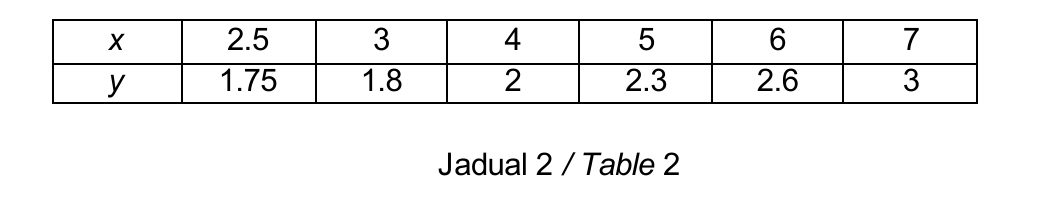
- (b)(i)
Find y when x² = 4.
[1] - (b)(ii)
Find p and q.
[4]
Section C
Diagram 6 shows a right prism ABCDEF. The length and breadth of the base BCFE are 12 cm and 5 cm. Calculate (a) CD, (b) the angle between BD and CD, (c) the area of triangle BCD, (d) the angle between the plane BCD and the plane BCFE.
Medium10 marks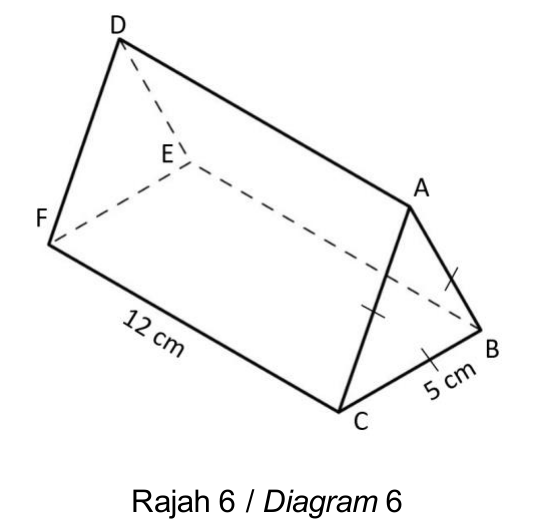
- (a)
Calculate CD.
[2] - (b)
Calculate the angle between BD and CD.
[3] - (c)
Calculate the area of triangle BCD.
[2] - (d)
Calculate the angle between the plane BCD and the plane BCFE.
[3]
Table 3 shows the price indices in 2023 based on 2017 (2017 = 100) of four materials P, Q, R and S used to produce a pair of shoes, with weightages: P index 140 weight 2m; Q 135, 3; R 120, 1; S 130, m. (a) Given the price of material P is RM3.00 in 2017, calculate its price in 2023. (b) Given the composite index for 2023 based on 2017 is 134.5, find the value of m. (c) Find the price of a pair of shoes in 2017 if its corresponding price in 2023 is RM45. (d) The price of material S is estimated to increase by 25% from 2023 to 2024, while the other materials remain unchanged. Calculate the composite index of a pair of shoes for 2024 based on 2017.
Easy10 marks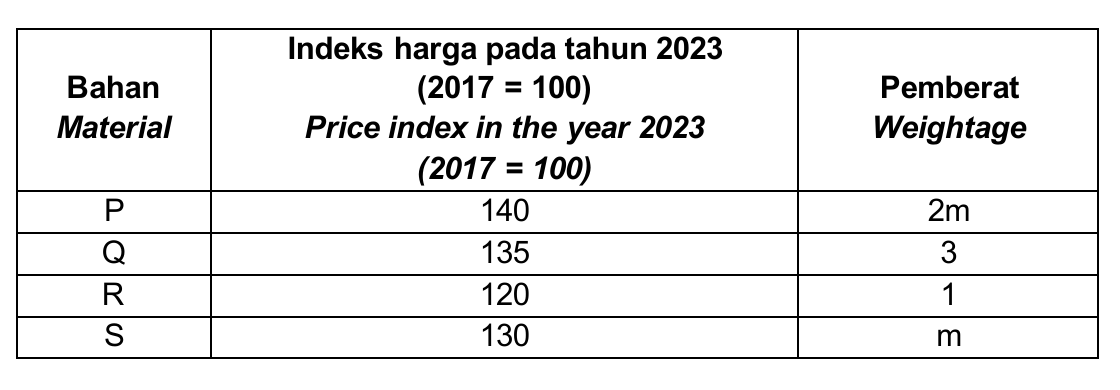
- (a)
Price of P in 2023.
[2] - (b)
Find m given composite index 134.5.
[3] - (c)
Price of a pair of shoes in 2017.
[2] - (d)
Composite index for 2024 based on 2017.
[3]
A particle moves along a straight line passing through a fixed point O. Its velocity, v m s⁻¹, t seconds after passing O is v = 3t² − 9t + 6. (a) Calculate the initial acceleration of the particle. (b) Find the values of t when the particle stops instantaneously. (c) Calculate the minimum velocity attained by the particle. (d) Calculate the total distance travelled by the particle from t = 0 to t = 6.
Medium10 marks- (a)
Initial acceleration.
[2] - (b)
Values of t when the particle stops instantaneously.
[2] - (c)
Minimum velocity.
[3] - (d)
Total distance from t = 0 to t = 6.
[3]
Harmoni Community College offers Zapin and Ballet dancing classes. The monthly fee per student is RM30 for Zapin and RM60 for Ballet. The number of students in the Zapin class is x and in the Ballet class is y. The constraints are: I: the total number of students is not more than 40. II: the total monthly fees collected is at least RM1200. III: the number of Ballet students is at most twice the number of Zapin students. (a) Write three inequalities, other than x ≥ 0 and y ≥ 0, which satisfy all the constraints. (b) Using a scale of 2 cm to 5 students on both axes, construct and shade the region R which satisfies all the constraints. (c) Use your graph in (b) to find (i) if 10 students are enrolled for Ballet, the range of the number of students that can be enrolled for Zapin, (ii) the maximum total fees that can be collected in a month.
Hard10 marks- (a)
Write three inequalities for the constraints.
[3] - (b)
Construct and shade region R (scale 2 cm to 5 students).
[3] - (c)(i)
If 10 students are in Ballet, the range of Zapin students.
[1] - (c)(ii)
Maximum total monthly fees.
[3]