Write your answer on paper. Then open the answer to check it.
Section A
(a) Determine whether the vector (√3/2)i − (1/2)j is a unit vector or not. Justify your answer. (b) Solution by scale drawing is not accepted. Diagram 1 shows the playing court of a traditional game on the Cartesian plane. Point P is the location of the "goal". The player has to push their marble into the "goal" starting from the origin. The game gives two trials. In the first trial, Aiman's marble shows a vector of [[3], [8]] (column vector) and in the second trial the marble shows a vector of [[p], [q]]. Finally, Aiman has successfully pushed the marble into the "goal", P. Assume motion of the marble is in a straight line. Find the value of p and of q.
Easy5 marks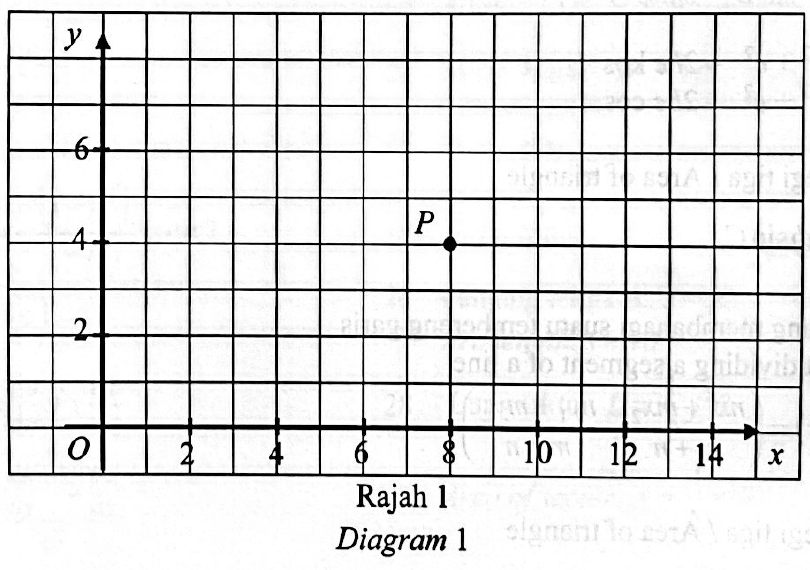
- (a)
Determine whether the vector (√3/2)i − (1/2)j is a unit vector or not. Justify your answer.
[2] - (b)
Find the value of p and of q (P is the point (8, 4) in Diagram 1; scale drawing not accepted).
[3]
Given the functions h(x) = 2x − 1 and g(x) = −4x + 2, (a) find gh(x). (b) Hence, find the value of x when gh(x/2) = 2.
Easy4 marks- (a)
Find gh(x).
[2] - (b)
Hence, find the value of x when gh(x/2) = 2.
[2]
An arithmetic progression has the first term −64 and common difference 7. If the number of positive terms of this progression is 3/2 times the number of negative terms, find (a) the number of negative terms of this progression, (b) the sum of all positive terms of this progression.
Medium5 marks- (a)
Find the number of negative terms of this progression.
[2] - (b)
Find the sum of all positive terms of this progression.
[3]
(a) Solve 2√x − 1 = √(4x − 9). (b) Given that logₓ 4 = k, express log₄ ∛x in terms of k.
Easy5 marks- (a)
Solve 2√x − 1 = √(4x − 9).
[2] - (b)
Given that logₓ 4 = k, express log₄ ∛x in terms of k.
[3]
(a) Given 7^(y−4) = 3^(2x). Express y in terms of x. (b) Show that 2^(x+5) + 2^(x+3) − 2^(x+2) can be divided by 4 for all positive integer x. Justify your answer.
Medium5 marks- (a)
Given 7^(y−4) = 3^(2x). Express y in terms of x.
[2] - (b)
Show that 2^(x+5) + 2^(x+3) − 2^(x+2) can be divided by 4 for all positive integer x. Justify your answer.
[3]
Two variables x and y are related by the equation y = x² + 4x + 4. Diagram 2 shows a straight line graph obtained by plotting Y against x. The line cuts the Y-axis at 4 and passes through the point (h, 5). (a) Express Y in terms of x or/and y. (b) Hence, find the value of h.
Easy4 marks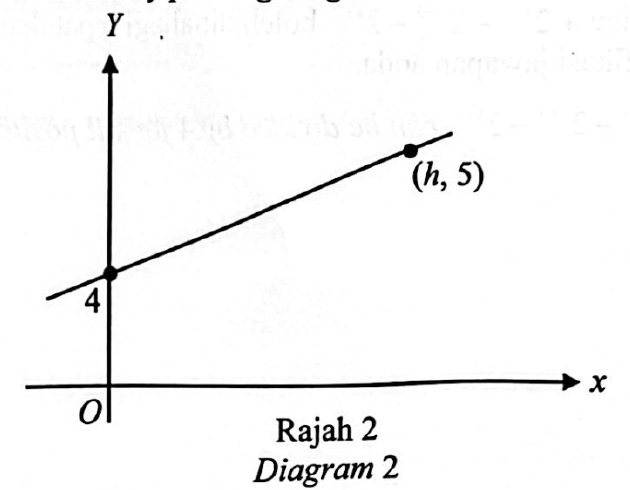
- (a)
Express Y in terms of x or/and y.
[2] - (b)
Hence, find the value of h.
[2]
(a) Given that the gradient of tangent to the curve y = x²(px + q) at point (1, −2) is 5. Express q in terms of p. (b) By using the method of Chain Rule, find the first derivative of y = 1/(2u⁵) if u = 6 − 3x.
Easy6 marks- (a)
Express q in terms of p.
[3] - (b)
By using the Chain Rule, find the first derivative of y = 1/(2u⁵) if u = 6 − 3x.
[3]
(a) Diagram 3 shows the graph of function y = f(x) (a straight line through (−4, 0) and (0, 2)). Answer using Diagram 4 in the answer space (a copy of the same grid and graph). (i) Draw the graph of function y = f⁻¹(x). (ii) Mark and label point A, where f(x) = f⁻¹(x). (b) A factory produces q packets of sambal goreng per day. The number of packets produced depends on the number of workers, n, by the function q(n) = 200 + 3n². The total profit per day, r, in RM, received from the sale of sambal goreng, q, is r(q) = 40q. Find (i) the number of workers needed to produce 500 packets of sambal goreng per day, (ii) the minimum number of workers required for the factory to make a profit of at least RM116 000 per day.
Medium7 marks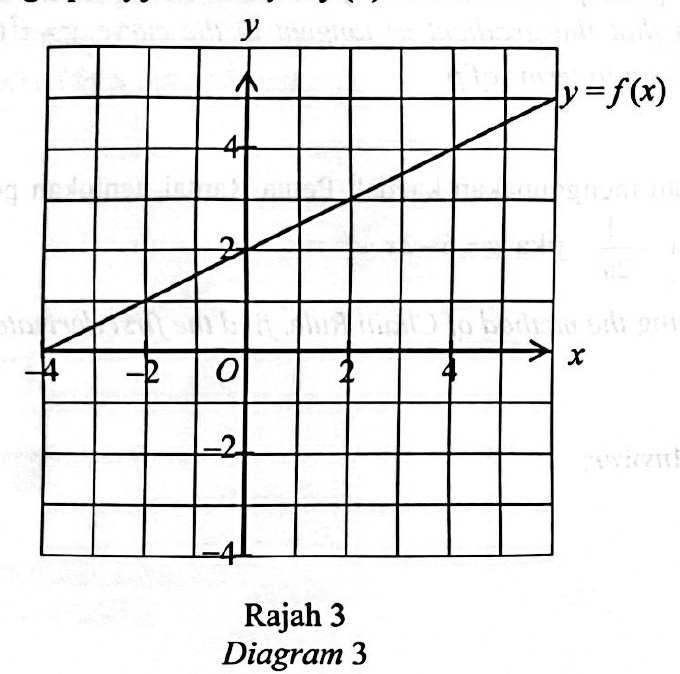
- (a)
Using Diagram 4: (i) draw the graph of y = f⁻¹(x); (ii) mark and label point A where f(x) = f⁻¹(x).
[2]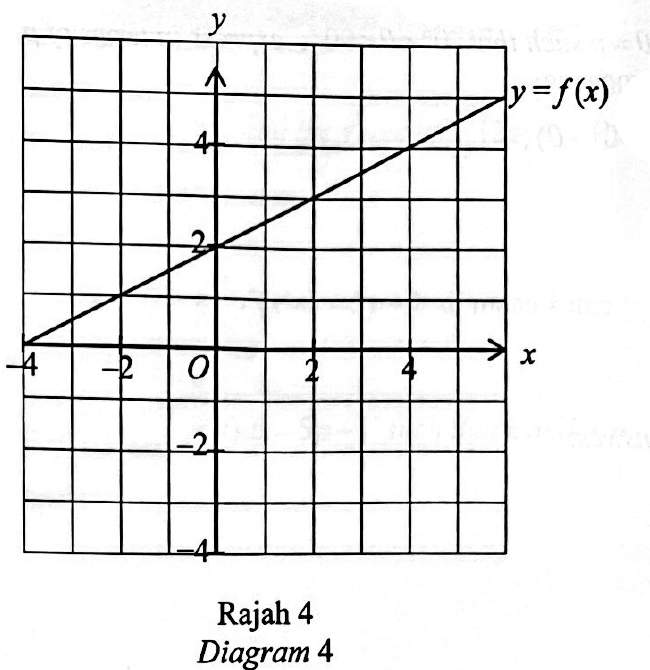
- (b)(i)
Find the number of workers needed to produce 500 packets of sambal goreng per day.
[2] - (b)(ii)
Find the minimum number of workers required for the factory to make a profit of at least RM116 000 per day.
[3]
Given cos θ = p such that 0° < θ < 90°, express in terms of p, (a) cosec (90° − θ), (b) sin ½θ.
Easy3 marks- (a)
Express cosec (90° − θ) in terms of p.
[1] - (b)
Express sin ½θ in terms of p.
[2]
(a) Given that d/dx[7/(4(3 − x)²)] = 4g(x), find the value of ∫₀² [2g(x) + 1] dx. (b) Given that 3p + ∫ₖ^(2k) f(x) dx − ∫₄ₚ^(2k) f(x) dx = 5p − 1 such that k and p are constants. Find the value of p if k = 4p.
Medium7 marks- (a)
Find the value of ∫₀² [2g(x) + 1] dx.
[4] - (b)
Find the value of p if k = 4p.
[3]
(a) In a certain school, students have prepared 7 performances which are 3 singing, 3 dancing and 1 drama for the Teacher's Day celebration. The committee wishes to arrange the performances. Find the number of arrangements of the performances if it must start with dancing, end with singing and the same categories of performances cannot be arranged in consecutive sequences. (b) A Mathematics quiz competition consists of section A and section B. There are 8 questions in section A and n questions in section B. Students who participate in the competition have to answer 5 questions from any section, such that the number of questions from section A has to be more than the questions from section B. Given that there are 1316 ways to form the combination of the questions, find the value of n.
Medium7 marks- (a)
Find the number of arrangements of the 7 performances (3 singing, 3 dancing, 1 drama) if it must start with dancing, end with singing and performances of the same category cannot be consecutive.
[3] - (b)
Given that there are 1316 ways to form the combination of 5 questions with more from section A than section B, find the value of n.
[4]
(a) Diagram 5 shows the graph of binomial distribution X ~ B(3, p). The bar heights are k at X = 0, m at X = 1, and 1/64 at X = 2 and X = 3. (i) Express P(X = 2) + P(X = 3) in terms of k and m. (ii) Find the value of p. (b) If X ~ N(15, σ²) and P(X ≥ 8) = 0.6844, find the value of σ.
Medium6 marks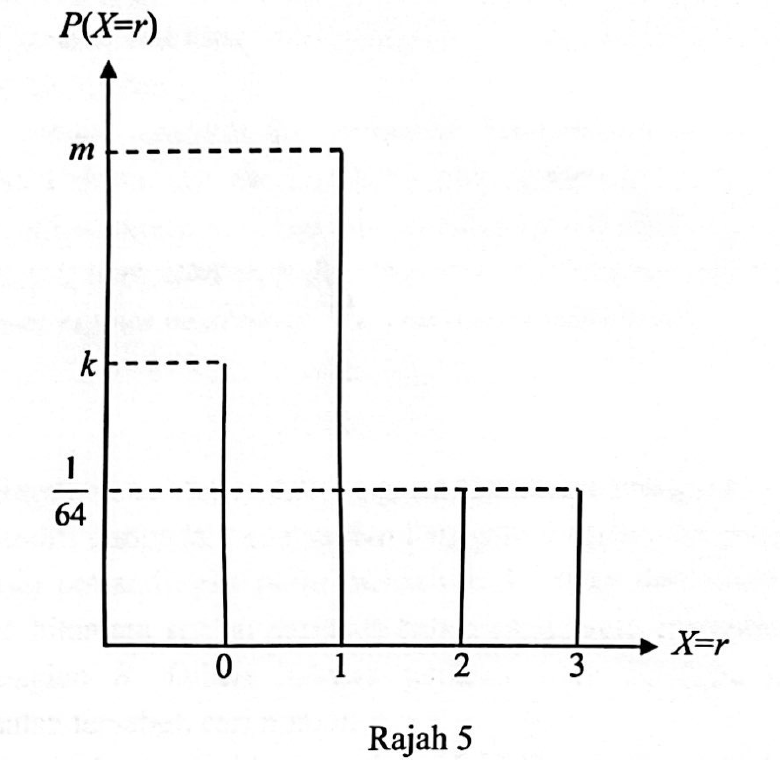
- (a)(i)
Express P(X = 2) + P(X = 3) in terms of k and m.
[1] - (a)(ii)
Find the value of p.
[2] - (b)
If X ~ N(15, σ²) and P(X ≥ 8) = 0.6844, find the value of σ.
[3]
Section B
Diagram 6 shows a rectangle ABCD on a Cartesian plane, with A(x, y), B(−4, 8), C(6, −2) and D on the negative y-axis. (a) Show that y = x + 12. (b) Find the area of △ABC in terms of x and y. (c) Hence, find the coordinates of A given that the area of the rectangle ABCD is 120 unit².
Medium8 marks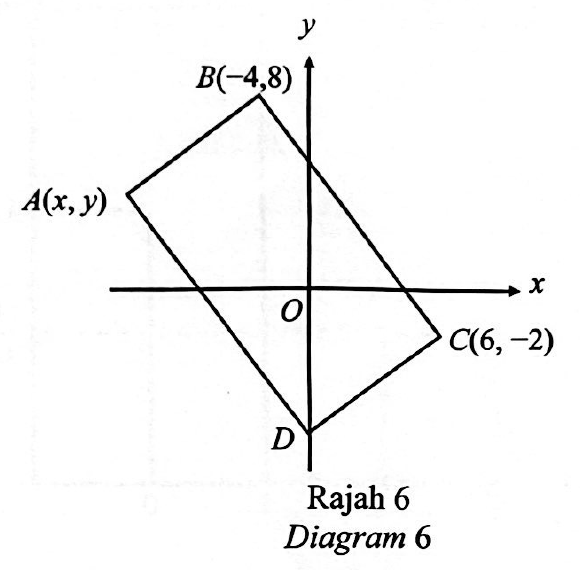
- (a)
Show that y = x + 12.
[3] - (b)
Find the area of △ABC in terms of x and y.
[2] - (c)
Hence, find the coordinates of A given that the area of rectangle ABCD is 120 unit².
[3]
(a) Given the quadratic equation ax² + bx + c = 0, such that a, b and c are constants and a ≠ 0. By using the method of completing the square, form the formula x = [−b ± √(b² − 4ac)]/(2a). (b) Hence, given the quadratic equation x² − 2kx + 2 − k = 0, express the roots of the quadratic equation in terms of k. (c) If this quadratic equation in (b) has real roots, determine the range of values of k by using the number line method.
Medium8 marks- (a)
By completing the square, derive x = [−b ± √(b² − 4ac)]/(2a).
[3] - (b)
Express the roots of x² − 2kx + 2 − k = 0 in terms of k.
[2] - (c)
If the equation has real roots, determine the range of values of k by the number line method.
[3]
(a) Diagram 7 shows a trapezium ABCD (AB = b at the top, AD = a on the left, BC = c, angle θ between the perpendicular from B to DC and BC). Derive one basic identity involving tan θ and sec θ. (b) Solve the equation sin x sec 2x = 1 for 0 ≤ x ≤ 360°. (c) Given cos(x − y) = p/q and sin x sin y = q. Write in terms of p and of q (i) cos x cos y, (ii) cos(x + y).
Medium8 marks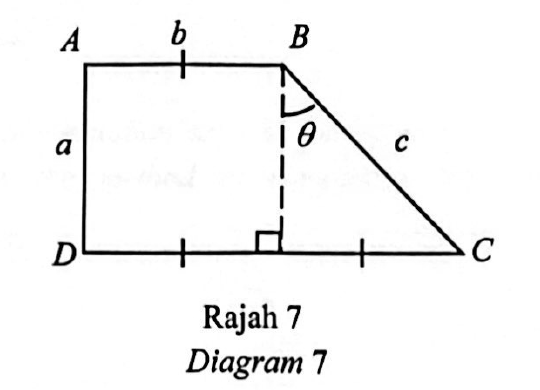
- (a)
Derive one basic identity involving tan θ and sec θ.
[2] - (b)
Solve the equation sin x sec 2x = 1 for 0 ≤ x ≤ 360°.
[3] - (c)(i)
Write cos x cos y in terms of p and q.
[2] - (c)(ii)
Write cos(x + y) in terms of p and q.
[1]