Write your answer on paper. Then open the answer to check it.
Section A
Diagram 1 shows a straight line obtained by plotting log₁₀ y against x. The variables p and q are related by the equation y = pq^x, where p and q are constants. The line meets the log₁₀ y axis at 4 and the x-axis at −3. Find the value of p and of q.
Easy3 marks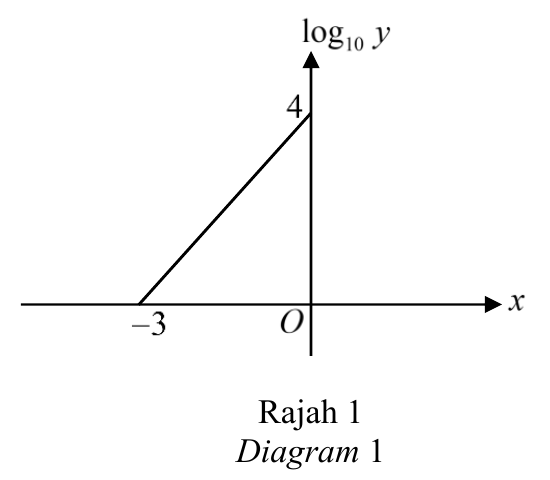
Find the value of p and of q. [3 marks]
[3]
Diagram 2 shows a triangle QRS with the vertices Q(−3, h), R(5, 2) and S(−1, −6), where h is a constant. Find
Easy4 marks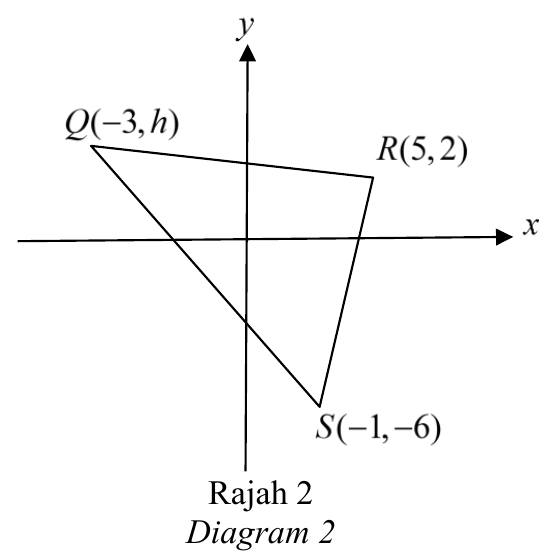
- (a)
the value of h if the area of the triangle is 38 unit². [2 marks]
[2] - (b)
the equation of the straight line that passes through point M(3, 5) that is parallel to the line QR. [2 marks]
[2]
(a) Given g⁻¹(x) = 5 − x², find (i) g⁻¹(−3), (ii) g(x). (b) Sketch the graph f(x) = −|x − 2| for domain −2 ≤ x ≤ 6. Hence state the range of f(x).
Medium6 marks- (a)(i)
g⁻¹(−3)
[1] - (a)(ii)
g(x). [(a): 3 marks]
[2] - (b)
Sketch the graph f(x) = −|x − 2| for −2 ≤ x ≤ 6 and state the range of f(x). [3 marks]
[3]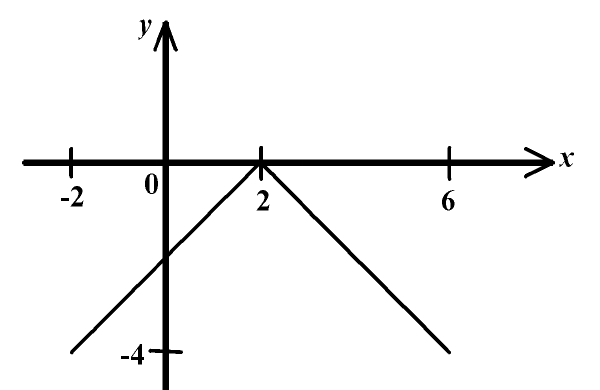
Given that RS→ = ½**x** + **y**, where **x** = 4**i** − 6**j** and **y** = 5**i** + 17**j**. Find (a) RS→ in terms of **i** and **j**, (b) the unit vector in the direction of RS→.
Easy3 marks- (a)
RS→ in terms of **i** and **j**. [1 mark]
[1] - (b)
the unit vector in the direction of RS→. [2 marks]
[2]
(a) Given the quadratic function f(x) = x² + px + 3p − 5 is always positive, where p is a constant, when u < p < v. Find the value of u and of v. (b) Diagram 3 shows the graph of a quadratic curve with x-intercepts −3/2 and 2 and y-intercept −3. Based on Diagram 3, form the quadratic function in intercept form.
Easy5 marks- (a)
Find the value of u and of v. [3 marks]
[3] - (b)
Form the quadratic function in intercept form. [2 marks]
[2]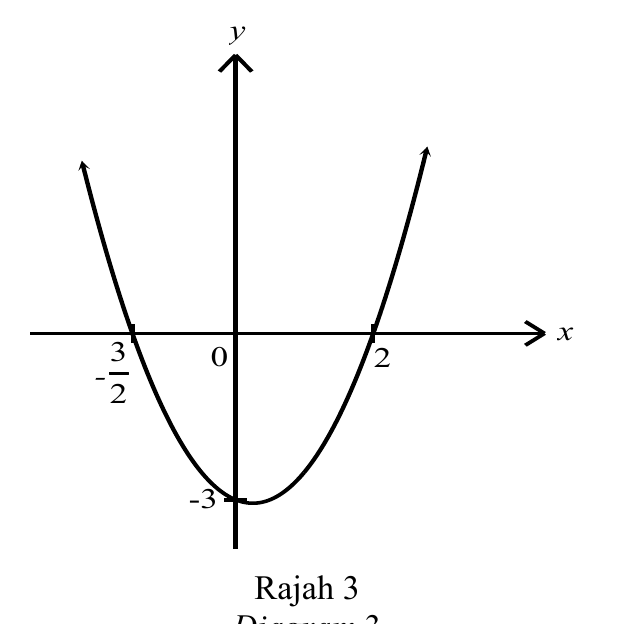
(a) Simplify log₃(x + 1) − 5 log₉ x² + 4 log₃ x. (b) Hence, find the value of x if log₃(x + 1) − 5 log₉ x² + 4 log₃ x = ½. Give the answer in the form of a + b√c.
Medium6 marks- (a)
Simplify log₃(x + 1) − 5 log₉ x² + 4 log₃ x. [3 marks]
[3] - (b)
Hence find x if the expression equals ½, in the form a + b√c. [3 marks]
[3]
Given 36, 11k − 5, 144 are three consecutive terms in a geometric progression where k is a positive integer. Find (a) the value of k, (b) the common ratio of the progression.
Easy4 marks- (a)
the value of k. [3 marks]
[3] - (b)
the common ratio of the progression. [1 mark]
[1]
(a) Given y = ⅓x², find dy/dx by using the first principles method. (b) Diagram 4 shows a curve y = x/(x + 1). A straight line y = −px + 6 passes through the point A(q, r) and is perpendicular to the tangent line at point A. (i) Find the gradient of the tangent that passes through point A in terms of q. (ii) Hence, express q in terms of p.
Medium6 marks- (a)
Find dy/dx by first principles for y = ⅓x². [2 marks]
[2] - (b)(i)
Find the gradient of the tangent at A in terms of q. [(b): 4 marks]
[2]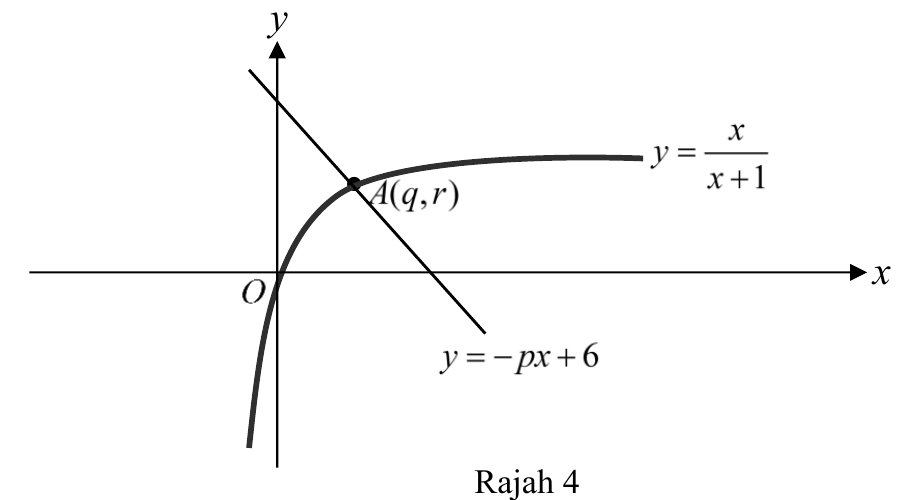
- (b)(ii)
Hence express q in terms of p.
[2]
A committee consists of a chairman, vice chairman, secretary, treasurer and 8 committee members, appointed from 2 male VVIP members, 10 male and 6 female members. (a) How many different ways can the positions be formed if (i) there are no conditions, (ii) the chairman and vice chairman must be VVIPs while the secretary and treasurer must be women. (b) All 12 committee members sit at a round meeting table with 12 chairs. Calculate the number of ways they can be arranged if the chairman and vice chairman sit side by side.
Medium7 marks- (a)(i)
no conditions. [(a): 4 marks]
[2] - (a)(ii)
the chairman and vice chairman must be VVIPs while the secretary and treasurer must be women.
[2] - (b)
Number of ways to arrange them at the round table if the chairman and vice chairman sit side by side. [3 marks]
[3]
Diagram 5 shows a graph of the probability distribution of a random variable X where X ~ B(3, p) and p + q = 1. The graph gives P(X = 0) = 3b, P(X = 1) = 2/9, P(X = 2) = a and P(X = 3) = 3b. (a) Express a in terms of b. (b) Hence, find P(X > 1) in terms of q.
Easy5 marks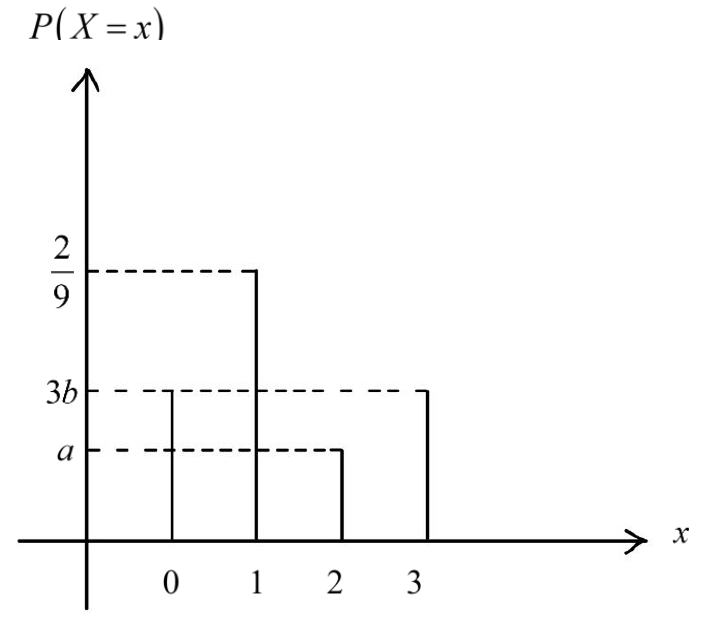
- (a)
Express a in terms of b. [2 marks]
[2] - (b)
Hence find P(X > 1) in terms of q. [3 marks]
[3]
Diagram 6 shows sector AOB of a circle with centre O and OA = x cm. Given ∠AOB = 40° and the area of the shaded region is 1.15 cm². (Use π = 3.142.) Find (a) the area of sector AOB, in terms of π and x, (b) the value of x.
Medium5 marks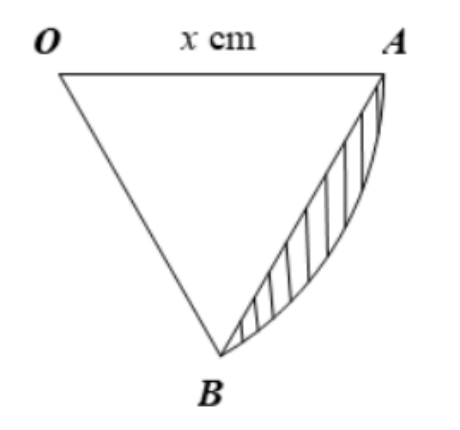
- (a)
the area of sector AOB, in terms of π and x. [2 marks]
[2] - (b)
the value of x. [3 marks]
[3]
The gradient function of a curve y = f(x) is 2x + k. (a) Find the equation of the curve y = f(x) at the point (3, 10) in terms of k. (b) (i) Given the area bounded by the curve y = f(x), the straight lines x = −2 and x = 4 and the x-axis is 30 unit², find the value of k. (ii) Hence, find the volume generated, in terms of π, when the region bounded by the curve y = f(x) and the straight lines x = 0 and x = 4 is revolved through 360° about the y-axis.
Medium10 marks- (a)
Find the equation of the curve in terms of k. [3 marks]
[3] - (b)(i)
Find the value of k. [(b): 7 marks]
[3] - (b)(ii)
Hence find the volume generated, in terms of π, when the region between the curve, x = 0 and x = 4 is revolved through 360° about the y-axis.
[4]
Section B
(a) The curved surface area of a cylinder is π(20√2 + 10) cm². Determine the height of the cylinder in the form (a√3 + b√6) cm if the radius of the cylinder is (3/√6 + √3) cm. (b) Based on Diagram 7 (a right-angled triangle with sides 2^(x+1), 2^(x/2) and hypotenuse 3 × 2^(1/2)), find the value of x.
Medium8 marks- (a)
Find the height of the cylinder in the form (a√3 + b√6) cm. [4 marks]
[4] - (b)
Find the value of x. [4 marks]
[4]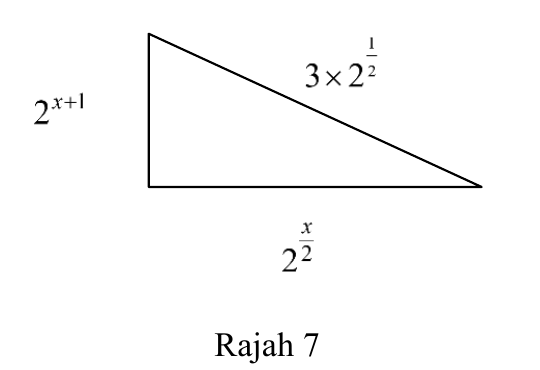
(a) Prove that (1 − cos 2x + sin 2x)/(1 + cos 2x + sin 2x) = tan x. (b) Sketch the graph y = −tan x for 0 ≤ x ≤ 2π. Hence, by using the same axes, sketch a suitable straight line to find the number of solutions for the equation 2x/π + (1 − cos 2x + sin 2x)/(1 + cos 2x + sin 2x) = 0 for 0 ≤ x ≤ 2π. State the number of solutions.
Hard8 marks- (a)
Prove the identity. [3 marks]
[3] - (b)
Sketch y = −tan x for 0 ≤ x ≤ 2π; hence sketch a suitable straight line and state the number of solutions. [5 marks]
[5]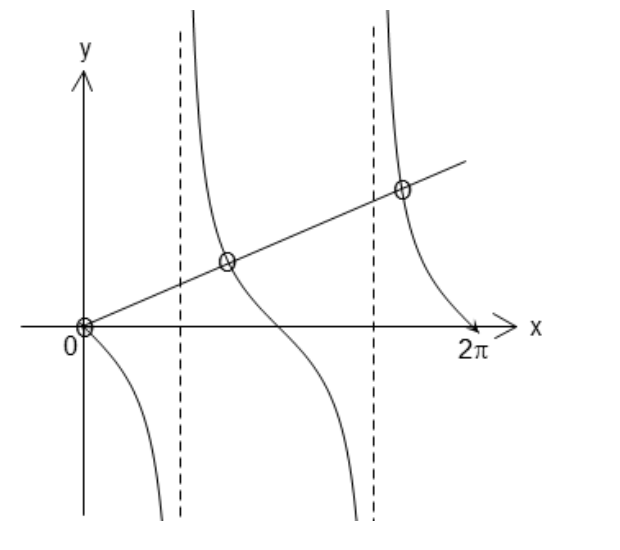
Given f : x → 3 − 2x and gf : x → −1 − 2x. Find (a) gf(2), (b) g(x), (c) g²(x). Hence, find g³⁰(x).
Medium8 marks- (a)
gf(2). [1 mark]
[1] - (b)
g(x). [3 marks]
[3] - (c)
g²(x). Hence find g³⁰(x). [4 marks]
[4]