Write your answer on paper. Then open the answer to check it.
Section A
Solve the simultaneous equations 2x − y = 1 and 2x² + y² − 3 = 1. Give your answers correct to three decimal places.
Medium5 marksSolve the simultaneous equations. Give answers correct to three decimal places. [5 marks]
[5]
(a) Given that d/dx(2x⁴ − 4/x) = 8x³ + 4/x². Find ∫(2x³ + 1/x²) dx. (b) Given ∫ from −1 to k of g(x) dx = 10. Find the value of k such that ∫ from −1 to k of [3 − g(x)] dx = 8.
Medium5 marks- (a)
Find ∫(2x³ + 1/x²) dx. [2 marks]
[2] - (b)
Find the value of k. [3 marks]
[3]
A rice factory sells imported white rice from January to December in 2020 at RM 25 for a 5 kg pack. The number of packs sold increases constantly by 250 packs each subsequent month. The number of packs sold in July is four times the number sold in January. Find (a) the number of packs sold in January, (b) the value of n if the total number of packs sold is more than 13 500, where n is the number of months after January, (c) the factory's profit in 2020 from the sale of imported white rice if the cost price for one pack is RM 17.
Medium8 marks- (a)
the number of packs sold in January. [2 marks]
[2] - (b)
the value of n if the total number of packs sold is more than 13 500. [3 marks]
[3] - (c)
the factory's profit in 2020 if the cost price for one pack is RM 17. [3 marks]
[3]
(a) Given sin x = a, where x is an obtuse angle, find in terms of a, (i) cos 2x, (ii) tan(180° − x). (b) (i) Prove that 2 tan x/(1 + tan²x) = sin 2x. (ii) Hence, solve the equation 2 tan x/(1 + tan²x) = ½ for 0 ≤ x ≤ 2π and give your answers in the simplest fraction form in terms of π rad.
Medium8 marks- (a)(i)
cos 2x in terms of a. [(a): 3 marks]
[2] - (a)(ii)
tan(180° − x) in terms of a.
[1] - (b)(i)
Prove that 2 tan x/(1 + tan²x) = sin 2x. [2 marks]
[2] - (b)(ii)
Hence solve 2 tan x/(1 + tan²x) = ½ for 0 ≤ x ≤ 2π, answers as fractions of π rad. [3 marks]
[3]
Diagram 1 shows a sector AOC of a circle with centre O and a right-angled triangle DOC (OC = 10 cm). Given ∠AOD = 40° and OB : OD = 2 : 3, find (a) ∠AOC, in radians, (b) the perimeter, in cm, of the shaded region.
Medium5 marks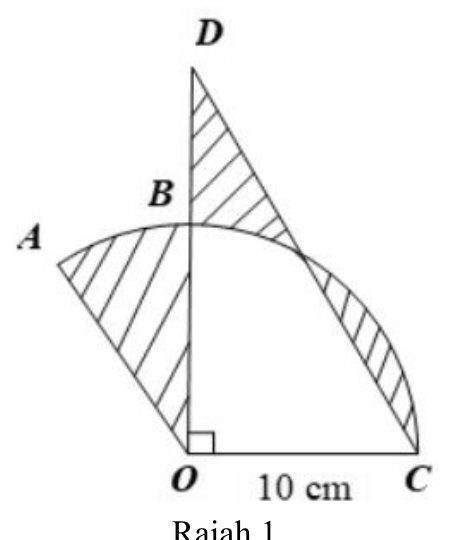
- (a)
∠AOC, in radians. [1 mark]
[1] - (b)
the perimeter, in cm, of the shaded region. [4 marks]
[4]
A point P divides a straight line AB in the ratio AP : BP = m : n. Given AB = 54 cm and AP = 12 cm. (a) (i) Find the values of m and n. (ii) The straight line APB is placed on the Cartesian plane with A(h, 3k), P(−k, −3h) and B(12, 12). Find the coordinates of point P. (b) Point Q moves along the circumference of a circle with centre A and radius AP. (i) Find the equation of locus Q. (ii) Determine whether the locus Q intersects the x-axis.
Medium10 marks- (a)(i)
Find the values of m and n. [2 marks]
[2] - (a)(ii)
Find the coordinates of point P. [3 marks]
[3] - (b)(i)
Find the equation of locus Q. [3 marks]
[3] - (b)(ii)
Determine whether the locus Q intersects the x-axis. [2 marks]
[2]
Diagram 2 shows the parabolic path of a basketball when Daniel made his trial shot. x is the horizontal distance of the basketball, in m, from point O (the origin of the Cartesian plane). The height of the basketball, in m, from the court's ground is f(x). The height of the basketball at B is 1.60 m from O. The horizontal distance of the basketball from O at maximum height is 4 m. At A, a perfect shot is made only when the basketball is at a horizontal distance of 7 m from O and at a height of 143/64 m from the court's ground. (a) Form an equation of motion of the ball in vertex form. Hence, determine whether the ball enters the net or not. (b) Hence, find the horizontal distance of the basketball, in m, from O when the basketball is at a height of 2 m from the court's ground after the maximum point.
Medium9 marks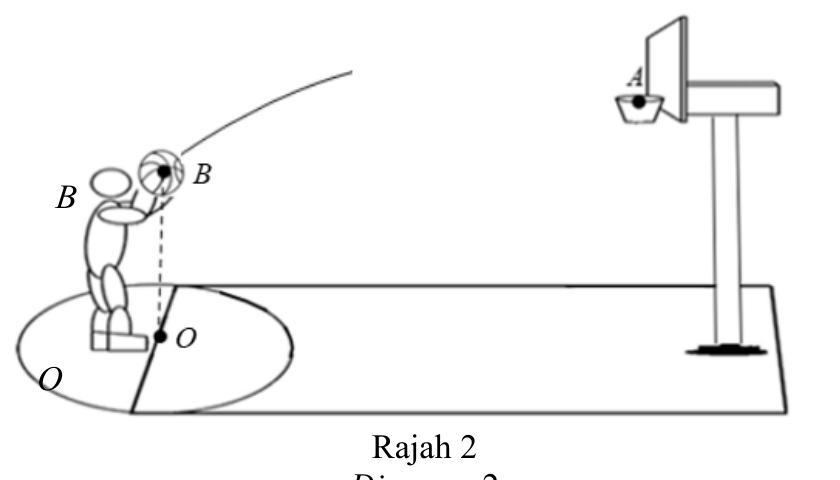
- (a)
Form an equation of motion in vertex form. Hence determine whether the ball enters the net. [6 marks]
[6] - (b)
the horizontal distance from O when the ball is at height 2 m after the maximum point. [3 marks]
[3]
Section B
(a) Diagram 3 shows a standard normal distribution graph representing the height of 1500 students in a college. The mean is 165 cm and the variance is 25 cm². (i) If 16.6% of the students are in the shaded region (z < H), state the value of H. Hence find the maximum height of the student in this group. (ii) Find the number of students whose height is between 165 cm and 175 cm. (b) The masses of durians produced in an orchard are normally distributed with a mean of 3 kg and a standard deviation of 0.65 kg. (i) If a durian is chosen randomly from the orchard, find the probability that its mass is more than 4 kg. (ii) A lorry carries 500 durians. How many of them are grade B durians if the probability is 0.0620?
Medium10 marks- (a)(i)
state the value of H; hence the maximum height. [(a): 6 marks]
[3]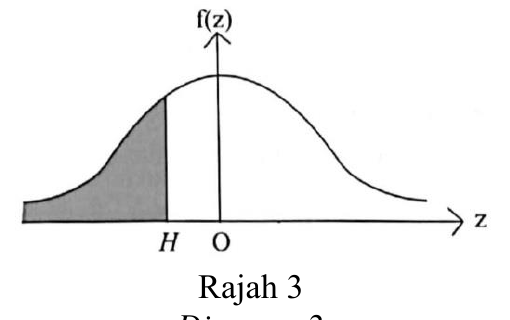
- (a)(ii)
the number of students with height between 165 cm and 175 cm.
[3] - (b)(i)
the probability that the mass is more than 4 kg. [(b): 4 marks]
[2] - (b)(ii)
the number of grade B durians in the lorry (probability 0.0620).
[2]
Diagram 4 shows points X and Y which are the midpoints of lines EF and DE, respectively. Given DF→ = 2**u**, FE→ = 2**v** and FY→ = ¾ FG→. (a) Express in terms of **u** and **v**: (i) DX→, (ii) XY→. (b) Show that DX→ is parallel to GE→ and state the ratio DX : GE.
Hard10 marks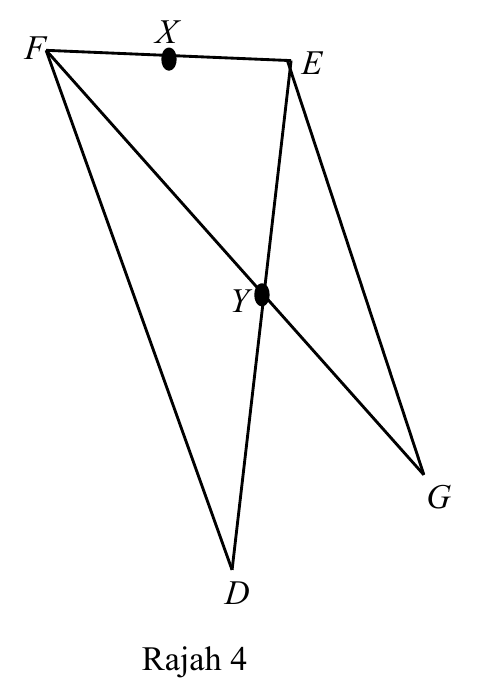
- (a)(i)
DX→ in terms of **u** and **v**. [(a): 3 marks]
[2] - (a)(ii)
XY→ in terms of **u** and **v**.
[1] - (b)
Show that DX→ is parallel to GE→ and state the ratio DX : GE. [7 marks]
[7]
Diagram 5 shows a sagging electric cable between pole A and pole B. The shape of the cable is y = ⅛x(x − 16), with point P as the origin. P and Q are on a straight line parallel to the ground surface AB, and P is 12 m above the ground. (a) By using differentiation, find the shortest vertical distance, in metres, from the curve of the cable to ground level. (b) Point R is 7 m from pole A. Find the equation of the normal through point R. Hence, state whether the normal line passes through point Q or not.
Medium10 marks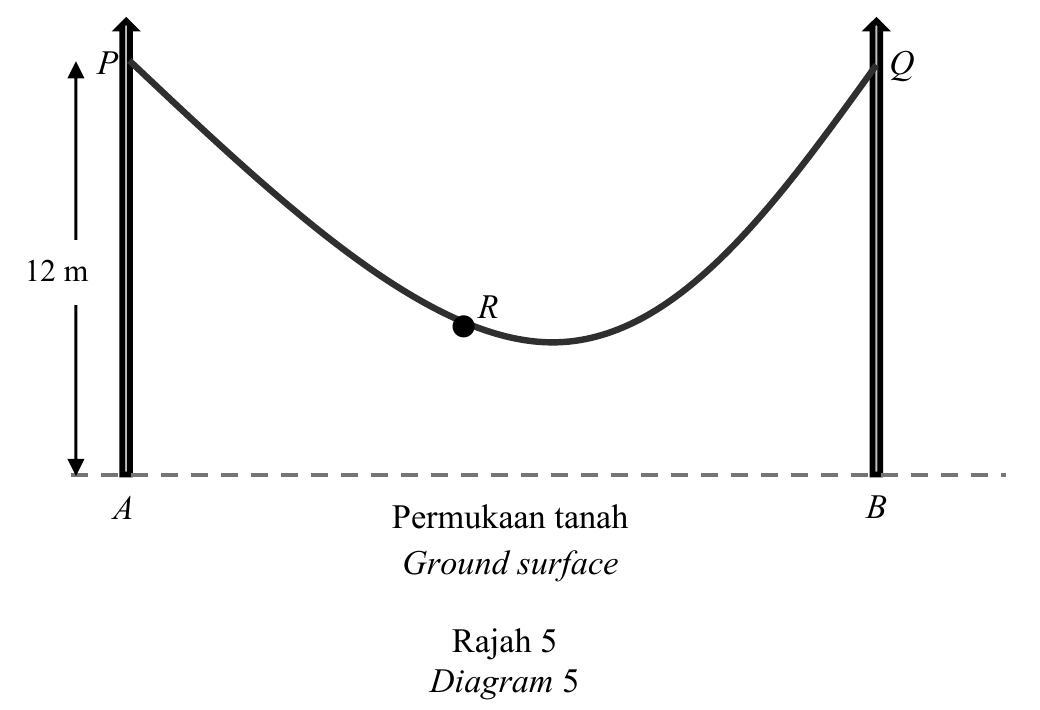
- (a)
the shortest vertical distance from the cable to ground level. [6 marks]
[6] - (b)
the equation of the normal at R; whether it passes through Q. [4 marks]
[4]
Table 1 shows the values of two variables, x and y, obtained from an experiment. x and y are related by y + x = qx + px², where p and q are constants. x: −0.6, −0.5, −0.4, −0.3, −0.2, −0.1; y: 1.128, 0.751, 0.472, 0.241, 0.096, 0.016. (a) Based on Table 1, construct a table for the values of y/x. (b) Plot y/x against x, using a scale of 2 cm to 0.1 unit on the x-axis and 2 cm to 0.2 unit on the y/x axis. Hence, draw the line of best fit. (c) Using the graph in (b): (i) find the value of y when x = −0.48, (ii) write y + x = qx + px² in linear form, hence find the value of p and of q.
Medium10 marks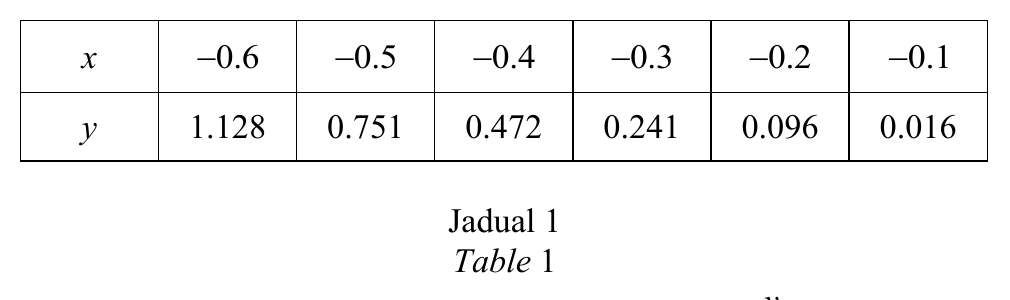
- (a)
construct a table for y/x. [1 mark]
[1] - (b)
Plot y/x against x and draw the line of best fit. [3 marks]
[3]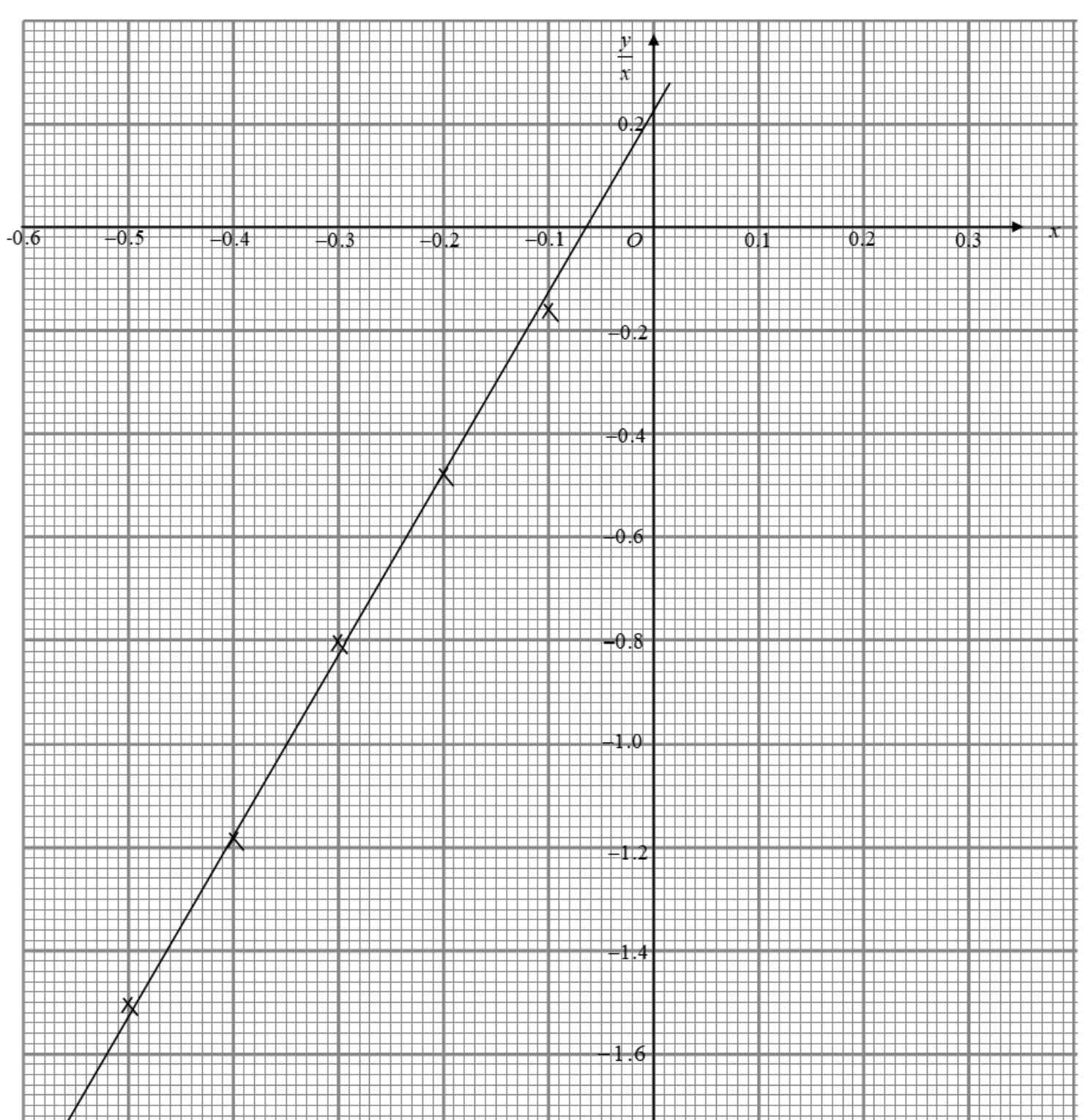
- (c)(i)
the value of y when x = −0.48. [(c): 6 marks]
[1] - (c)(ii)
Write the equation in linear form; hence find p and q.
[5]
Section C
A particle moves along a straight line and passes through a fixed point O with a velocity of 12 m s⁻¹. Its acceleration, a m s⁻², is given by a = 2t − 8, where t is the time, in seconds, after passing through the fixed point O. [Assume motion to the right is positive.] Find (a) the initial acceleration, in m s⁻², of the particle, (b) the minimum velocity, in m s⁻¹, of the particle, (c) the time, in seconds, when the particle is instantaneously at rest, (d) the total distance, in m, travelled by the particle in the first 5 seconds.
Medium10 marks- (a)
the initial acceleration, in m s⁻². [1 mark]
[1] - (b)
the minimum velocity, in m s⁻¹. [3 marks]
[3] - (c)
the time, in seconds, when the particle is instantaneously at rest. [2 marks]
[2] - (d)
the total distance, in m, travelled in the first 5 seconds. [4 marks]
[4]
Solutions by scale drawing are not accepted. Diagram 6 shows triangle MNO with MN = 7.2 cm, ON = 5.4 cm and ∠MNO = 95.5°. (a) Find (i) the length, in cm, of MO, (ii) ∠MON. (b) The straight line ON is extended to N′ such that MN = M′N′. (i) Sketch the triangle M′N′O′. (ii) Find ∠O′M′N′. (iii) Calculate the area of triangle M′N′O′, in cm². Hence, find the shortest distance of M′ from N′O′.
Medium10 marks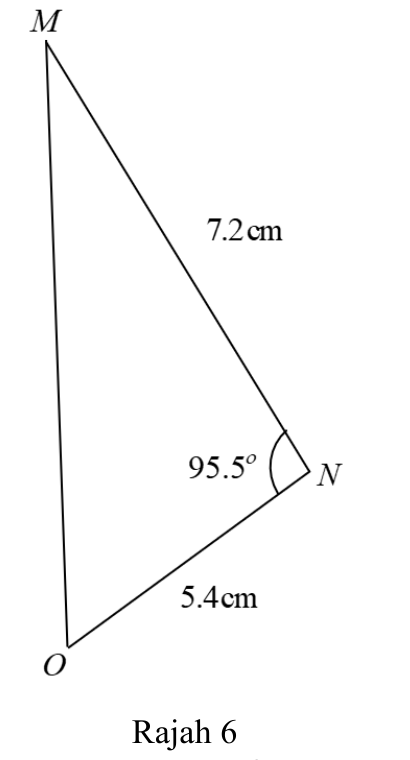
- (a)
Find (i) the length MO, in cm, (ii) ∠MON. [4 marks]
[4] - (b)(i)
Sketch the triangle M′N′O′. [(b): 6 marks]
[1]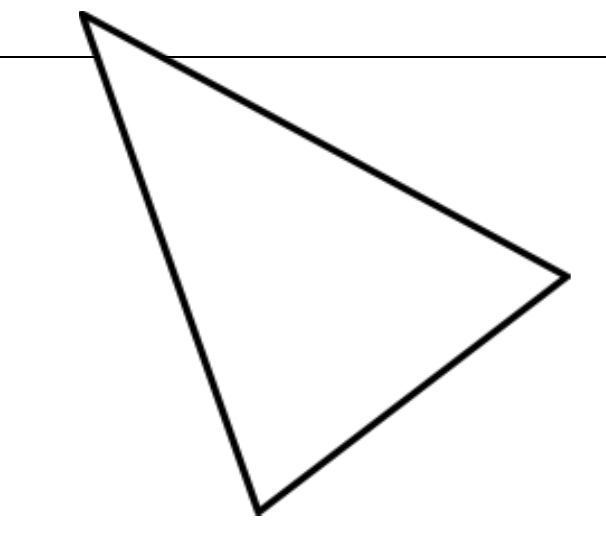
- (b)(ii)
Find ∠O′M′N′.
[1] - (b)(iii)
Calculate the area of triangle M′N′O′, in cm². Hence find the shortest distance of M′ from N′O′.
[4]
Table 2 shows four materials used in making Lipo shoes in 2019 and 2022. Material A: cost 2019 RM m, cost 2022 RM 40, price index 160, usage 40%. Material B: RM 35, RM 38, 108.57, 30%. Material C: RM 160, RM n, 107.50, 10%. Material D: RM 85, RM 85, 100, 20%. (a) Find the value of m and of n. (b) Calculate the composite index for the cost of making the shoes in 2022 based on 2019. (c) Given that the cost price of a pair of Lipo shoes is RM 100 and it is sold at a profit of RM 50 in 2019, calculate the corresponding selling price in 2022. (d) Given the production cost in 2022 is RM 35 000 and is expected to increase by 55% from 2022 to 2025, calculate the percentage change in the production cost from 2019 to 2025.
Medium10 marks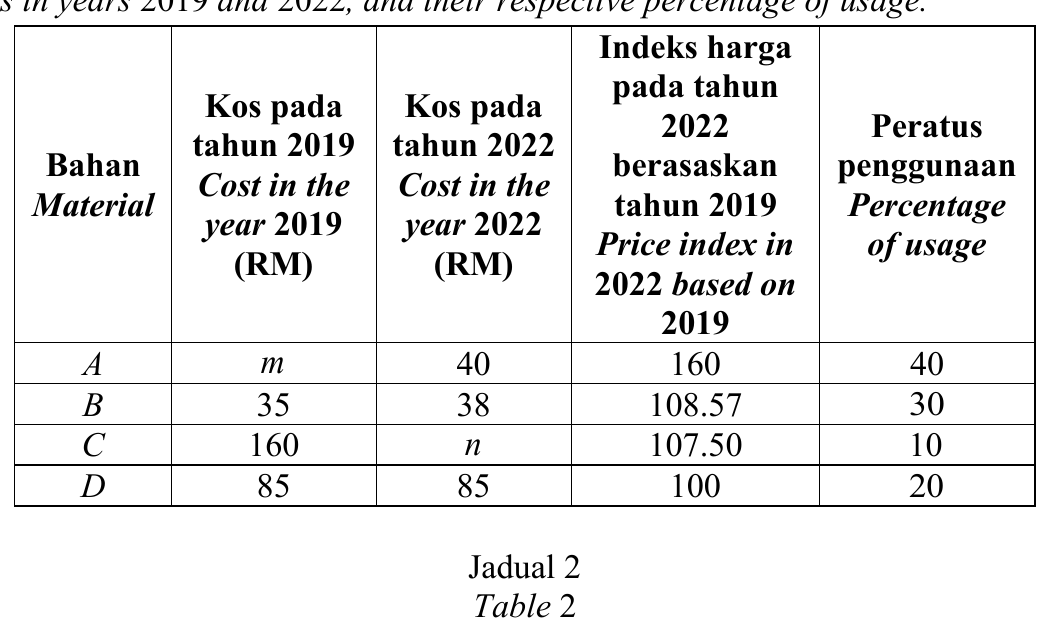
- (a)
Find the value of m and of n. [3 marks]
[3] - (b)
the composite index in 2022 based on 2019. [2 marks]
[2] - (c)
the corresponding selling price in 2022. [2 marks]
[2] - (d)
the percentage change in the production cost from 2019 to 2025. [3 marks]
[3]
A private secondary school offers two packages, STEM A and STEM B, for Form 4 intake. Constraints: I. The school's capacity is 190 pupils. II. The minimum total intake is 80 pupils. III. The number of pupils in STEM B is more than two times the number in STEM A by at most 20. x pupils register for STEM A and y pupils for STEM B. (a) Write three inequalities, other than x ≥ 0 and y ≥ 0, that satisfy all the constraints. (b) Using scales of 2 cm to 10 pupils on the x-axis and 2 cm to 20 pupils on the y-axis, construct and shade the region R that satisfies all the constraints. (c) Using the graph, find (i) the range of the number of pupils registered for STEM B if the number registered for STEM A is 30, (ii) the minimum amount of fee collection per month if the monthly fee is RM 400 for a STEM A pupil and RM 380 for a STEM B pupil.
Medium10 marks- (a)
Write three inequalities (other than x ≥ 0, y ≥ 0). [3 marks]
[3] - (b)
Construct and shade the region R. [3 marks]
[3]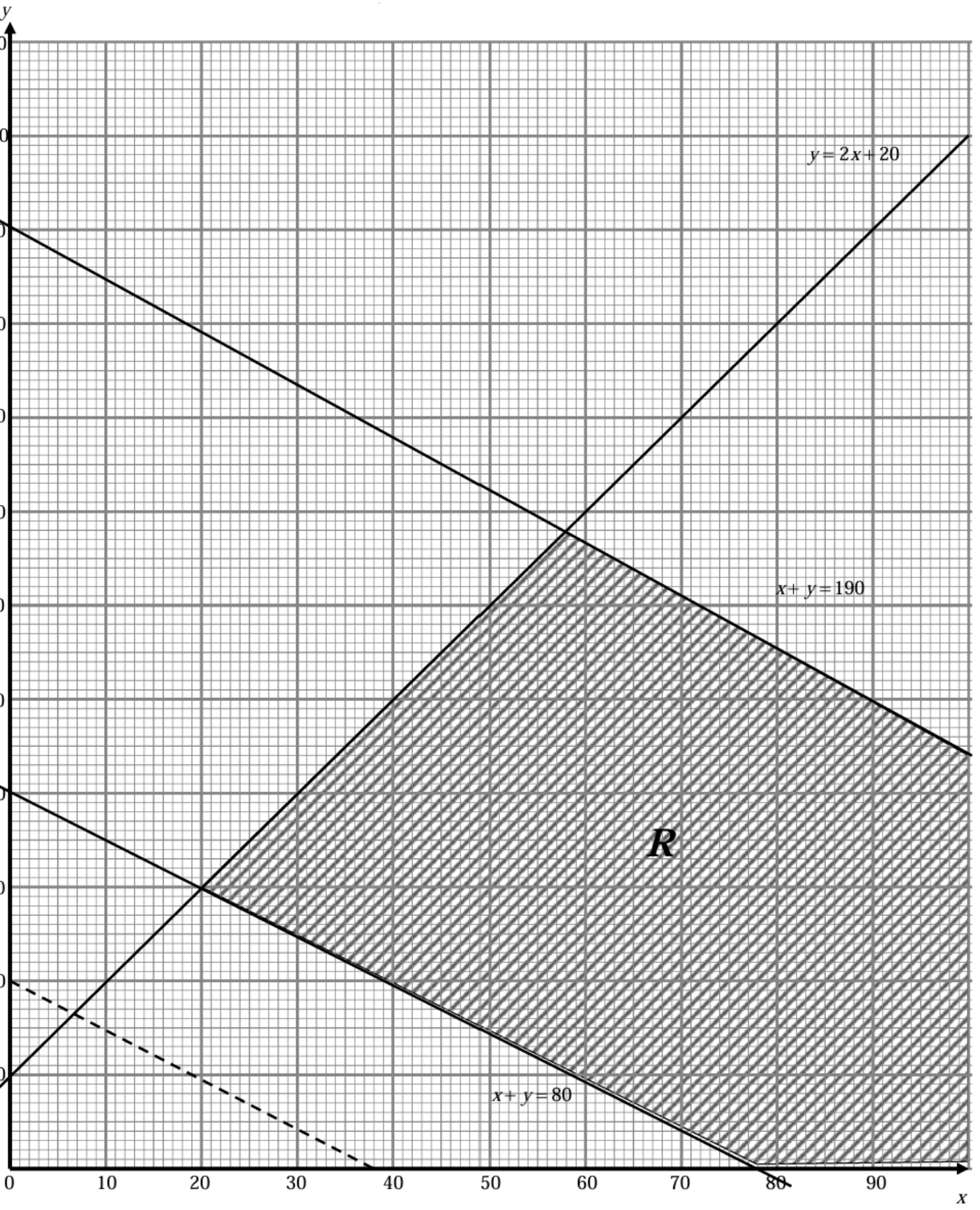
- (c)(i)
the range of y when x = 30. [(c): 4 marks]
[1] - (c)(ii)
the minimum monthly fee collection. [(c) total 4 marks]
[3]