Write your answer on paper. Then open the answer to check it.
Section A
Given a = (3, 4) and b = (6, p − 2) as column vectors. Find the value of p if |3a − b| = 9, and the unit vector of 3a − b.
Easy5 marks- (a)
Find the value of p if |3a − b| = 9.
[2] - (b)
Find the unit vector of 3a − b.
[3]
It is given that h : x → 5x + m and h⁻¹ : x → 2kx + 1 where m and k are constants.
Medium7 marks- (a)
Find the value of m and of k.
[4] - (b)
Find gh⁻¹(x) if g : x → 10x² − 1.
[3]
Syuhada has an 8188 cm ribbon roll that will be cut into a few pieces to decorate her class. The length of each piece of ribbon increases and follows a geometric progression with common ratio r > 1. The length of the second ribbon is 8 cm while the length of the third ribbon exceeds the length of the first ribbon by 12 cm.
Medium6 marks- (a)(i)
Find the common ratio.
[2] - (a)(ii)
Find the maximum number of ribbons that can be cut.
[2] - (b)
State the length of the largest ribbon.
[2]
(a) Given the function h(x) = px³ − 7x² + 3x. Find the value of p if h″(2) = 10. (b) Determine the limit of (x² + x − 12)/(x + 4) as x → −4.
Easy6 marks- (a)
Given the function h(x) = px³ − 7x² + 3x. Find the value of p if h″(2) = 10.
[4] - (b)
Determine the limit of (x² + x − 12)/(x + 4) as x → −4.
[2]
A, B and C decide to donate different amounts of money to buy a present for their friend's birthday. Each friend keeps their contribution confidential. Table 1 gives three scenarios. Scenario 1: A + B − 3C = RM3. Scenario 2: A + 3B + C = RM11. Scenario 3: 2A + 5B − 2C = RM16. How much did A, B and C contribute to the purchase of the birthday gift?
Medium8 marks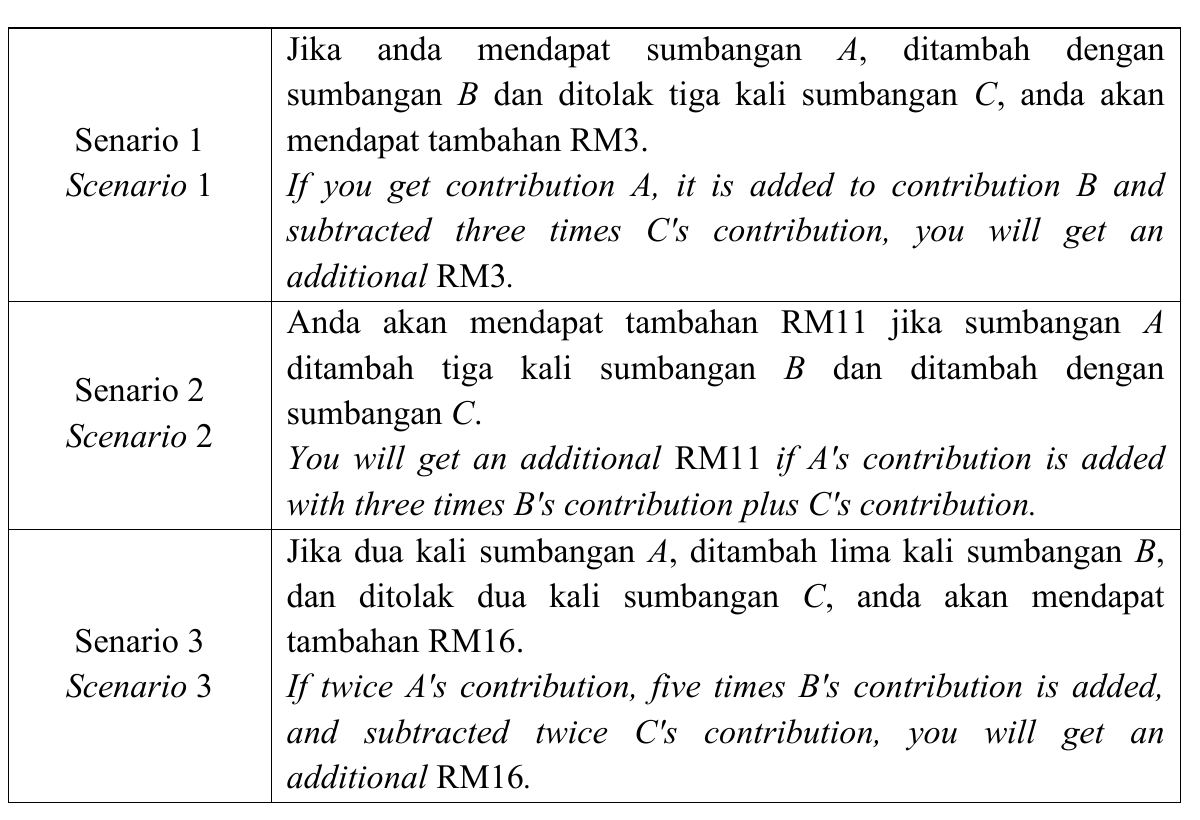
Form three equations from Table 1 and find the total contribution of A, B and C.
[8]
(a) Prove that sin(x + π/4) = cos(x − π/4). (b)(i) Complete Table 2 for y = 3cos 2x for 0 ≤ x ≤ 2π and draw its graph. (ii) Hence, draw a suitable straight line to find the number of solutions of 3cos 2x = 2x/π − 2.
Medium8 marks- (a)
Prove that sin(x + π/4) = cos(x − π/4).
[2] - (b)(i)
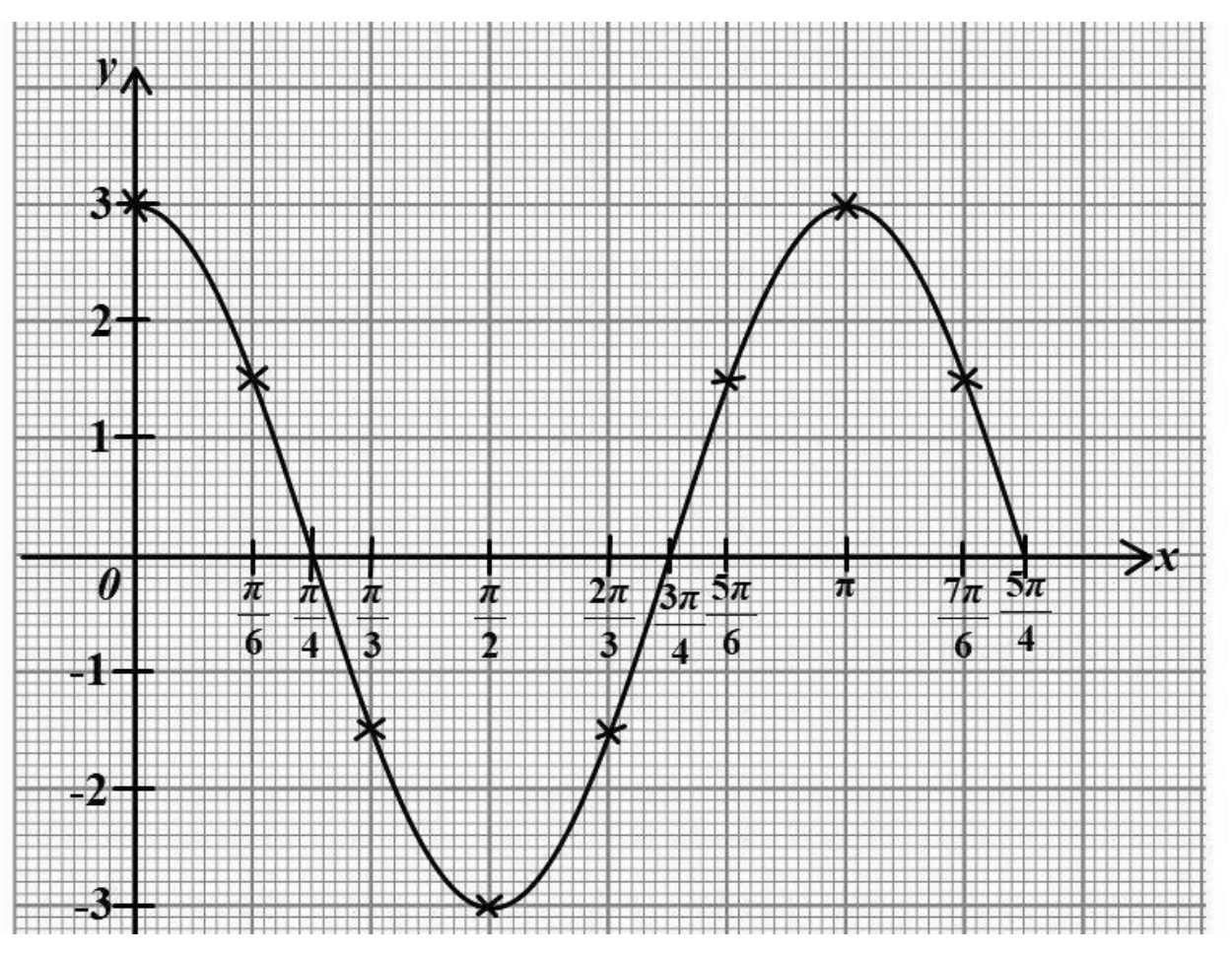
Complete Table 2 for the equation y = 3cos 2x for 0 ≤ x ≤ 2π. Draw a graph of y = 3cos 2x using a scale of 2 cm to π/6 units on the x-axis and 2 cm to 1 unit on the y-axis.
[4]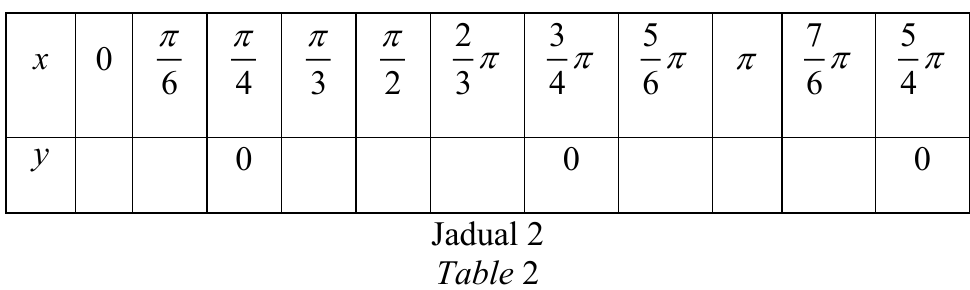
- (b)(ii)
Hence, on the same axes, draw a suitable straight line to find the number of solutions for 3cos 2x = 2x/π − 2.
[2]
Diagram 1 shows a painting of elephant tusks in a semicircle AOF with centre O and radius 14 cm. Arc BG is on sector BDG and arc EG on sector ECG. Given CO = OD = 2 cm and points B, C, D and E lie on the straight line AF.
Medium10 marks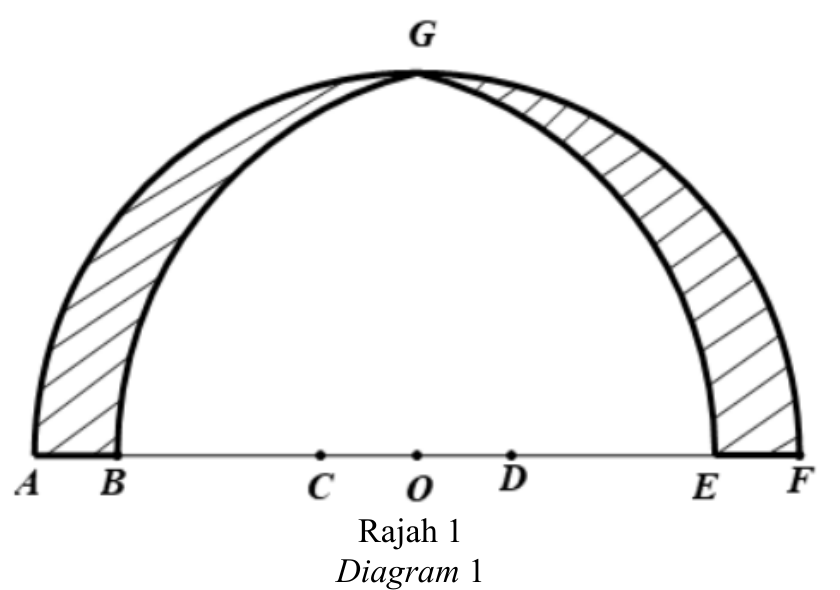
- (a)
Find ∠ADG, in radians.
[2] - (b)
Find the perimeter, in cm, of the shaded region.
[4] - (c)
Find the area, in cm², of the shaded region.
[4]
Section B
Table 3 shows the values of two variables, x and y, obtained from an experiment: x = 2, 4, 6, 8, 10, 14 and y = 5.37, 4.27, 3.24, 2.51, 1.95, 1.17. The variables are related by r = s^(x+1) y, where r and s are constants.
Medium10 marks- (a)
Based on Table 3, construct a table for the values of (x + 1) and log₁₀ y.
[2]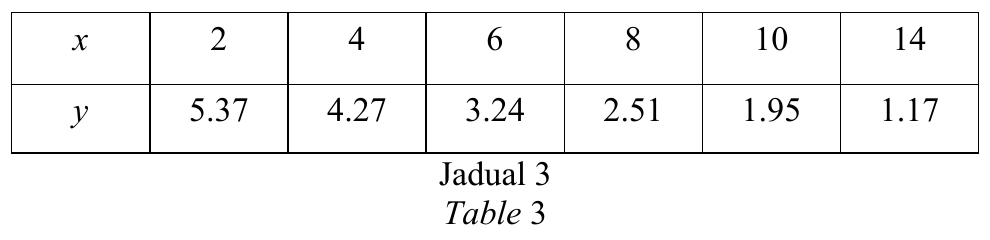
- (b)
Plot the graph of log₁₀ y against (x + 1), using a scale of 2 cm to 2 units on the (x + 1) axis and 2 cm to 0.1 unit on the log₁₀ y axis. Hence, draw the line of best fit.
[3]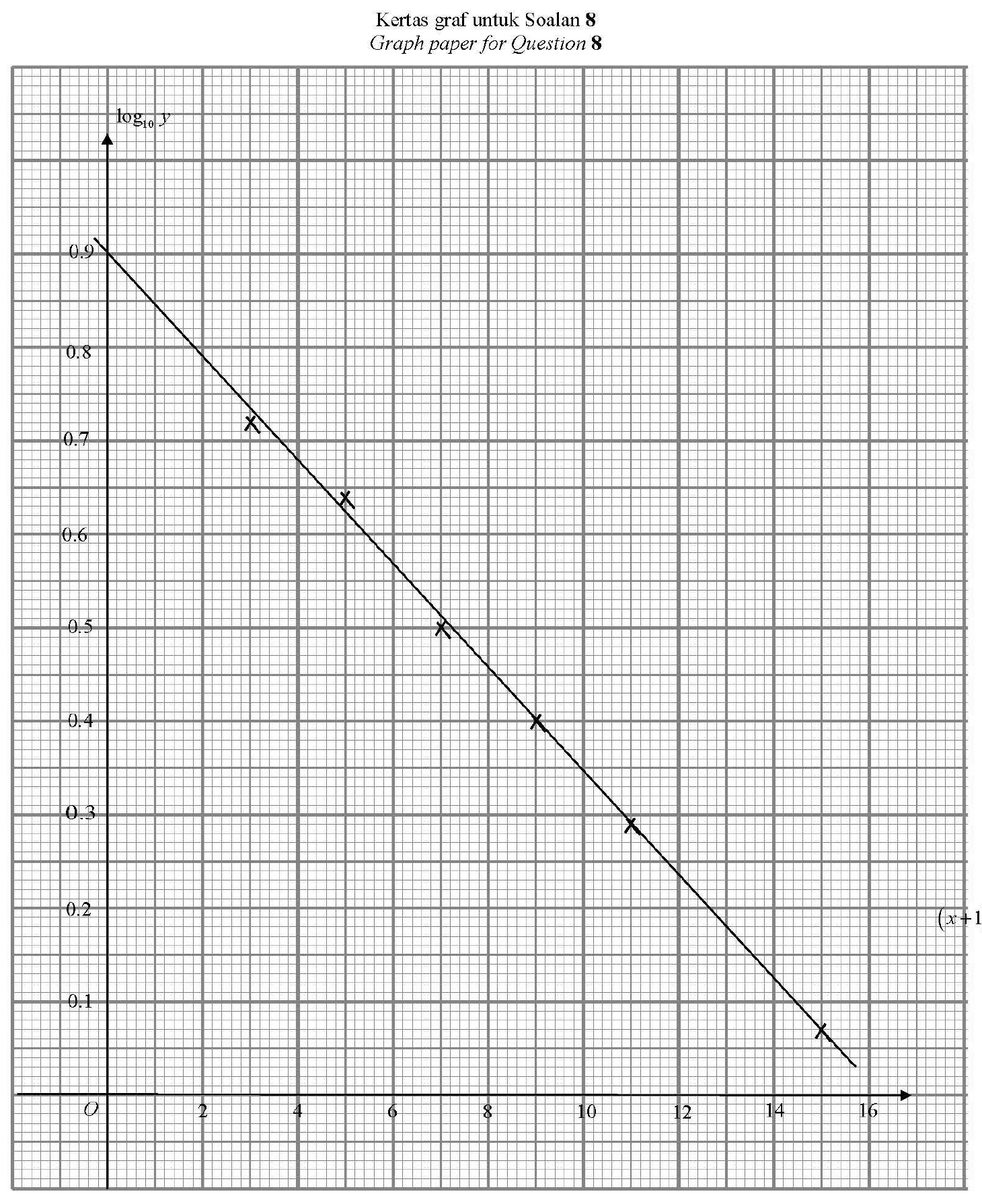
- (c)
Write r = s^(x+1) y in linear form. Hence, by using the graph in (b), find the value of (i) r, (ii) s.
[5]
(a) Point K moves such that its distance from point M(4, 0) is twice its distance from point L(−2, 0). (b) The straight line (1/2)y − 2 = x intersects the locus of K at point P(x₁, y₁) and point Q(x₂, y₂) where x₁ > x₂. (c) A triangle PQR is drawn on the Cartesian plane, with R on the y-axis and ∠PQR = 90°.
Hard10 marks- (a)
Find the equation of the locus of K.
[3] - (b)
Find the coordinates of point P and point Q.
[3] - (c)
Calculate the area of triangle PQR.
[4]
(a) A box contains 2 types of candies, A and B. The probability of selecting candy type B is 2/3. Five candies are selected randomly one by one with replacement. (b) The lengths of a type of insect are normally distributed with a mean of 2 cm and a variance of 0.09 cm².
Medium10 marks- (a)(i)
Calculate the probability that exactly 4 type B sweets are chosen.
[2] - (a)(ii)
Calculate the probability that more than 2 type A sweets are chosen.
[3] - (b)(i)
Find the percentage of insects that have a length of more than 2.28 cm.
[2] - (b)(ii)
Find the value of m if 15% of the insects have a length of less than m cm.
[3]
Diagram 2 shows the curve y = 4 − x² and a straight line y = mx + c that is tangent to the curve at point R(1, 3). Region A is the shaded region between the tangent, the curve and the y-axis; region B is the shaded region between the tangent, the curve and the x-axis [as shown in the diagram].
Medium10 marks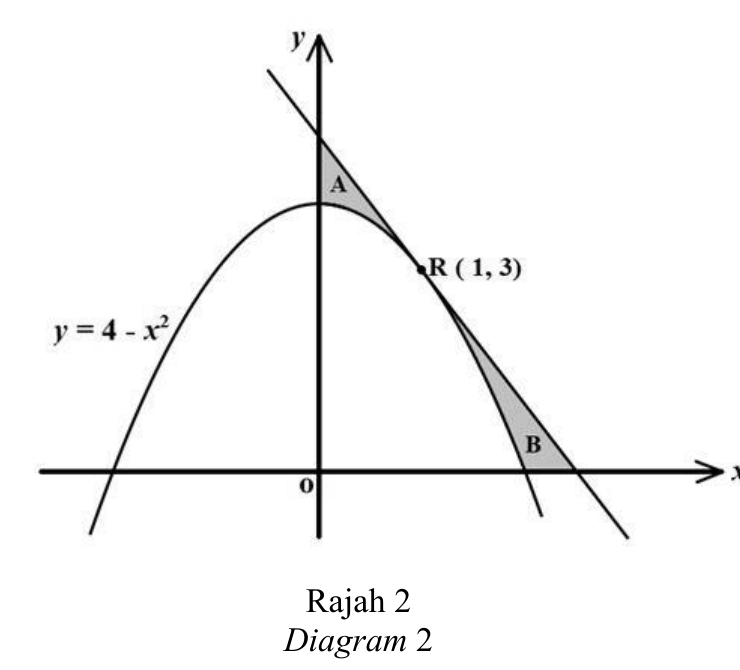
- (a)
Find the value of m and of c.
[2] - (b)
Find the area of region A.
[4] - (c)
Find the volume generated, in terms of π, when regions A and B are revolved through 180° about the y-axis.
[4]
Section C
Solution by scale drawing is not accepted. Diagram 3 shows a cuboid on the horizontal plane with dimensions 10 cm, 5 cm and 4 cm. Triangle ABC is drawn inside the cuboid.
Medium10 marks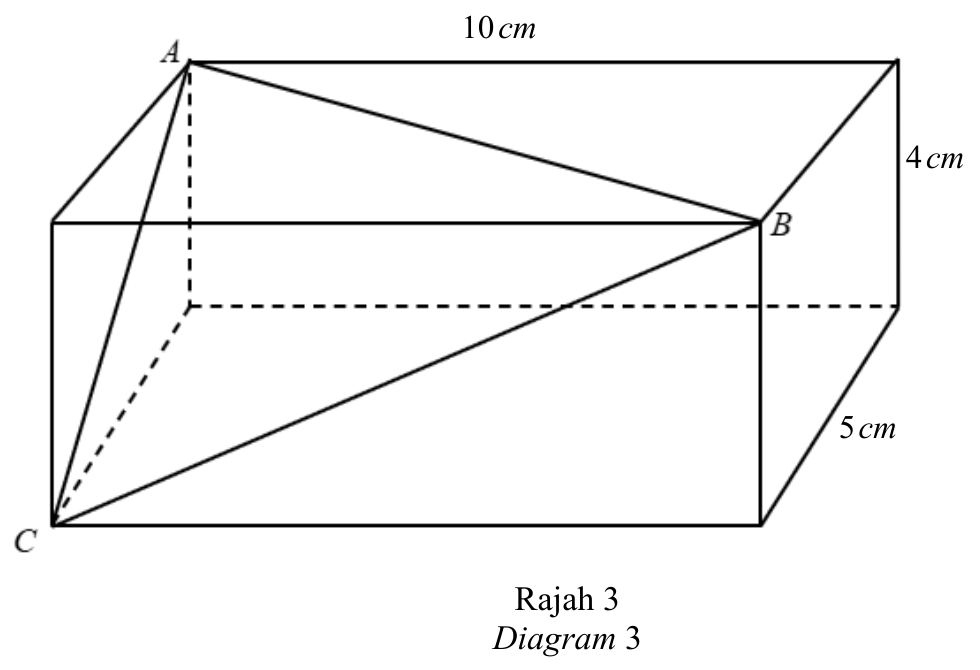
- (a)
By using Heron's formula, find the area of triangle ABC.
[3] - (b)
Find ∠ACB.
[2] - (c)(i)
Sketch a triangle A′B′C′ which has a different shape from triangle ABC, such that A′C′ = AC, A′B′ = AB and ∠A′B′C′ = ∠ABC.
[1]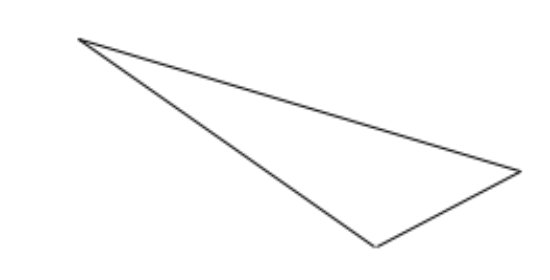
- (c)(ii)
Hence, state the size of ∠A′C′B′.
[1] - (c)(iii)
Find the area of triangle A′B′C′.
[3]
A particle moves along a straight line through a fixed point O, with velocity V m s⁻¹ given by V = 8 + pt − qt², where t is the time, in seconds, after passing through O and p and q are positive constants. The acceleration of the particle is zero when its velocity is 12 m s⁻¹. The particle is 24 m from O after 3 s.
Medium10 marks- (a)(i)
Calculate the value of p and of q.
[6] - (a)(ii)
Calculate the range of t during which the velocity of the particle decreases.
[2] - (b)
Sketch the velocity-time graph of the particle's motion for 0 ≤ t ≤ 3.
[2]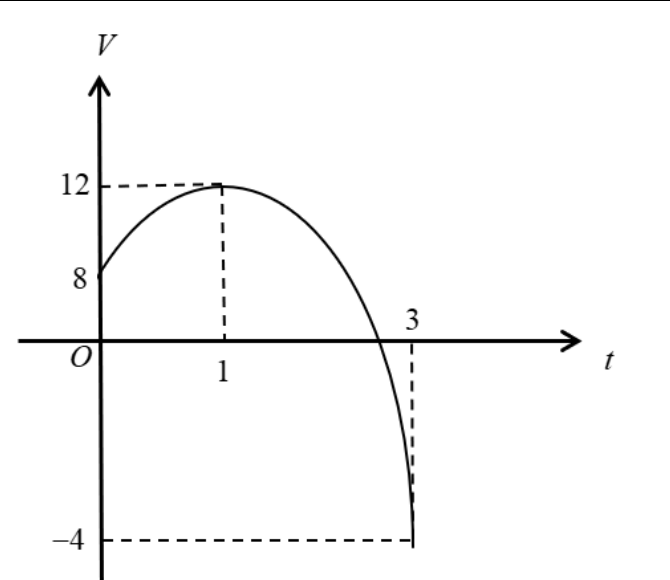
A teacher wants to buy x Additional Mathematics exercise books and y Additional Mathematics reference books. Table 4: exercise book RM12.00, reference book RM15.00 per unit. Constraints: I. The total allocation for buying both types of books is RM1800. II. The number of exercise books is more than 16. III. The number of reference books is at least 15 more than the number of exercise books.
Medium10 marks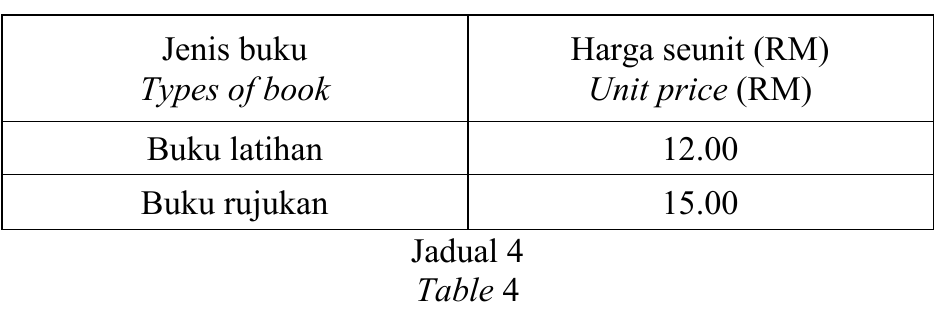
- (a)
Write three inequalities, other than x ≥ 0 and y ≥ 0, that satisfy all the above constraints.
[3] - (b)
Using a scale of 2 cm to 10 books on both axes, construct and shade the region R which satisfies all the above constraints.
[3] - (c)(i)
Use the graph constructed in 14(b) to find the maximum number of exercise books to be purchased if the number of reference books to be purchased is 70.
[1] - (c)(ii)
Use the graph constructed in 14(b) to calculate the minimum purchase price of the books.
[3]
Table 5 shows the price indices (year 2021 based on 2018) and weightages of four basic ingredients, P, Q, R and S, used in the production of a type of perfume: P 135 (weightage 4), Q 120 (x), R 88 (5), S 130 (x + 2).
Medium10 marks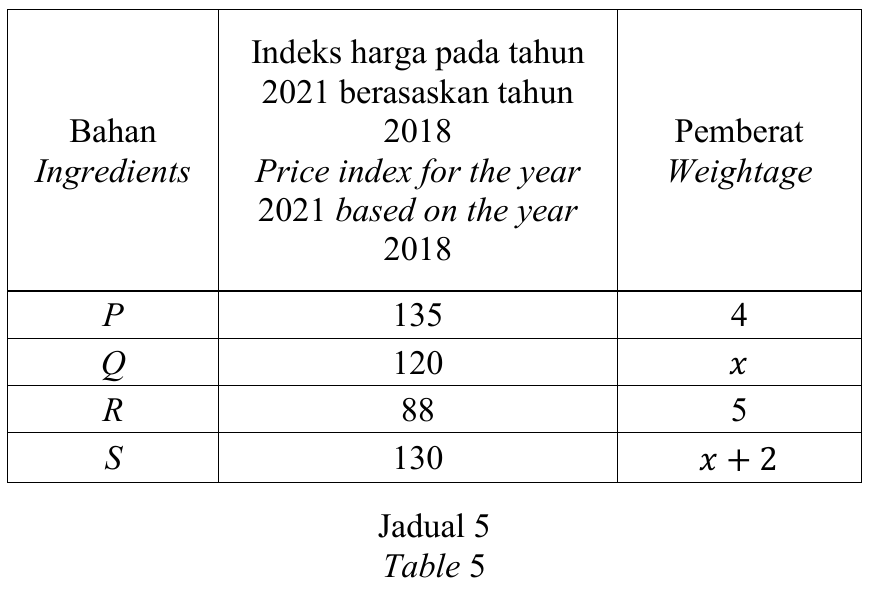
- (a)
If the price of ingredient P is RM54 in the year 2021, calculate its price in the year 2018.
[2] - (b)
If the price of ingredient Q is RM32 in the year 2018, calculate the increase in its price in the year 2021.
[2] - (c)
If the composite index for the basic ingredients in the year 2021 based on the year 2018 is 116, calculate the value of x.
[3] - (d)
It is given that the price of ingredient S increases by 37.5% from the year 2021 to the year 2022 while the prices of other basic ingredients remain unchanged. Calculate the composite index for the prices of the basic ingredients in the year 2022 based on the year 2018.
[3]