Write your answer on paper. Then open the answer to check it.
Section A
Given p = 2x − 3 and y = −3/p². Find (a) the rate of change of x when p changes at a rate of 3 units per second, (b) dy/dx in terms of x, (c) the approximate change in y when x decreases from 2 to 1.98.
Medium6 marks- (a)
Find the rate of change of the value of x when p changes at a rate of 3 units per second.
[2] - (b)
Find dy/dx in terms of x.
[2] - (c)
Find the approximate change in y when x decreases from 2 to 1.98.
[2]
(a) Evaluate ∫ from 1 to 2 of 2(x − 3)(x + 3)/(3x²) dx. (b) Given y = (2x − 1)/x² and dy/dx = 2g(x), where g(x) is a function in terms of x, find the value of ∫ from −1 to 1 of g(x) dx.
Easy5 marks- (a)
Evaluate ∫ from 1 to 2 of 2(x − 3)(x + 3)/(3x²) dx.
[2] - (b)
Given y = (2x − 1)/x² and dy/dx = 2g(x), find the value of ∫ from −1 to 1 of g(x) dx.
[3]
(a) Find the number of ways to form five-digit even numbers from the digits 4, 5, 6, 7 and 8 without repetition. (b) A group of 4 students is to be chosen from 4 boys and 6 girls. Find the number of different ways if at least 2 boys must be selected.
Easy5 marks- (a)
Find the number of ways to form five-digit even numbers from the digits 4, 5, 6, 7 and 8 without repetition.
[2] - (b)
A group of 4 students is chosen from 4 boys and 6 girls. Find the number of ways if at least 2 boys must be selected.
[3]
In an Additional Mathematics test, 75% of the students passed. If 10 students are selected at random, find the probability that (a) exactly 3 students have failed the test, (b) more than 8 students have passed the test.
Easy4 marks- (a)
Find the probability that exactly 3 students have failed the test.
[2] - (b)
Find the probability that more than 8 students have passed the test.
[2]
Diagram 5 shows the circle ABCD and the sector EFG, both with centre G. It is given that AG = 1.1 cm and the length of arc EF is 21 cm. The length of arc ADC is 27 times shorter than the length of arc EF. Calculate (a) the value of θ, in radian, (b) the perimeter, in cm, of the shaded region.
Easy5 marks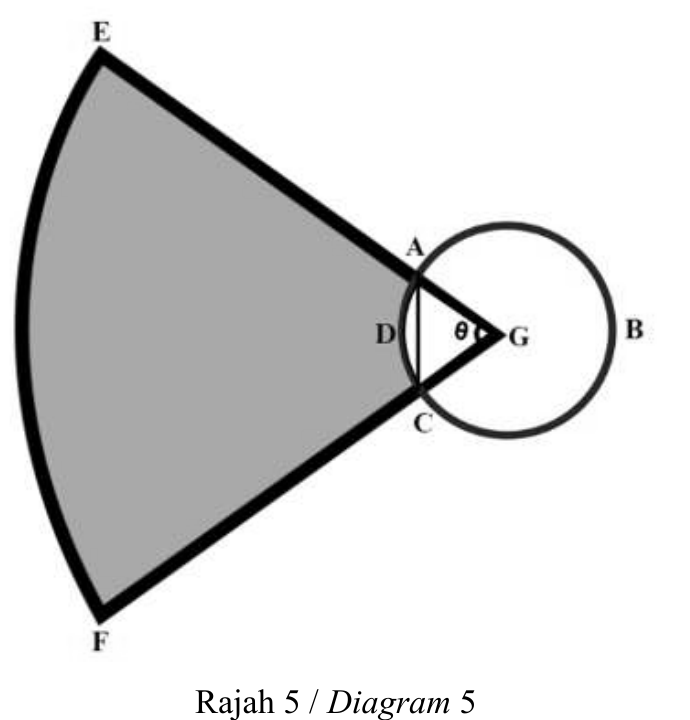
- (a)
Calculate the value of θ, in radian.
[2] - (b)
Calculate the perimeter, in cm, of the shaded region.
[3]
ABC is a triangle. The coordinates of A are (−4, 1), AC→ = 6i + 3j and BC→ = −2i + 6j. (a) Using the triangle law of vectors, find the coordinates of the midpoint of line BC. (b) Determine the unit vector in the direction of AC→.
Easy6 marks- (a)
Using the triangle law of vectors, find the coordinates of the midpoint of line BC.
[4] - (b)
Determine the unit vector in the direction of AC→.
[2]
Diagram 7 shows part of the graph of y against x, passing through (2, 14) and (4, 44). It is known that x and y are related by the linear equation y/x = kx + h, where h and k are constants. (a) Sketch the straight line of the equation. (b) Calculate the value of h and of k.
Easy5 marks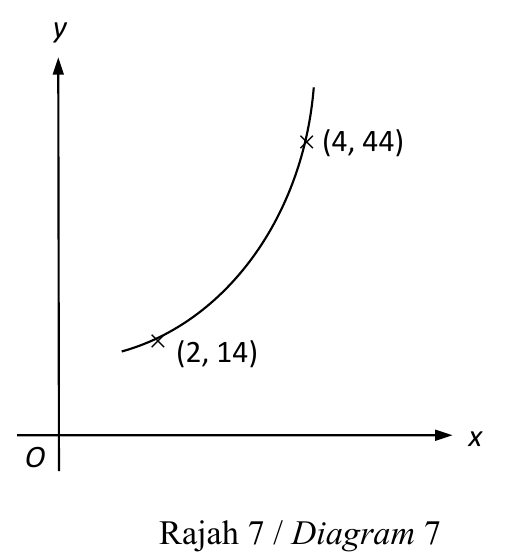
- (a)
Sketch the straight line of the equation y/x = kx + h (graph of y/x against x).
[2] - (b)
Calculate the value of h and of k.
[3]
Solve the following simultaneous equations: 6x + y + 18 = 3x² + 9x − y = 3.
Easy5 marksSolve the simultaneous equations 6x + y + 18 = 3x² + 9x − y = 3.
[5]
(a) Rationalise the denominator and simplify 2/(√2 − 2). (b)(i) Show that log_(a³) hk = (1/3) log_a h + (1/3) log_a k. (ii) Hence, if (1/3)(log_a 3 + log_a q) = 1, express q in terms of a.
Medium7 marks- (a)
Rationalise the denominator and simplify 2/(√2 − 2).
[3] - (b)(i)
Show that log_(a³) hk = (1/3) log_a h + (1/3) log_a k.
[2] - (b)(ii)
Hence, if (1/3)(log_a 3 + log_a q) = 1, express q in terms of a.
[2]
Given the quadratic function f(x) = −½(x − 1)² + 2. (a) Sketch the graph of the quadratic function. (b) Write the quadratic function when the graph is reflected on the f(x)-axis.
Easy4 marks- (a)
Sketch the graph of the quadratic function.
[3] - (b)
Write the quadratic function when the graph is reflected on the f(x)-axis.
[1]
In Diagram 11, P, Q and R are three points on the line 2y − x = 4 such that PQ : QR = 1 : 4 and Q is (2, 3). Find (a) the coordinates of point P, (b) the equation of the straight line that passes through Q and is perpendicular to PR, (c) the coordinates of point R.
Medium6 marks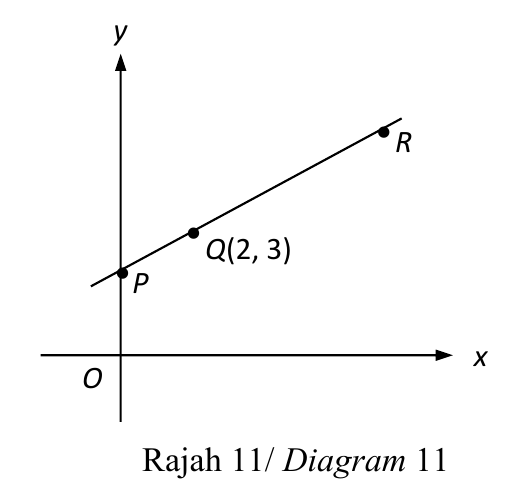
- (a)
Find the coordinates of point P.
[1] - (b)
Find the equation of the straight line that passes through Q and is perpendicular to PR.
[3] - (c)
Find the coordinates of point R.
[2]
(a) By considering a geometric progression 2, −6, 18, −54, …, where a is the first term and r is the common ratio, show that the nth term is given by T_n = ar^(n−1). (b) The first three consecutive terms of a geometric progression are 6 + 2m, 2 − m, 4 − 2m. Determine the negative value of m.
Medium6 marks- (a)
Show that the nth term of the geometric progression 2, −6, 18, −54, … is T_n = ar^(n−1).
[3] - (b)
The first three terms of a geometric progression are 6 + 2m, 2 − m, 4 − 2m. Determine the negative value of m.
[3]
Section B
Diagram 13 shows a graph of f(x) = 3x − 2 for −2 ≤ x ≤ 2. The points P(−2, −8) and Q(2, 4) lie on the graph. (a) Sketch the graph of f⁻¹(x) by showing the points corresponding to P and Q. (b)(i) Find f⁻¹(x) and hence verify that f⁻¹(x) is the inverse function of f(x) = 3x − 2. (ii) State the domain of f⁻¹(x). (iii) Find the value of x if f⁻¹(x) = f(x).
Medium8 marks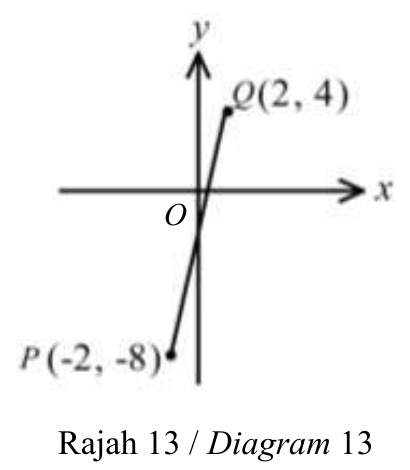
- (a)
Sketch the graph of f⁻¹(x) by showing the points corresponding to point P and point Q.
[2] - (b)(i)
Find f⁻¹(x) and hence verify that f⁻¹(x) is the inverse function of f(x) = 3x − 2.
[3] - (b)(ii)
State the domain of f⁻¹(x).
[1] - (b)(iii)
Find the value of x if f⁻¹(x) = f(x).
[2]
Given x = h − 1/h and y = 2h + 1/h. (a) Show that dy/dx = (2h² − 1)/(h² + 1). (b) Hence, determine the turning point for h > 0.
Medium8 marks- (a)
Show that dy/dx = (2h² − 1)/(h² + 1).
[4] - (b)
Hence, determine the turning point for h > 0.
[4]
(a) Solve the equation 3 sin 2x = sin x for 0° ≤ x ≤ 360°. (b) Given sin x = 4/5, where x is an obtuse angle, find the value of tan 2x.
Medium8 marks- (a)
Solve the equation 3 sin 2x = sin x for 0° ≤ x ≤ 360°.
[4] - (b)
Given sin x = 4/5, where x is an obtuse angle, find the value of tan 2x.
[4]