Write your answer on paper. Then open the answer to check it.
Section A
(a) If α and β are the roots of x² + 4x + 6 = 0, find the new quadratic equation whose roots are 1/α and 1/β. (b) Two quadratic curves with the equations y = x² − 4x + 5 and y = m + 2x − x², where m is a constant, touch at the point P. Determine the coordinates of point P.
Medium6 marks- (a)
If α and β are the roots of x² + 4x + 6 = 0, find the new quadratic equation whose roots are 1/α and 1/β.
[3] - (b)
The curves y = x² − 4x + 5 and y = m + 2x − x² touch at point P. Determine the coordinates of P.
[3]
(a) Prove that 6 tan x − 6 sin² x tan x = 3 sin 2x. (b) Hence, solve the equation 6 tan x − 6 sin² x tan x = 1 for 0° ≤ x ≤ 360°. (c) Sketch the graph y = 3 sin 2x for 0 ≤ x ≤ 2π.
Medium8 marks- (a)
Prove that 6 tan x − 6 sin² x tan x = 3 sin 2x.
[2] - (b)
Hence, solve 6 tan x − 6 sin² x tan x = 1 for 0° ≤ x ≤ 360°.
[3] - (c)
Sketch the graph y = 3 sin 2x for 0 ≤ x ≤ 2π.
[3]
Diagram 3(ii) shows the part of the flat windscreen wiped by the windscreen wiper AB. The wiper makes a rotation of 150° with each wipe. [Use π = 3.142] The length of the wiper is 35 cm and OA = 7 cm. Calculate (a) the length of arc BB′, (b) the ratio of the arc length AA′ to BB′, (c) the area of the region wiped by the wiper.
Medium7 marks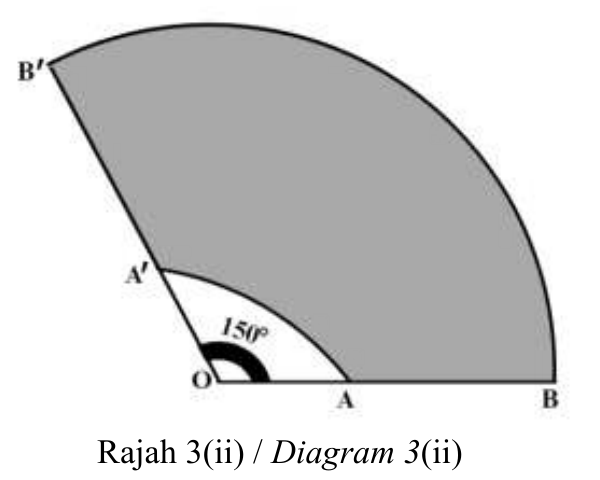
- (a)
Calculate the length of arc BB′.
[2] - (b)
Calculate the ratio of the arc length AA′ to BB′.
[3] - (c)
Calculate the area of the region wiped by the car's windscreen wiper.
[2]
(a) Given log₅ 3 = h and 5^(5k+6) = 1215. Express k in terms of h. (b) Given ln 8 = m and 4eˣ − 6 = 250. Express x in terms of m. (c) Solve √(2x − 3) + √(2x − 1) = 4.
Medium8 marks- (a)
Given log₅ 3 = h and 5^(5k+6) = 1215, express k in terms of h.
[3] - (b)
Given ln 8 = m and 4eˣ − 6 = 250, express x in terms of m.
[2] - (c)
Solve √(2x − 3) + √(2x − 1) = 4.
[3]
Diagram 6 shows that PQR is a straight line such that PR = 4PQ. Point T on line SQ is such that SQ = 3TQ. Point U on line SR is such that SR = 3SU. Given PQ→ = x and PS→ = y. (a) Express PU→ and PT→ in terms of x and y. (b) Determine whether points P, T and U are collinear or not.
Medium7 marks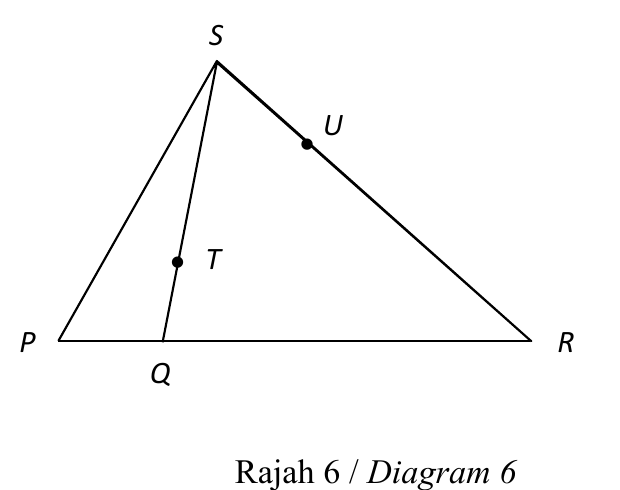
- (a)
Express PU→ and PT→ in terms of x and y.
[4] - (b)
Determine whether points P, T and U are collinear or not.
[3]
Table 6 shows an advertisement for the sale of cars by Proton: PESONA (actual price RM 58,000, promotional price RM 55,000), X50 (RM 93,000, RM 90,000) and X70 (RM 113,000, RM 110,000). The plant sold 140 cars of these 3 types in December 2024 and made a total profit of RM 5,150,000. The production cost for one PESONA, X50 and X70 is RM 30,000, RM 50,000 and RM 60,000 respectively, with total production cost RM 6,300,000. Find the number of cars of each type sold in December 2024.
Medium7 marks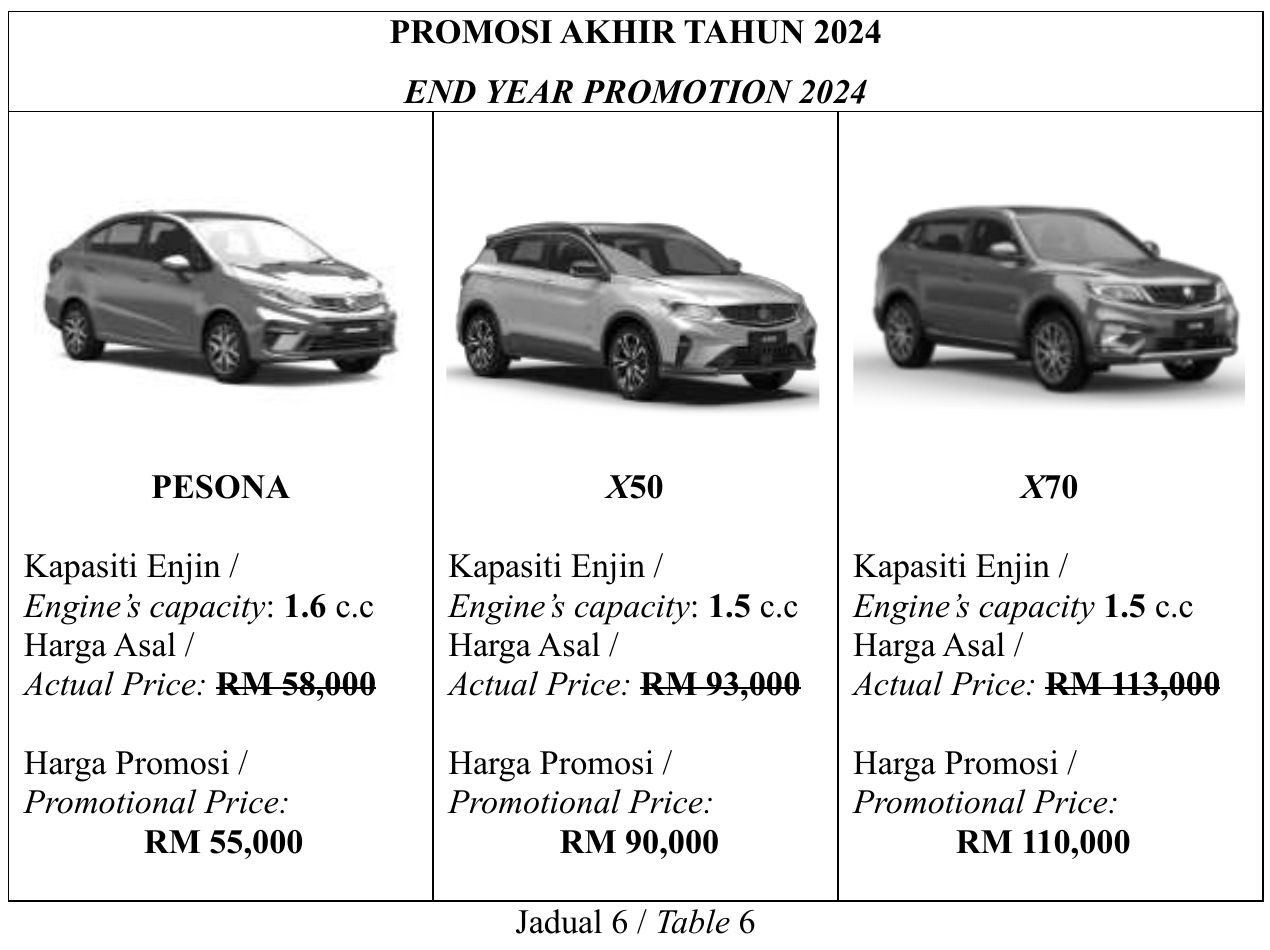
Find the number of cars of each type sold in December 2024.
[7]
Diagram 7 shows a sequence of semicircles drawn on a straight line OVWXY. The diameter of the smallest semicircle is 2a cm and increases by a cm for the next semicircle. (a) Find the perimeter of the first three semicircles. (b) Hence, show that the perimeters form an arithmetic progression. (c) If a = 2, find the semicircle that has the perimeter of 12(π + 2) cm.
Medium7 marks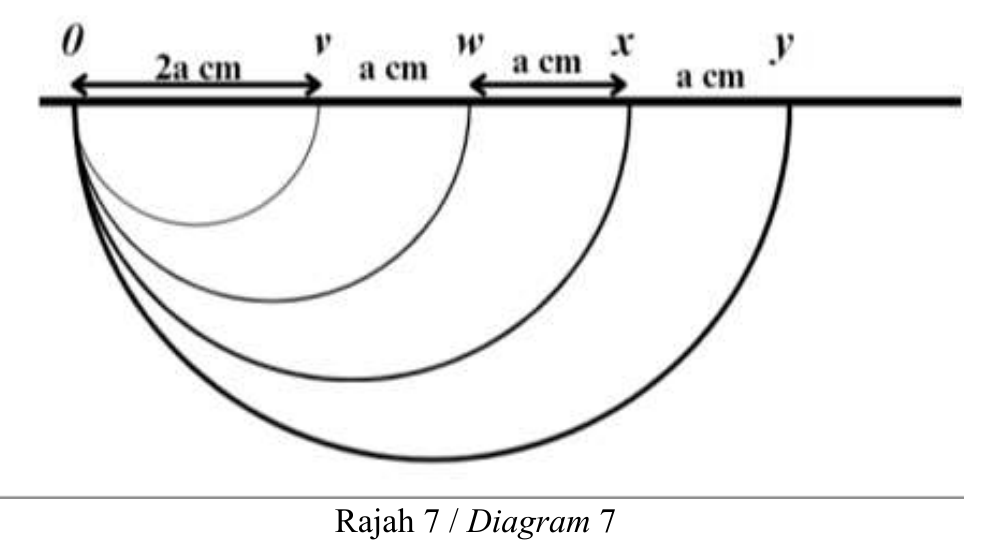
- (a)
Find the perimeter of the first three semicircles.
[3] - (b)
Hence, show that the perimeters form an arithmetic progression.
[2] - (c)
If a = 2, find the semicircle that has the perimeter of 12(π + 2) cm.
[2]
Section B
Use the graph paper provided. An experiment determined the percentage, P, of red blood cells that were crenated when dripped with sodium chloride solutions of different concentrations, K mol dm⁻³. P and K are related by P = (4/μ²)(K + A)², where μ and A are constants. Table 8: K = 0.50, 0.75, 1.00, 1.25, 1.50, 1.75; P = 0.4, 5.0, 14.5, 27.6, 46.2, 68.9. (a) Convert the equation into linear form. (b) Plot √P against K, using a scale of 1 cm to 0.5 unit on the √P-axis and 1 cm to 0.1 unit on the K-axis. Hence, draw the line of best fit. (c) Use the graph in (b) to find (i) μ and A, (ii) the value of P when K = 1.2.
Medium10 marks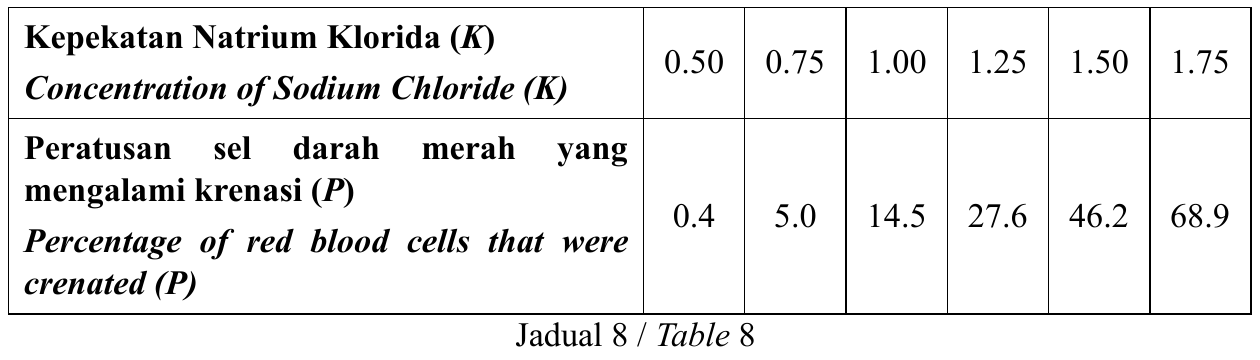
- (a)
Convert the equation P = (4/μ²)(K + A)² into linear form.
[1] - (b)
Plot √P against K using a scale of 1 cm to 0.5 unit on the √P-axis and 1 cm to 0.1 unit on the K-axis. Hence, draw the line of best fit.
[3] - (c)
Use the graph in (b) to find (i) μ and A, (ii) the value of P when K = 1.2.
[6]
Diagram 9 shows the straight line y = x intersecting the curve y = 2x² − 4x at point A. (a) Find the coordinates of A. (b) Find the area of the shaded region. (c) Find the volume of revolution, in terms of π, when the shaded region enclosed by y = 2x² − 4x, y = x and y = 0 is revolved through 360° about the x-axis.
Medium10 marks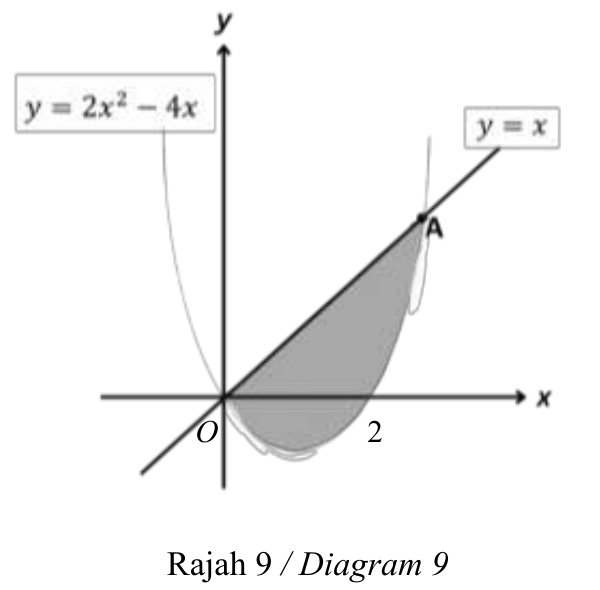
- (a)
Find the coordinates of A.
[2] - (b)
Find the area of the shaded region.
[4] - (c)
Find the volume of revolution, in terms of π.
[4]
Solutions by scale drawing and vector are not accepted. Diagram 10 shows a semicircle ABCD with centre D. The point P moves such that PB = BC = BA. The locus of P is a circle with centre B, where A(3, −4), B(2, 3), C(9, 4) and D(6, 0). (a) Find the distance BC. (b) Show that the equation of the locus of P is x² + y² − 4x − 6y − 37 = 0. (c)(i) Find the area of the major sector BAPC. (ii) Hence, show that the area of the shaded region is 25(π + 1) unit².
Medium10 marks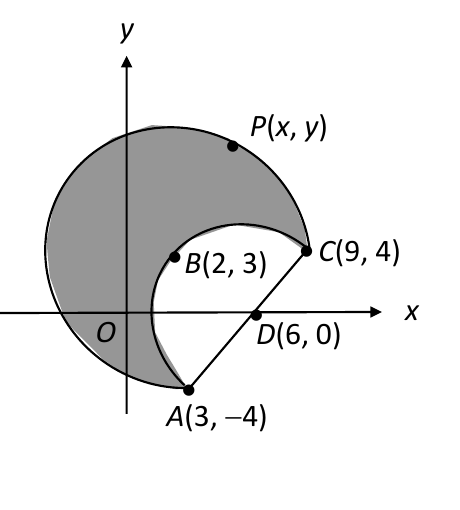
- (a)
Find the distance BC.
[2] - (b)
Show that the equation of the locus of P is x² + y² − 4x − 6y − 37 = 0.
[2] - (c)(i)
Find the area of the major sector BAPC.
[3] - (c)(ii)
Hence, show that the area of the shaded region is 25(π + 1) unit².
[3]
(a) The weight of freshly picked melons is normally distributed with mean μ and standard deviation σ. 2.28% of the melons weigh less than 1.5 kg and 25.23% weigh more than 3.5 kg. Find μ and σ. (b) Diagram 11 shows part of the graph of the probability distribution of X: P(X = 0) = 5/128, P(X = 1) = 61/128, P(X = 4) = P(X = 5) = 21/128. X has a binomial distribution with 5 trials, probability of success p and probability of failure q. (i) Find P(X = 2) + P(X = 3) in fraction form. (ii) Hence, show that q = 1/(8p).
Medium10 marks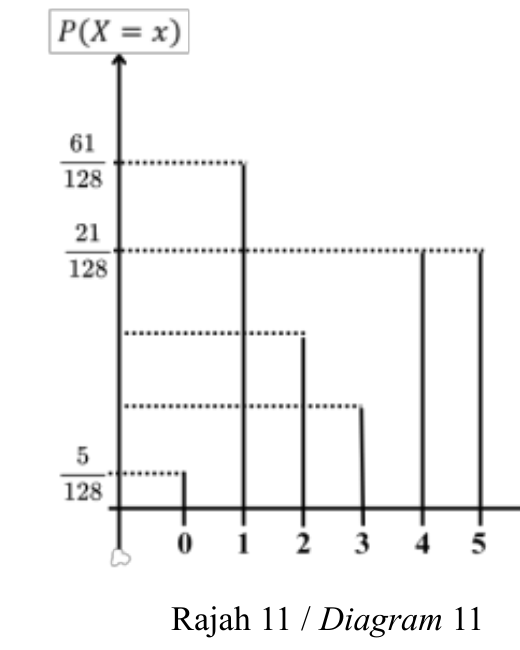
- (a)
Find μ and σ of the freshly picked melons.
[5] - (b)(i)
Find the value of P(X = 2) + P(X = 3) in fraction form.
[2] - (b)(ii)
Hence, show that q = 1/(8p).
[3]
Section C
A particle moves along a straight line and passes through a fixed point O. Its displacement, s m, t seconds after passing O is s = 2t² − t³ + 7t. Find (a) the initial acceleration, in m s⁻², (b) the maximum velocity, in m s⁻¹, (c) the value of t, in seconds, when the particle is instantaneously at rest, (d) the total distance, in m, travelled in the first 2 seconds.
Medium10 marks- (a)
Find the initial acceleration, in m s⁻², of the particle.
[2] - (b)
Find the maximum velocity, in m s⁻¹, of the particle.
[3] - (c)
Find the value of t, in seconds, when the particle is instantaneously at rest.
[2] - (d)
Find the total distance, in m, travelled by the particle in the first 2 seconds.
[3]
Diagram 13 shows a triangular plot of land ABC divided into three parts. ADB, BFC and AEGC are straight lines. AD = 0.13 km, DB = 0.07 km, AE = 0.06 km, EC = 0.24 km, angle FGC is a right angle and sin ∠BAC = 12/13. (a) If a fence is to be raised along BC, calculate the length of the fence. (b) Calculate ∠BCA. (c) Given that the area of ΔFCG equals the area of ΔADE, calculate the length of GC.
Medium10 marks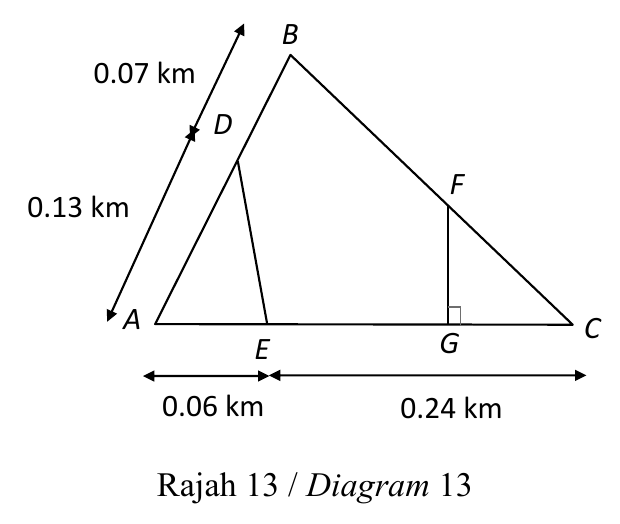
- (a)
Calculate the length of the fence along BC.
[3] - (b)
Calculate ∠BCA.
[2] - (c)
Given that the area of ΔFCG equals the area of ΔADE, calculate the length of GC.
[5]
A school has allocated at least RM 4,000 to buy x type A chairs and y type B chairs. The price of one type A chair is RM 80 and of one type B chair is RM 120. The total number of chairs must not exceed 65. The number of type A chairs is more than twice the number of type B chairs. (a) Write down three inequalities, other than x ≥ 0 and y ≥ 0, that satisfy all the conditions. (b) Using a scale of 2 cm to 10 units on both axes, construct and shade the region R that satisfies all the conditions. (c) Based on the graph in (b), find (i) the maximum cost to buy the chairs, (ii) the range of the number of type A chairs that can be purchased if 10 type B chairs have been purchased.
Medium10 marks- (a)
Write down three inequalities, other than x ≥ 0 and y ≥ 0, that satisfy all the conditions.
[3] - (b)
Using a scale of 2 cm to 10 units on both axes, construct and shade the region R.
[3] - (c)
Based on the graph in (b), find (i) the maximum cost to buy the chairs, (ii) the range of the number of type A chairs if 10 type B chairs have been purchased.
[4]
Table 15 shows the price and price indices of four ingredients used to make a cup of Mat Kilau's coffee. Coffee: 2022 RM 0.70, 2023 RM 0.72, index 102.86, usage w%. Milk: RM 2.50, RM 2.70, index 108, usage 47%. Sugar: RM x, RM 0.50, index 100, usage 2%. Long jack's powder: RM 1.80, RM y, index z, usage 25%. (a) Find w, x, y and z if the price of long jack's powder increases by 7.5% in 2023 from 2022. (b) Calculate the composite index for the cost of a cup in 2023 based on 2022. (c) If the owner makes a profit of 40% from the sale, what is the price of a cup in 2022? (d) Calculate the price of a cup in 2023 if its profit remains unchanged. (e) The composite index for the cost increases by 18% in 2024 from 2022. If a cup is sold at RM 8.99 in 2024, is it fair to make a profit of 40%?
Medium10 marks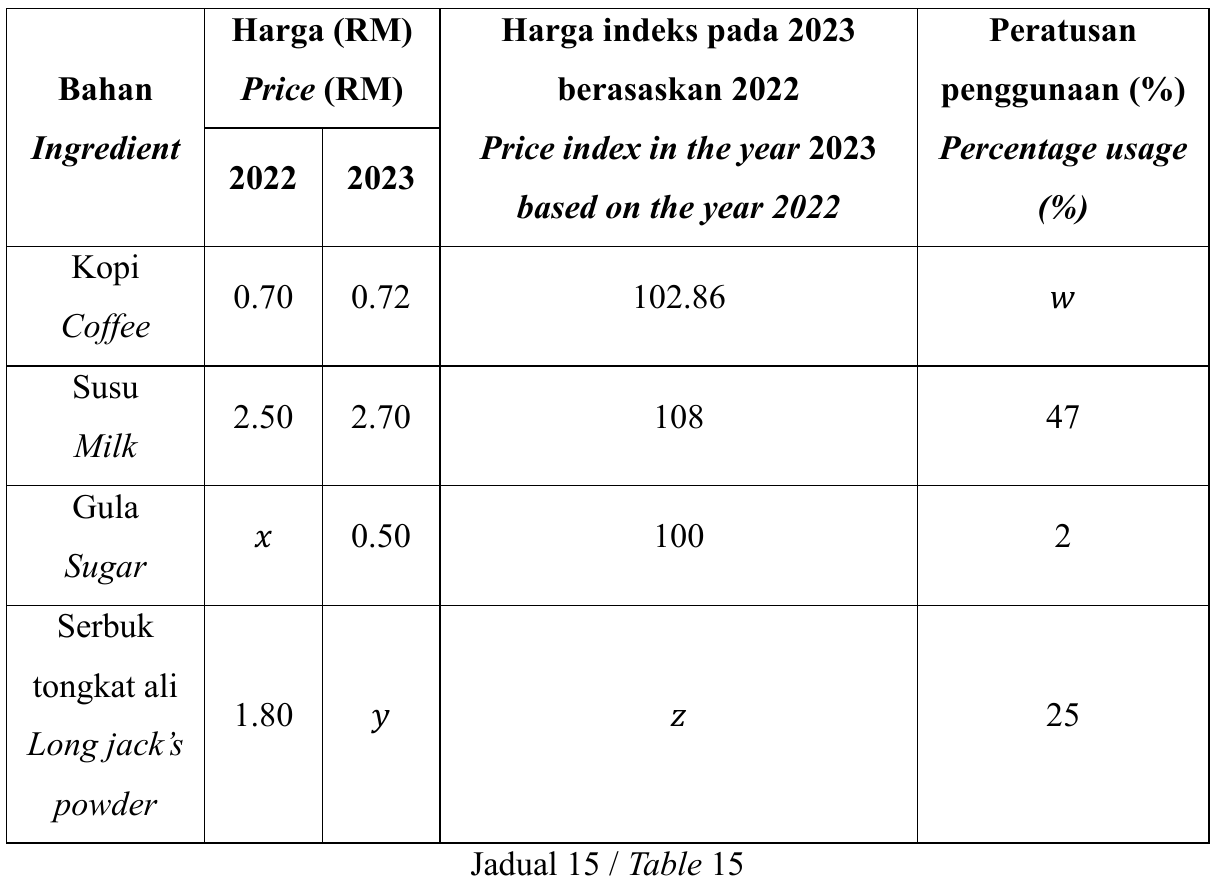
- (a)
Find the values of w, x, y and z if the price of long jack's powder increases by 7.5% in 2023 from 2022.
[3] - (b)
Calculate the composite index for the cost of a cup of Mat Kilau's coffee in 2023 based on 2022.
[2] - (c)
If the owner makes a profit of 40%, what is the price of a cup of coffee in 2022?
[1] - (d)
Calculate the price of a cup of coffee in 2023 if its profit remains unchanged.
[2] - (e)
The composite index increases by 18% in 2024 from 2022. If a cup is sold at RM 8.99 in 2024, is a profit of 40% fair?
[2]