Write your answer on paper. Then open the answer to check it.
Section A
Diagram 1 shows OQ→ = a and OP→ = b on a square grid of sides 1 unit. Express in terms of a and/or b: (a) OR→ (b) RS→
Easy2 marks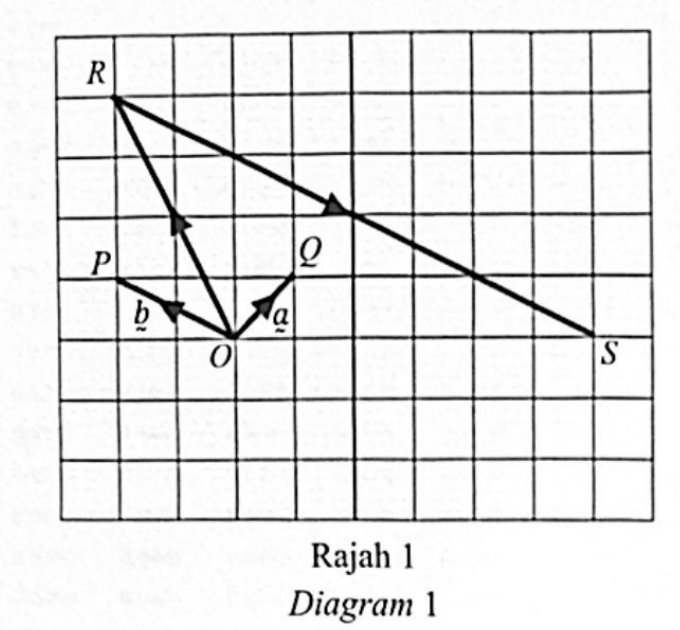
- (a)
OR→
[1] - (b)
RS→
[1]
Diagram 2(a) shows the curve y = −2x² + 4. Diagram 2(b) shows the straight line graph obtained when y = −2x² + 4 is expressed in the linear form Y = 4X + c.
Easy4 marks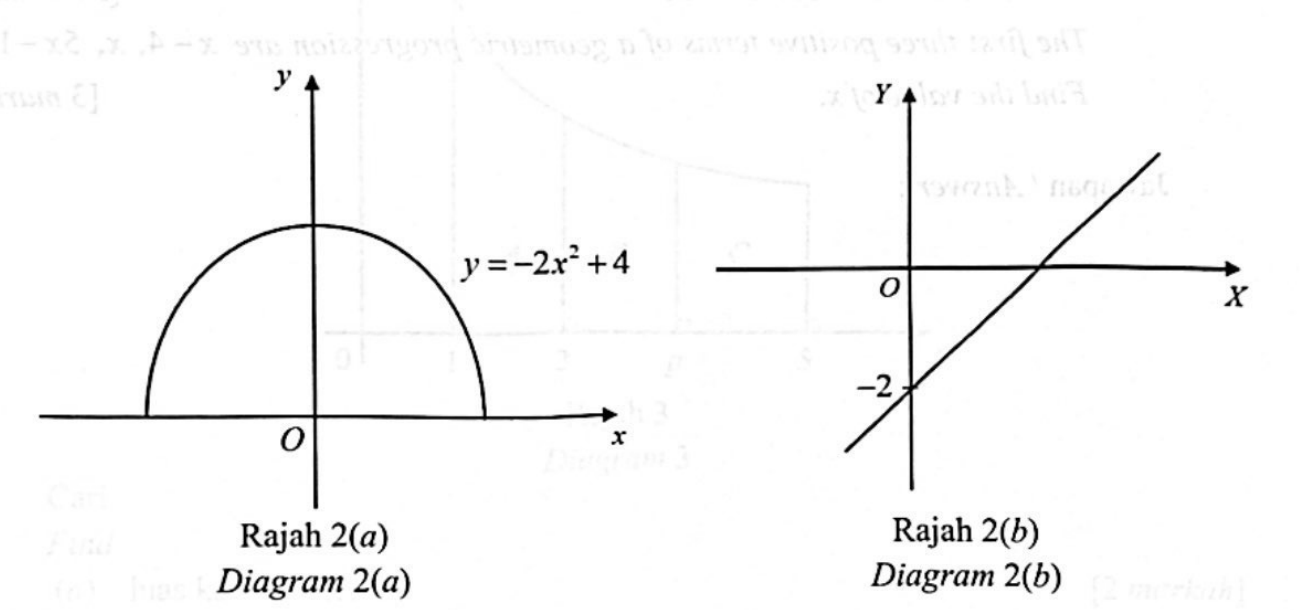
- (a)
Express X and Y in terms of x and/or y.
[3] - (b)
Find the gradient of the graph in Diagram 2(b).
[1]
(a) Three consecutive terms of an arithmetic progression are p, q and r. State the relation between p, q and r. (b) The first three positive terms of a geometric progression are x − 4, x, 5x − 12. Find the value of x.
Easy5 marks- (a)
State the relation between p, q and r.
[2] - (b)
Find the value of x.
[3]
Diagram 3 shows a part of the curve y = 12/x². The regions A, B and C lie between x = 1, 3, p and 5 as shown. Find (a) the area of region A, (b) the value of p such that the regions B and C have the same area.
Easy5 marks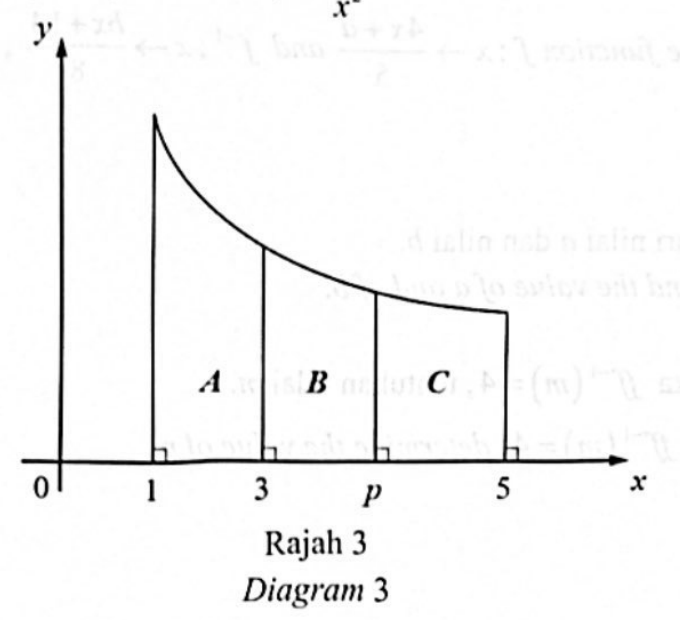
- (a)
Find the area of region A.
[2] - (b)
Find the value of p such that the regions B and C have the same area.
[3]
Given that the function f: x → (4x + a)/5 and f⁻¹: x → (bx + 14)/8, such that a and b are constants. (a)(i) Find the value of a and of b. (ii) If ff⁻¹(m) = 4, determine the value of m. (b) Given the function f: x → 4/x, x ≠ 0 and g: x → 2x − 5. Express 4/(2x − 5), x ≠ 5/2 in terms of f and/or g. Hence, give your justification.
Medium6 marks- (a)(i)
Find the value of a and of b.
[3] - (a)(ii)
If ff⁻¹(m) = 4, determine the value of m.
[1] - (b)
Express 4/(2x − 5), x ≠ 5/2 in terms of f and/or g. Hence, give your justification.
[2]
The following information refers to the vectors m and n: m = [[2], [k]] (column vector), n = [[3], [11]] (column vector). Find the value of k if vector 2m + n is parallel to [[1], [−1]]. [3 marks]
Easy3 marksFind the value of k if 2m + n is parallel to [[1], [−1]].
[3]
A quadratic function is given by f(x) = 4x² − 16x + k, such that k is a constant. (a) Find the smallest value of k such that f(x) > 0 and k is an integer. (b) The roots of the quadratic equation when f(x) = 0 are α and β. (i) If β exceeds α by 1, determine the value of k that satisfies the equation. (ii) If the product of roots is 2α + 5, express the value of α in terms of k.
Medium7 marks- (a)
Find the smallest value of k such that f(x) > 0 and k is an integer.
[2] - (b)(i)
If β exceeds α by 1, determine the value of k.
[3] - (b)(ii)
If the product of roots is 2α + 5, express α in terms of k.
[2]
Diagram 4 shows the intersection of Jalan Mawar and Jalan Ros in a small town. Stalls A, B and C are located close to each other as shown. OABC is a parallelogram. (a) If the position of the meeting place of Jalan Mawar and Jalan Ros is O and is represented by (0, 0), state the position of stall B and stall C. (b) Find the shortest distance between the intersection of Jalan Mawar and Jalan Ros, O and the position of stall A. (c) Another stall D is opened such that its distance from stall A is 2 times its distance from stall C. Find the position of stall D.
Medium7 marks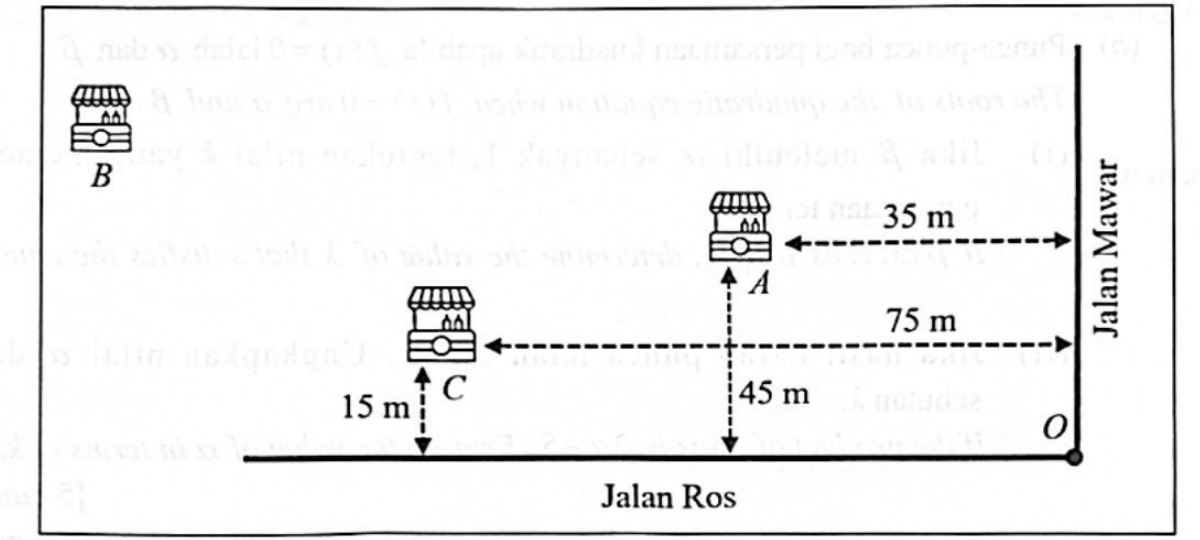
- (a)
State the position of stall B and stall C.
[2] - (b)
Find the shortest distance between O and the position of stall A.
[3] - (c)
Find the position of stall D.
[2]
(a) Diagram 5 shows a cylinder. It is given that the radius of the cylinder is 4√3 cm, the height h cm and the total surface area is 56π√6 cm². Express h in the form m√2 + n√3, such that m and n are constants. (b) Given that log_p k = a and log_q k = b, show that log_k pq = (a + b)/(ab). (c) Solve ln(1/x) = 3. Give the answer correct to four significant figures.
Medium7 marks- (a)
Express h in the form m√2 + n√3.
[3]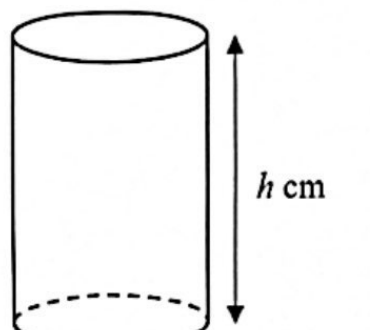
- (b)
Show that log_k pq = (a + b)/(ab).
[2] - (c)
Solve ln(1/x) = 3, correct to four significant figures.
[2]
A participant in a Mathematics quiz answered 40 multiple choice questions such that each question has four choices, one of which is correct. The participant knew the answers to 35 questions and guessed the answers to the remaining questions. Assume the participant answered the 35 known questions correctly. (a) Find the probability that the participant guessed all the answers correctly. (b) Estimate the number of questions correctly answered by the participant and explain your answer.
Easy5 marks- (a)
Find the probability that the participant guessed all the answers correctly.
[2] - (b)
Estimate the number of questions correctly answered and explain your answer.
[3]
(a) Cards labelled with 7 consonant letters and 5 vowel letters are placed on a table. Find (i) the number of ways to choose 10 letters if the number of consonants must be equal to the number of vowels. (ii) the number of possible arrangements if all 12 letters need to be arranged in a circle such that the vowels are in separated arrangement. (b) Find the number of passwords consisting of 4 letters followed by 2 digits, without repetition, that can be formed if the sum of the digits must be 5.
Medium7 marks- (a)(i)
Number of ways to choose 10 letters with equal consonants and vowels.
[2] - (a)(ii)
Number of arrangements of 12 letters in a circle with vowels separated.
[3] - (b)
Number of passwords of 4 letters followed by 2 digits with digit sum 5, no repetition.
[2]
(a) Solutions using other than calculus are not accepted. Find the small change in the volume of a cube when each of its sides increases from 2 cm to 2.02 cm. (b) Dania tried to find the first derivative of y = x² − 2x − 3 using the first principles but was unable to continue her work. Her working: y = x² − 2x − 3; y + δy = (x + δx)² − 2(x + δx) − 3; y + δy = x² + 2x(δx) + (δx)² − 2x − 2δx − 3; … Help Dania answer the question.
Easy6 marks- (a)
Find the small change in the volume of a cube when each side increases from 2 cm to 2.02 cm (calculus only).
[3] - (b)
Continue Dania's first-principles working to find the first derivative of y = x² − 2x − 3.
[3]
Section B
(a) By using completing the square method, express f(x) = 8 − 6x − x² in the form f(x) = a − (x + b)². Hence, find the range of f(x). (b) It is given that a quadratic function f(x) = a(x − m)² + n, where a > 0 has a negative discriminant value. Sketch the possible quadratic graph. (c) Find the range of values of x for (1 − x)² + 2x ≥ 17 by using number line method.
Medium8 marks- (a)
Express f(x) = 8 − 6x − x² in the form a − (x + b)² and find the range of f(x).
[3] - (b)
Sketch the possible quadratic graph (a > 0, negative discriminant).
[2]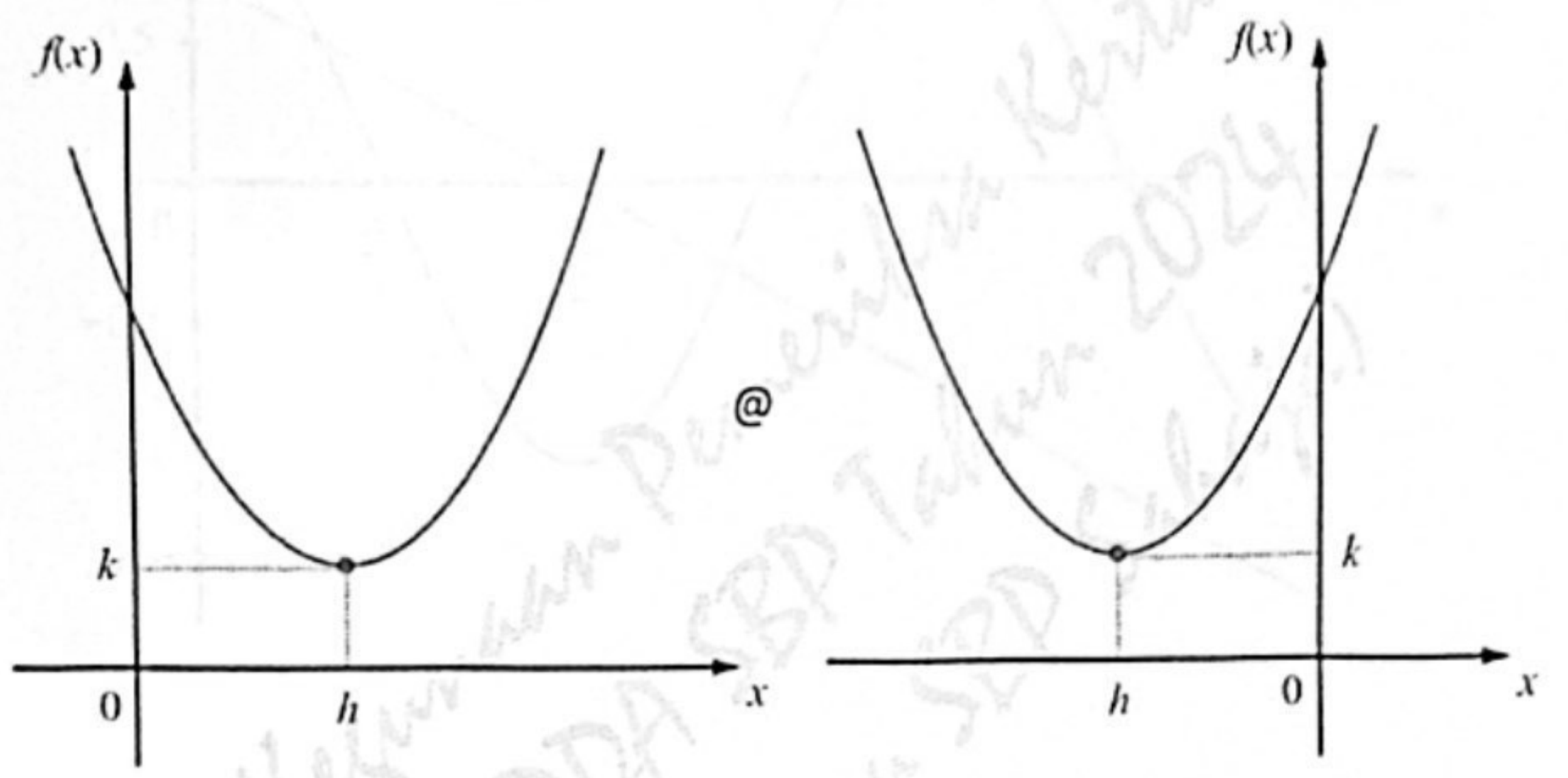
- (c)
Find the range of values of x for (1 − x)² + 2x ≥ 17 by number line method.
[3]
(a) Given f(θ) = 5 sin Xθ + Y for 0° ≤ θ ≤ 360°. The period of the graph is 180° and the minimum value of f(θ) is −1. State the value of X and Y. (b) Sketch the graph of y = cos 2x for 0 ≤ x ≤ 3π/2. On the same axis, sketch a suitable straight line to find the number of solutions for the equation 6x/π + 4 cos 2x = 3. Hence, state the number of solutions.
Medium8 marks- (a)
State the value of X and Y.
[2] - (b)
Sketch y = cos 2x for 0 ≤ x ≤ 3π/2 and a suitable straight line; state the number of solutions of 6x/π + 4 cos 2x = 3.
[6]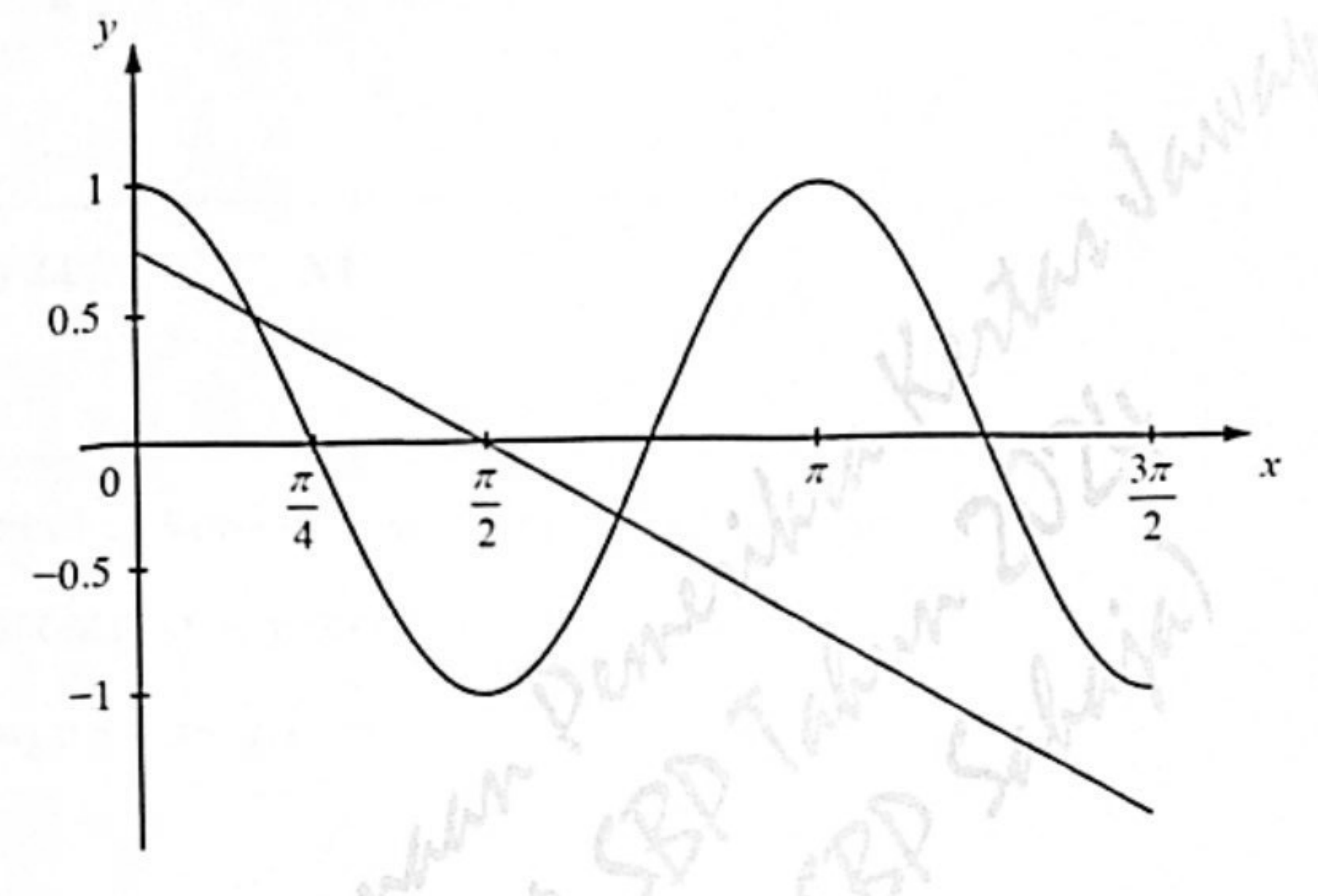
(a) Given that 81√(3√27) = 9ᵏ. Find the value of k. (b) Solution by listing is not accepted. After t years, the price of the car that was bought by Nik is RM78 000(0.8)ᵗ. (i) Determine the price of the car after 6 years. (ii) Find the minimum number of years that it will take for the price of the car to be less than RM30 000. (iii) Starting from the seventh year and onwards, the car's value depreciates by 65%. If Nik bought the car in 2018, calculate the value of Nik's car in 2027.
Medium8 marks- (a)
Find the value of k.
[2] - (b)(i)
Determine the price of the car after 6 years.
[1] - (b)(ii)
Find the minimum number of years for the price to be less than RM30 000.
[2] - (b)(iii)
Find the value of Nik's car in 2027 (depreciating 65% from the seventh year).
[3]