Write your answer on paper. Then open the answer to check it.
Section A
Diagram 1 shows sector PQR of a circle with centre Q of radius 8 cm and sector PRS of a circle with centre R. Given that the length of arc PR is 6.4 cm and ∠PQR = ∠PRS = θ. [Use π = 3.142]
Easy4 marks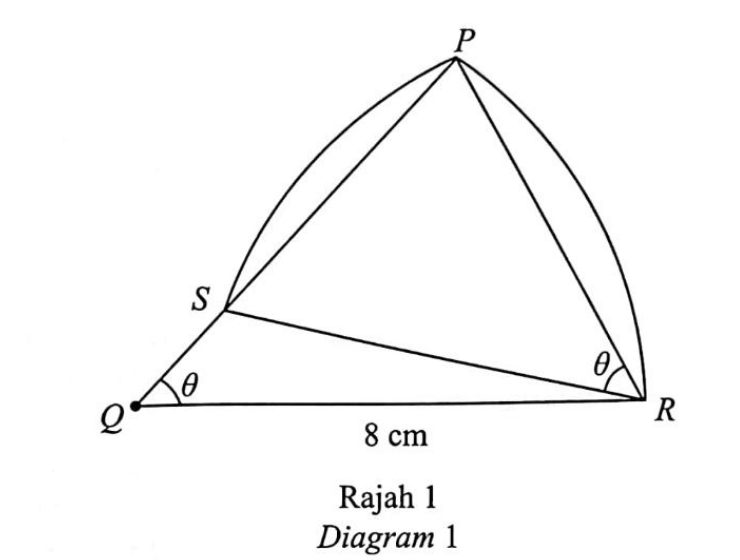
- (a)
Find the value of θ, in radians.
[2] - (b)
Show that the length of PR = 6.23 cm.
[2]
Diagram 2 shows the graph of log10 y against x. The straight line passes through (0, p) and (q, 2). The variables x and y are related by the equation y = 10^(2x−3). Find the value of p and of q.
Easy4 marks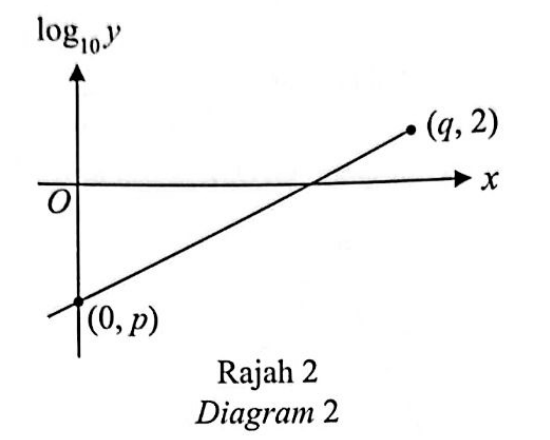
Find the value of p and of q.
[4]
(a) Determine whether the sequence p⁸, p¹², p¹⁶, p²⁰ is a geometric progression or not. Give your justification. (b) If a is the first term and r is the common ratio of a geometric progression, show that the sum of the first n terms is Sn = a(rⁿ − 1)/(r − 1).
Medium5 marks- (a)
Determine whether p⁸, p¹², p¹⁶, p²⁰ is a geometric progression or not. Give your justification.
[2] - (b)
If a is the first term and r is the common ratio of a geometric progression, show that the sum of the first n terms is Sn = a(rⁿ − 1)/(r − 1).
[3]
(a) The radius of a circle increases at a rate of 3 cm s⁻¹. Find the rate of change of its area, in cm² s⁻¹, when the radius is 2 cm. (b) It is given that the function k(x) = mx³ − 2x² + 6x. Find the value of m if k″(2) = k′(1).
Medium5 marks- (a)
The radius of a circle increases at a rate of 3 cm s⁻¹. Find the rate of change of its area, in cm² s⁻¹, when the radius is 2 cm.
[2] - (b)
It is given that the function k(x) = mx³ − 2x² + 6x. Find the value of m if k″(2) = k′(1).
[3]
(a) Ken undergoes two cycling training sessions. In each session, Ken cycles a distance of 150 km. In the first session, Ken cycles at an average speed of x km h⁻¹. In the second session, Ken increases his average speed by 10 km h⁻¹, and he finishes the training 20 minutes earlier compared to the first session. Calculate Ken's average speed in the first session. (b) Given α and β are the roots of the quadratic equation 2x² − 6x + 9 = 0. Form a quadratic equation which has the roots α + 2 and β + 2. Give your answer in the form ax² + bx + c = 0 where a, b and c are integers.
Medium7 marks- (a)
Calculate Ken's average speed in the first session.
[4] - (b)
Form a quadratic equation which has the roots α + 2 and β + 2. Give your answer in the form ax² + bx + c = 0 where a, b and c are integers.
[3]
(a) Determine whether the quantity below is a scalar quantity or a vector quantity. Give your justification: Water has a density of around 1 000 kg/m³. (b) Diagram 3 shows two straight lines ODC and ADB. Given OA = 5p, OB = 10q, AD : DB = 2 : 3, AC = mOB and OD = nOC. (i) Express OC in terms of m, p and q. (ii) Express OC in terms of n, p and q. (iii) Hence, find the value of m and of n.
Medium7 marks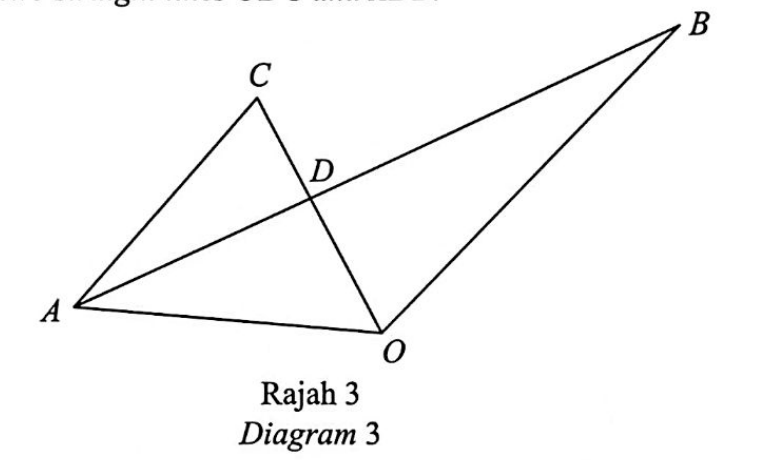
- (a)
Determine whether the quantity is a scalar quantity or a vector quantity. Give your justification. Water has a density of around 1 000 kg/m³.
[1] - (b)(i)
Express OC in terms of m, p and q.
[2] - (b)(ii)
Express OC in terms of n, p and q.
[1] - (b)(iii)
Hence, find the value of m and of n.
[3]
Diagram 4 shows a logo designed using three congruent sectors with a radius of 12 cm. Find the area of the uncoloured region. [Use π = 3.142]
Easy4 marks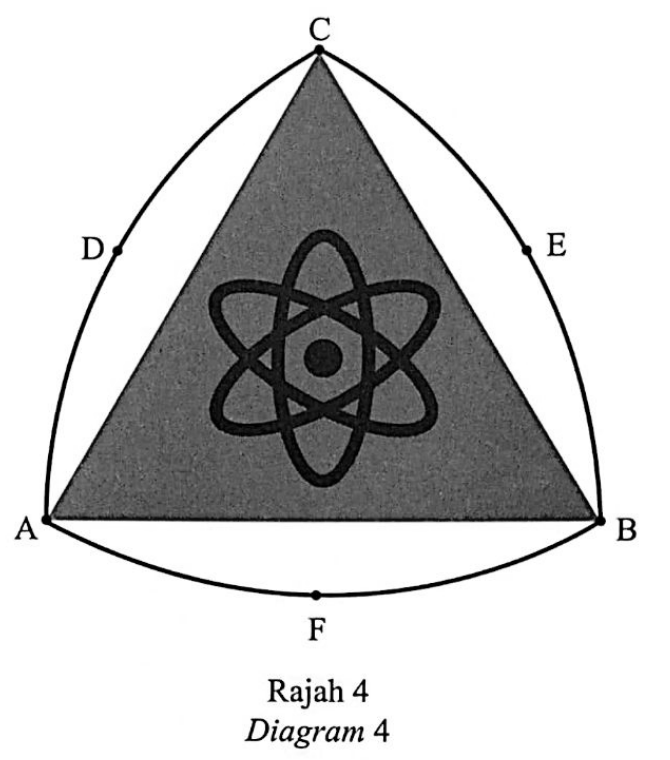
Find the area of the uncoloured region.
[4]
Solutions by scale drawing and vectors are not accepted. The coordinates of points A, B and C are (1, 1), (2, 6) and (4, 2) respectively. Find (a) the equation of the straight line that passes through point A and the midpoint BC, (b) the area of triangle ABC, (c) the equation of locus of a moving point P(x, y) such that it is always equidistant from point A and point C.
Medium8 marks- (a)
The equation of the straight line that passes through point A and the midpoint BC.
[4] - (b)
The area of triangle ABC.
[2] - (c)
The equation of locus of a moving point P(x, y) such that it is always equidistant from point A and point C.
[2]
(a) Find the number of even numbers that can be formed from all the digits 4, 3, 5 and 7 with all the digits except 4 appearing exactly twice. (b) Diagram 5 shows three straight lines l1, l2 and l3. It is given that 3 points lie on line l1, 3 points lie on line l2, and 4 points lie on line l3. If the points from each line are used to form a polygon, find the number of (i) triangles that can be formed, (ii) quadrilaterals that can be formed.
Medium7 marks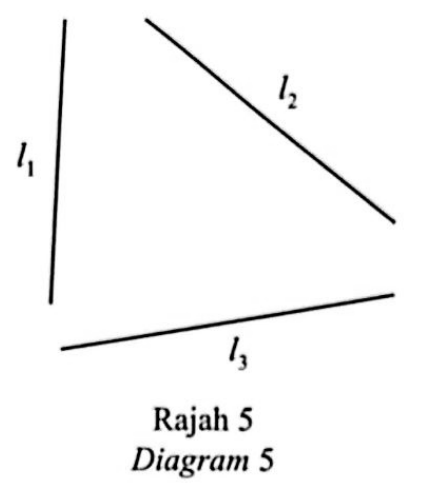
- (a)
Find the number of even numbers that can be formed from all the digits 4, 3, 5 and 7 with all the digits except 4 appearing exactly twice.
[2] - (b)(i)
Find the number of triangles that can be formed.
[2] - (b)(ii)
Find the number of quadrilaterals that can be formed.
[3]
It is given that d/dx (2/(x + 5) − 3) = f(x), find ∫ from −1 to 2 of ½ f(x) dx.
Easy3 marksFind ∫ from −1 to 2 of ½ f(x) dx.
[3]
It is given that the curve y = (x − 5)²/x. (a) find the coordinates of the stationary points of the curve. (b) Hence, determine the nature of the stationary points.
Easy5 marks- (a)
Find the coordinates of the stationary points of the curve.
[3] - (b)
Hence, determine the nature of the stationary points.
[2]
In a certain game, the probability of Qayyum winning is 0.25. The game was carried out for n times. The probability for him to win once is ten times the probability of losing all games. (a) Find the value of n. (b) Calculate the variance of the number of wins.
Medium5 marks- (a)
Find the value of n.
[3] - (b)
Calculate the variance of the number of wins.
[2]
Section B
(a) Diagram 6 shows the graph of function f(x) = |5 − 2x| for the domain −2 ≤ x ≤ 8. (i) Find the image of −2 and of 8. (ii) Sketch the graph g(x) = 1 − f(x) for the domain −2 ≤ x ≤ 8. (b) Given that hk : x → 2x − 9 and h : x → 4/(x + 2), x ≠ −2, determine the function k(x).
Medium8 marks- (a)(i)
Find the image of −2 and of 8.
[2]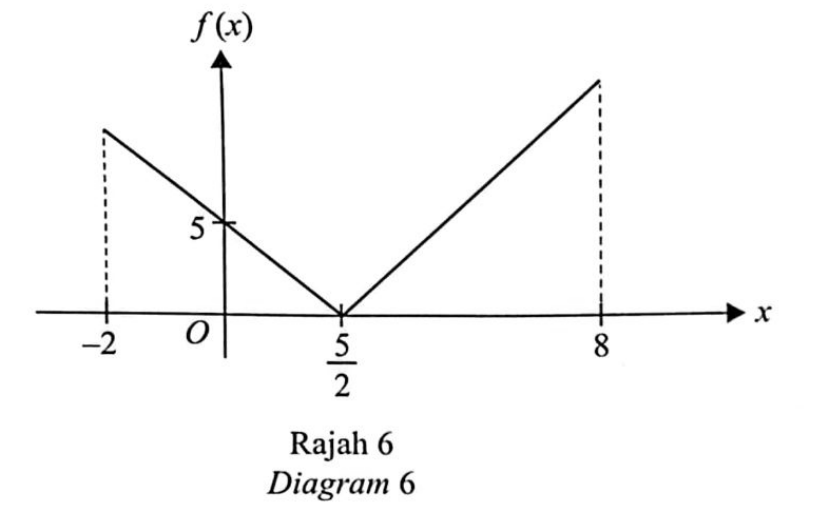
- (a)(ii)
Sketch the graph g(x) = 1 − f(x) for the domain −2 ≤ x ≤ 8.
[2]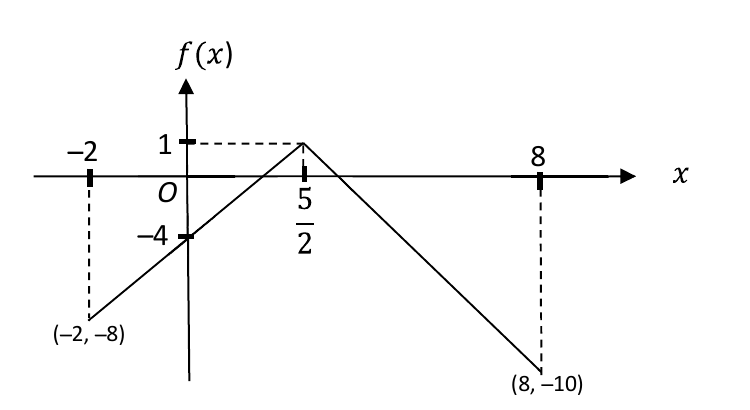
- (b)
Given that hk : x → 2x − 9 and h : x → 4/(x + 2), x ≠ −2, determine the function k(x).
[4]
(a) Solve (i) 2^(2x−1) − 9(2^(x−2)) + 1 = 0, (ii) log_x 4 = 2 + 4 log_4 2. (b) Solve the equation 5 + 4√k = 9 + 8√2. Write the answer in the form a + b√2 with a and b are integers.
Medium8 marks- (a)(i)
Solve 2^(2x−1) − 9(2^(x−2)) + 1 = 0.
[3] - (a)(ii)
Solve log_x 4 = 2 + 4 log_4 2.
[3] - (b)
Solve the equation 5 + 4√k = 9 + 8√2. Write the answer in the form a + b√2 with a and b integers.
[2]
(a) It is given that cos α = p, where α is an acute angle. Express cosec α in terms of p. (b) Prove (1 + cos x)/sin x + sin x/(1 + cos x) = 2 cosec x. (c) By using trigonometric ratio, find the value of cos 480°.
Medium8 marks- (a)
Express cosec α in terms of p.
[2] - (b)
Prove (1 + cos x)/sin x + sin x/(1 + cos x) = 2 cosec x.
[3] - (c)
By using trigonometric ratio, find the value of cos 480°.
[3]